Religion

Faith under fire

Giles St Aubyn, in this long, scholarly book, sets out to chronicle the shifts in the Christian churches from the scientific revolution of the 17th century, and the Enlightenment of the 18th, to the apparent triumph of secularism in the 20th. H. H. Asquith, as leader of the Liberal party, was not an enthusiastic Christian. Nor did the Labour Prime Minister Clement Attlee waste much time on religious concerns, which bored him. What mattered was the NHS and the welfare state, which saved men’s bodies rather than their souls. The Reformation had shattered the universal Catholic church of the Middle Ages, leaving in its wake what the Catholic apologist Blaise

Scientology: Cult or Worse?

The problem Scientology has… Let me start again, among the problems with Scientology is that it wasn’t founded a couple of thousand years ago. Had it been it might not seem quite so obviously fraudulent and, well, nuts. Age rubs off the harsh edges and all that and at least permits the creation of a splendid literature, if nothing else. And that literature is a bit more than nothing. But Scientology, apart from its artistic desert, also seems to be a wicked organisation. Consider this New York Times story: Raised as Scientologists, Christie King Collbran and her husband, Chris, were recruited as teenagers to work for the elite corps of

Pope Benedict XVI is correct: the Equality Bill is fundamentally un-British

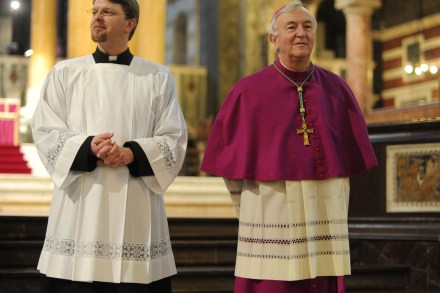
I doubt His Holiness and I would hit it off, but he is right that Harriet Harman’s Equality Bill would impose strictures upon religious communities that run contrary to their beliefs. The coalescence of British and EU anti-discrimination law is but an immodest garment for trenchant ideology. Harman’s bill strives to subjugate individual freedoms, such as that to religious expression, beneath state-imposed rights. This legislation is the progeny of faith in social engineering, not social mobility; it ignores that toleration and freedom in Britain were derived from the right to religious observance free from state proscriptions. If enacted, the bill will require organisations to employ without thought to suitability, and

Will faith prove Cruddas’ undoing?

What intrigues me most about the Cruddas/Purnell axis is their commitment to faith in public life. Many politicians discuss faith carefully and define its role in society as essentially passive – remember David Cameron’s recent interview with the Evening Standard. Cruddas and Purnell envisage faith and the civic mutualism it engenders as an active ingredient to renew both party and country. Writing in the Guardian earlier this week, Purnell wrote: ‘The Labour movement was built upon organisation, the practices of reciprocity and mutuality that, if successful, led to a shared responsibility for one another’s fate… There are deep conservative elements in the Labour tradition, and we should honour them –

Addle-pated modernist

In 1564 a book was published calculating that there were 7,409,127 demons at work in the world, under the administrative control of 79 demon-princes. Eight years later, Michel Eyquem de Montaigne began to write his Essays, a book which still seems to speak to us directly with all the force of rational understanding and an identifiable human personality. If Montaigne marks the beginning of modernity, it is because he tells us exactly what he is like; how he sees the world, fallibly and yet honestly; and because there was no book in the world like it before, and we are still writing books rather like it today. Montaigne, in common

What do Muslims think?

Coffee House readers sometimes complain that we do not talk enough about Muslims and Islam. I have certainly shied away from the subject, fearing that emotion and prejudice, rather than argumentation and empirical data, would dominate the debate. I don’t write about Christians, Jews or Buddhists, so why focus on Muslims? At any rate, I don’t like talking about collective groups, much as I prefer not to be talked about based solely on my heritage. But now a new study called Muslims in Europe allows for an empirically-based debate about sentiments across a number of Muslim communities. Based on interviews and surveys in 11 European cities, it presents some interesting

Parsons’ displeasure

Despite its prosaic title, this is a humdinging page-turner of a book, revealing in livid detail the scandal of how the Church of England jettisoned onto the market what the author describes as ‘perhaps the most admirable, desirable and ascetic body of domestic buildings ever built’. Despite its prosaic title, this is a humdinging page-turner of a book, revealing in livid detail the scandal of how the Church of England jettisoned onto the market what the author describes as ‘perhaps the most admirable, desirable and ascetic body of domestic buildings ever built’. Out of his reckoned 50,000 of such buildings that served England’s churches — ‘hallowed stones, if properly used,

A careful believer

Is David Cameron religious? In the course of his interview with the Evening Standard he provides a clear glimpse of his attitude to religion. He sees it as something that should be advocated with the utmost care, if votes are not to be squandered. He is asked if faith in God is important to him. “If you are asking, do I drop to my knees and pray for guidance, no. But do I have faith and is it important, yes. My own faith is there, it’s not always the rock that perhaps it should be.” Hmmm. Surely praying for God’s guidance is a basic part of Christian faith, and nothing

The BNP’s appropriation of British institutions must be resisted

Hardly a day passes without Nick Griffin cosying up to a poster of Churchill and the Few. Valour provides potent nationalist imagery, but Griffin has no right to it – as his distinctly ambiguous stance on the Ghurkhas’ residency rights makes clear. This morning, senior officers, in conjunction with Nothing British, condemned Griffin’s opportunism:   ‘We, the undersigned, are increasingly concerned that the reputation of Britain’s Armed Services is being tarnished by political extremists who are attempting to appropriate it for their own dubious ends. We deplore this trend for two reasons. First, the values of these extremists – many of whom are essentially racist – are fundamentally at odds

Biblical Corruption: Liberals & Fellow-Travelling Surrender Christians

Did you know that the problem with the Bible is that it is, frankly, a book for liberal surrender-monkeys? Apparently so. Hence the urgent need for a new, properly conservative translation. Let’s hear it for the Conservative Bible Project. Apparently, As of 2009, there is no fully conservative translation of the Bible which satisfies the following ten guidelines… Framework against Liberal Bias: providing a strong framework that enables a thought-for-thought translation without corruption by liberal bias Not Emasculated: avoiding unisex, “gender inclusive” language, and other modern emasculation of Christianity Not Dumbed Down: not dumbing down the reading level, or diluting the intellectual force and logic of Christianity; the NIV is

Playing the opportunist

In historical writing the Restoration era has been the poor relation of the Puritan one before it. It is true that we all have graphic images, many of them supplied by Samuel Pepys, of the years from the return of the monarchy in 1660: of the rakish court and the mistresses of the merry monarch; of the Restoration playhouses and the newly-founded Royal Society; of the disasters of the great plague and the fire of London and the Anglo-Dutch naval war. Yet until very recently there has been no equivalent to the scholarly foundations which were laid by Victorian narratives of the civil wars and the republic, and on which

Too much information | 23 September 2009

Freemasons have been getting steadily less glamorous since their apotheosis in The Magic Flute. Nowadays, one thinks of them in connection with short-sleeved, polyester shirt-and-tie sets, pens in the top pocket, sock-suspenders and the expression ‘My lady wife’. I honestly can’t see them guarding the secrets of the universe. Dan Brown’s new conspiracy theory cosmic thriller, portraying freemasonry as a wise secret sect, starts at a considerable disadvantage. Ends there, too. Robert Langdon — was there ever a dimmer name for an action hero? — is lured away from his cryptological studies by an invitation from a wise old acquaintance, Peter Solomon, in Washington. Or so it seems; because when

Liobams lying with rakunks

Set in the future, The Year of the Flood tells the story of the build-up to and aftermath of a pandemic known as the Waterless Flood, which all but eradicates the human race. The environment the survivors are left with is extremely inhospitable: Earth’s natural resources are long depleted, and the flora and fauna that remain are made up of genetically spliced, hybrid organisms such as rakunks (rats crossed with skunks), pigoons (hybrid pigs resembling balloons because they’re stuffed with duplicate human transplant organs), and liobams (lions forced not just to lie down with lambs but to integrate with them biologically) — not to mention soydines, chickeanpeas and beananas. Margaret

Dangerous liaisons | 27 June 2009

Surviving, by Allan Massie The Death of a Pope, by Piers Paul Read Coward at the Bridge, by James Delingpole Alcoholism, with its lonely inner conflict between escapism and conscience, is an inexhaustible subject for literature. The emotional agony of addiction is fascinating, as long as it is other people’s. Allan Massie, the illustrious Scottish littérateur, has written an empathetic novel about the loneliness of the long-distance boozer, always isolated, even in the company of fellow alcoholics who try to help. Some alcoholics in desperation submit to Alcoholics Anonymous, in the hope that mutual support may ease the daily fear of lapsing. Massie once spent several years in Rome and

Gordon Brown’s Presbyterian Conscience

When a politician tries to make a virtue out of the fact that he was brought up in a household in which lying was frowned upon then, verily, you know he’s on his uppers. Equally, though I daresay that much of the expenses scandal does offend the remnants of Gordon’s “presbyterian conscience” it’s not immediately clear that asserting his own membership of the Elect is necessarily going to endear the Prime Minister to his twin congregations at Westminster and in the country at large, each of which is manifestly fallen… Anyway, if Brown’s “presbyterian conscience” really is all he’d like us to think it is and if his bally “moral

You can go home again

Stranger to History: A Son’s Journey Through Islamic Lands, by Aatish Taseer The publication of Stranger to History is likely to be turned into a fiery political event in Pakistan. The author is the half-Indian son of Salman Taseer, the glamorous and controversial Governor of the Punjab and one of Pakistan’s most important newspaper proprietors.The work is a heartfelt cry for attention from the old mogul, and with its talk of alcohol and of illicit liaisons it provides plenty of fuel for the Governor’s enemies. But it will be a pity if Aatish’s first book — part family memoir, part an account of his journey through the heart of the

Ways of escape

At a time in modern, secular Britain when religion is seen not as the saviour but as the cause of many of society’s problems, we have become skilled not so much at turning the other cheek as turning a blind eye. Thank God (maybe literally) for writers like Michael Arditti, whose invigorating novels dare to shake us out of our complacency. Arditti returns to the ecclesiastical territory he charted in previous works, in particular the award-winning novel Easter. As well as examining Christianity as seen through the lives of several members of the Church of England, Arditti’s nuanced cartography now extends to Islam, Judaism, and, briefly, Buddhism and Paganism —

Instead of the poem

On this book’s title page its publishers enlarge on Peter Ackroyd’s ‘retelling’: his book, they declare, is at once a translation and — wait for it — an ‘adaptation’ of Chaucer, and from the beginning, you are made aware of what form this adaptation will take. This is how Chaucer introduces his Prioress in the General Prologue, and it is a moment of quiet, if sly, humour as he sketches the prissy little ladylike ways of this Merle Oberon in a wimple: And Frenssh she spak ful faire and fetisly, After the scole of Stratford atte Bowe, For Frenssh of Parys was to hire unknowe. And you don’t need to

Geert Wilders is Still a Bigot and Still No Kind of Hero

Way back in February I suggested that Geert Wilders should have been allowed to show his wee film Fitna in Britain and that it was a mistake to deny him entry to the United Kingdom. But I also suggested that he was no sort of champion of freedom or free speech or any liberal sense of decency. Not to put too fine a point on it, I argued, he’s a boor and a bigot. Many commenters took issue with this and that, for sure, is their prerogative. I rather think, however, that Mr Wilders is helping make my case for me. Here is his Ten Point Plan To Save The

Faith and Begorrah…

Good lord, it’s like the last thirty years never happened: the Irish government wants a new law to prohibit blasphemy. If passed then, astonishingly, the courts will be asked to decide if the supposed victim has been sufficiently outraged for there to have been an offence. Remarkable. And expensive too since it could cost you up to €100,000 and a visit from the Gardai Siochana to confiscate the “offensive material”. As Carol Coulter explains: For that to happen, a court will have to be satisfied the matter published is “grossly abusive or insulting in relation to matters held sacred by any religion, thereby causing outrage among a substantial number of