Religion

From the Bible to Tolkien: the risks & rewards of collecting rare books

27 min listen

The Bible is widely said to be the most published book of all time. Despite this, many older versions of the Bible are still sought after. This is because, as Tom Ayling tells Damian Thompson on this episode of Holy Smoke, there is a great deal of diversity amongst the editions precisely because it has been so widely published. Tom, a young antiquarian bookseller who set up his own business, joins the podcast to talk about the risks and rewards behind collecting rare books. Tom explains why, for him, books are ‘most than just a text’; takes us through the various religious books in his collection, from old editions of the Holy Bible to the Book of Common Prayer; and reveals some of the more amusing mistakes he has come across. For more from Tom, go to: www.tomwayling.co.

The Catholic influencers spreading the word of God

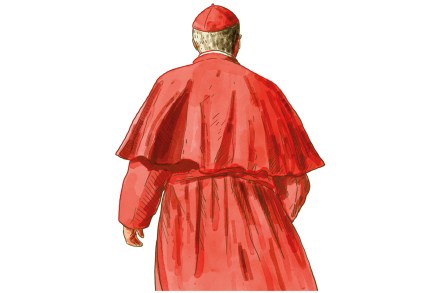
Vatican City In an auditorium just outside St Peter’s Basilica, the Vatican’s Secretary of State, Cardinal Pietro Parolin, sat solemnly in the front row as a young crowd sang, danced and hopped around to a pop hymn. The cardinal, who is 70, was widely expected to become the pope earlier this year. Instead, he inaugurated the Catholic Church’s first social media influencer conference. Around 1,000 influencers attended last week’s Jubilee of Digital Missionaries and Catholic Influencers. In his opening remarks, Parolin described social media as not just an instrument of communication, but ‘a way of living in the world’.

Massacres in Syria & the Congo: why aren’t Western elites drawing attention to religious persecution?

28 min listen

After the fall of the Assad regime in Syria, many people voiced fears that the religious minorities in the country could face increased persecution. This could be at the hands of the new government’s supporters, or simply because the new regime can't protect them. Now those fears appear to have been realised. There is rising sectarian violence against Christians, the Alawites and the Druze (pictured). There are also frequent barbaric attacks on Christians in parts of Africa: more than 40 Christians have just been murdered by Islamists in the Democratic Republic of the Congo while attending church.

Recovering the Sacred: listen to our unique Spectator event celebrating the rediscovery of tradition by young Christians

75 min listen

Last week The Spectator held a live event entitled ‘Recovering the Sacred’ in the glorious surroundings of St Bartholomew the Great, the oldest parish church in the City of London. The speakers included two London parish priests – one Anglican, one Catholic – who have contributed much to the growing interest among young people in traditional liturgy and Christian theology, a development that the hierarchy of their respective churches certainly didn’t foresee. They were the Rev Marcus Walker, Rector of St Bart’s, whose Prayer Book Evensongs and Eucharists attract large numbers of young professionals to his ancient church; and Fr Julian Large, the Provost of the Brompton Oratory, where an increasingly youthful congregation flocks to Latin Masses.

A double loss: The Möbius Strip, by Catherine Lacey, reviewed

The Möbius Book has been variously described as ‘a hybrid work that is both fiction and non-fiction’ and a ‘memoir-cum-novel’. Catherine Lacey herself asserts that it is a work of non-fiction, but with a qualifying ‘however’. It comprises two narratives, first- and third-person, and is published to be flipped 180 degrees. Ali Smith’s How to be Both had a similar format, as did Mark Danielewski’s Only Revolutions. All three force the reader into making a choice and living with the consequences. This is not cosmetic, as The Möbius Book is about decisions and repercussions. Lacey writes in the aftermath of two break-ups: a romantic one with a man referred to as ‘the Reason’, and an earlier one with God.

Why should the hunt for the next Archbishop of Canterbury be ‘inclusive’?

On 21 July 1828, the urbane aristocrat Charles Manners-Sutton, 89th Archbishop of Canterbury, died. Just two and a half weeks later, on 8 August, the mild-mannered linguistic scholar William Howley was elected as his successor. The efficiency of this process is in marked contrast to the current search to find the next successor to Manners-Sutton and Howley. Justin Welby announced he was vacating the throne of St Augustine on 12 November last year; it took until 28 May even to assemble the committee who will discuss the names of his potential successor. It will be a miracle if we know the name of the new Primate of All England by the autumn.

It’s time for Pope Leo XIV to make some tough decisions

13 min listen

Nearly everyone loves Robert Prevost, the unassuming baseball fan from Chicago who unexpectedly became Pope Leo XIV this year. But as he prepares to spend his summer in Castel Gandolfo he has some difficult decisions to make. Is he prepared to clear up all the doctrinal confusion created by his predecessor Pope Francis? And will he allow liberal bishop to continue to persecute Catholics who prefer the ancient Latin form of Mass?  Damian Thompson gives us his thoughts in advance of Recovering the Sacred, a Spectator event at St Bartholomew-the-Great in the City of London on July 8 featuring debate and sacred music illustrating the recovery of tradition by a new generation of Christians. For tickets and more information, go to spectator.co.uk/church.

Why are young Christians returning to tradition?

41 min listen

Today’s Holy Smoke is a curtain-raiser for ‘Recovering the Sacred’, a Spectator event at St Bartholow-the-Great in the City of London in which a panel of experts will explore the rediscovery of traditional worship and theology by young Anglicans and Catholics. The event will be held on Tuesday 8th July; for more details, and to book tickets, go to: spectator.co.uk/church In today’s episode Damian Thompson talks to Anglican James Vitali and Catholic Georgia Clarke, two Generation Z professionals bursting with enthusiasm for their faith. It’s an exhilarating discussion; don’t miss it.  Produced by Patrick Gibbons.

How do you exhibit living deities?

The most-watched TV programme in human history isn’t the Moon landings, and it isn’t M*A*S*H; chances are it’s Ramayan, a magnificently cheesy 1980s adaptation of India’s national epic. The show has a status in India that’s hard to overstate. Something like 80 per cent of the entire population watched its original run; in rural areas entire villages would crowd around a single television hooked up to a car battery. When the show ended, omitting the ‘Uttara Kanda’, the fairly controversial last book of the original poem, street sweepers across the country went on strike, demanding the government fund more episodes. The government caved. But while every country has its pieces of cult media, in India the cult is literal. Some viewers would take a ritual bath before tuning in.

A Jewish guide to arguing 

52 min listen

Daniel Taub, former Israeli Ambassador to the UK, joins Damian Thompson to talk about his new book Beyond Dispute: Rediscovering the Jewish art of constructive disagreement. In a fast-moving interview, Daniel explains how the art of arguing has shaped Jewish humour and scholarship, and Damian asks him about keeping kosher, life after death – and the influence of the Talmud on Curb Your Enthusiasm.  Produced by Patrick Gibbons.

This is a dangerous moment for free speech

Britain without blasphemy laws is a surprisingly recent development. Blasphemy was abolished as a common law offence in England and Wales only in 2008 and in Scotland in 2021. But that was the final burial of a law dead for much longer. The last execution for the crime was in 1697; the last imprisonment in 1921; and the last successful trial in 1977 – Mary Whitehouse’s prosecution of Gay News for publishing a poem about a centurion’s rape of Christ’s corpse. Even if 11 local councils banned Monty Python’s Life of Brian two years later, the trend since has been towards trusting that the Almighty is big enough to fend for himself. Yet this week the clock seemed to have been turned back to around ad 650.

The mystifying process – and problems – behind choosing the next Archbishop of Canterbury

39 min listen

After Pope Francis died, it took the Roman Catholic Church just 17 days to choose a successor in Pope Leo XIV. It has been well over 6 months since Archbishop of Canterbury Justin Welby resigned and we are only just making sense of those chosen to sit on the Crown Nominations Commission (CNC), that will recommend his successor. Even then, it’s unlikely we will know more until the autumn. Why has it taken so long? Journalist, commentator – and quite frankly expert – Andrew Graystone joins Damian Thompson and William Moore, the Spectator’s features editor, to take listeners through the process.

The secrets of ‘God’s influencer’

Assisi In a medieval church built of white stone, pilgrims and tourists shuffle past the body of a 15-year-old boy in a tomb with a glass side. The boy is handsome, with dark curly hair, and wears a blue tracksuit top, jeans and Nike trainers. Everyone peers through the glass and some realise, with a start, that the perfectly preserved face and hands are eerily lifelike silicone. The real remains, decomposing for almost 20 years, are inside the effigy. This is Carlo Acutis, the Italian teenager known as ‘God’s influencer’, who is about to become the first millennial saint of the Roman Catholic Church. The tomb is held up from behind and so appears to levitate, surrounded by a corona of bright light.

Lamorna Ash: why are Gen Z turning to Christianity?

40 min listen

My guest on this week’s Book Club podcast is Lamorna Ash, author of Don’t Forget We’re Here Forever: A New Generation’s Search for Religion. She describes to me how a magazine piece about some young friends who made a dramatic conversion to Christianity turned into an investigation into the rise in faith among a generation that many assumed would be the most secular yet — and into a personal journey towards religious belief.

How should Christians embrace ‘faithful dissent’ today?

This is an excerpt from the latest episode of the Holy Smoke podcast with Damian Thompson, which you can find at the bottom of this page: The Easter issue of the Spectator includes two provocative articles exploring aspects of Christianity. Nigel Biggar, Regius professor emeritus of moral theology at Oxford University, now a Conservative peer, celebrates the heroic ‘faithful dissent’ of Christian heroes such as Thomas More and Helmuth von Moltke, who lost their lives rather than defend injustice.  Meanwhile Spectator columnist Mary Wakefield interviews Roman Williams, former Archbishop of Canterbury. She’s inspired by his holiness but depressed by his use of ‘C of E bureaucratese’ to uphold liberal orthodoxy on subjects such as gender ideology.

Easter special: in praise of faithful dissent, a conversation with Nigel Biggar and Mary Wakefield

24 min listen

The Easter issue of the Spectator includes two provocative articles exploring aspects of Christianity.  Nigel Biggar, Regius professor emeritus of moral theology at Oxford University, now a Conservative peer, celebrates the heroic ‘faithful dissent’ of Christian heroes such as Thomas More and Helmuth von Moltke, who lost their lives rather than defend injustice.  Meanwhile Spectator columnist Mary Wakefield interviews Roman Williams, former Archbishop of Canterbury. She’s inspired by his holiness but depressed by his use of ‘C of E bureaucratese’ to uphold liberal orthodoxy on subjects such as gender ideology. But, she says they can share an uncomfortable space together within faith.

Is it time for Christians to unite over Easter?

So, you thought the date of Easter, which rambles irritatingly round the spring calendar, was settled by the Synod of Whitby, no? That gathering in 664 AD, which established that Northumbria would celebrate Easter in the Roman calendar, used to be one of the events that Every Schoolboy Knows, though probably not now. There were two rival ways of computing Easter, the Celtic and the Roman, and the problem was that King Oswald belonged to the Irish/Iona tradition, and his wife, Eanflaed, kept the Roman calendar. One bit of the court would be in Lent and fasting, vegan-style, and abstaining from sex and fighting, while the other was celebrating Easter, gorging on Paschal lamb and presumably up for conjugal relations and brawling.

How I found Christianity

I wasn’t brought up in the faith. My maternal grandfather was a Methodist lay-preacher, but when my mother left County Durham for marriage in south-west Scotland, she left the religion of her childhood behind. My Scottish father’s experience of church gave him an odd penchant for the electric organ, but that was about it. So when, at the age of 12, I screwed up my courage and came out as a Christian, Dad put his hand on my shoulder – for the only time – and said: ‘It’s OK, son; it’s just a phase.’ Now, as my Christian phase approaches its seventh decade, I find myself looking back and wondering what had happened to me. What caused me to risk that first venture of exposed dissidence? There were mediating institutions and people, of course.

Was Simeon of Jerusalem the first Christian in recorded history?

28 min listen

In Luke's Gospel, an ancient inhabitant of Jerusalem named Simeon meets Mary and Joseph when they bring Jesus to be presented at the Temple on the 40th day after his birth. He has been promised that he will not die until he has seen Christ, and as he takes the baby into his arms he utters the words, 'Lord, now let your servant depart in peace, according to your word; for my eyes have seen your salvation which you have prepared in the presence of all peoples, a light for revelation to the Gentiles, and for glory to your people Israel.'  This prayer, known down the centuries by its opening Latin words Nunc dimittis, explains the title of Quentin Letts's novel Nunc!, a delightfully quirky retelling of the story of Simeon and his friends.

The C of E’s tragic misuse of its sacred spaces

I am a priest in the high church tradition of the Church of England. The technical term is Anglo-Catholicism, but I come from a very different Christian background. My heritage is non-conformist evangelical – I was baptised in a swimming pool in the summer of my first year of university. St James’s in Piccadilly hosts events featuring ‘icons’ from RuPaul’s Drag Race UK It’s a long story as to how I’ve ended up wearing a chasuble and celebrating ‘Mass’, but a big part of it has been to do with church architecture. After several years in the charismatic evangelical scene, I became fascinated with the beauty of medieval churches, particularly cathedrals. I began to think of the large white-cuboid former bingo hall owned by our church as soulless and empty.