Religion

Faking it | 16 November 2017

David Mamet’s plays are tough to pull off because his dialogue lacks the predictable shapeliness of traditional dramatic speech. He prefers the sort of meandering, oblique, backtracking and self-deluding conversation you might overhear in a hotel dining-room. Glengarry Glen Ross opens in a restaurant, where a handful of realtors are discussing the perils and joys of their craft. The scene culminates in one of the landmarks of American drama. Top salesman Ricky approaches a potential customer in disguise and delivers a sales pitch that sounds like a poetic meditation on destiny and existence. It’s impossible to say what darkness this little masterpiece emerged from but Christian Slater (Ricky) captures all of it, abruptly and shockingly, with laser-like precision.

To hell and back

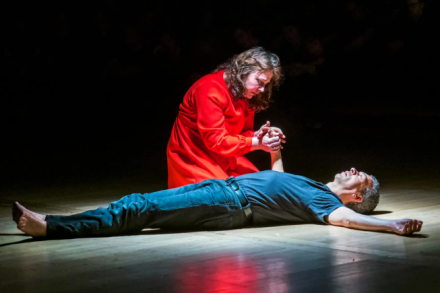
The Exorcist opened in 1973 accompanied by much hoo-ha in the press. Scenes of panic, nausea and fainting were recorded at every performance. Movie-goers showed up to witness mass hysteria rather than to enjoy a scary movie. This revival, produced by Bill Kenwright, targets the early 1970s demographic. At press night, the stalls were thronged with pensioners eager to relive a lurid evening from their adolescence. As one who dislikes shocks of any kind, I sat through this ordeal with my eyes bent towards the floor and my fingers wedged so firmly in my ears that their tips turned crimson. The show opened with a CRUMP loud enough to shake the theatre to its foundations. Everybody screamed. Then they all giggled. This pattern of shrieking followed by feathery tittering continued throughout.

Is Britain becoming a Christianophobic country?

Kicked ‘like a football’ were the words used by a Pakistani Christian to describe a brutal assault that left him unconscious outside a restaurant in Derby last month. The victim, Tajamal Amar, claims Muslim men singled him out for offence he’d caused by displaying a cross and two large red poppies on his car, and for being a Kaffir – a derogatory term for non-Muslims. As it happens, the attack occurred towards the end of National Hate Crime Awareness Week, and has been recorded as a hate crime. The British Pakistani Christian Association, a group who’ve been supporting Amar, inform me his wife and daughter have been moved to a new location; he remains in hospital. But is his case symptomatic of a broader anti-Christian sentiment brewing in Britain?

Martin Luther’s genius was to teach us that feeble faith is enough

I sometimes identify with something that Evelyn Waugh once said. A friend asked him how come he claimed to be a Christian, being such a cantankerous curmudgeon, such a master of cruel wit. Well, Waugh replied, imagine how horrid I’d be if I didn’t try to be a Christian. There’s something authentically Christian in that answer – an admission that we can never be very successful Christians. Because it demands so much, this religion is an awkward commitment, full of tension and ambiguity. Because it demands so much, we can be honest about our failure. For me, this capacity for honesty is crucial. If I felt there was no room in Christianity for such honesty, I think I would have walked away.

New York now refuses to be terrorised

I am marvelling at the resilience of New York City. Yesterday afternoon a real monster visited Lower Manhattan, weaponising a truck in the foul Isis fashion to mow down scores of citizens, killing eight. Yet just a few hours later the streets of Manhattan were thronging with pretend monsters. With vampires, skeletons, witches, Leatherfaces and other fancy-dress freaks, blood-stained and drunk, acting at being menacing but really being merry, gathered in their thousands for the Halloween Parade. Where I watched them stream by, at the corner of Sixth Avenue and 14th St, there were hundreds of people pressed together, a heaving, happy crowd. They whooped and Instagrammed as floats with giant monsters and dancing dead people passed by.

Martin Luther is the patron saint of individualism

Martin Luther shot to fame five hundred years ago with his protest against indulgences in October 1517. At the core of his message was the straightforward idea that the answer to every religious question was to be found in the Bible, the Word of God, taken in its plain and simple sense. As we now know, it didn’t quite work out. The Word of God just wasn’t as plain and simple as Luther thought. Rival prophets, from erudite theologians down to everyday cranks, read the same Word of God with different and sometimes swivelling eyes, and came to very different conclusions. Ulrich Zwingli, the godfather of the Reformation in Zurich, preached his distinctive brand of Christianity from the pulpit of the city’s Grössmunster church in the 1520s.

More secrets and symbols

Being reflexively snotty about Dan Brown’s writing is like slagging off Donald Trump’s spelling: it just entrenches everyone’s position. In a world where a quarter of people read literally no books in any given year, can we give each other a break on this kind of thing? If you found Angels and Demons good fun, thoroughly enjoyed The Da Vinci Code (as I unironically did), but despised Inferno for the worthless piece of rat doodah that it was, then the good news is that Brown is back on form here. Origin is brisk, fun and filled with adorably pointless Wikipedia paragraphs; and what’s at stake is endearingly grandiose. Here, the premise is atheism vs religion.

The ties that bound us

Only Neil MacGregor could do it — take us in a single thread from a blackened copper coin, about the size of a 10p piece, dating from Rome in about 200 AD, to a packed music hall in London during the first world war. In his new 30-part series for Radio 4, Living with the Gods, the former director of the British Museum looks at the ways in which societies come together through shared rituals and beliefs and how these rituals are developed and used to make sense of our place in a universe beyond human comprehension. One side of the coin shows a fire burning within the Temple of Vesta, dedicated to the Roman goddess of fire, and surrounded by the Vestal Virgins, whose job it was to keep the flames alight, to protect the ‘hearth’, or the focus of Rome’s power.

A Muslim’s insights into Christianity

I’m not a critic, I’m an enthusiast. And when you are an enthusiast you need to try your best to keep it in check when writing reviews, just in case your prodigious levels of excitement and, well, enthusiasm, threaten to overwhelm readers and only succeed in putting them off. Because people generally need a bit of room — to create some distance, establish a tiny bit of breathing space — in order to make their own considered decisions about the liable goodness or badness of a thing. But shucks to all of that.

From China to Europe, the world is becoming more dangerous for Christians

‘Persecuted and Forgotten?’ is the name of the latest report by Aid to the Church in Need. Unfortunately, there is no need for that question mark in the title. Both the persecution and the oblivion are facts. Christians have been victims of the genocide in Isis-controlled parts of Iraq and Syria. In 2011, there were 150,000 Christians in Aleppo and now there are 35,000. Persecution rises in other Muslim countries such as Pakistan, Sudan and Iran. In Nigeria, 1.8 million people have been displaced by Boko Haram. In India, there is much more harassment of Christians since Narendra Modi came to power in 2015. In China, there are now thought to be 127 million Christians.

The Football Lads Alliance is a working-class movement – and the political class wants to ignore it

Politicians are always going on about ‘the voiceless’. By which they usually mean poor and working-class people. People who have been shunted from public life and never get to air their concerns. At the Conservative party conference Theresa May styled herself ‘voice of the voiceless’ (before, too ironically, becoming voiceless herself). Impeccably bred Corbynistas, all bleeding-heart ABC1s, dream of giving a leg-up to the little people and having more working-class voices in politics. Which makes it odd, then, that on Saturday, London hosted one of the largest working-class demonstrations of recent years and these weepers for the voiceless said nothing. Nada. Zilch. Ah, but these were the wrong kind of working-class people.

Can we no longer distinguish between an evangelical Christian and a jihadist?

Is it possible that London commuters are now unable to tell the difference between the cry of God is Great, Allahu Akbar - a sentiment that unfortunately accompanies every IS atrocity - and the actual Bible? It seems like it from the reaction on the Shepperton to Waterloo service at 8.30am yesterday. As one report put it, 'a man with a rucksack began reciting what seemed to be passages from the Old Testament. He apparently declared homosexuality and pre-marital sex to be a sin.' Or as one commuter put it, 'Some nutter starts reciting verses from the Bible… and causes such panic that some people have forced open the doors and jumped onto the tracks. He recited lines about homosexuality and sex outside marriage being a sin. God gave his only son for our sins etc.

The West is delusional about de-radicalising jihadists

The error of Emma Kelty, the one that cost the British adventurer her brave life on the banks of the Amazon, was a failing all too common in Europeans: she had too much good faith. Raised in comfort and educated in compassion, Kelty had little concept of the savagery that lurks in some souls. Displaying a mix of naivety and conceit, she ignored warnings from villagers and went on her way, even posting a joke on social media mocking the locals' concern for her welfare. Two days later she was murdered by a gang of 'water rats', young men with no regard for human life. What happened to Kelty is little different from what has been happening to Europe in recent years.

Why won’t Britain support the Kurdish referendum?

Erbil They like the British here in Iraqi Kurdistan. You hear it from people everywhere in Erbil, the region’s capital. And there were a great many of them out in the streets. It was hot and crowded on 25 September; the polls opened early for the Kurds to vote. The question was simple: did they want independence from Iraq? Did they, after over 2,000 years of statelessness, want their own sovereign nation? 48 hours after the question was officially put to the populace they replied- unequivocally. The Kurdish electoral commission said around 92 per cent voted 'yes' to an independent Kurdistan. This answer – though entirely expected – did not go down well in Baghdad or with any of Erbil’s neighbours. The day before the vote, Iran closed its airspace to Kurdistan.

Kurdistan defies the threats to hold its referendum vote

The Machko teahouse in the centre of Erbil, the capital of the Kurdistan region of Iraq, has seen much of the area’s history. Founded in 1940, it survived Saddam Hussein’s oppression and years of privation. On September 25th, it was packed with patrons gathering to watch the latest chapter in the Kurdish region’s long history unfold. Since June, when Kurdistan Regional president Masoud Barzani announced a referendum on independence, the eight million residents of this autonomous part of northern Iraq have been waiting to see if the vote would take place. On September 25th, it happened. Initial figures showed a 76 per cent turnout.

If Jesus Christ was on Twitter, would he be attacked by malignant trolls?

You must listen to the feisty new episode of the Holy Smoke podcast, in which Cristina Odone and I ask our guest Jeremy Vine whether, if he were alive in the 21st century, Jesus would have been on Twitter. If so, what would happen to him? Jeremy – whose new book What I Learnt discusses social media – points out that the Sermon on the Mount could easily be sliced up into memorable tweets. Indeed, but you can also fit Jesus's description of the Jews as children of Satan into 140 characters. That would lose him his blue tick, if not cause him to be banned altogether. But all three of us agreed that, if Christ appeared on social media, he'd be a magnet for trolls.

Britain has an anti-Semitism problem. Here are the numbers that prove it

A new report on anti-Semitism in Britain makes uncomfortable reading all round. The study, a joint enterprise by the Community Security Trust and the Institute for Jewish Policy Research, is an in-depth exploration of anti-Jewish attitudes, the role of animus towards Israel, and the prevalence of prejudice in 2017. It is a sober analysis and the researchers tend towards restraint – sometimes a little too much restraint – in drawing conclusions from their data. It is this very interpretive modesty that makes the findings all the more concerning.

Religion is on the decline – yet our society is underpinned by faith

For Church of England vicars who worry less about what they will preach on Sunday than whether there will be any parishioners to listen to them, the latest findings of the British Social Attitudes Survey will make grim reading. For years the number of people professing religious belief in Britain has hovered around the 50 per cent mark. Now it seems to have dived decisively, plunging from 52 per cent to 47 per cent in just a year. According to a survey we are no longer a Christian country, but then neither — for all the squeals over sharia law — are we becoming much of a Muslim country, or indeed any other religion. Just 6 per cent of us profess a faith other than Christianity, down from 8 per cent last year. Our established national church is declining fastest of all.

Britain is a nation of quiet Christians

The latest survey says that under half of us (42 per cent) identify as Christian, and that just over half have no religion. Does this show that we have finally turned the corner, and are no longer a Christian nation? Well, it’s a very curved corner – we’ve been turning it for about fifty years. But on one level we remain a Christian nation until a movement comes along that redefines us in explicitly secular terms – and there’s no real sign of it. It might sound perverse, but I think these figures show religion to be surprisingly popular. For consider how little religion there is in popular – or indeed less popular – culture. A Martian who visited Britain and studied our culture would assume that just a few per cent sympathised with religion.

Keeping faith | 7 September 2017

For Church of England vicars who worry less about what they will preach on Sunday than whether there will be any parishioners to listen to them, the latest findings of the British Social Attitudes Survey will make grim reading. For years the number of people professing religious belief in Britain has hovered around the 50 per cent mark. Now it seems to have dived decisively, plunging from 52 per cent to 47 per cent in just a year. According to a survey we are no longer a Christian country, but then neither — for all the squeals over sharia law — are we becoming much of a Muslim country, or indeed any other religion. Just 6 per cent of us profess a faith other than Christianity, down from 8 per cent last year. Our established national church is declining fastest of all.