Plato

Secrets of the universe

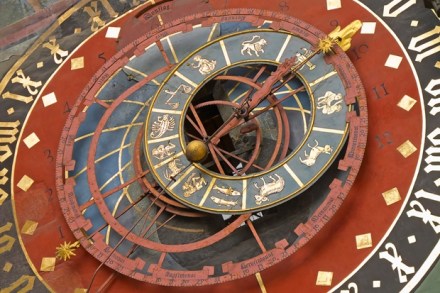
A few years ago, in Berne, I visited the apartment where Einstein wrote his theory of special relativity, which changed our understanding of the world forever. It’s a small apartment, plain and nondescript. The best thing about it is the view. From the window you can see Berne’s huge medieval clock, the Zytglogge. It was this clock which inspired Einstein’s great breakthrough. At the end of every humdrum day, in his dead- end job at Berne’s patent office, he took the tram home, past the Zytglogge, back to this apartment. As he gazed at that clock through the tram window, he wondered: what if his tram could travel at the speed of light? Logically, the light from the Zytglogge should never overtake him.

Shady past

David Hockney: It is a kind of joke, but I really mean it when I say Caravaggio invented Hollywood lighting. It is an invention, in that he quickly worked out how to light things dramatically. I’ve always used shadows a bit, because that’s what you need below a figure to ground it, but mine are more like Giotto’s than Caravaggio’s. I use shadows that you see in ordinary lighting conditions; you don’t find ones like Caravaggio’s in nature. But there are other varieties of Hollywood lighting. The ‘Mona Lisa’ is one of the first portraits with very blended shadows. That face is marvellously lit, the shadow under the nose, and that smile. The soft transition from the cheekbone down to underneath the jaw is extraordinary.

Plato on grammar schools

Theresa May wants to use grammar schools to create a meritocratic, ‘socially mobile’ society at a cost of £50 million. But that raises the question: merit in what, precisely? In his Republic, Plato envisaged Socrates wondering how society was created, with a view to determining how best to establish a just one. Socrates suggested that society originated out of universal needs which individuals could not necessarily satisfy themselves. Food, shelter and clothing were the most basic ones, demanding therefore farmers, builders and weavers; and since everyone had different aptitudes, workers best served the whole community by sticking to their last. Then again, the farmer needed his plough, the builder his tools, etc.

Corbyn’s shadow puppets

Wrapped in his fantasy world of a Labour party ruling the country in accordance with the diktats of those of its members who support him, Jeremy Corbyn reminds one of Plato’s image of humans trapped in a cave, able only to see the wall in front of them. Behind them, at the opposite end of the cave, is a fire, and in front of that, a puppet show. The shadows of those puppets, cavorting on the wall in front of him, are man’s reality. And Corbyn’s. His MPs are right to want a party connected to the real world, but is a leadership battle the right way to go about it? The contest should be a purely rhetorical one, though Corbyn’s followers will not hesitate to use force instead.

Plato on the EU referendum

Our politicians, realising that the referendum campaign will be settled not by themselves under the usual parliamentary constraints but by the Twitter-maddened populace under no constraints at all, have decided to abandon any principles they may have and play the straight populist game. Plato well understood the behaviour and its consequences. In his Republic, he envisages a man in charge of a large and powerful animal who studies its moods and needs. He learns when to approach and handle it, when and why it is savage and gentle, the meaning of the various noises it makes and how to speak to it to annoy or calm it. He might then deduce that he has a scientific understanding of animals.

People power then and now

It does seem extraordinary that the increasingly puce-faced Mr Cameron offered us an ‘in-out’ referendum and is now telling us that ‘out’ would mean the end of the world as we know it. What on earth did he think he was doing? His reaction is to eviscerate MPs who support ‘out’, and intentionally deprive us who will actually make the decision of information enabling us to do so. People power is clearly not for him. One of the great virtues of 5th-century bc Athenian direct democracy was that those who made the policy decisions were citizens meeting weekly in Assembly. Parties did not exist. So there were no such things as party policies, party positions (Clause 4s and so on), or party members, let alone MPs.

Quintilian on lecturers

Professor Louise Richardson, Oxford’s new vice-chancellor, is worried about a new government plan to judge teaching quality. Her reason is that she does not know how to measure it. One wonders what else she does not know about assessing a university’s basic function. Plato made a distinction between the art of teaching and the pupil’s desire for learning. Without the latter, the job was impossible. A good teacher did his best to strike that spark of desire which would turn into a flame. Success was not guaranteed: Plato knew students who preferred a suntan education (his image), turning over now and again till lightly educated on both sides. As for pedagogy, the orator and teacher Quintilian (c.

Drinking at school with Plato

Rugby and Ampleforth schools have decided to give their charges experience of sensible drinking by introducing a little alcohol, under close staff supervision, at dinner. But, as Plato realised, what they actually need is experience of senseless drinking. Plato’s last work, Laws (c. 350 bc), depicts a new utopia, quite unlike that of the Republic with its philosopher-kings. Called Magnesia, it lays down a detailed code of laws which its inhabitants must obey without question because the code will inculcate moral goodness. A key feature of that is self-control, which the speaker (‘the Athenian’) proposes to achieve by means of symposia, or drinking parties.

Plato and think-tanks

In Living with Difference, a think-tank report on the problems raised by a multi-faith UK, the chair Baroness Butler-Sloss says that the recommendations amount to a ‘new settlement for religion and belief in the UK’ and are aimed at providing space and a role in society for all citizens, ‘regardless of their beliefs or absence of them’. This is what happens when good people decide this messy world needs to be hammered into an intellectually satisfying shape. Plato’s Republic is a very good example of the genre. It is an extraordinarily interesting document, telling one a very great deal about Plato and the ancient Greeks, deeply influential on intellectuals down the millennia, and complete tosh from start to finish. Composed c.

Spellbinding stuff

With the briefest of introductions to each chapter, it is up to the reader to decide how they want to tackle nearly 600 pages of extracts from religious discourses, scientific tracts, demonologies, and literary works, expertly chosen and translated by Brian Copenhaver, an eminent scholar of intellectual magic and professor of philosophy and history at the University of California. The structure is chronological, beginning with passages from the Hebrew Bible and the Greek New Testament, then moving on to the Greco-Roman writings of the likes of Plato, Pliny and Ptolemy.

Party-naming with Plato

In order to make a sensible choice of new leader, the Labour party is trying to work out what its ‘core values’ are. Perhaps it would be helpful to begin by thinking about its core name: does ‘Labour’ still correlate with the party’s function any more? In Plato’s dialogue Cratylus, Socrates and chums discuss the significance of the names we apply to the world around us. Does a name give the clue to the real nature of the object to which it is applied, or is it a convention, merely an arbitrary sound or sign? At one level, Socrates argues, names are significant.

Start-up culture in Ancient Greece

Honduras wants to establish start-up cities to experiment with alternative economic, regulatory, and legal systems. Could this concept help stop mass migration into Europe? Ancient Greeks, living in a time and place when poverty was endemic, were adventurers and readily took to the seas to establish their start-ups abroad, all around the coasts of the Mediterranean. These apoikiai (‘homes from home’), far from being ‘colonies’, were in fact new, wholly independent Greek cities. They were variously motivated by e.g. the search for fertile farming land and profitable raw materials, trade in slaves, metals and luxury goods, proximity to and therefore business with non-Greeks, and so on. They spread around the Med ‘like frogs around a pond’ (Plato).

Voting for heroes

To judge from elections, the purpose of politics is to win power by promising to make people better off. Plato, feeling this made the politician the equivalent of a procurer or pimp, argued that the purpose of politics was to make people not better off, but simply better — better humans, and therefore better able to run their own lives, as well as better citizens, able to make sound judgements about the qualities required to run a better state. In other words, politics had a high purpose — the moral good of the whole community, guaranteed by both citizens and their leaders driven by the same purpose. In a famous allegory, the philosopher Prodicus (c. 465–395 bc) put the choice available to citizens, and by implication communities, in the starkest possible terms.

The Green party isn’t nearly tough enough on Ancient Greece

The Green party’s manifesto appears to make saving the planet only a small element in its otherwise painfully unoriginal agenda. This is a pity. People have been wreaking environmental havoc for thousands of years, Greeks and Romans included. Deforestation and subsequent soil erosion were the most serious example of such havoc in the ancient world. Wood was the equivalent of today’s coal and plastic. It provided fuel for houses, baths and industry, especially pottery-firing. We hear of one Phaenippus who made a useful income from his six donkeys bringing firewood into Athens every day. It was the basic building material for everything from chairs to houses and ships (even the pitch with which to caulk them).

John Gray’s great tour-guide of ideas: from the Garden of Eden to secret rendition

You can’t accuse John Gray of dodging the big questions, or indeed the big answers. His new book The Soul of the Marionette: A Short Enquiry into Human Freedom isn’t really that short and certainly isn’t confined to a reflection on human freedom. As a reviewer you’re often faced with books that are so bereft of content, so painfully thin that they’re transparent, and you wonder why anyone would publish them. I can imagine Gray’s editor begging him to jettison some profundity. The reader is bombarded with boulders of philosophy and politics. Religions are gobbled up. Whole civilisations whizz past. It’s the ontological kitchen sink coming atcha, or to paraphrase Joyce, Here Comes Everything. Not just the past, but the future too.

Old age is not for sissies

The secret of eternal youth, according to Alice Roosevelt Longworth, is arrested development, and the penny dropped last week. The mountains were misty, snow was falling and I went to the dojo for some karate training. I was sparring with a tough, fifth-degree black-belt instructor, Roland, and kept nailing him, something I hadn’t been able to do previously. That’s when it dawned on me. Respecting my advanced age, he was taking a dive. ‘If you don’t stop this crap, I’ll beat the crap out of you,’ I threatened. He didn’t — and nor did I. We ended up laughing and doing kata instead. I felt great after 45 minutes of punching and kicking, but what a bore old age is.

Making physics history

The European philosophical tradition, Alfred North Whitehead claimed, consists of a series of footnotes to Plato. If you really want to see Plato’s heirs in action, though, philosophy is the wrong place to look. Look, instead, at physics. Nowhere else is the spirit of the Academy cultivated so assiduously: the maths fetishism, the disdain for mere appearances, the passionate yearning for a timeless, radiant truth. Throw a rock in a physics faculty and you’ll hit someone explaining that the laws of reality are eternal, written in the burning sigils of mathematics. Extreme cases, such as Max Tegmark, go so far as to claim that reality itself just is mathematics, which actually overshoots Plato to land among antiquity’s greatest weirdos, the Pythagoreans.

Nicky Morgan vs Socrates

After the Philae space-lab’s triumph, one can see why Education Secretary Nicky Morgan should have hymned the ‘Stem’ subjects (science, technology, engineering and maths). At the heart of our service industries, they solve physical problems from vacuum cleaners to Viagra and make life more agreeable for billions. Solve the problem of finite resources and pollution, and all should be peace and light. But will it? In Phaedo — a conversation reported by Plato between Socrates and his friends on the day of Socrates’ execution (399 bc) — Socrates talks of his enthusiasm as a young man for speculation about how the world worked.

How Plato and Aristotle would have tackled unemployment

Labour is up in arms because many of the new jobs currently being created are among the self-employed. This seems to them to be cheating. Quite the reverse, ancients would have said. Ancient thinkers knew all about the needs of the poor and were worried about their capacity to cause trouble (as they saw it) by revolution. So in a world where everyone lived off the land (the wealthy by renting it out), Plato thought there should be a law that everyone should have a basic minimum of land to live off, and no one should own property more than five times the size of the smallest allotment; any excess should be surrendered ‘to the city and to the gods’, presumably for redistribution as necessary.

Socrates on Maria Miller

Our former culture secretary, Maria Miller, is still apparently baffled at the fuss created by her fighting to the last to prevent her expenses being examined. It was a mere ‘legalistic’ transgression; that’s what MPs do. So that’s OK, then. Socrates once discussed with the young Euthydemus the question of going into politics. Euthydemus’ assumptions about what it entailed were all too simple, which led Socrates into discussing the importance of examining oneself. ‘Isn’t it obvious,’ said Socrates, ‘that people are successful, when they know themselves, and failures, when they do not? Those who know themselves know what suits them best, because they can distinguish between what they can and what they cannot do.