Emma Park

Britain’s glassmaking tradition is fracturing

From our UK edition

We live in a strange era in which much of our day-to-day experience is constructed for us digitally on a screen. Even in the ‘real’ world, many objects that inhabit our homes will have been designed on a screen, made by computerised machines, and have that flat, wobble-free digital aesthetic – not only electronics, but furniture, tableware, toys, clothes and books. It is probably impossible to resist this digital colonisation of our physical space altogether but, in some cases, there is an antidote: choosing objects that have been designed and made by hand, or by tools intended to assist humans rather than replace them. I am not talking about fine art but about ‘applied’ or ‘decorative’ arts and crafts, the products of small businesses or makers.

An unlikely heart-throb

From our UK edition

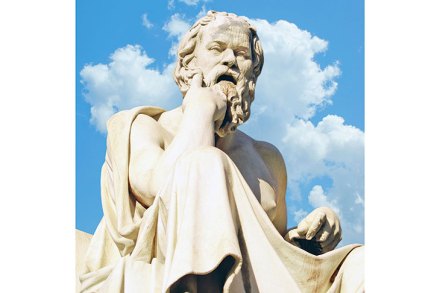
If western philosophy is no more than ‘footnotes to Plato’, so, arguably, is the myth of its founding hero, Socrates. While there is good evidence for certain aspects of Socrates’ life — his preoccupation with ethics, question-and-answer technique and his trial and death in 399 BC — most of it is shrouded in uncertainty. His only contemporary depictions are in a few satirical comedies by Aristophanes.

Ovid’s last laugh

From our UK edition

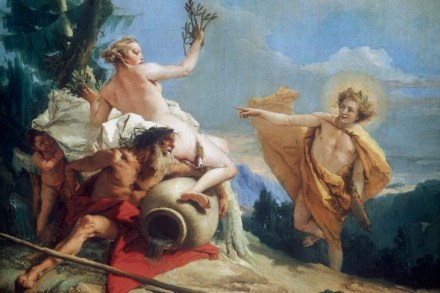
‘My spirit moves me to speak of forms changed into new bodies,’ proclaimed Ovid at the beginning of the Metamorphoses: a glorious compendium of classical mythology stretching from the creation of the universe to the Emperor Augustus. Metamorphica is a collection of 53 versions of classical myths as told by Ovid, Homer and the Greek tragedians (Mason’s first novel was The Lost Books of the Odyssey). They are inspired less by Ovid’s content than by his technique of ‘moving lightly through the ancient sources, taking up what he liked and reinventing it’. Metamorphica takes the bare premise of an ancient myth as the starting point from which to create a modern one with a wholly different focus.

Not dead – yet

From our UK edition

It was a dark afternoon in November, and the wind was rattling the casements of the bare schoolroom. My small but enthusiastic class of Greek students nibbled chocolate biscuits and listened politely as I ploughed through yet another list of irregular verbs. Suddenly, standing by the electronic whiteboard, I had a sort of minor epiphany (Epiphany: from the Greek term for a god’s manifestation to undeserving mortals). Why, I asked myself, were these bright teenagers devoting so much time to studying a difficult language which they would never be able to use to communicate, whose native speakers died two millennia ago, and in which it would take years to reach fluency? Twenty years ago, when I was learning Greek and Latin, this question would never have occurred to me.