Omicron

Should we worry about the BA.2 Omicron variant?

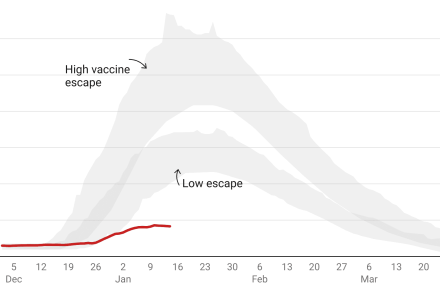
When the Omicron variant (now categorised as BA.1) swept across the world at the end of last year it was seen by optimists as the final chapter in the Covid story – it was so contagious it would infect essentially anyone, but would be far less likely to cause serious illness. Now a new wave of Omicron – the BA.2 variant – is becoming dominant in many parts of the world. In the UK, cases are again on the rise. Genomic surveys show that BA.2 made up 76 per cent of new cases in England as of 5 March. The below is from the Sanger Institute: So what's going on? Firstly, both the BA.1 and BA.2 variants do not have an intrinsically much higher growth rate than any previous variant. Instead, they have spread globally for two main reasons.

On Sage’s Covid models

In the confusion that has arisen from the demonstrable inability of a certain type of mathematical model to predict the time course of the SARS-CoV-2 pandemic, many have taken to reciting – with a variable mixture of glee and sympathy – that ‘all models are wrong but some are useful’. I have never been comfortable with this statement (it doesn’t really deserve to be called an aphorism) and even less so the smugness with which it is typically pronounced. One might as well say all metaphors are wrong but some are useful. ‘Wrong’ seems to be employed here to suggest that ‘statistical or scientific models always fall short of the complexities of reality (but can still be useful nonetheless)’.

Why Denmark has called for the end of Covid restrictions

England has been described by some as an outlier in that the government is lifting Plan B restrictions in spite of Covid infections remaining high – daily numbers are still higher than at any point prior to the emergence of the Omicron variant. Some have even accused the Prime Minister of lifting the restrictions in order to divert attention from his political troubles. Yet Boris Johnson’s government is not alone. The Danish government, too, has announced that all remaining restrictions will be lifted on 1 February and Covid-19 will no longer be classified as a ‘socially critical disease’ in the country.

Returning to live gigs

From our US edition

Gigs. Remember them? They were awful. You’d get to some dump of avenue, in a bad part of town (if a small capacity) or out in some apocalyptic wasteland (if an enormo-dome). You’d arrive too early and have to try and dodge some mediocre support band (who’d bought their way on to the tour) or queue for seven hours for a beer in a plastic cup. If you dared to speak while some awful act was plodding away, some goody-goody would hold a finger up to their lips, glare and shoosh you. An hour and a half later in the back of the venue, you’d stand gratefully nearer to death’s beckoning cold hand. “Ever get the feeling you’ve been cheated?” Yes. When Covid rampaged through the world like a Viking raid of death-cult realtors, the world was suddenly shorn of live music.

gigs

Sage ‘scenarios’ vs actual: an update

Given that lockdown was very nearly ordered on the advice of Sage last month, it’s worth keeping an eye on the ‘scenarios’ it published, and how they compare to the situation today. Another week of data offers more food for thought. This week was the period when deaths were supposed to be peaking – so given that no extra restrictions were ordered, it’s interesting to compare the peak the models predicted for this week with what actually happened. Deaths were said by Sage to peak at anything from 600 to 6,000 a day (the latter figure, predictably, hogged the headlines).

Omicron is on its way out

Omicron peaked in England in early January, according to figures just released by the ONS. The estimates from the weekly infection survey show that cases in the UK peaked at around four million before falling. In the week ending 15 January, 1 in 20 had Covid in England, Scotland and Northern Ireland, and 1 in 25 in Wales. We shouldn't be surprised by this We shouldn't be surprised by this — this is how Omicron seems to go world over. As in Gauteng, as in South Africa, as in Lambeth, as in London and now in the UK: it falls almost as fast as it rises. Quite simply, the variant is so infectious that it quickly reaches levels of prevalence that are unsustainable because so many people have been vaccinated, infected and become immune.

The evidence is in: remote learning doesn’t work

From our US edition

As the omicron wave crests and public schools face teacher sickouts, strikes, and a rash of student absences, it is worth reviewing some basic facts about the pandemic and public education. The results of last year's experiment in remote learning have confirmed what any minimally competent teacher could have told you from the outset: instructing students online yields disastrous consequences. Indeed, the results are so bad that defenders of a maximally cautious approach can only argue about terminology (please don’t say “learning loss!”) while proposing that we shouldn’t actually measure how far students fell behind under lockdown. Meanwhile, the psychological costs of the pandemic era continue to mount.

zoom

Sage scenarios vs actual: an update

‘Deaths could hit 6,000 a day,’ reported the newspapers on 17 December. A day later documents for the 99th meeting of Sage were released which said that, without restrictions over and above ‘Plan B’, deaths would range from 600 to 6,000 a day. A summary of Sage advice, prepared for the Cabinet, gave three models of what could happen next: Do nothing (ie, stick with 'Plan B') and face "a minimum peak" of 3,000 hospitalisations a day and 600 to 6,000 deaths a dayImplement ‘Stage 2’ restrictions (household bubbles, etc) and cut daily deaths to a lower range: 500 to 3,000.

My Omicron hell

Gstaad   It is hard to imagine that we have reached the year 2022 and are still imposing completely irrelevant restrictions on each other. By we I mean those of us in the supposedly enlightened West, where silliness, jealousy, cruelty and woke rule the roost. I’ll begin with the Chinese virus that has contrived to dominate the headlines even more than Boris and Meghan put together. I got it following my Christmas party, which was a great success if one is to believe some of the thank-you notes I received. All I can say is that it’s not true that chastity is sexually alluring. If it were, women would go for newly ordained priests who take their vows seriously, rather than elderly swine.

Boris Johnson rejects lockdown (again)

Boris Johnson latest Covid press conference was slightly confusing. The Prime Minister spent nearly an hour saying nothing particularly new. He warned that there was ‘considerable pressure’ on the NHS at the moment and unveiled daily priority lateral flow testing for 100,000 essential workers so that key services, including healthcare, don’t seize up due to staff absences. But while he accepted that hospitals were feeling the heat, he also insisted that there was no data suggesting that a lockdown was necessary or helpful. Indeed, he argued:  ‘We have a chance to ride out this Omicron wave without shutting down our country once again. We can keep our schools and our businesses open, and we can find a way to live with this virus.

Boris’s plan to test key workers daily

The Prime Minister is attempting to lessen the threat posed by Omicron to essential services by requiring around 100,000 workers in specified industries to take daily Covid tests. In order to keep the lights on, maintain the supply of food and keep aeroplanes flying, these workers will have to test five days a week —  so that infections are caught as early as possible, to minimise spread of the virus to colleagues. A government source said the requirement to test daily would apply to those in civil, nuclear and other power generation, air traffic control, meat processing and food supply chains.

Is Boris feeling lucky?

The political and economic new year is all about surging Covid and a surging cost of living. The list of what families in particular will contend with in the coming weeks is enough to induce tears of exasperation. Take schools for starters. Staff absences, largely caused by coronavirus, were 8 per cent at the end of last term. On the Department for Education's own projections, the Omicron surge means these absences will rise to between 9 per cent and 13 per cent at the beginning of this term, and it is not inconceivable the upward path in absences will peak at between 20 per cent and 25 per cent. The Education Secretary, Nadhim Zahawi, is determined schools should remain open.

Does Warwick’s Omicron modelling make restrictions more likely?

Two weeks ago, the London School of Hygiene and Tropical Medicine (LSHTM) and Imperial College both published modelling showing frightening scenarios if the government did not react to the Omicron variant by imposing immediate restrictions on our day to day lives. The former suggested that hospitalisations could peak at 7,190 a day in January in its most pessimistic scenario; the latter was reported as suggesting that deaths might peak at 5,000 a day in January. Both figures, however, were made on the assumption that Omicron was every bit as virulent as the Delta variant. Since then, several UK studies have suggested that this is not the case, with data showing it is between 20 per cent and two thirds less likely to land us in hospital.

Farewell to 2021, 2020’s dull hangover

From our US edition

The thing about an annus horribilis is that eventually it's supposed to end. Yet this has not been the case with 2020, which incidentally, according to the Chinese calendar, was a Year of the Rat, proving that the universe can be just a bit too literal sometimes. Dashed were the hopes that 2021 would be a fresh start, that the endless problems of 2020 would dissolve into the ether like so much smoke at a mostly peaceful protest. Instead this year began like it was going to be even more 2020 than 2020 was. Six days into 2021 and we'd already suffered an event so jarring that it's now denoted by just a date.

Sage modellers start to accept that Omicron is milder

Public health officials in Britain and South Africa were on different planets for about a fortnight. While those in South Africa kept presenting data suggesting that Omicron caused less severe disease than earlier variants, scientists in Britain continued to claim it was too early to say. Scenarios published by the London School of Hygiene and Tropical Medicine (LSHTM) last week pictured a frightening picture of January, suggesting that hospitalisations could peak above previous waves. An assumption was made that Omicron was just as likely to land you in hospital or kill you compared with Delta. As LSHTM admitted, quite a big assumption:- Due to a lack of data, we assume Omicron has the same severity as Delta.

Sage memo makes the case for lockdown

On Monday, Covid restrictions were rejected after the cabinet debated the issue robustly for the first time since the pandemic started. The Prime Minister said he’d revisit the decision, so the debate is very much still ongoing. But it wasn’t just ministers meeting that day. Sage assembled its experts as well, with over 70 scientists and government officials in attendance. The minutes, seen by The Spectator, give an interesting summary of the official case for more lockdown restrictions. Everyone is wrestling with two questions; if there are no more restrictions, how far will Omicron case numbers rise? And how will that translate into hospitalisations? If there is reason to believe that the NHS will be overwhelmed, this makes the case for more restrictions now.

It’s time to end the era of forced lockdown restrictions

Monday’s Cabinet meeting held over Zoom was a fraught affair by the sounds of it. Michael Gove and Sajid Javid were reportedly the leading voices calling for more restrictions on household mixing and on the hospitality sector, while the likes of Rishi Sunak and Liz Truss argued that the data did not warrant such a draconian and retrograde step. The Prime Minister seems to have been swaying somewhere in the middle. In the end it was agreed that no new restrictions would be imposed that day but the data would be constantly analysed with a view to imposing restrictions swiftly and before Christmas if alarming trends were picked up on the burden Omicron was placing on the NHS.

Is Omicron now falling in South Africa?

Man makes Covid predictions and God laughs. Yet with the stakes this high in Britain, every bit of real-world data is useful. That’s why South Africa is so important: it’s a country with a well-digitised healthcare sector that we have to thank for sequencing the Omicron variant, and has been first to experience the impact. That’s why its figures, released daily, are being watched so eagerly world over. Right now, there are two questions: is Omicron now falling? And if so, what conclusions can we draw? The epicentre is Gauteng province: home to Johannesburg, Pretoria and about a quarter of South Africans.

sports

Pro sports can lead us out of pandemic insanity

From our US edition

With the emergence of the Omicron variant, a new Covid panic has swept through the country, driven by twin forces: the New York and DC-based national media, and professional sports leagues. The National Hockey League suspended games through December 26 and all cross-border games until December 23. The National Football League scrambled to reschedule games based on over 150 players entering Covid protocols. Games were suspended, regardless of player vaccination status. The NHL touts an almost 99 percent vaccination rate. When the National Basketball Association suspended games and vaccinated Brooklyn Nets players went into the Covid protocol, they invited star player and anti-vaccination spokes-star Kyrie Irving back to the team.

Five lockdown questions the cabinet must ask

The cabinet will meet this afternoon, with more restrictions and even a new lockdown on the agenda. But have ministers been given the information they need to make an informed decision? There are rumours of briefing documents being sent around over the weekend with a pro-lockdown bias (i.e., heavy on the worst-case scenarios and not much said about potential side-effects). But the Times today reports that this time around the cabinet wants a full discussion — with at least ten ministers demanding a better quality of briefing before decisions are made that affect the lives of millions. The below is a list of questions that ministers need answered: 1. What is Sage’s central scenario for Omicron — and what assumptions lie behind it?