Novel

Something happens to everyone

From our UK edition

Towards the end of Cressida Connolly’s novel, one of the characters says of another, ‘I dare say she didn’t see her life as completely uneventful. Something happens to everyone.’ You could, I suppose, argue that not a huge amount happens to anyone in My Former Heart — there are no multiple pile-ups, cyborg invasions or satanic rituals. But what there is is something infinitely more rewarding: a succession of relationships analysed and orchestrated by a writer who seems able to peer directly into the human heart, to understand its follies and strivings, and to write about them with such sparkling originality that it makes you see the world afresh.

Infuriating brilliance

From our UK edition

A.L. Kennedy is a very remarkable writer. And her new novel — the first since Day won the Costa prize in 2007 — is a remarkable book. What is really extraordinary about it is that at one level it is a pretty trite love story with dark secrets to be revealed and lots of reflection on truth and lies and how the past lingers on and affects the present — bog-standard stuff. The basic set-up is somewhat improbable, and (as always with Kennedy) somewhat elliptical, even evasive. Elizabeth, the protagonist, is crossing the Atlantic on a cruise ship with her boyfriend who may or may not be planning to marry her.

Golden corn

From our UK edition

Sebastian Barry’s novels, I’m beginning to think, are a bit like that famous illusion of the two faces and a vase. Most of the time you’re reading them, they seem to be wrenchingly powerful and heartfelt depictions of suffering and grief. Yet, it doesn’t take much of a squint for them suddenly to look like the purest Irish corn. When his last novel The Secret Scripture won the Costa Book of the Year Award in 2008, even the judges suggested that it was badly spoiled by a melodramatic twist at the end. The public, who bought it in their hundreds of thousands, clearly didn’t agree — and neither, it appears, did Barry. On Canaan’s Side also comes complete with a big closing revelation that two of the characters are more connected than we thought.

A choice of first novels | 30 July 2011

From our UK edition

As L.P. Hartley noted, the past is a foreign country: they do things differently there. And no more so than during the two world wars, a fact that has provided a rich seam for several debut novelists to mine this summer. In Mark Douglas-Home’s puzzler The Sea Detective (Sandstone Press, £17.99), the tidal pull of a long-gone drama creates a psychological undertow for its hero Cal McGill. As the novel opens, Cal is on the run after covertly planting arctic flowers in Scottish ministers’ gardens as a subtle protest against the administration’s environmental policy. Cal is an oceanographer, skilled in the mapping of briny mysteries, logging sinister flotsam and jetsam through analysis of currents and shipping routes.

The revised version

From our UK edition

The narrator of Julian Barnes’s novella has failed disastrously to understand his first love. David Sexton admires this skilful story, but finds something missing Julian Barnes once said that the only time he had ever threatened to throw a guest out of his house was not because the churl had disparaged his food or insulted his wife but because he had disputed the greatness of Ford Madox Ford’s novel The Good Soldier.

Recent crime fiction | 23 July 2011

From our UK edition

John Lawton’s Inspector Troy series constantly surprises. John Lawton’s Inspector Troy series constantly surprises. A Lily of the Field (Grove Press, £16.99), the seventh novel, has a plot stretching from Austria in 1934 to Wormwood Scrubs in 1949, via Los Alamos and Paris. Fiction rubs shoulders with fact. There are big themes — including the Holocaust, the atomic bomb and Cold War espionage — but they are linked to individual lives, beautifully and economically described. Meret is a cellist whom we meet as a schoolgirl in prewar Vienna, and her career provides the thread that binds together the various strands of the novel. Like all the characters, she is caught up in a world changing beyond recognition; and, as their world changes, so do they.

The man who came to dinner

From our UK edition

Each year Genevieve Lee holds an ‘alternative’ dinner party, to which she invites, along with her friends, a couple of people she wouldn’t ordinarily mix with — a Muslim, say, or homosexual. Each year Genevieve Lee holds an ‘alternative’ dinner party, to which she invites, along with her friends, a couple of people she wouldn’t ordinarily mix with — a Muslim, say, or homosexual. At her latest party a guest named Miles, whom she’s never met before, locks himself in the spare room, and refuses come out. In the first of the novel’s four sections, Genevieve contacts Anna, who had met Miles during a holiday in 1980, hoping that a familiar voice will persuade him to leave, but it does not.

Golden lads and girls | 2 July 2011

From our UK edition

Sam Leith tracks the careers of Alan Hollinghurst’s captivating new characters through youthful exuberance to old age, dust and a literary afterlife It’s quite hard to know where to begin, reviewing The Stranger’s Child. As I finished it, and was heard making bloody-hell-this-is-good noises, two people asked me: ‘What’s it about?’ That, as it turns out, is a very good question. Ostensibly, it’s about a fictional poet called Cecil Valance, a diffusion-line Rupert Brooke described years after his death in the first world war as ‘a first-rate example of the second-rate poet who enters into common consciousness more deeply than many greater masters’.

Chinese whispers

From our UK edition

River of Smoke begins with the storm that struck the convict ship the Ibis at the end of Amitav Ghosh’s 2008 Man Booker-shortlisted Sea of Poppies. River of Smoke begins with the storm that struck the convict ship the Ibis at the end of Amitav Ghosh’s 2008 Man Booker-shortlisted Sea of Poppies. Redruth, the vessel of a Cornish plant-hunter, Frederick ‘Fitcher’ Penrose, sails in to Port Louis, Mauritius, two days after the Ibis, while the Anahita, belonging to Bahram Modi, a Bombay opium merchant, encounters the same storm on the other side of the Indian Ocean. Counting the cost of their voyages, characters from all three ships make their way to the Chinese port of Canton.

Mumbai and Mammon

From our UK edition

This is a state of the nation novel or more accurately a state of Mumbai novel. Behind the tale of a struggle by a developer to acquire, for flashy redevelopment,  the three towers of the lower-middle-class, crumbling Vishram Co-operative Housing Society, lies a colourful and ambitious novel about the changing standards and habits of the citizens of Mumbai, poisoned as much by the rocketing wealth all around, as by the foul air and excrement-laden byways. (Adiga mentions shit and its stench time and again.) On the one side of the divide is a group of friends and neighbours who live in Tower A of the Society. The most respected of them is Masterji — Yogesh A. Murthy — a retired and recently widowed schoolmaster.

When more is less

From our UK edition

If you know anything at all about Cynthia Ozick — an officially accredited grande dame in America, less famous in Britain — you won’t be surprised to hear that her new novel is influenced by Henry James. If you know anything at all about Cynthia Ozick — an officially accredited grande dame in America, less famous in Britain — you won’t be surprised to hear that her new novel is influenced by Henry James. Throughout Ozick’s career, James has hovered over her fiction and featured heavily in her essays. Now, in Foreign Bodies, she goes for, among other things, a full-scale recasting of The Ambassadors.

Bookends: When will there be good news?

From our UK edition

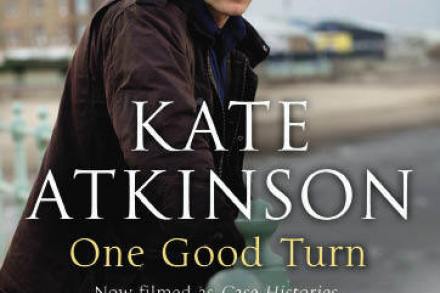
I am in love with Jackson Brodie. Does this mean that, in a literary homoerotic twist, I am actually in love with Kate Atkinson, his creator? I think it must. Sometimes I think I am Jackson Brodie. We share many traits: 50-odd, mid-life crisis, a lost (though in my case not murdered) sister. I know that it’s really Kate Atkinson who is Jackson Brodie. She must have a lost or murdered sister, mustn’t she?   I am in love with Jackson Brodie. Does this mean that, in a literary homoerotic twist, I am actually in love with Kate Atkinson, his creator? I think it must. Sometimes I think I am Jackson Brodie. We share many traits: 50-odd, mid-life crisis, a lost (though in my case not murdered) sister. I know that it’s really Kate Atkinson who is Jackson Brodie.

Those who die like cattle

From our UK edition

An ex-farmer whose brother has died fighting in Iraq is the man at the centre of Graham Swift’s new book, a state-of-the-nation novel on a small canvas. An ex-farmer whose brother has died fighting in Iraq is the man at the centre of Graham Swift’s new book, a state-of-the-nation novel on a small canvas. Jack runs a caravan park on the Isle of Wight, having sold his centuries-old Devon farm to a banker in need of a bolt-hole. His parents are dead, and more than a decade has passed since he’s last been in touch with Tom, nine years his junior. Now Tom’s gone too, blown up by an IED, and Jack’s preparing to return to Devon for the funeral; it’s the first time he’ll have been back since selling up.

Pearls before swine

From our UK edition

The story of Harry the Valet is the stuff of fiction. He was a dazzlingly adept, smooth, glamorous jewel thief, who never stooped to petty crime but carried off the kind of robberies more commonly found in novels and films: huge ruby necklaces, diamonds and pearls all poured out, pirate-treasure fashion, into his waiting hands. The Valet was the son of a successful lower-middle-class tradesman, a picture-framer, who died when he was a young man, leaving his widow to carry on his business, unsuccessfully. Harry meanwhile bet on horses, drank and smoked and revelled in bad company, soon finding himself with no money and no profession. He took the easy way out, deciding to steal a living, rather than earn one.

We are the past

From our UK edition

Julie Myerson’s eighth novel is told by a woman who roams the City of London after an unspecified apocalypse (no power, bad weather). Julie Myerson’s eighth novel is told by a woman who roams the City of London after an unspecified apocalypse (no power, bad weather). The Monument is rubble, Tower Bridge has ‘long gone’ and scavengers are chopping fingers off frozen bodies to snatch rings. Our narrator can’t remember much — two thirds of the book pass before we find out her name is Izzy — but a couple of randy fellow vagrants claim to know her, and some children say she’s their mum. By the time one of them ‘lifts off the ground and comes flying through the air’ — and vanishes — we’re not sure what to believe.

Victorian rough and tumble

From our UK edition

Derby Day is meticulously plotted and written with bouncy confidence. It tells the story of a sordid, conniving rascal called Happerton who plots a betting swindle for a Derby of the 1860s. He marries the colourless but near-sociopathic daughter of a rich attorney, and cheats on her without noticing the intensity of her passion for him. The couple sedate the old man, reduce him to his dotage and raid his savings. Happerton also masterminds a raid on the strong-room of a City jewellers — echoes here of the jewellery raid in Taylor’s previous novel, At the Chime of a City Clock.

The way to dusty death

From our UK edition

Beryl Bainbridge’s last novel is a haunting echo of her own final years, according to A. N. Wilson Some writers die years before bodily demise. They lose their grip. In the last five or six years of life, Beryl Bainbridge feared that this was happening, or had happened, to her. The books which had come in a steady flow from middle age onwards slowed to a trickle, and she was seized, not merely by illness, but by a black sense that the ‘bloody book’ on which she was engaged would not come. Yet her last book, all but completed, suggests something odder was happening in her case. A prescient friend had a theory, during those years in which Bainbridge struggled to write The Girl in the Polka Dot Dress.

Freudian slip

From our UK edition

At Last is the fifth — and, it’s pretty safe to say, most eagerly awaited — of Edward St Aubyn’s Patrick Melrose novels. At Last is the fifth — and, it’s pretty safe to say, most eagerly awaited — of Edward St Aubyn’s Patrick Melrose novels. The first three, now called the Some Hope trilogy, took Patrick from an upper-class childhood where he was raped by his father from the age of five, through his understandably drug-addicted youth and on to the nervous beginnings of recovery at 30. Somehow, though, the result was a joy to read: full of dazzling phrase-making, terrific black comedy and stirringly vicious satire on the ghastly inhabitants of Patrick’s privileged world.

Doomed to disillusion

From our UK edition

The Forgotten Waltz is one of those densely recapitulative novels that seek to interpret emotional crack-up from the angle of its ground-down aftermath. At the same time, it is not really a book about hindsight. Sometimes extending information to the reader and sometimes deliberately covering its tracks, sometimes inviting sympathy for its characters and sometimes implying that sympathy only gets in the way of knowledge, it offers the enticing spectacle of a heroine determined to decode the human acrostics that strew her path while darkly conscious that most of her judgments are either horribly provisional or downright inchoate.

In search of a character

From our UK edition

A chronicle of three young actors desperate to forge careers in the acting profession sounds like a dangerously familiar proposition. We are all now habituated to the weekly Saturday evening drama of wide- eyed dreamers drilled, mauled, culled and reculled in search of a Nancy, Dorothy or Maria. In Lucky Break, however, Esther Freud redraws the path that leads from Television Centre direct to London’s glittering West End. These young hopefuls are plunged into the maelstrom of a three-year drama school programme that stretches and befuddles them in equal measure. There is a squirm- inducing accuracy to the students’ earnest endorsement of their training, hilariously realised in the principal and the quasi-mystical movement teacher.