Nicola sturgeon

Sturgeon’s main strength is her lack of real opposition

The SNP’s ability to defy political gravity — a poll conducted last month put them on 51 per cent in Holyrood voting intentions — is easier to understand when you consider the alternatives. Jackson Carlaw, unveiled on Friday as Ruth Davidson’s successor at the helm of the Scottish Tories, is a pleasant chap with a certain flair but unlikely to bring the House of Sturgeon to its knees. Scottish Labour is led by Richard Leonard, a man so anonymous there are members of the witness protection programme with better name recognition. Scots go to the polls next May for the Scottish Parliament election and the choice is between the least effective government of the devolution era and an opposition most voters aren’t aware exists.

Boris is failing a crucial One Nation test in Scotland

Yesterday, Nicola Sturgeon unveiled a proposal to devolve certain aspects of our post-Brexit immigration policy to Scotland. Well, you might say, she would say that, wouldn’t she? But Sturgeon’s argument has some merit, for Scotland has a demographic problem that is not shared by the rest of the United Kingdom. A few thousand Scotland-only visas issued each year has the potential, assuming they proved sufficiently attractive, to address that. This is not just an SNP ploy, either. There is a widespread acceptance in Scotland that the country needs to be able to do more to attract more immigrants. On current trends, immigration is likely to be essential for the population growth Scotland is likely to need.

Indyref2 could be the biggest headache of Boris’s premiership

Nicola Sturgeon is the only opposition leader who survived the general election. She has emerged far stronger. The Tories had hoped to halt the nationalists’ advance, but in the end, Scotland was the only part of the UK in which their party suffered serious setbacks. Sturgeon’s advancing army dethroned Liberal Democrat leader Jo Swinson, claimed seven of the 13 Scottish Tory seats and took 48 of Scotland’s 59 MPs. The First Minister’s message now is pretty clear: she is the only politician who can stand up to the Bullingdon boy, and the battle for the Union is back on. Within hours of the result, Sturgeon declared that the SNP surge ‘renews, reinforces and strengthens’ her case for another independence referendum.

Nicola Sturgeon’s threat of Indyref2 could save the Scottish Tories

In the village of Waterfoot on the outskirts of Glasgow, a lady in her thirties is explaining to her local Conservative MP, Paul Masterton, why he has her vote. It can’t exactly be described as complimentary. ‘We were talking about this the other night. Corbyn’s an absolute clown and Nicola’s just horrific so… I don’t want to say the best of a bad bunch…’ Masterton chips in before things get awkward: ‘Don’t worry. I’ve heard lots of phrases said on the door. “Best of a bad bunch” would be acceptable.’ His seat, East Renfrewshire, was a Scottish Tory stronghold before the party’s 1997 wipeout.

The real reason Nicola Sturgeon is campaigning against Brexit

Nicola Sturgeon, who claimed this week that ‘Scotland is rich enough, strong enough and big enough’ to take its place ‘among the proud, independent nations of the world’, is a slippery fish. She claims the case for Scottish independence will be strengthened by the UK’s departure from the European Union and yet she campaigned for Remain during the referendum and has done what she can to obstruct Brexit since. For instance, the 35 SNP MPs voted against Theresa May’s withdrawal bill three times. If they’d voted for it on the third occasion, it would have passed.

Nicola Sturgeon’s Brexit bounce

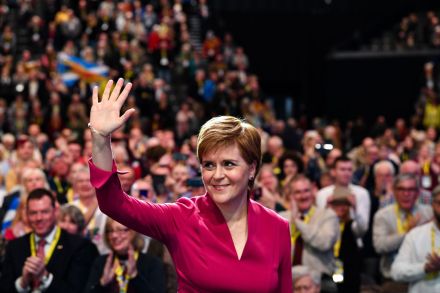
There was a fairytale quality to Nicola Sturgeon’s speech to the SNP conference this afternoon. On the one hand, she demanded a second referendum on independence next year; on the other, almost no-one in Scottish politics really believes there will be a referendum next year. In tandem with this rallying call for national liberation – an emancipation made ever more urgent by the looming Brexit fiasco – there ran another line of argument: conference delegates, like the wider nationalist movement, must be careful and canny and patient. Which is another way of saying that, whatever the headlines suggest, it’s probably not happening. At least not yet.

Nicola Sturgeon’s dismal failure to stand up to China

Nicola Sturgeon fancies herself as something of an international stateswoman, jetting off to the United States to boost her profile and touring the capitals of Europe in search of allies against Brexit. She is fond, too, of tweeting her commentary on global affairs, in the hope that others may learn from her example so that, one day, they too can lead a country with a £12.6bn deficit that can’t teach its children how to read. A network of de facto embassies has been steadily assembled, nominally to promote trade ties (which the UK Government already does) but in reality to promote Scotland externally as a separate state.

Nicola Sturgeon is taking Scottish nationalists for a ride

There’s an episode of Father Ted in which the simple but endearing Father Dougal gets stuck on a milk float booby-trapped with a bomb. The finest clerical minds in Craggy Island convene to devise a solution and as they discount each increasingly far-fetched fix, the well-meaning Father Beeching pipes up: ‘Is there anything to be said for another Mass?’. Nicola Sturgeon evidently studied at the Beeching Seminary for Crisis Management. Every time there’s an SNP conference looming, her advisors agonise over how to string along the Yes faithful a little longer, until the boss sighs: ‘Is there anything to be said for another Indyref 2 statement?

Nicola Sturgeon’s play for time

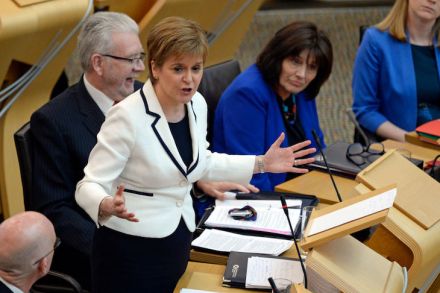
Nicola Sturgeon is a reader and, to judge by the statement she has just made to the Scottish parliament on the implications of Brexit for Scotland’s future, the book she’s been reading lately is ‘The Gentle Art of Letting People Down Gently’. The people being, in this instance, the SNP members preparing to attend the party’s conference in Edinburgh this weekend. Of course many headlines will focus on her suggestion that Scotland should, given the wreckage of Brexit and the manner in which Scotland still faces being withdrawn from the EU against its will, enjoy a new referendum on independence before the next Holyrood elections in 2021. That is a possibility that must always remain on the table. And it might happen yet.

Who does Nicola Sturgeon think she is?

It’s been a busy old week in Scottish politics. The SNP government is suffering a public backlash over plans to allow councils to levy a tax on workplace car parks. There has been a fatal infection outbreak at another hospital. MSPs are angry that the nationalists have installed one of their own as chair of the parliamentary inquiry into the government’s handling of the Alex Salmond affair. Best of all, the Scottish Government’s headquarters opened its first gender-neutral toilets.  Nicola Sturgeon, though, has missed it all. The First Minister is on a trade mission ‘promoting Scotland in North America’, according to the Scottish government. Scots have been settling Canada and the United States since the mid-17th century.

Why is Sturgeon rolling out the red carpet for Catalonia’s president?

Pity the flunky at Bute House, official residence of Nicola Sturgeon, whose job it is to get the red carpet ready for formal visits. The poor lad mustn’t know whether he’s coming or going. Two weeks ago, the First Minister said it wasn’t ‘appropriate at this time for the red carpet to be rolled out’ for Donald Trump. ‘Meetings are one thing, perhaps, but red carpet treatment is another,’ she added. McJeeves shouldn’t store away the crimson runner just yet though. Next Wednesday, Sturgeon will welcome to Bute House, Joaquim 'Quim' Torra, the publisher turned politician who was sworn in as Catalan president in May.  The Scottish Nationalists are dabblers in international solidarity. Palestine: free. Ireland: don’t bring that up.

The myth of the SNP’s Brexit ‘power grab’

Forgive me if I seem out of sorts but my country has been through a lot this past week. We have been subjected to 'provocation' and our imperial masters in Westminster intend to 'exert a kind of colonial authority' over us. Our parliament has been 'slighted' and we are bearing the 'impact of such condescension on the psyche'. The UK Government has sought to 'lessen the ability of the people of Scotland to govern their own affairs' and in doing so its 'contempt for Scotland was laid bare'.  The amen corner of the Scottish commentariat is once again standing up and bravely telling it like Nicola Sturgeon says it is. The SNP leader has decreed Scotland the victim of a 'power grab' and Westminster the destroyer of the devolution settlement.

Sunday shows round-up: Nicola Sturgeon, Keir Starmer, Ken Clarke, Dominic Raab

Keir Starmer - Tory Remainers should vote with us The week ahead promises a showdown in the House of Commons as the government's EU Withdrawal Bill will face several key votes which could decisively impact the future of Brexit. The votes come after the bill was substantially amended by the House of Lords back in April, with peers notably seeking to keep the UK in the EU's customs union and to give Parliament a 'meaningful say' on the final Brexit deal. Shadow Brexit Secretary Sir Keir Starmer joined Andrew Marr to discuss Labour's approach to the bill, with Marr highlighting that Labour was not seizing the opportunity to keep the UK in either the single market or the European Economic Area: https://youtu.be/E2nTJR66vSw AM: You've let the Prime Minister off the hook really, haven't you?

Scotland’s luvvies are coming unstuck over their bid for the Channel 4 HQ

Those who worry that Channel 4 has become risk-averse might be fretting needlessly. The broadcaster has shortlisted Glasgow as a location for its new headquarters. Currently, C4 has only 30 staff based outside London and hopes shifting its HQ to the regions, along with two other ‘hubs’, will help it better reflect that narrow slice of the country beyond SW1. In shortlisting Glasgow, Channel 4 has decided either that there will be no second independence referendum any time soon – which is bold – or that any such re-run would not be commercially disruptive – bolder still.

A Brexit ‘power grab’ could play into the SNP’s hands

The stramash between Theresa May’s government in London and Nicola Sturgeon’s ministry in Edinburgh over the need for the devolved parliaments to consent to the UK government’s EU withdrawal bill is, as the wags say, the world’s most boring constitutional crisis. So much so, indeed, that many voters in Scotland – to say nothing of elsewhere in the realm – remain splendidly indifferent to it.  The Scottish parliament yesterday refused to give its consent to the withdrawal bill. Legally, this changes little. Politically, it has the potential to change many things. Nicola Sturgeon, with the support of Labour, the Lib Dems and the Greens, says she is “protecting devolution” and standing up for the Scottish parliament.

Why has the SNP inflicted this video on us?

I don’t know where people get the idea the SNP is intolerant of criticism. Scotland’s most open-minded party has released a new video that appears to be an attack on one of its critics dressed up as a party political broadcast. The video depicts a group of thirtysomethings gathered for a house party. They are Scottish but improbably so, smiling excessively and expressing enthusiasm for life. A couple of latecomers are warned that ‘Davey’ is in the kitchen ‘bangin’ on about politics again’ and soon we are introduced to a cartoonish party bore. Stuffy, bespectacled Davey is the wrong side of 40 but sports a hipster-trad three-piece and Brooklyn-worthy beard in the hope of passing himself off as a millennial.

Brexit can strengthen the Union

There will be no chance of the United Kingdom making a success of Brexit if Scotland votes to break up the kingdom. And although the immediate danger of that happening appears to have passed — the Scottish National Party lost ground in the general election and Nicola Sturgeon doesn’t speak anywhere near as much about independence nowadays — this could change if Brexit is mishandled. When Britain leaves the EU then Scotland leaves too — those are the rules, and Spain, which is not too keen on the idea of secession, will insist upon them. So Brexit in itself will make Scottish independence an even bigger risk.

Sunday shows round-up: Scottish independence scotched (again)

Sturgeon - It is 'premature' to set a date for second independence referendum The SNP are rounding off this year's party conference season in Glasgow, and Scottish First Minister Nicola Sturgeon is eager to keep the dream of independence alive. Recent weeks have seen votes in Catalonia and Iraqi Kurdistan, but the chances are that any 'indyref2' in Scotland will take place later rather than sooner. ITV's Robert Peston asked Sturgeon about whether she had made a mistake in pushing for a second referendum so soon after the first: https://youtu.be/pGDnv3GiADs RP: There are some in your party who do believe that one of the reasons you did rather badly or worse than many people expected in the last general election is that you pushed too hard for an early vote.

Brexit poses fresh problems for Welsh devolution

Twenty years ago Wales (barely) said Yes to devolution. Despite a Welsh Assembly being supported by the wildly popular new Prime Minister Blair and opposed by the very unpopular Conservatives, the public gave the most grudging endorsement to partial self-rule. A lot of water has flowed under many Welsh bridges since then. Public opposition to devolution fell away surprisingly quickly after 1997; the latest evidence, which I will be presenting in Cardiff on Monday, confirms that a clear majority in Wales now support devolution. There is little political opposition either. The Conservatives swiftly accepted the referendum result; since returning to power at Westminster they have overseen two Wales Acts transferring additional responsibilities to the National Assembly.

Nicola Sturgeon’s Third Way

Nicola Sturgeon is invariably at her most persuasive best when she puts partisanship to one side and emphasises that, in addition to leading the Scottish National Party, she is also first minister of Scotland. Occasions such as yesterday, when she outlined her programme for government, give her that opportunity to shine. In place of boastfulness, there was modesty; in place of gurning about what she could not do, there was a refreshing emphasis on what she could. It was a speech tacitly admitting the truth of admissions made by former SNP ministers that during the referendum years the party allowed itself to be distracted by independence at the expense of ambitious government on the domestic front.