Nicola sturgeon

What’s the point of the SNP?

Well, golly, Nicola Sturgeon, leader of the SNP and First Minister of Scotland, says this general election has nothing to do with the arguments for or against Scottish independence.  In one sense, this is correct in as much as independence is not the question on the ballot. But in another, deeper, more genuine sense, everyone knows Sturgeon is pulling your leg here. The election is a proxy referendum on the question of whether there should, at some point in the next couple of years, be another independence referendum. Everyone in Scotland, including SNP supporters, knows this. Even so, as the Tories have noted, this is a familiar SNP argument.

There is something grubby about Theresa May’s snap election

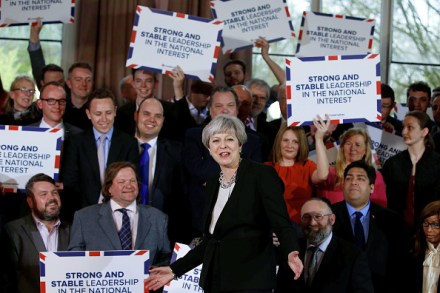
Since I suggested last July that Theresa May, newly anointed as leader of the Conservative and Unionist party and Prime Minister of the United Kingdom of Great Britain and Northern Ireland, should call an election to both establish her own legitimacy and allow the country an argument over the kind of Brexit it preferred, it would be unseemly to now deplore her belated decision to go to the country.  Happily, there remain many other things that may be deplored. Far from the least of these is the manner in which the Prime Minister has made her case for an election. It’s not her fault, you see, that she has (correctly, in my view) gone back on her word. She remains a pretty straight kinda gal, you know.

Nicola Sturgeon’s election response: full text

Nicola Sturgeon says that Theresa May has called an early general election in order to 'force through a hard Brexit'. The Scottish First Minister also accused the Prime Minister of attempting to 'to move the UK to the right'. Here's Sturgeon's full statement on a snap election: This announcement is one of the most extraordinary U-turns in recent political history, and it shows that Theresa May is once again putting the interests of her party ahead of those of the country She is clearly betting that the Tories can win a bigger majority in England given the utter disarray in the Labour Party.

The joys of Brexit

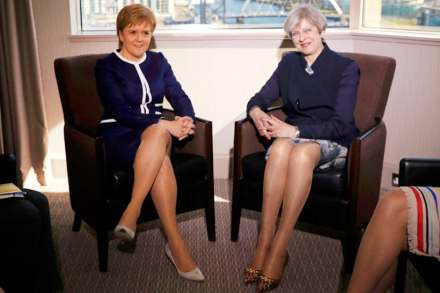
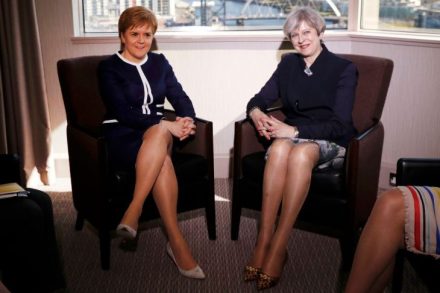
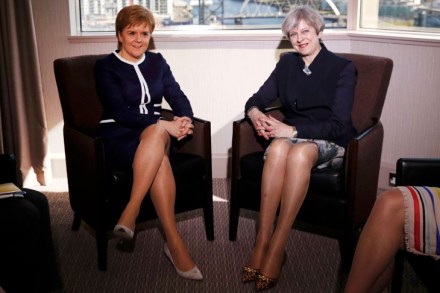
The thing that got me about the photo-graph which prompted the Daily Mail’s harmless but now infamous headline ‘Never mind Brexit — who won Legs-it!’ was what I shall call the Sturgeon Lower Limb Mystery. In the photograph, the SNP leader seemed to be possessed of two slender and very long legs indeed. Whereas we know from television news footage that her legs are only seven inches long from her toes to that bit where they join the rest of her body. Walking to Downing Street for meetings, or being interviewed on the hoof by camera crews, Nicola Sturgeon usually resembles a slightly deranged Oompa--Loompa, or, as many have commented before, Janette Krankie.

Let’s compare Sturgeon and May’s sure-footedness – not their legs

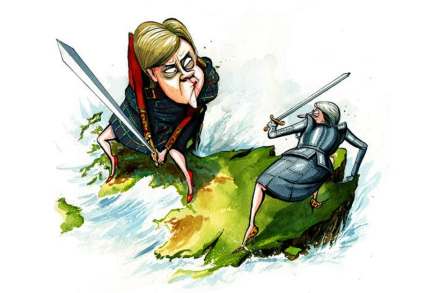
One must not make odious comparisons between Mrs May’s legs and those of Ms Sturgeon, but it is not sexist to ask which is the more sure-footed. So far, Ms Sturgeon has run much the faster, and by doing so has gained attention far in excess of the numbers she can command. Mrs May might look the more plodding. But as Ms Sturgeon charges forward yet again with a call for another referendum, I wonder if she is becoming like Bonnie Prince Charlie, who reached Derby, and then slipped.

Moving on | 30 March 2017

Most people are glad to see the end of a referendum campaign, but the losing side always wants to keep going. Nicola Sturgeon has this week demanded a second vote on independence, in defiance of public opinion. And as Brexit talks begin, the country is still divided, with many people wishing to see the negotiations break down and the referendum result be overturned. The Prime Minister will need to fight these two battles in different ways. In Scotland, she must take care not to fall into the nationalists’ traps. Ms Sturgeon ran for office promising not to call a second referendum unless it was ‘clear’ that a ‘majority of people wanted a referendum’. At the time, the SNP expected support for independence to rise.

Brexit brings us endless little beakers of joy

The thing that got me about the photo-graph which prompted the Daily Mail’s harmless but now infamous headline ‘Never mind Brexit — who won Legs-it!’ was what I shall call the Sturgeon Lower Limb Mystery. In the photograph, the SNP leader seemed to be possessed of two slender and very long legs indeed. Whereas we know from television news footage that her legs are only seven inches long from her toes to that bit where they join the rest of her body. Walking to Downing Street for meetings, or being interviewed on the hoof by camera crews, Nicola Sturgeon usually resembles a slightly deranged Oompa--Loompa, or, as many have commented before, Janette Krankie.

The golden rule for Daily Mail hysteria

Here’s a cast-iron law of the media in 21st-century Britain: the hysteria about a Daily Mail article will always be worse than the Daily Mail article itself. It will be more silly, shrill, over-the-top, reactionary and potentially harmful to public life than the polemic or editorial or sidebar shot of a half-dressed celeb it is raging and spluttering against. You can hold me to this. Go through the archives of Twitterstorms about the Daily Mail — they number in the gazillions — and you will see it’s the same every time: every bad thing the Mail has said or done has paled into insignificance in comparison with the hot, mad 24-hour fury of the Twits it has generated. Consider ‘Legs-it’.

Who has the better mandate: Theresa May or Nicola Sturgeon?

For the last week, the Unionist opposition at the Scottish parliament has enjoyed observing that the Scottish government is happy to ignore non-binding votes at Holyrood when it suits them to do so but now expects the UK government to be bound by today's vote authorising the Scottish government to seek a Section 30 order that would begin the process by which a lawful second referendum on independence can be held. It is a neat line but an insufficient one, not least since this vote - unlike some of those on which the SNP government has been defeated - actually recommends a particular course of action that the government should follow.

The Daily Mail is pulling your leg

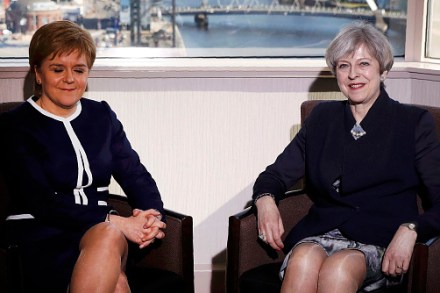
The top half of the front cover of the Daily Mail today is of course trivial: the big story of the meeting between Theresa May and Nicola Sturgeon is, obviously, the plummeting relations between Westminster and Holyrood and whether we will still have a United Kingdom in five years’ time. The big story is not the quality of two middle-aged women's legs. But it is also really rather brilliant in how it has worked as a bait for the Left – which by reacting in an absurdly overblown way has merely revealed its own obsession with trivia.

How Unionists are preparing for a second Scottish referendum

This afternoon Scottish Parliament will vote on Nicola Sturgeon's call for a second independence referendum. With MSPs expected to vote in favour of the motion, Theresa May's line that 'now is not the time' for a referendum looks set to come under increased pressure. 'IndyRef2' could still be pushed back as far as 2020/21 but behind the scenes Unionists are beginning to make preparations for a second vote. So, what would -- and what should -- a cross-party campaign look like this time around? Two years prior to the 2014 referendum, Better Together was established with the support of the three main unionist political parties in Scotland: Scottish Labour, the Scottish Conservative Party, and the Scottish Liberal Democrats.

Theresa May’s Brexit speech in Scotland, full transcript

It is very good to be with you here with you today, and particularly to be able to thank you all for the work you do on behalf of the Government and on behalf of the British people. Vital work that helps millions around the world and speaks strongly to the values that we share as a country. And it is vital work. Not just because the things you do here have a material impact on the lives of some of the poorest and most vulnerable people around the world. But also because the work you do here – in conjunction with your colleagues at the Department for International Development in London – says something important about Britain. It says that we are a kind and generous country.

Why is Nicola Sturgeon so cagey about Scotland’s EU future?

It's important to keep an ear out for the rhetoric of Britain’s remaining Remain parties, because they are changing, too. Having announced plans for a second Scottish referendum entirely because of Brexit, Nicola Sturgeon is now incredibly cagey about whether her independent nation would even be part of the EU, or perhaps more like Norway. The same is true of the Lib Dems. Last weekend, Tim Farron managed to give a whole speech to his party’s spring conference railing against only a ‘hard Brexit’ and thus never quite saying whether a Lib Dem government (humour me) would leave the EU or not. These people need to get off the fence. Mind you, so do I.

Sunday political interviews round-up

Tim Farron's fearsome foursome: May, Le Pen, Trump, Putin What can Tim Farron, leader of the Liberal Democrats, do to get attention? He had an idea  for the party's conference in York today: suggest that the world is in the grip of a fearsome foursome: Donald Trump, Vladimir Putin, Marine Le Pen... and Theresa May. He claimed that have the same traits in common: being "aggressive, nationalistic, anti-Nato, anti-EU. It is the post-war internationalist consensus unravelling in real time. Winston Churchill's vision for a world that achieves peace through trade, common values and shared endeavour evaporating before our eyes." Clegg: Bring on the election.

The Spectator’s Notes | 16 March 2017

The great achievement of the Scottish Nationalists is to persuade people outside the borders of their own nation — including the London-based media — to equate them with the Scottish people. Obviously, they are their chief elected representatives just now, but the result of the referendum on Scottish independence quite clearly showed that the equation is false. So when Nicola Sturgeon says there has to be another referendum because of Brexit, the equation should be much more firmly challenged. There is no moral reason why the result of a declaredly UK-wide referendum should require another vote in part of the kingdom (next, UDI for London?). Nor is there a constitutional right.

The Spectator podcast: Double trouble

On this week's edition of The Spectator Podcast, we discuss Theresa May's double bind in Edinburgh and Brussels, Milton's cultural relevance in 2017, and the slaughter of Cypriot songbirds. First, Lara Prendergast spoke to James Forsyth about his cover piece in this week's magazine. Have Theresa May's negotations with the European Union been hamstrung by this latest intervention from Holyrood? And will she be able to find a version of Brexit that soothes the fears of pro-Remain Scots? Time will, of course, tell, but in the meantime James joins the podcast along with the Spectator's Scotland Editor, Alex Massie. As James writes in his piece this week: "Theresa May is a cautious politician.

Sturgeon’s great trick has been to convince us the SNP represent all Scots

The great achievement of the Scottish Nationalists is to persuade people outside the borders of their own nation — including the London-based media — to equate them with the Scottish people. Obviously, they are their chief elected representatives just now, but the result of the referendum on Scottish independence quite clearly showed that the equation is false. So when Nicola Sturgeon says there has to be another referendum because of Brexit, the equation should be much more firmly challenged. There is no moral reason why the result of a declaredly UK-wide referendum should require another vote in part of the kingdom (next, UDI for London?). Nor is there a constitutional right.

Double trouble | 16 March 2017

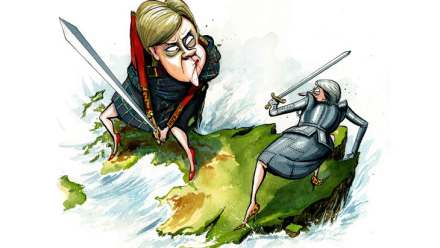
Theresa May is a cautious politician. She has risen to the top by avoiding unnecessary risks; no one survives 18 years on the Tory front bench by being a gambler. But few prime ministers have the luxury of choosing their battles, and she would not have chosen the two that may now define her premiership: successfully negotiating Britain’s exit from the European Union while saving the United Kingdom. If she achieves both, she will join the pantheon of great prime ministers. If she fails, she’ll be keeping Lord North company in the history books. Unlike David Cameron, May has been preparing for a new Scottish referendum from the moment she entered Downing Street.