Libya

Hiding from the Nazis in wartime Italy

From our UK edition

When memories come back to you, wrote W.G. Sebald in Austerlitz, his digressive novel about history and how it is remembered, their dreamlike quality sometimes makes you ‘feel as if you were looking at the past through a glass mountain’. Malcolm Gaskill’s exploration of the wartime adventures of his great-uncle Ralph, captured in Italian-occupied Libya in 1942, came from just such a memory, a ‘haunting’ dream experienced by his mother about her long-dead uncle. Finding a diary kept by Ralph while a prisoner, and fascinated by the ‘imperfections of memory’, Gaskill set off on a seven- year forage into the past that took him from archive to archive, retracing Ralph’s several attempts to escape.

Three men in exile: My Friends, by Hisham Matar, reviewed

From our UK edition

Hisham Matar’s third novel is, among its many other virtues, a paean to reading widely; to imagining literature as not, in the narrator Khaled’s words, ‘a field of demarcations’, but as a great river that connects and animates ‘the entire human event’. Reading is how Khaled – exiled from Libya when his part in the anti-Gaddafi demonstration at the country’s embassy in St James’s Square in April 1984 made a return to Benghazi impossible – lays the foundations beneath his precarious life in London. Carrying with him his father’s copy of Abual Ala al Ma’arri’s The Epistle of Forgiveness, an 11th-century  precursor to Dante’s Divine Comedy, he ponders the links between Stendhal and Mahfouz, Borges and Conrad.

The virtues of American ‘nation-building’

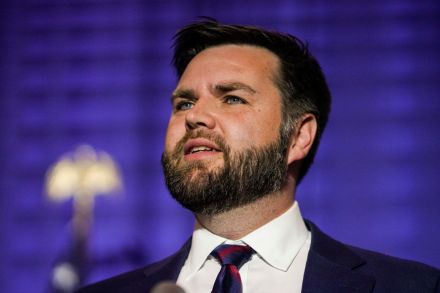
Newly minted senator JD Vance of Ohio has wasted no time in extolling the virtues of a soft isolationist foreign policy. In a January 31 op-ed for the Wall Street Journal, Vance endorsed Donald Trump for president largely because Trump isn't a hawk. A prominent member of the GOP's national conservative wing, Vance has made skepticism of American leadership abroad a centerpiece of his political identity. The senator attacks the “bipartisan foreign policy consensus that has led the country astray many times.” Never mind that the so-called "consensus" only really exists under extreme circumstances, such as after the 9/11 terror attacks. Think of the deep divide between right and left over how to deal with Cuba and Saudi Arabia, for example.

America has lost her Top Gun spirit

Quick Top Gun II: Maverick movie synopsis (and spoiler alert) by the Bad Guys: let's build a secret base using the Star Wars Death Star plans. We'll leave an air vent that looks like a giant bullseye where one bomb will take down the whole place. Good Guys movie synopsis: to make it a fair fight, instead of one Navy Seal throwing a grenade down that ventilation shaft, we'll come up with a near impossible plan involving multiple airplanes flown by irascible characters. Should kill the whole two hours. It seems like some sort of anti-union move to credit people with the screenwriting for this movie.

High life | 1 June 2017

From our UK edition

I feel like an obituary writer, what with Nick Scott, Roger Moore, Alistair Horne — all great buddies — and now my oldest and closest friend, Aleko Goulandris, dead at 90. Mind you, they all had very good lives: plenty of women, lots of fun, accomplishments galore, and many children and grandchildren. And they all reached a certain age — what else can you ask of this ludicrous life of ours? Well, I won’t be writing about the high life this week, but scum life instead. And I’ll tell you why: those innocent young children slaughtered by that Islamist scumbag in Manchester, that’s why.

Is Putin nuts?

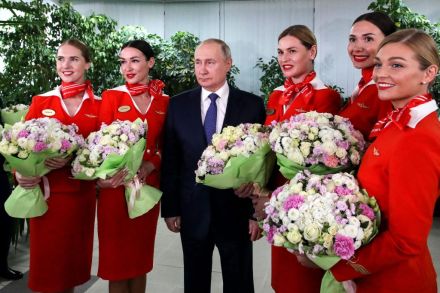
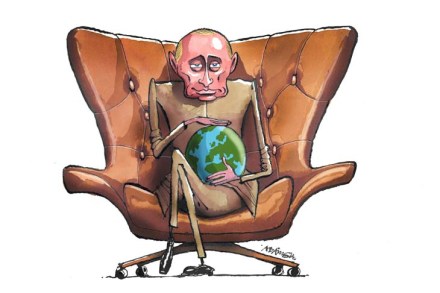
As Russian forces level Ukrainian cities with artillery, missiles and airstrikes, there's a concerted effort to get inside the mind of Vladimir Putin: from pundits, former US national security officials and current heads of government. What could possibly get the man to stop the bombardment and support a ceasefire? Is Putin intent on conquering all of Ukraine? Or is there some combination of concessions the Ukrainian government and the West could offer that would end the war and bring about a full Russian troop withdrawal? The fact is none of us know what Putin’s endgame is. Putin’s own advisors, especially those kept out of the inner circle, may not even understand what the Russian leader is planning.

crazy nuts

Kamala in Paris

Ah, the French. Is there any other people Americans so love to antagonize? Recall that after France (rightly) decided to abstain from the Iraq war in 2003, we didn't just express our discontent; we introduced the term "cheese-eating surrender monkeys" into the Kissingerian lexicon. We then canceled French fries, which are Belgian. Call it a sibling rivalry between children of the Enlightenment; call it a clash between social democracy and rugged individualism. Whatever you call it, just don't go canceling a submarine agreement at the last minute for the love of God. That's what Joe Biden did last month when Australia suddenly nixed a plan to purchase subs from the French in favor of American and British vessels. And stop the presses! A conspiracy of the Anglophones was afoot!

The dark Prince

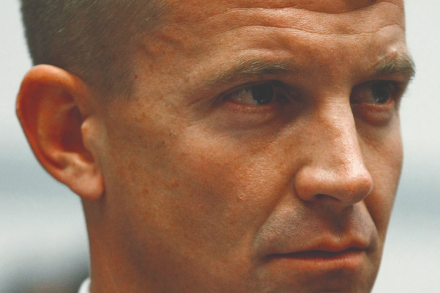
‘No modern US war would be complete without the involvement of Blackwater founder Erik Prince,’ wrote journalist Jeremy Scahill in his seminal book Dirty Wars. That was back in 2013. Since its founding in 1997, Blackwater, Prince’s private military outfit, has been reincarnated several times under different names. But Prince has stayed the same. Iraq, Afghanistan, Libya, Somalia — Prince, a very 21st-century mercenary, has wreaked havoc in all these places. He comes, he spoils, he leaves a mess that is impossible to clear up. Take Libya.

prince

Libya’s crisis exposes the deep divide at the heart of the EU

From our UK edition

The European Union already has a lot on its plate. The continuing doom of Brexit, upcoming parliamentary elections, a resurgent and ever strident nationalist movement across the continent and migration to name only a few. But over the last week, Libya can be added to the list. The armed conflict just across the Mediterranean is splitting the EU. Not for the first time, it makes the institution look floundering, divided and unsure of its capacities. Libya has been a basket-case ever since a Nato and Arab-led military coalition helped the country’s rebel brigades kick Gaddafi from power. The North African nation is in reality not a nation at all, but a collective of individual militias chocked to the brim with weapons and refugees.

Putin the peacemaker

From our UK edition

When Russia entered the Syrian civil war in September 2015 the then US secretary of defense, Ash Carter, predicted catastrophe for the Kremlin. Vladimir Putin was ‘pouring gasoline on the fire’ of the conflict, he said, and his strategy of fighting Isis while backing the Assad regime was ‘doomed to failure’. Two years on, Putin has emerged triumphant and Bashar al-Assad’s future is secure. They will soon declare victory over Isis inside the country. The dismal failure turned out to be our cynical effort to install a Sunni regime in Damascus by adopting the Afghanistan playbook from the 1980s. We would train, fund and arm jihadis, foreign and domestic, in partnership with the Gulf Arab despots.

Diary – 31 August 2017

From our UK edition

Boris Johnson is inspecting the guard of honour and we are doing our best not to giggle. The Foreign Secretary is walking down a line of soldiers from the Libyan National Army. The red carpets are blowing over in the breeze. One of the senior officers looks uncannily like Colonel Gaddafi. And the band is playing the worst version of the national anthem I have ever heard. Yet Mr Johnson manages to control his features. Just. For this is the headquarters of Field Marshal Khalifa Haftar, whose forces control large swaths of eastern Libya. A thought strikes me. Mr Johnson’s critics accuse him of upsetting allies, lacking foreign policy vision and speaking with forked tongue over Brexit.

The Spectator Podcast: Madness in the Med

From our UK edition

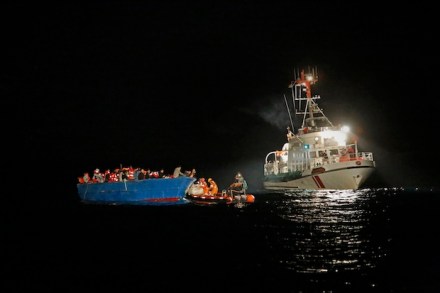
On this week’s episode, Isabel Hardman is joined by guests to look at the migrant crisis in the Mediterranean and how NGOs might be making things worse, rather than better. We also wonder whether Bristol should be ashamed of its past, and discuss binge drinking with Julie Burchill. Fewer than 300 miles off the Libyan coast lies the Italian island of Lampedusa. With a population of just over 6,000, Lampedusa has become the nexus of a migration crisis that has rumbled on for years, with seemingly no resolution in sight. In this week’s magazine, Nicholas Farrell reports from Italy on a crisis that he believes is being compounded by boats run by NGOs bringing migrants ashore in Europe.

Madness in the Med

From our UK edition

Following the EU’s deal with Turkey over people smuggling, the issue of migrants trying to cross, and quite often drowning in, the Mediterranean has largely disappeared from the British media. There have been no more images like that of three-year-old Alan Kurdi, washed up on a Turkish beach after the rubber dinghy in which his family were trying to reach the Greek island of Kos capsized in August 2015. Now, people smugglers and migrants know there is little point in trying to make the crossing from Turkey to Greece because they will only be sent back, in return for the EU taking refugees directly from camps in Turkey.

Hot Spring

From our UK edition

Imagine if Kathy Lette — or possibly Julie Burchill — had written a feminist, magic-realist saga that sent four women on a road-trip around the broiling hotspots of the Arab Spring. No, not easy to do — yet the intrepid Turkish journalist and writer Ece Temelkuran has, in this novel, come up with just that sort of pantomime chimera. Temelkuran, an outspoken truth-teller whose fearless reportage has jeopardised both her livelihood and security in Turkey, flings together a quartet of ill-assorted travellers — one of whom resembles the author. She whisks them around the crisis zones of the eastern Mediterranean just as revolutions flare and tyrants tumble.

The Spectator’s Notes | 29 June 2017

From our UK edition

At Guildhall on Tuesday, the Centre for Policy Studies held its Margaret Thatcher Conference on Security. Its title is an implied reproach to the way security is seen by current governments. You couldn’t have a Barack Obama Conference on Security, or a Donald Trump one, because neither cares about the subject. You could, I suppose, have a Theresa May Conference about Security, but that would have nothing to say about international institutions and alliances, the values of democracy, totalitarian ideology, and the needs of global defence. It would concern itself with second-order subjects like the surveillance of terrorist suspects and the state of deportation law. Many have complained that the Tory election campaign failed to preach any Conservative economics.

Letters | 25 May 2017

From our UK edition

NHS in a mess Sir: Max Pemberton is quite right to say that the NHS is close to collapse, but I’m not sure a Royal Commission is the answer (‘This is an emergency’, 20 May). The problems facing the NHS have been obvious for years, and need, as Max points out, a strong politician to take unpopular decisions, not an expensive Royal Commission to decide what the issues are. The other problem with a Royal Commission is that it would draw its membership from senior doctors, retired politicians, and other members of the establishment, some of whom are responsible for the mess in the first place. Dr Chris Nancollas Yorkley, Gloucestershire How to free up beds Sir: How gratifying to read Max Pemberton’s well-constructed debate on NHS funding.

Your enemy’s enemy isn’t always your friend when it comes to refugees

From our UK edition

For those who argue that Britain should blindly accept refugees, the family history of Salman Abedi must make somewhat uncomfortable reading. Salman was born in Britain in 1994 to a couple who had newly arrived as refugees from Libya. At the time, such people were welcomed with open arms because they were opponents of President Gaddafi, whose embassy staff had killed PC Yvonne Fletcher in London in 1984, who was suspected of commissioning the Lockerbie bomb and who was generally considered to be one of the world’s most evil dictators. On the principle of “my enemy’s enemy is my friend”, rather little seems to have been asked of Gaddafi’s opponents.

How Libya became a breeding ground for jihadists

From our UK edition

In August 2011, I was in Sabratha, the latest city on the road to Tripoli to fall to the rebels. After months of fighting, there was now a clear sense that the endgame was approaching in Libya’s bloody civil war: the trap was closing around Muammar Gaddafi. While admiring an ancient basilica in Sabratha, a Unesco heritage site - built on rich layers of Phoenician, Roman and Byzantine history - an American colleague and I were approached by an armed fighter dressed in combat fatigues. He was Akram Ramadan, from Manchester, who had given up his job as an MOT inspector to join the revolution in the country of his birth. Ramadan wasn't the only one to have made the journey from the north west of England: we met other fighters, many from Manchester.

Letters | 18 May 2017

From our UK edition

Libyan solution Sir: Boris Johnson correctly reports glimmers of hope in Libya, but to say its problems can be solved by political will risks falling into the same trap of wishful thinking that has hobbled the international community’s intervention there (‘Libya’s best hope’, 13 May). To fix Libya, its political process must be restructured to incentivise cooperation between its various factions. One thing nearly all Libyans can agree on is that the country’s oil should flow freely, since oil revenues pay for everybody’s fuel, medicine and salaries. In recent years, oil production has been repeatedly blockaded by criminal militias and politicians alike; sometimes by the same people engaged in people-trafficking.

Libya’s best hope

From our UK edition

We were in a detention centre for migrants in Tripoli and we came to a big locked door. It was impressively bolted and padlocked. Someone murmured that we didn’t have time to look inside. But I felt somehow obliged to do so. Outside in the sun I had already said hello to about 100 migrants — almost all of them from West Africa: Guinea-Conakry and Nigeria. They were sitting on the concrete in rows, their heads in their hands; the men in one group, and about half a dozen women a little way off. They had been here for months, in some cases, and they wanted to go home. Kwasi Kwarteng and Kim Sengupta consider the future of Libya: ‘J’ai faim,’ said one of the men. ‘C’est pas bon ici,’ said another.