Labour party

Tories cock-a-hoop about Lib Dem disarray

Every Tory I have spoken to this week has said the same thing, ‘aren’t the Lib Dems having a terrible time.’ The Tories are particularly happy because they see the Lib Dems’ credibility on economics taking a battering thanks to the total confusion over Cable’s proposed new tax on million-pound homes. They also think that the new Lib Dem policy will hurt the Lib Dems in a lot of the Southern seats the Tories are trying to win—Richmond, Winchester, Meon Valley and Taunton—as well as in three way marginals like Hampstead and Kilburn.   The other thing that is putting a smile on Tory faces is the Lib Dems downgrading

More than half of those who voted Labour in 2005 say they won’t do so this time round

The new ICM poll for The Guardian shows the Tories in an extremely strong position heading into conference season. They are on 43 percent, 17 points ahead of Labour. The extent of Labour’s fall since the last election is illustrated by the fact that only 47 percent of those who voted for the party then intend to do so again. Indeed, even 40 percent of those who have remained loyal to Labour now expect a Tory victory at the next election. The poll also shows that Labour is not seen as credible on the state of the public finances by the electorate. Only 14 percent of voters believe that Labour is

The Tories must ready themselves for the coming tax battle

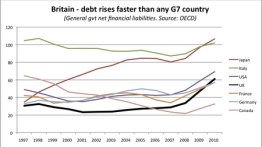
You may not agree with the specifics, but one of the successes of the Lib Dem conference so far has been to shift the debate about our fiscal recovery from one wholly about spending cuts to one about tax changes too.  This is a necessary step.  For reasons which have been delved into by Danny Finkelstein, spending restraint alone won’t be enough to tackle Brown’s debt mountain.  There will have to be tax rises.  And, what’s more, they will have to be efficient and – as far as possible – fair. These points are made by Jackie Ashley in today’s Guardian, who argues that Labour should move as quickly as

Could You Vote for the Liberal Democrats?

Sometimes, you know, I wish I could. Then the Liberal Democrats come along to remind one how difficult it is to support them. But, in theory, could one vote for a truly liberal party? Of course one could. And would, if only one were so available. In Massie’s Better Ordered Political Landscape the Liberal Democrats would, roughly speaking, be the equivalent of Germany’s Free Democrats*. It’s true that there are some liberals** in the Lib Dems – one thinks of the gang at Liberal Vision and other bloggers such as Charlotte Gore – but they’re a minority within their own minority. As Mark Littlewood says, a new BBC poll confirms

Lib Dems in the limelight

The Lib Dems need eye-catching policies to attract attention and this time round their neon lit policy is a 0.5% levy on houses valued at over £1million. The party forecast levying £1.1bn from the top 1% of rich property owners to raise the income tax threshold to £10,000. The tax will be collected by councils using land registers to identify which properties are liable. It doesn’t follow that families can afford a £2,500 bill just because they happen to own a property worth in excess of £1million. But, providing the levy remains a temporary measure, the proposal is a fair way to fund an income tax threshold rise, the current

Blair and Brown, the story that keeps on running and running

Adam Boulton is exceptionally well sourced in the Blair circle so the extract from his updated history of the Blair years makes for fascinating reading. It shows how Blair is carving out a post-premiership in a way that no other ex-British Prime Minister ever has. What is making news, though, is what Boulton reveals about relations between the Blairites and Brownites. In a way, it is no surprise that Blair regards Brown as a quitter not a fighter. Brown’s avoidance of contests where the result is not certain has been a feature of his political career. Again, it is—when you think about it—not a shock that some in Blair’s circle

The Budget bombshells revealed

An interesting spat is just breaking out over cuts. The Conservatives have a leak from the working of the Budget showing detailed projections in government revenue to 2013-14 covered by all the main Sundays. This suggests income tax rising from £140bn this year to £191bn in four years’ time. The Tories say this is not explained by economic growth and that the gap – £15bn – is equivalent to 3p in the basic rate of income tax. Liam Byrne is pushing back, saying Osborne is trying to “mislead the British people” (as if the government would try to do such a thing) and that the increase was accounted for “the

Why Vince Cable is not too sexy for his party

For all his celebrity, Vince Cable is not exactly an economic genius – as those who have read his book, The Storm,  will know all to well (Specator review here). But he is seldom tested on this point, as he encounters broadcasters whose line of questioning is normally “tell us, Sage of Twickenham, what is happening.” For those who don’t regard him as the new Oracle and have wanted  see him put through his paces, Andrew Neil – Cable’s former student – gives his old master a grilling on the BBC News Channel. In the interview, Cable gets steadily more irritated (and rumbled) and admits to having flip-flopped. The Cable phenomenon

Liberal moment or Liberal Democrat dilemma?

It’s not often that a man who claims to have bedded and satisfied over 30 women declares that the nation is on the cusp of ‘its liberal moment’, and it’s drawn attention to the Liberal Democrats. With Labour seemingly returning home to the house that Jack Jones built, Nick Clegg should be sweeping the country, but his earnest predictions about a progressive liberal future have made no impression and his party still trails. Why are the Lib Dems doing so poorly? Lloyd Evans’ appraisal that they failed to use the expenses scandal to push their long-standing reform agenda has much to commend it. And today, Polly Toynbee writes a brilliant

Is Osborne worth it?

Fresh from winning GQ’s Politician of the Year award last week, George Osborne now has an accolade he may be even happier with: heavy praise from both Peter Oborne and Matthew Parris.  Both commentators write columns today which dish out the superlatives for Osborne’s response to the fiscal crisis, and suggest he has been vindicated by events.  Here’s the key passage from Oborne’s article, by way of a taster: “Slowly Osborne began to win the argument. First (as I revealed in this column last March), Bank of England governor Mervyn King sent private warnings to the Treasury that he feared extra public spending would damage the official credit ratings that

The Tories will be thrilled if Brown starts playing the World Saver again

Patrick Wintour has an insightful article in today’s Guardian, setting out how and why Brown has dithered when it comes to deploying the c-word.  So far as the current landscape is concerned, this passage is particularly striking: “There is tension between Brown and Darling on how far the campaign can be based on Brown’s achievements in saving the world economy, and how far it must be based on visions of the future. Brown’s determination to dwell on the fact that he made the correct big decisions in the recession has been one cause of his past reluctance to address the future deficit mountain, and how to deal with it. It

Another calamitous set of polls for Brown and Labour

A Populus poll for The Times shows that the Conservatives are more trusted to run vital services than Labour. Here are the details: ‘The Tories are now in a strong position on most public services, which have traditionally been vote-winners for Labour. On doing the best job of improving the NHS, the Tories are on 37 per cent (up 10 points since last March) against 34 per cent for Labour (down 1 point). The Tories are in the lead on: managing the economy (42 per cent against 33 per cent for Labour); improving standards in schools (39 against 33 per cent); getting the balance right between taxes and spending (38

How quickly things change

Spot the difference: 5 September, 2009: Gordon Brown warns G20 countries against reining in spending, The Telegraph “Britain is resisting pressure from Germany and other Euro-currency countries who are planning to moves towards an ‘exit strategy’ that would see some of the planned anti-recessionary spending programmes being scaled back to cut rising national debts.” 18 September, 2009: Gordon Brown to call for international agreement to cut public spending, The Telegraph “Mr Brown says ‘exit strategies’ from the emergency fiscal measures that were introduced to stave off the worst excesses of the recession need to be agreed by all the leading nations. The Prime Minister will tell world leaders that a

An April election is on the cards

A couple of weeks ago, Kevin Maguire told us that No.10 is thinking about a March or April general election.  And now Steve Richards follows up by suggesting April is most likely: “Speaking to influential ministers and aides I get the impression that their favoured month for an election is next April. In theory they could hold out until June, but that would mean going to the country in the immediate aftermath of the May local elections when Labour is expected to do badly. This option is already ruled out. There will be no June election. Obviously a general election could be held on the same day as the May

The Baroness Scotland’s housekeeper scandal exposes the mess our immigration system is in

The news that the UK Border agency will launch an investigation into allegations that the Attorney General, Baroness Scotland, employed an illegal immigrant is, obviously, highly embarrassing for the government. With his customary lack of style, the Tories’ attack-dog Chris Grayling commented: “This is a Government that says all small employers should be prosecuted if they don’t know the immigration status of their employees and yet we have senior ministers who can’t be bothered to make the checks themselves. There is a real ‘one rule for them, one rule for us’ attitude at the heart of this Government and it is a disgrace.” That overstates the case. I can’t imagine

The Good Old Cause

Paul Waugh’s beaten us to it, but Ed Ball’s New Statesman article is a rallying cry to the left. He writes: ‘As we approach the most important general election for a generation, this is no time for introspection or defeatism. There’s never been a moment when Labour’s values and experience have been more relevant or necessary.’ And what are those values? Well, they’re not Blairite: ‘In public-service reform, we sometimes sounded as though private-sector solutions were always more efficient; and who can now doubt that, despite the tougher measures we brought in, financial regulation was not tough enough?’ The most telling statement is that Balls believes markets to be intrinsically

Which Miliband’s star is ascending?

For the Kremlinologists among us, Andrew Grice has an insightful article in today’s Independent on the growing support for Ed Miliband in the Labour Party.  He kicks it off by asking the pivotal question when it comes to the Brothers Miliband – “Will Ed Miliband eclipse brother David?” – and follows that up with some affirmative evidence: “…the word in Labour circles is that Ed is no longer trailing in his brother’s wake. Indeed, some senior figures believe he has already overtaken him in the game that increasingly occupies Labour minds as the party appears to head for a general election defeat – its future leadership stakes… …friends are quietly

Clegg: Are you one of the millions who turned to new Labour in 1997?

Nick Clegg joins the ‘progressive’ debate with a double of salvo in The Times and in a pamphlet, titled ‘The liberal moment’, published by Demos. The philosophically anachronistic Labour party is his target. He writes: ‘The contrast between Labour and liberals is starkest in their different approaches to power. While Labour hoards at the centre, liberals believe that power must be dispersed away from government – downwards to individuals and communities, and upwards to the international institutions needed to tackle our collective problems. State-centered, top-down solutions are wholly out of step with the demands of our age. Devising a fairer tax system, protecting civil liberties, reforming our clapped-out politics, breaking