Labour party

Labour lurched towards honesty in its reshuffle

Labour types are pretty grumpy that yesterday's far-reaching reshuffle of their ranks is being billed as another 'lurch to the left'. The reality is a little more complex: the party hasn't lurched to the left so much as lurched towards being honest about what it believes. This was what Ed Miliband did in Brighton two weeks ago. He didn't suddenly discover, with a jolt, that he was a socialist: he just started being more honest about that. Liam Byrne, Stephen Twigg and Jim Murphy were moved not because they were hopeless performers, but because they were never really given a chance to perform. What was Labour's policy on free schools? Twigg spent most of his tenure being tortured by the conflict between his own instincts and what it was that the party leadership thought was right.

Andy Burnham’s last stand

The details of the government reshuffle are currently being hammered out at the 8.30 Downing Street meeting. But as MPs and ministers nervously wait for the call from the Number 10 switchboard, Ed Miliband will be plotting his own changes to his top team for later this week. And as key Shadow Cabinet members such as Liam Byrne look vulnerable, one shadow minister who is holding on with all he's got is Andy Burnham. The Shadow Health Secretary is very popular with the party's grassroots, but he is also politically vulnerable because of his connections to the previous Labour government. But though Ed Miliband failed to publicly back Burnham at the party's conference, his colleague has in the past few days launched an offensive on his detractors that also makes it more difficult to move him.

George Osborne attempts political jiu-jitsu on Ed Miliband

If this conference season is remembered for anything, it will be for Ed Miliband’s pledge to freeze energy prices. This pledge might be economically flawed but it has given the Labour leader a retail offer to voters and rebutted the charge that he doesn’t have any policies. Initially, the Tories were uncertain of how to respond. But, as I write in the Mail on Sunday, the Tory leadership has now decided what it wants to do. In George Osborne’s autumn statement, they want to remove some of the seven green taxes and levies that are driving up energy bills. Not only would this reduce the salience of Miliband’s pledge but it would also put him in a difficult position. As Energy Secretary he imposed several of these.

Referendum now: Tom Watson backs Tory rebels calling for early EU vote

When Tom Watson left the Labour frontbench, he was fulsome in praise (in the correct sense of the phrase) for his leader. But since then, he's not exactly been trying that hard to keep Ed Miliband in a state of zen-like calm. He told the Marr Show this morning that he would support Adam Afriyie's troublemaking amendment to the EU referendum bill: 'I don't want to add to the PM's panic but I will probably be supporting Adam Afriyie with his amendments so… I think there are a lot of people on both sides of the House who think we need clarity on this now. And the country has asked for it for a long time, business is saying that there is a lot of uncertainty, and you know, parties have got to draw up their manifestos for the 2015 general election.

The knives are out for Andy Burnham

When David Cameron first addressed Parliament on the Francis Report, he told MPs that he didn't want to seek scapegoats. Some of his MPs were disappointed that the Tory leadership wasn't going after Andy Burnham or Sir David Nicholson. Well, the latter has left, and the former is looking vulnerable in a forthcoming Labour reshuffle, and for months the gloves have been off. After gaining access to a dossier of emails suggesting that Labour tried to stop the Care Quality Commission informing the public about failings at Basildon Hospital, Tory MP Stephen Barclay, who has been digging away on this for months, has called for Burnham to resign. He said: ‘Labour tried to cover up failing hospitals before the last General Election.

Miliband vs Mail reveals Labour leader’s belief about the role of politicians

It's hardly a surprise that Ed Miliband has called for another inquiry following the row about the Daily Mail's treatment of his father. The Labour leader is always calling for one inquiry or another. But normally these inquiries are led by someone outside the organisation that Miliband is taking issue with: his latest call is in fact for Lord Rothermere to investigate the culture and practices of his own newspapers. Now, there is nothing wrong with the Labour leader wanting to defend his father: that is quite natural and few would disagree with such an instinctive reaction. And there is nothing wrong with him objecting to a reporter turning up at a family memorial service.

Matthew Parris: The Tories mustn’t cuddle up to Ukip — just imagine if it happened on the left

Such is my respect for Spectator readers that I offer you a column whose subtext is in Latin. Ours is one of the last mainstream magazines among whose readership the phrase mutatis mutandis will be very widely understood. But the little test you and I are going to try concerns a live issue, not a dead language. For the purposes of this test I am going to paint you a scenario, and you’re going to give me the broad thrust of the advice you’d give in such circumstances. Imagine that the Labour party has been trying for some time to position itself firmly on the centre ground.

Who’s united the Tories? Ed Miliband and Nigel Farage

The Tory party has been at peace with itself this week. Eurosceptic backbenchers have given Nigel Farage a verbal kicking on the fringe, Cabinet ministers have stuck resolutely to the ‘hard- working’ conference script, and even Boris Johnson has behaved himself. Gay marriage, which so divided the leadership from the grassroots, has barely been mentioned, and you’d never know that just a month ago David Cameron lost a Commons vote on Syria. The new harmonious mood has come about in part because the leadership has moved towards the rest of the party. Tory conference was once decorated with posters extolling the benefits of ‘the big society’. Now, there is a simple Conservative message: ‘Welfare Capped: Immigration Down: Crime down’.

Eric Pickles pictures the horrors of a Labour government

Eric Pickles has a vivid imagination. He set out to remind the Conservative faithful today the dangers of letting Labour back into office, and why they, not the Tories, are the real nasty party. He painted a picture of where Britain might be if we were living under a Labour coalition: 'Labour would have quickly lost the confidence of the markets for failing to tackle the deficit. Mortgage rates would have soared, and after that, taxes too. The Chancellor, Ed Balls, would be extending his so-called “mansion tax” to ordinary family homes...the Business Secretary – Unite’s Baron McCluskey of Mersey Docks – would be abolishing Margaret Thatcher’s trade union reforms and turning the clock back to the 1970s.

A history of spinners, from Robert Walpole to Damian McBride and Andy Coulson

A full colour Andy Coulson looms ominously behind a black and white David Cameron on the front cover of Andrew Blick and George Jones’s book on aides to the Prime Minister. In a week when another former prime ministerial adviser, Damian McBride, has been spilling the beans on life behind the scenes of Gordon Brown’s government, the story of the apparatchiks who work in the shadows of the people in power seems ripe for revelation. However, if this makes you think that the text is going to be filled with juicy disclosures about today’s politics then, after a compelling first chapter detailing the workings of Cameron’s Downing Street, you will be sorely disappointed. Although Blick and Jones share a publisher with McBride, the revelations here are rather more limited.

Take it from a teenager: 16-year olds shouldn’t be able to vote

Like Charles Moore in this week’s Spectator, I am inclined to wonder whether there is 'any conceivable good reason' why 16-year-olds should have the vote. As a teenager interested in politics, I found not being eligible to cast a ballot until this year frustrating but reasonable. The idea that, at 18, I would become an adult, and as an adult I would be able to vote, made perfect sense. Departing from this principle by picking an arbitrary voting age is, as Moore points out, a slippery slope: what about all those politically oppressed 8 year olds? It is never argued that 16-year-olds should have the vote as part of a broader scheme to lower the age of majority - which is what happened to 18-year-olds in 1969 and which would at least be a logical policy suggestion.

Damian McBride: Why I clutched at my trousers in front of Jeremy Paxman

They say nothing beats the feeling of seeing your book in print. But for me, the proudest moment was presenting the first copy to my Mum. She’s been ill recently and I read her most of the chapters in draft while she was convalescing, albeit leaving out the nasty bits. I sat with her that evening, reading her more of the book and feeling quite pleased with it. But the nervous feeling kicked in the next day when I saw the first extracts in the Daily Mail, and heard some of the reactions from the media and Labour folk. It strikes me as bizarre that people would reach conclusions and issue condemnations after reading 2 per cent of the book, but it didn’t stop them piling in.

Gordon Brown’s gossip girls

Brown’s boot boys had a reputation for political assassination, karaoke, and curry and lager. But if Damian McBride is to be believed, they’re really just a gaggle of gossiping girls. ‘How much of an appetite for gossip does Ed Miliband have then?’ Fraser Nelson asked of McBride for this week’s Spectator podcast. ‘He’s a bit like Gordon Brown,’ replied the repentant sinner/spinner: ‘He wouldn’t declare that he was interested in that kind of thing. But if you started saying to him ‘well I think so and so is going out with so and so’ amongst his officials he would go ‘really’ and want to hear about it.  ...

The View from 22: Fraser Nelson interviews Damian McBride + Labour conference review

How well did Damian McBride know Ed Balls ? Is he surprised at the scale of interest and hostility towards his book? How strong was his relationship with Ed Miliband? Did journalists ever suspect he was feeding them untruths? Fraser Nelson puts all these questions to the former Labour spin doctor on this week's View from 22 podcast (21:00), in light of his memoirs Power Trip, published this week. Labour conference is now over and three of Westminster's top political commentators give us their opinion on how it went.

Ed Miliband’s second conference message: ‘bring it on’

If you're looking for two phrases to summarise this year's Labour conference, they'd be 'Britain can do better than this' (in case you missed its fleeting reference in Ed Miliband's speech) and 'bring it on'. Ed Miliband has decided that even though he doesn't poll above his party like Cameron, or have a history of impressing in broadcast and question-and-answer performances like Nick Clegg, he can still enter a presidential-style 2015 election without fear.

The three groups helping Miliband drive his conference message home

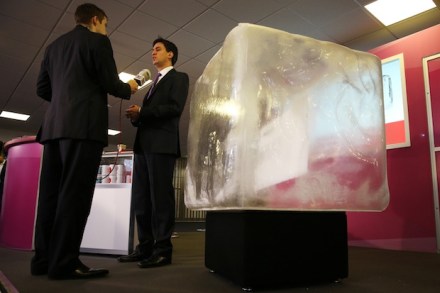
The Labour party held a briefing this morning for party campaigners on how they can follow up Ed's speech on the doorstep. Activists had arrived at conference hoping for a simple message that they can sell to a voter in a dressing gown with their arms crossed and a sceptical expression on their face, and now they've got one: frozen energy bills. They were told that campaigning on energy bills wasn't just something they can use on the doorstep this weekend, but a major digital and ground war campaign that is going to go on for months. The idea is to demand that David Cameron freeze bills now, using petitions. The party is handing out these ice cubes, although it quickly ran out at the briefing, with campaigners scrabbling over who should have one, because they carry such a clear message.

Ed Miliband has done politics a favour. The election will finally see philosophies compete

The next election is going to be the big, post-crash debate that the country didn’t have in 2010. Ed Miliband, as his speech yesterday demonstrated, believes that radical state intervention is needed to deal with the ‘living standards crisis’. His answer to the fact that there’s no money left is to get companies to pick up the tab for redistribution. There’ll now be clear red water between Labour and the two other main parties at the next election. This raises the question of how the Lib Dems fit into all this. Miliband barely mentioned them in his speech yesterday and has steered clear of attacks on them this conference season.

Damian McBride’s book Power Trip trips up its first victim

Damian McBride’s book has bruised many Labour conference delegates, and reopened old wounds. Now I can report that it’s claimed its first physical casualty. Telegraph journalist Matthew Holehouse had been tipped off that copies of the book were selling out fast at the Waterstones stall inside the conference zone. He ran across a road to get a copy, but was hit by a car and broke his leg. Sadly, Holehouse will be out of action for weeks, though at least he will have some good reading material.

Ed warns energy firms: don’t reinforce perception you are the problem

Following the announcement of his plan to tackle rising energy prices — and the accompanying backlash — Ed Miliband has fired a warning shot at energy providers this morning, suggesting unless they get on board with his proposals, they will be seen as part of the problem, not the solution, by their customers. Here is the full text of his letter: 'In recent years we have discussed the need to rebuild public trust in the energy market many times. I think we all agree on the importance of that objective if we are to build a market that both delivers for consumers and underpins the investment in future clean energy capacity that we all want to see.