Israel

Portrait of the week: US and Russia talk, Chiltern Firehouse burns and Duchess of Sussex rebrands

Home Sir Keir Starmer, the Prime Minister, said that, to guarantee the security of Ukraine, he was ‘ready and willing’ to put ‘our own troops on the ground if necessary. I do not say that lightly’. Parliament would be allowed a vote on such a deployment, the government said. Earlier, Sir Keir took an unannounced telephone call from President Donald Trump of America about their forthcoming meeting. Afterwards, Mr Trump said: ‘We have a lot of good things going on. But he asked to come and see me and I just accepted his asking.’ The Chiltern Firehouse hotel in Marylebone burnt down.

Why do Australian doctors want to kill Israeli patients?

Imagine the uproar if a white Christian doctor refused to treat a Muslim Arab patient – or worse, boasted of killing them under their care. The public would be outraged, not only at the cruelty but at the sheer incongruity of such malice from a profession defined by care and a faith defined by compassion. Yet when two Australian nurses – Ahmad Rashad Nadir and Sarah Abu Lebdeh – publicly declared their willingness to kill Israeli patients, the horror was accompanied by something more chilling than shock: recognition. Their depravity felt like an affirmation of the darkest fears about imported hatreds and their place within our institutions. The video that surfaced of the pair talking online to an Israeli man on Chat Roulette was harrowing.

The case for ending the Israel-Hamas ceasefire

The question now facing Israel is this: will the war in Gaza recommence? The ceasefire agreement was signed less than a month ago, and it is already looking shaky.   The first phase of the deal has not yet been completed. Sixteen of the 33 Israeli hostages scheduled to be freed in this phase have been released, and so have 656 of 2,000 Palestinian prisoners. But Hamas has now announced the postponement of the release of an additional three hostages, which was scheduled to take place this Saturday. US President Donald Trump has expressed support for abandoning the phasing of the deal, and demanded that all hostages be released by Saturday at noon – not just those scheduled for the weekend.

What will happen to Hamas’s tunnels?

Even if the third phase of the Gaza ceasefire deal is successfully completed and all hostages, alive and dead, are handed over, Hamas will still retain its most treasured and most deadly warfare advantage: hundreds of miles of deep tunnels and bunkers known as the Gaza metro. From day one of the Israel Defence Forces’ retaliatory invasion of Gaza, the search began for the tunnel complex which their opponents were using to hide command bunkers, weapon-making plants, munition stores, fighters and the 250 hostages seized from southern Israel on 7 October, 2023. The IDF may have killed an estimated 17,000 of Hamas’s 30,000 soldiers, but the remnants of the battered fighting force survived because of the Gaza metro.

Trump’s ICC sanctions will test an outdated institution

Once you get beyond trade and maritime borders, you will find that much of international law is, pace Clausewitz, the continuation of policy by other means. The International Criminal Court (ICC) was continuing policy by other means when it issued arrest warrants for Israeli prime minister Benjamin Netanyahu and former defence minister Yoav Gallant. The two stand accused of crimes against humanity and war crimes over Operation Swords of Iron, Jerusalem’s response to the Palestinian invasion of its territory and mass murder of its citizens on 7 October 2023.

Britain could learn from Trump’s approach to foreign policy

The Foreign Secretary describes his approach to diplomacy as ‘progressive realism’. One can legitimately ask what is progressive about a closer accommodation with the slave-labour-deploying Leninists of Beijing or what is realistic about ceding the UK’s sovereignty over the Chagos Islands to China’s ally Mauritius. But David Lammy seems happy in his work. His choice of words serves to give an updated gloss to what most observers would readily recognise as the Foreign Office’s traditional approach – appeasement of our enemies and embarrassment at anything which appears to be a reminder of our colonial past. Whatever the aptest description of this government’s foreign policy, it is fair to say Donald Trump is piloting a different approach to international affairs.

Portrait of the week: Shoplifting surges, Trump eyes Gaza Strip and Norway’s government collapses

Home Sir Keir Starmer, the Prime Minister, flew to Brussels for an EU summit, sought a ‘reset’ of relations and had celeriac soup and sea bream for dinner. AstraZeneca dropped plans to invest £450 million in a vaccine manufacturing plant in Speke, Liverpool, blaming the government’s ‘final offer compared to the previous government’s proposal’. Rachel Reeves, the Chancellor of the Exchequer, said that she supported the expansion of Leeds Bradford Airport; she had already backed a third runway at Heathrow and the reopening of Doncaster Sheffield airport. Water bills in England and Wales will rise to an average of £603. Some councils will be allowed to raise their tax by more than 5 per cent – Bradford by 10 per cent.

How the ancient Greeks tackled treaties

Israel and Hamas signed a ceasefire agreement. Though the ancients would have employed oaths, the practical ancient Greeks often ensured there was a flexibility about them: the real world might intervene. For example, treaties between city-states were agreed between opposing generals. Hostages were exchanged, oaths sworn and the terms of the treaty widely inscribed on stone and bronze pillars, but it was citizens who oversaw the treaty’s maintenance. In a Greek democracy, however, there was no saying how, under the influence of different leaders, policy might change and annul a treaty at a stroke. Then again, though treaties could be sworn to last forever, ‘circumstances’ were very unlikely to remain so accommodating.

The psychological toll of being constantly tracked and harassed

In late 2018 a Saudi journalist living in exile in Canada, who liked to work out in between recording YouTube critiques of his government, ordered some protein powder online. When a text message landed on Omar Abdulaziz’s smartphone notifying him of a DHL delivery, he clicked on it without hesitating. The portrait Deibert paints is a million miles away from the Cold War binary world of John le Carré The DHL invitation was fake digital bait. By clicking on it, Abdulaziz had enabled Pegasus, a spyware program designed by a now infamous Israeli company, NSO Group.

The Donald’s plans for the Middle East

The former US president Jimmy Carterdied, at the age of 100, just before news of an imminent deal to free the last of Israel’s hostages in Gaza. Carter’s presidency was crippled by his own hostage crisis, American diplomats held captive in Tehran. Freeing them became his administration’s highest priority, and he worked on it for every single one of the 444 days the crisis lasted, often to the exclusion of anything else. By contrast, the Israeli Prime Minister, Benjamin Netanyahu, resisted massive domestic pressure to do a deal for his hostages in order to pursue the war aim of destroying Hamas. You could call this statesmanship, or something else, but it is a kind of victory for Netanyahu.

The Church of the Holy Sepulchre contains terrible art – but is filled with magic

For a press tour of the Church of the Holy Sepulchre in Jerusalem – the Church of the Resurrection, the Mother of churches, site of the last four stations of the Cross – you must apply to the Patriarch. This being Jerusalem, there are three: the Latin, the Armenian and the Greek Orthodox. The process of accreditation is like a scene from an Olivia Manning novel. If you receive an acknowledgment of your email from the Greek Patriarchate – the Latin and the Armenian were otherwise engaged – you turn into Greek Patriarchate Street and present yourself at the Patriarchate palace. It is pale limestone, silent, a home to spoilt cats.

Israel must leave Syria

As I walked through Vienna last weekend, I happened upon several protests organised by Syrian refugees celebrating the downfall of Bashar al-Assad, the butcher from Damascus. People were singing, some even crying, as they rejoiced the end of the father-and-son al-Assad dictatorship, which had lasted 53 years.   The protestors had not yet seen the images of tens of thousands of released political prisoners, the slaughterhouses, or the underground torture chambers, but they had already seen enough. They were among the 12 million people who were displaced during the Syrian civil war and many of them undoubtedly had family members or close friends who had been among the over half million Syrians who had been killed. It was a rare moment of total jubilation.

Iran’s axis is dying

From the hilltop viewpoint at Misgav Am, Israel’s northernmost kibbutz in the Upper Galilee, the view into southern Lebanon is a panorama of uncertainty. Less than a full day after Assad was finally defeated in Syria, I stand at and look down at the rubble of the Lebanese buildings destroyed in the recent fighting, as close to the Syrian border as the IDF will allow. Beside my feet, spent bullet casings remind me that less than two weeks ago this peaceful spot was a frontline position. The shell of a bombed-out nearby community viewpoint serves as a silent witness to the RPG attacks Hezbollah regularly launched on civilian homes and buildings since it started its war on Israel in October 2023.

Will the Syrian Civil War create another ISIS?

There are unintended consequences, and then there are unintended consequences. What we are seeing in Syria, as Aleppo and Hama fall (and Homs braces itself) to a coalition of anti-regime forces whose DNA is to be found in al-Qaeda et al, is an unintended consequence of Israel’s bombardment in Syria of Iran-funded pro-Assad groups, and the pulverising of Hezbollah in Lebanon. An unintended consequence of the weakening of Iran and its Axis of Resistance. For the three pillars on which Bashar al-Assad props up (for the time being) his murderous kleptocratic narco-state – Iran, Hezbollah and Russia – are, respectively, on their ‘best’ behaviour in the hope of talks with the US, broken, or extremely distracted.

Beware the Qataris

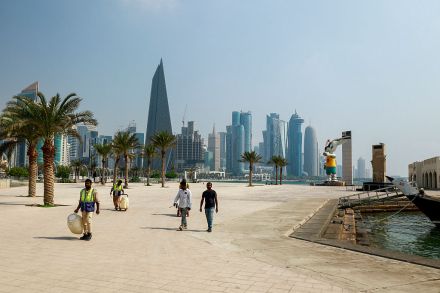
I feel some sympathy for the British royal family because of the ghastly people they are forced to meet. The late Queen had to greet Nicolae and Elena Ceausescu, Idi Amin and Robert Mugabe. This week the King and Prince and Princess of Wales had to meet the Emir of Qatar and his wife. True to form, the state media in Britain managed to miss every major problem with this. The BBC did say that there might be protests around the visit because of Qatar’s record on ‘LGBT rights’. But more troubling is that Britain should ever have welcomed the leadership of such a sordid, terrorist-supporting statelet.

The leak that’s haunting Netanyahu’s government

Early September, days after the gruesome discovery of six murdered Israeli hostages in a tunnel in Gaza, a dramatic scoop appeared in Bild. The German newspaper had obtained a secret internal Hamas document, supposedly obtained from Hamas leader Yahya Sinwar’s personal computer, that revealed Hamas’s hostage negotiation strategy. The document claimed that Hamas was deliberately exploiting the divisions in Israeli society, manipulating the families of the hostages to help blame Benjamin Netanyahu’s government for not making a deal.

Portrait of the week: Storm Bert, Israel-Hezbollah ceasefire and Putin gives cockatoos to North Korea

Home A white paper outlined measures to counter economic inactivity (which had risen by September to 41.2 per cent among those aged 16 to 24): everyone aged 18 to 21 would be offered an apprenticeship, training, education or help to find a job; Jobcentres would be rebranded as the National Jobs and Careers Service. Rachel Reeves, the Chancellor of the Exchequer, said: ‘What I haven’t heard are many alternatives’ to the tax rises imposed by October’s Budget; she was speaking to the Confederation of British Industry. A petition on the parliament website, accusing Labour of breaking promises and calling for a general election, gathered more than 2.

What the ICC gets wrong about Israel

Legal reasoning is only as good as the ethical concepts it uses. That’s why the International Criminal Court’s decision to issue arrest warrants for Israel’s Prime Minister and former defence minister is basically flawed. The ICC claims reasonable grounds for believing Benjamin Netanyahu and Yoav Gallant guilty of the war crimes of ‘intentionally and knowingly depriv[ing] the civilian population in Gaza of objects indispensable to their survival’, creating ‘conditions of life calculated to bring about [their] destruction’. The grounds are these: Israel’s failure to facilitate relief ‘by all means at its disposal’ and to ‘ensure that the civilian population... would be adequately supplied with goods in need’ amounts to a violation of the ‘fundamental rights...

There may soon be peace in Lebanon

If the leaks and briefings are to be believed, Israel is getting ready to end its war in Lebanon. With the US pushing hard, and after a successful military campaign, reports say that Israeli leaders are looking to make a deal. Lebanese Hezbollah joined Hama’s war against Israel on 8 October, 2023; around 100,000 Israeli civilians have evacuated the border area. Almost immediately after Israeli troops moved into the Gaza Strip, determined to oust Hamas and release the hostages captured on 7 October, there were negotiations, brokered by Qatar, Egypt and the USA, to try and reach some kind of deal that would free the hostages and end the war. Apart from a brief ceasefire in December, that deal is still being unsuccessfully negotiated today.

Portrait of the week: Tax rises, a cheddar heist and snail delivery man gets slapped

Home Rachel Reeves, the Chancellor of the Exchequer, repeatedly mentioning an inherited ‘£22 billion black hole’, raised taxes by £40 billion in the Budget, while saying she was abiding by Labour’s manifesto promise not to increase taxes on ‘working people’. A big hit came from increasing employers’ contributions to national insurance; the threshold at which it begins to be paid was reduced from £9,100 to £5,000. But income tax and NI thresholds for employees would be unfrozen from 2028. Capital gains tax went up; stamp duty for second homes rose. Fuel duty would again be frozen. The non-dom regime was abolished. Tobacco went up; a pint of draught went down a penny. The minimum wage would rise. Defence spending would rise by £2.9 billion.