Charlie Gammell

Charlie Gammell is a historian and former diplomat who was on the Iran desk at the Foreign Office. He is the author of The Pearl of Khorasan

Why Iran doesn’t want peace

Perhaps we should be used to be this by now. Yet again, there have been a flurry of promises to rapidly achieve peace in Iran. Yet again, the American administration has threatened to destroy the nation’s infrastructure. J.D. Vance is again flying to Pakistan for more talks. And yet the conflict shows no sign of ending. We don’t know whether the Iranians will actually turn up. A foreign ministry spokesman said yesterday that Iran will not be joining the talks. The speaker of the parliament Mohammad Bagher Ghalibaf has also made clear that the regime won’t negotiate under threat of civilizational destruction. Why would they resist peace talks? There is both a diplomatic and domestic answer.

iran peace

Iran-US: how this could end

From our UK edition

A ceasefire between Israel and Lebanon has just come into effect. Iran’s Foreign Minister says 'in line with the ceasefire in Lebanon, the passage for all commercial vessels through Strait of Hormuz is declared completely open for the remaining period of ceasefire'. Freddy Gray is joined by Spectator contributor Charlie Gammell, an expert on Iran, to discuss the negotiations and why they originally broke down plus what a post-conflict Iran could look like.

Iran-US: how this could end

Why Iran thinks it’s winning

President Trump has what he so dearly craves; the attention of the global media and the world hanging on his every word. As time ticks down to Donald’s deadline, after which he is threatening to commit war crimes on an unprecedented scale against the Iranian people, the gap for negotiations narrows and the likelihood of a US ground invasion into Iran widens. We should be honest about the talks’ chances of success: very low. At present it is likely that negotiators are seeking only to find common ground, however thin, from which a pause in fighting can be agreed upon. We are talking here about the foothills of a framework of an agreement. That’s a million miles from a deal that will satisfy the White House’s demands. And for all that oil.

iran

Trump has lost control of his war

From our UK edition

US President Trump has what he so dearly craves – the attention of the global media and the world hanging on his every word. As time ticks down to Donald’s deadline, after which he is threatening to commit war crimes on an unprecedented scale against the Iranian people, the gap for negotiations narrows and the likelihood of a US ground invasion into Iran widens. We should be honest about the talks’ chances of success: very low. At present it is likely that negotiators are seeking only to find common ground, however thin, from which a pause in fighting can be agreed upon. We are talking here about the very foothills of a framework of an agreement. A million metaphorical miles from a deal that will satisfy the White House’s desire for ‘the big one’. And for all that oil.

Will Iran descend into civil war?

33 min listen

Freddy is joined by historian and former diplomat, Charlie Gammell. They discuss the situation in Iran, whether the US is heading for a decisive confrontation, and examine the regional consequences: proxy warfare, Gulf energy security, Pakistan’s delicate position, and migration pressures on Europe.

Will Iran descend into civil war?

Could Iran descend into civil war?

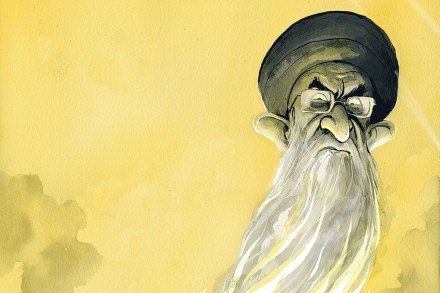
Ayatollah Ali Khamenei, a man whose life has been defined by the harshness of his rhetoric against the West (specifically, the US and Israel) and his ruthless rule, has died a martyr’s death under the rubble of his compound in Pasteur, Tehran.  It was always going to end this way. Khamenei came to prominence as a revolutionary first and then second as a wartime leader when he assumed the role of President of Iran during the Iran-Iraq war. What is needed is a clear plan that can unite Iranians behind a shared, inclusive vision of their country The Islamic Republic is facing its most serious crisis since January, when it set about killing its way out of nationwide protests.

The US is offering Iran a lifeline – will it take it?

The talks are still alive. Just. Iranian and US diplomats, engaging indirectly through Omani intermediaries, have yet to make any substantive progress towards a framework of understanding that governs further talks – as Kafkaesque as that might sound – but they are talking, and that is the best that the diplomats can hope for right now.  What separates Iran and America is a vast chasm between their respective red lines, and beyond that, the very substance of the talks themselves. The US is not willing to countenance an Iran that enriches uranium, has a ballistic missile programme and arms proxies throughout the region.  Iran, for its part, perhaps unwisely – as they may be about to find out, will simply never agree to neuter itself on the above trilogy of capitulations.

Mickey Down, Charlie Gammell, Sean Thomas & Douglas Murray

From our UK edition

32 min listen

On this week’s Spectator Out Loud: Mickey Down, co-creator of Industry, reads his diary for the week; Charlie Gammell argues that US intervention could push Iran into civil war and terrorism – warning that there are more possibilities than just revolution or regime survival; false dichotomy at the heart of; Sean Thomas bemoans the bittersweet liberation from his libido; and, Douglas Murray believes Britain has a growing obsession with race. Produced and presented by Patrick Gibbons.

The rule of the Ayatollahs is broken. What happens now?

‘Help is on the way,’ promised Donald Trump to the people of Iran defying the Islamic Republic. In the same social media post, the US President, characteristically light on detail, also urged Iranian protestors to take over the institutions of the Islamic Republic (presumably by force) and to keep a note of the names and numbers of their oppressors for retribution’s sake. Whatever these words presage – be it air strikes on Iranian Revolutionary Guard Corps (IRGC) and Basij facilities, or cyberattacks on Iran’s intelligence agencies, to blind the regime as the regime has blinded protestors by shutting down the internet – it remains to be seen if such an intervention will tip the balance in favour of the regime, the protestors, or simply chaos.

What’s really going on in Iran?

24 min listen

Spectator contributor and author Charlie Gammell and Freddy Gray discuss what is really happening as protests play out on the streets of Iran. They discuss imams turning on the Shah, whether Trump could actually be seeking talks rather than war, what the Middle East wants from a fractured Iran, and what issues could arise from replacing the regime with Reza Pahlavi.

Unrest is spreading across Iran

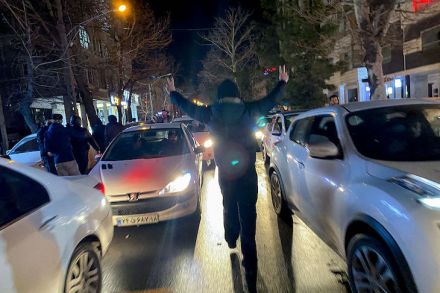
‘If they shut down the internet, you know it’s serious,’ said a well-informed observer of Iran to me yesterday morning. The internet blackout came yesterday afternoon – along with over a million Iranians marching in streets across the country. Strikes are continuing in bazaars and the cries for the end of the Islamic Republic are becoming more brazen. A video was sent to me before the blackout from Iran’s upscale northern suburbs, home to the sons and daughters of the regime elites, in which the cries of ‘death to the dictator’ could be heard loud and clear. ‘We are excited,’ was the caption to the video. And this morning there came unconfirmed reports that the National Bank of Iran had implemented a ban on people withdrawing cash, a potentially huge moment in events.

Maduro’s fall could galvanise Iran’s opposition

On the afternoon of the 28 December in a Tehran electronics bazaar, shopkeepers (known as bazaaris) shuttered their shops and walked out, outraged at a planned gas price rise and crippled at the continuing slide in the value of the Iranian currency and the government’s powerlessness to shepherd Iran’s economy towards something better than corruption, unemployment and inflationary cycles. Tehran’s Grand Bazaar was quick to follow suit. A day or so later, several of Tehran’s most prestigious universities staged demonstrations.

Israel and Iran come full circle

On September 28, the UN again imposed wide-ranging economic sanctions on Iran. Earlier in the summer, European powers had notified the UN Security Council of their intention to trigger the snapback mechanism within the original nuclear deal, the JCPOA, citing Iranian non-compliance with the terms of the original deal – specifically, the eye-watering percentages to which Iran is enriching uranium. And without a new resolution being agreed upon, the same sanctions that crippled the Iranian economy from 2013 to 2015, effectively dragging Tehran to the table in the first place, will have a devastating effect on ordinary Iranians who will see the value of their currency plummet and the price of daily goods skyrocket.

Iran

Why the US will probably strike Iran again

From our UK edition

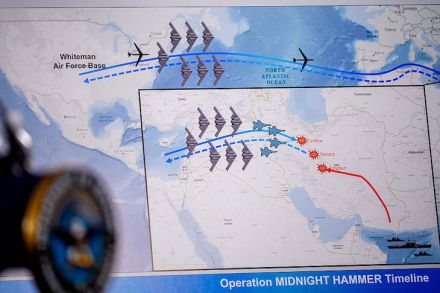
It was bound to happen. Leaving aside, for the moment, the burning question of whether the US strikes on Iran will have set back Tehran's nuclear programme by weeks, months or years, this moment feels in many ways like an apotheosis of sorts. The Omega (or perhaps Alpha depending on your sense of ontology) of US attempts at talking to the Islamic Republic, a culmination of decades of frustration at the Ayatollah’s unique ability to talk peace and negotiation while murdering and destabilising.

Whatever happens, Iran will still seek a nuclear weapon

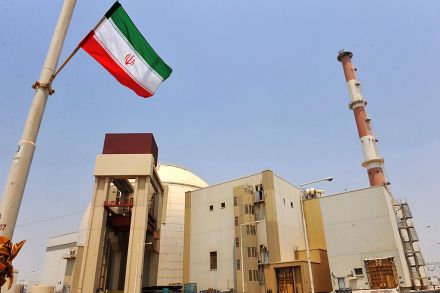
An Iranian politician sits on a sofa giving an interview about Iran’s nuclear ambitions. "Why should Iran not have a nuclear weapon when France, the UK and the US all have nuclear weapons? What is the difference between our nations?" The politician goes on to lay out Iran’s regional intellectual and cultural superiority, citing an illustrious history going back centuries, explicitly linking Iranian exceptionalism with the issue of nuclear power. You’d be forgiven for thinking that this Iranian politician was an official of the Islamic Republic. It was the Shah and the year was 1973.

Iran

Striking Fordow will not solve the Iran problem

From our UK edition

The world is watching Donald Trump to see if he will give his military the green light to use one of America’s most deadly weapons, the Massive Ordnance Penetrator (Mop), to destroy Iran’s underground nuclear facilities at Fordow. As a man with a seemingly inexhaustible need for attention, this is a gratifying position for him to be in. But a potentially dangerous one for the rest of us. ‘Trump doesn’t have a taste for war,’ someone said to me recently. ‘War’s bad for business.’ This appears to be true so far; we have certainly seen Trump try his hand at peace-making in Gaza, Ukraine and Iran with consistently poor results. But history is full of examples of far more principled men than Trump acquiring a taste for war through a thirst for power and money.

The Islamic Republic has been weakening for months

From our UK edition

In October 2023, the mullahs of the Islamic Republic could look within Iran’s borders, and beyond, and be content with the worlds they had created. After all, they had weathered the storm of the Women, Life, Freedom protests by terrorising their own people, and could rest assured in the strength of their proxy networks, feared fighters operating at Iran’s behest (or guidance) throughout the Middle East. Yes, if we’d looked hard enough, there were signs of weakness in their response to the killing of Qasem Soleimani – in hindsight, a singular failure to match the violence of the words to the violence and efficacy of their actions, a fatal mistake in today’s world.

Israel isn’t close to victory over Iran

From our UK edition

Amongst a swirl of pronouncements from Tel Aviv, Washington and Tehran – and against the dramatic backdrop of an Iranian TV presenter’s rather tired fire and fury being interrupted by the sound of bombs – Benjamin Netanyahu has claimed that Israel is close to “victory.” Yet despite Ayatollah Khamenei being hidden in a bunker, experiencing regular panic attacks and now shielded from the worst news of his battered nation, any talk of “victory” by the Israeli prime minister feels hollow and premature. Talk of human rights, revolutions and the evils of the Islamic Republic have been cast aside as luxuries As this war thunders into its fifth day, Iranians across the country seek only to flee Israeli bombs.

Operation Rising: will Trump get dragged into the Israel-Iran conflict?

From our UK edition

20 min listen

Relations between Iran and Israel are deteriorating rapidly, with comparisons being drawn to Israel’s 1981 strike on Iraq’s Osirak nuclear reactor. Israeli Prime Minister Benjamin Netanyahu appears to be advocating for regime change in Tehran, reportedly encouraging the United States to take military action. Donald Trump, who previously came close to authorising a strike, is now said to be more cautious – mindful of the risks of exposing American forces abroad and being drawn into another protracted conflict, contrary to the non-interventionist platform on which he was elected. The Iranian regime, built on a foundation of resistance, is responding to Israel’s attacks while also expanding its network of regional proxies, which now extends as far as South America and east Africa.

How likely is regime change in Iran? 

From our UK edition

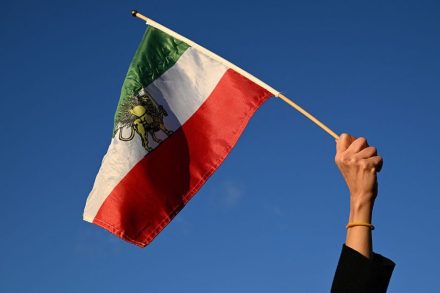
The clue is in the name of Israel’s operation. ‘Operation Rising Lion’ is a direct reference to the Pahlavi flag used by Iran before the Islamic revolution, which shows a lion standing proud against the backdrop of a glowing orb, the sun. In Persian this is called the ‘Shir-e Khorshid.’ For many years now, Netanyahu has sought to speak directly to Iranians, attempting to transcend the Islamic Republic, and to present himself as the saviour of the Iranian people. These ongoing strikes are simply a continuation of this policy, and Israel’s determination to avoid civilian casualties (something we’ve not seen in Gaza) feeds into its desire for an anti-regime uprising caused by elite splits and popular rage.