Israel

Will Trump ‘totally obliterate’ Iran’s nuclear programme – again?

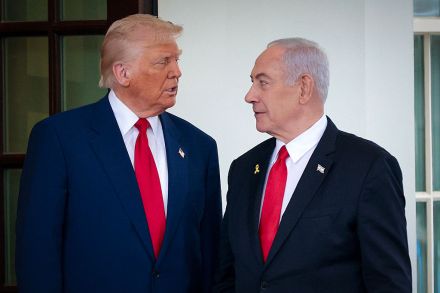
Donald Trump spent much of the second half of last year boasting about the total and utter success of his military strikes on Iran. “As you know,” he said in August, “we took out the nuclear capability of Iran, and to use the term that people try to dispute without any knowledge, it was obliterated.” Iran’s nuclear programme, he assured the world, had been set back by “decades.” Trump and Hegseth protested too much Yet yesterday, just six months on, there he was again – meeting Israel’s Benjamin Netanyahu once more to discuss the urgent need to prevent Iran from developing a nuclear weapon. In the wake of Operation Midnight Hammer –

Has Iran called Trump’s bluff?

Over the last week, the USS Abraham Lincoln aircraft carrier, additional F-15 fighter planes and naval vessels carrying sea-launched cruise missiles have been making their way to the Middle East in what can only be described as a bid by President Trump to squeeze Iran into submission. In case anybody doubted this is what Trump was after, he took to Truth Social yesterday to send the Iranians a message: give me what I want or face bombing the likes of which you’ve never seen. ‘A massive Armada is heading to Iran. It is moving quickly, with great power, enthusiasm, and purpose,’ Trump wrote. ‘Hopefully Iran will quickly “Come to the

The US plan for Gaza is absurd

Donald Trump’s strangely artificial Board of Peace event in Davos on Thursday looked like a Hollywood rendering of an international summit. Everything was too slick, faintly uncanny. Like an AI-generated image, it was photo-real yet failed the most basic human glance test. Too perfect. No wabi-sabi. The first tell was visual: the set, complete with a crisp new institutional logo: a globe on a shield, flanked by olive branches. It carried the unmistakable whiff of Grok or ChatGPT, but the strangeness went deeper than design. The speeches themselves were weirdly messianic and utopian. The most peculiar part was the show-within-a-show: a piece of political meta-theatre featuring Marco Rubio, Steve Witkoff,

The age of absolutism

A Labour MP was prevented from visiting a school in his constituency because the teaching unions and the Palestine Solidarity Campaign do not like the fact that he believes Israel should have a right to exist. The MP in question is Damien Egan, who represents Bristol North East and who is vice-chairman of the Labour Friends of Israel caucus – or, as it is almost certainly referred to within the party, Labour Friends of Genocide. We haven’t heard from Egan just yet – perhaps he is less cross about it than I am, or simply doesn’t want to make a fuss. The school in question is the Bristol Brunel Academy,

What the Iranian uprising means for the Middle East

The Middle East has long been organised around two competing logics: pragmatic alignment and ideological alignment. Before the 7 October war, these logics produced two regional blocs that structured most political, diplomatic and security behaviour. The Palestinian attack and invasion that triggered the war ruptured both systems. Incentives shifted, alliances frayed, and assumptions collapsed. What followed has not been the emergence of a calmer order, but a reconfiguration in which ideology has returned in new forms and pragmatism has narrowed, and hardened, requiring deliberate encouragement and support to survive. For more than a decade, regional politics moved along these two tracks. Pragmatic alliances rested on interests that could be negotiated,

The westerners helping Hamas win the propaganda war

After two years of war, and despite Israel’s many successes on the battlefield, Hamas can also claim a kind of victory – at least for now. The terror group has survived and is once again exerting control in the areas of Gaza under its authority. Public executions, whippings, stonings and kneecappings have returned. In the first five days of the ceasefire, Hamas executed at least 100 Gazans. Hamas’s survival was achieved not only through its remaining fighters and its holding of hostages, but also thanks to a chorus of western apologists. A coalition of so-called progressives and professional activists has excused, rationalised and defended the group’s actions across universities and

George Abaraonye deserves his downfall

Contrary to what I had expected, the Oxford Union president-elect, George Abaraonye, lost his vote of no confidence by a whopping margin and will now have to resign. More than 70 per cent of Union members voted for the semi-literate, dreadlocked leftie to lose his job following his apparent delight at the murder of Charlie Kirk. Intimidation and hostility was reported as his supporters sought to disrupt proceedings by hampering the work of the returning officer and Abaraonye, in the manner of a presidential candidate who has been defeated in a general election in a country composed largely of what we are now enjoined to call the global majority, refused

A sip of Israeli history

We were drinking Israeli wine as the talk ranged from frivolity to seriousness: from Donald Trump to the tragic paradoxes of the human condition. Some would claim we were discussing the same topic, yet this may not be the time to disrespect the US President. I once described Ariel Sharon as a bulldozer with a Ferrari engine. It was one of the many tragedies to have afflicted Israel/Palestine that just when he had decided to bulldoze for peace, he should have been stricken with a massive stroke. One reason I love being in Israel is that one is never more than 50 yards from an argument Now a new and

What is the West without the Jews?

To the studio! Podcasts, if you ask me, are the one good thing to have come out of the digital revolution. My new one, The Brink, which I present with hulking former Parachute Regiment officer Andrew Fox, has hosted three guests so far: American media supremo Bari Weiss, former Israel defence minister Yoav Gallant and Mossad spymaster Yossi Cohen. What are we? Well, we’re not Rory Stewart and Alastair Campbell. The highlights? Weiss observing that society is not facing a crisis of trust but of trustworthiness: ‘You should not trust something that’s not worthy of your trust.’ Then there was Gallant’s message to the West: ‘We all think war is

The increasing fear felt by Britain’s Jews

If you walked down the Strand in London on Tuesday this week you would have been greeted by hundreds of people outside King’s College London. The gathering was organised by students from KCL, the London School of Economics and University College London. They chanted ‘Intifada, intifada’ and ‘Long live the intifada’. They had chosen the day well – Tuesday was the second anniversary of the 7 October massacre, in which some 1,200 Israelis were killed and hundreds more taken hostage. Tuesday’s hate-fest was not, of course, an unusual event. The first demonstrations in support of the 7 October massacre of Jews took place in west London on the day of

Will Israel always have America’s backing?

Marc Lynch is angry. The word ‘rage’ appears six times on the first page, and comes in response to Israel’s war in Gaza. This should be sufficient warning to anyone expecting a cool, calm, dispassionate analysis of the Middle East that they might have picked up the wrong book. That is not to say that Lynch, who runs the George Washington University’s Middle East programme, is not worth reading. On the contrary, and despite the occasional lapse into the sort of political-science-speak favoured by academics, he is a fierce and compelling voice. Lynch dates the beginning of America’s Middle East to 1991, the conclusion of a swift military campaign against

Do Palestinians want Hamas gone?

Discussion of Donald Trump’s peace proposal for Gaza revolves around one question: who is for it and who is against it? Israel is for it, though mostly because it is backed into a corner and has no choice. The Arab states are for it, which is to be expected since they wrote it. The European Union is for it, which is to be expected since the Arabs are for it. Palestinian Islamic Jihad and the Houthis are against it, and Hamas is expected to be too. I don’t know what the UK government has said and, in concert with the rest of the world, I don’t really care. This is

Keir Starmer’s Palestine doesn’t exist

King Cnut is misremembered as a deluded fool who tried to subdue the sea. In fact, he was a wise and pious man who wished to demonstrate to his subjects the limitations of regal power. ‘You and the land on which my throne is standing are subject to me,’ Cnut admonished the tide. ‘No one has ever defied my royal commands and gone unpunished.’ When the waters began splashing at his feet, the monarch turned to the crowd and proclaimed: ‘Let all the world know that the power of kings is a vain and trifling thing.’ There was, Cnut said, only one true sovereign: ‘That King whose commands heaven, earth and sea obey, according to eternal laws’. Keir Starmer

Should Britain recognise Palestine?

17 min listen

The government is expected to press ahead with recognition of Palestinian statehood, before a formal declaration at the United Nations. Prime Minister Keir Starmer set out plans earlier this year to recognise Palestine – but what does this actually mean? And what does the move actually achieve; is it driven by principle, by politics – or by pressure from within his own party? Michael Stephens of RUSI and Gabriel Pogrund of the Sunday Times join James Heale to assess the significance of this shift. They discuss the backlash from countries like the US, the unease within Labour ranks and the growing tension between domestic politics and Britain’s standing with allies

Israel is right to strike Hamas’s leaders in Qatar

When the government of Qatar condemned the Israeli airstrike in Doha as a ‘cowardly’ act, it revealed less about the operation itself than about the priorities of the state voicing the charge. In reality, the strike was an extraordinary and unprecedented move: Israel launched a precision airstrike inside Qatari territory targeting senior Hamas leadership, aiming to eliminate figures at the apex of the group’s external political and financial hierarchy. It was a direct and deliberate attack on the masterminds behind terrorism, carried out by Israeli fighter aircraft with exceptional range and accuracy. The operation marked a bold assertion of Israeli extraterritorial power and strategic doctrine. There is nothing cowardly in

Israel risks rewarding Hamas’s kidnapping

What weapon is stronger than F-16s, drones, targeted strikes, disciplined and war-hardened ground troops, and even nuclear weapons? Hostages. Despite its formidable armed forces and weapons capabilities, in the long and bitter struggle between Israel and its enemies, no tool of war has proven more effective in bending the will of the Jewish state than the abduction of its own citizens. Missiles can be intercepted, tanks can be destroyed, but a single captive Israeli can paralyse decision-making at the highest levels of government, as we are seeing today. From the earliest wars, prisoner exchanges followed the conventions of armed conflict. After 1948 and again in 1967, soldiers were exchanged for

Letters: The case for recognising Palestine

State of emergency Sir: As someone who spent time undertaking research in Israel and Egypt, living for almost a year on Kibbutz Re’im, one of the communities attacked on 7 October 2023, I find myself in agreement with much of the description in your leading article ‘State of denial’ (26 July) – but not the conclusions. Many of us are aware that Israeli intelligence knew what was being planned for 7 October, but did nothing to prevent it. Why? The horrors that have happened since have played into the hands of Benjamin Netanyahu and his supporters as they seek to create a Greater Israel, with no room left for a

Portrait of the week: Recognition for Palestine, victory for the Lionesses and no name for Corbyn’s party

Home Britain will recognise Palestinian statehood in September, Sir Keir Starmer, the Prime Minister, announced, ‘unless the Israeli government takes substantive steps to end the appalling situation in Gaza, reaches a ceasefire, makes clear there will be no annexation in the West Bank, and commits to a long-term peace process that delivers a two-state solution’. He had convened a cabinet meeting to discuss Gaza, although parliament was in recess, a few days after a meeting by telephone with Germany and France. President Emmanuel Macron had said that France would recognise a Palestinian state in September. Some 255 MPs, 147 of them Labour, had signed a letter to Sir Keir calling

What the media doesn’t tell us about Gaza

Sir Keir Starmer’s apparent justification for threatening to recognise a Palestinian state by September is pictures. ‘I think people are revolted at what they are seeing on their screen,’ he said on Monday. On Tuesday, he spoke of ‘starving babies, children too weak to stand, images that will stay with us for a lifetime’. Pictures, however grim, seem a weak basis for a massive constitutional change. Sir Keir is also assuming that the pictures in question are ‘true’. Yet pictures, precisely because of their emotional impact, often undergo less editorial scrutiny than words and are frequently reproduced by other media unchecked. At the weekend, the New York Times put an

Israel has gone too far

If any other country in the Middle East had behaved as monstrously as Israel has in recent weeks, the jets would be lined up on our runways ready to do a bit of performative bombing. Never mind BDS (boycott, divestment and sanctions) and diplomatic pressure. I mention this because those of us who support Israel, and have done so largely uncritically since 7 October 2023, need the scales to fall from our eyes a little – for the good of Israel, as well as the good of those starving Palestinians. I have been to Israel many times, as a journalist, as a holidaymaker, as a friend. I accept without demurral