Iran

Time for Tulsi

From our US edition

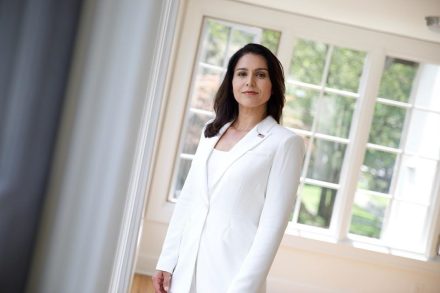
Tulsi Gabbard is looking pretty good right now. I mean, even better than usual. The veteran and Hawaii congresswoman has stood out from the crowded Democratic field with her peacenik foreign policy-focused campaign. And now President Trump, with his impulsive killing of Qasem Soleimani, has become the Big Bad Hawk Gabbard has described him as all along. When she entered the race in February of last year, Gabbard pledged to strike out against the military-industrial complex: 'We must stand up.

tulsi

Trump’s Iran strategy has finally won over the ‘Never Trumpers’

As a general rule, neoconservatives and hawkish Republican foreign policy officials don’t respect President Donald Trump’s capacities as commander-in-chief. They view him as impulsive, unwise, short-sighted, and buffoonish—the kind of guy who doesn’t do his homework, spends more time on Twitter than reading briefing books and would rather pull up America’s drawbridge than act as the leader of the free world. This crop of foreign policy intellectuals are quick to refer to Trump as an 'isolationist', a favourite pejorative of the Washington policy elite, who is shattering Washington’s superpower status into a million different pieces.

Soleimani’s assassination has exposed the EU’s big weakness

What a difference a day makes. When I went to bed on 2 January what seemed to be the most important issue in the Middle East was the long-term impact of the brave – if desperate – mass protests in Lebanon, Iraq and Iran. Many were trying to extract some positive meaning: were they the precursor of a renewed popular drive for better governance in some of the key states of the region? Could they shake the stability of the Islamic Republic of Iran and its grip on the greater Levant? Or would they be suppressed and ignored, only to recur more virulently, as had happened so many times before? When I woke up on 3 January, the world had changed.

Could Iran’s retaliation against the United States lead to war?

So it happened. Iran has just struck back against the United States for its killing of Quds force chief Qassem Soleimani on 3 January. The Iranians had vowed to retaliate from almost the moment that their most potent – and famous – commander was killed. Iran’s leader Ali Khamenei had vowed a “severe revenge.” Now it has come. And while it may not so far be “severe “exactly, it was undoubtedly swift and it was bold. Details are still pouring in about the strike but it is clear that Iran has struck two bases housing US and coalition forces in Iraq with more than a dozen missiles.

So much for de-escalation

From our US edition

‘We are not looking to start a war with Iran,’ said defense secretary Mark Esper today. ‘We are looking to finish one.’ Iran just replied by firing off at least a dozen missiles at American targets in Iraq in an effort supposedly dubbed Operation Martyr Soleimani. It doesn’t mean all out war yet — but all the Trump administration’s talk about ‘de-escalating’ the situation sounds like hot air. As I write, the details of Iran’s retaliation are unclear — we don’t know if the strikes were aimed at American troops or infrastructure. Is it a face-saving measure? A decoy? Why did Iran attack Erbil and Al-Asad, rather than more obvious US bases? Have the fortified American defenses at these bases worked?

de-escalation al asad iran
iranian

Exclusive: the Iranian cultural sites Trump will bomb

From our US edition

Hours after Donald Trump tweeted a threat to target ‘52 Iranian sites’, some of them ‘at a very high level & important to Iran & the Iranian culture’, Cockburn met an Iranian exile source at the Moby Dick House of Kabob, Connecticut Avenue, Washington, DC. The source took Cockburn’s order and then slipped a tiny piece of paper no bigger than a grain of rice into Cockburn’s baghali polo. As baghali polo is a rice dish, Cockburn didn’t know this until he’d eaten it. It took 24 hours to recover the message. When Cockburn read it, he realized that he was holding the president’s target list.The first five targets are listed here.

My clash with Alastair Campbell convinced me it’s time to hug a remainer

I confess I had butterflies doing the first BBC Politics Live of 2020. It felt like the first day back at school. Beyond Twitter spats and Christmas family banter, the festive period had been politics-free. Would I be rusty, especially as one of the other panelists was the formidable Alastair Campbell? As a former People’s Vote heavyweight, Campbell is something of an arch nemesis who has a reputation for taking no prisoners. But regardless, one of my new year resolutions is to not dwell on past enmities. I am keen to build some unity, in order to make Brexit as productive as possible.

Boris Johnson’s dismal response to Qasem Soleimani’s assassination

Two weeks ago, I asked what kind of prime minister Boris Johnson might be and whether he could be ‘the great disruptor’ on foreign policy, defying standard practices and elite assumptions as Donald Trump has. I think I might have my answer. On Trump’s decision to take out Iranian terrorist-in-chief Qasem Soleimani, the Prime Minister was silent for two days. When he finally spoke, it was hardly worth it. Of course Johnson was right to say, given the Quds Force head’s role in the killing of thousands of civilians, ‘we will not lament his death’. He was right too to warn Tehran against escalation.

Will the Iran-US confrontation spiral out of control? Even the experts don’t know

From our US edition

Politicians and policy experts tell us, with confidence, that America’s targeted killing of Qasem Soleimani makes the world safer — or more dangerous. Take your pick. Whatever answer they give, the talking heads sound very certain. They shouldn’t be. However deep their understanding of Iran, the Middle East, and US foreign policy, nobody really knows what will happen next.The problem is simply too complex. It depends on a sequence of difficult decisions, first by Iran’s Ayatollah Ali Khamenei and then by President Donald Trump, each responding to the other’s choices, each calculating the risks of going too far — or not far enough.The next decision is Tehran’s.

iran
pompeo

Mike Pompeo’s dishonest Iran defense

From our US edition

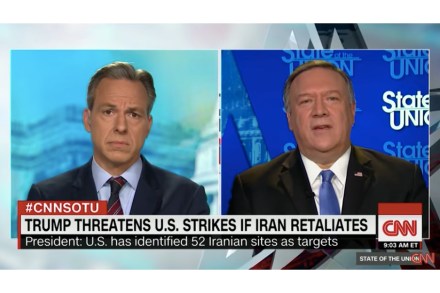
P.G. Wodehouse once described a character as so crooked that he sliced bread with a corkscrew. Secretary of state Mike Pompeo’s behavior on the Sunday morning television shows brings to mind Wodehouse’s description. No, Pompeo wasn’t toting a corkscrew or a loaf of bread, but he offered a study in deceit. Pompeo didn’t merely reiterate the wafer-thin claim that Iran was about to pose an 'imminent' threat to American interests in the Middle East, but also claimed that President Obama and his aides had essentially been in league with the mullahs of Tehran.In responding to Jake Tapper of CNN, Pompeo was unable to explain how blowing Qasem Soleimani to kingdom come would enhance the safety of America.

Qasem Soleimani’s demise is a gamechanger for Israel

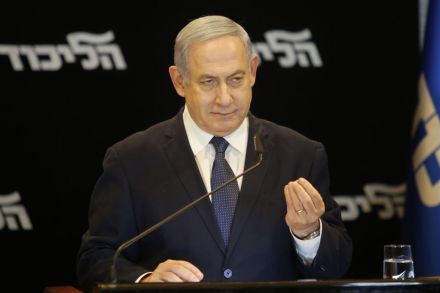
The targeted assassination of Qasem Soleimani is a game changer for Israel in its simmering conflict with Tehran. This drone strike could mean an Iranian attack on Israel in response. But whether Iran seeks to attack or not, it means that the country’s remaining allies in the region – such as Hezbollah’s leader Hassan Nasrallah – will know they could meet a similar, sticky end to Soleimani. For Israel, Trump's decision to target Soleimani is a moment to celebrate. Israel viewed the Iranian Quds Force commander as a central figure behind Tehran’s threats to destroy Israel. In August, Israel's PM Benjamin Netanyahu gave a stark warning to Soleimani, blaming him for an attempted drone attack on Israel from Syria.

Iran’s generals are weeping for Qasem Soleimani. But soon they will prepare to fight

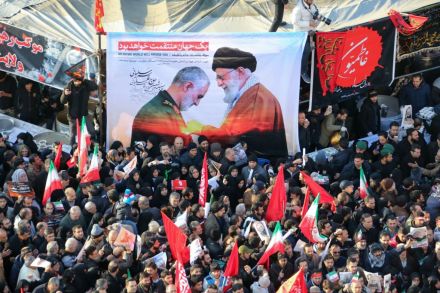
It has been 24 hours since America droned Qasem Soleimani near Baghdad airport. Now both Iran and the United States are getting ready to deal with a new reality in the Middle East that has (quite literally) exploded into being. There is a mutual recognition that when Soleimani died, the old rules of the game died alongside him. What is instructive about his assassination is not that it happened, but that it took so long. After all, this was a man whose carefully posed portrait spread across Twitter every time he visited yet another of Iran’s many wars in the region. If I knew when Haji Qasem was in Syria, then the Americans surely did too.

Ten handy phrases for bluffing your way through the coming Iran crisis

That gathering drumbeat you hear could be the sound of World War III, or it could be 10,000 journalists still Googling facts about Iran following the assassination of Qasem Soleimani. The internet is a bluffer’s paradise, but it also means that everybody— not just the hacks — now feels a strong impulse to talk knowledgeably about the Middle East when news happens. You have to know your Shiite, as they say, your IRGC from your Kataib Hizbollah. Don’t muddle Khamenei with Khomeini. But more importantly don’t be afraid! The Spectator is here with some handy phrases to get you through any difficult Twitter spat or pub chat. 1) Say ‘Iran’s proxies in the region’ a lot The word ‘proxies’ is bluffer gold-dust so sprinkle liberally.

China and Russia win from America’s wars

From our US edition

I woke up late on Friday, so missed the livestreamed assassination of Franz Ferdinand and the rolling barrage of tweet-commentary about the super-judicial martyrdom of Hassan Thingy and the start of World War Three. It was all over by lunchtime, bar the shooting, because there could only be one winner. Or was that two?The first winner, as always when it comes to American foreign policy, is Xi’s China. Anything that ties the United States into the open-ended shambles of the Middle East distracts the energies of the United States, and the eyes of America’s allies and clients, from China’s surreptitious campaigns to replace the United States as global patron. In war as in online shopping, China emerges as hegemon not despite American efforts, but because of them.

china
neocon soleimani

Taking out Soleimani is like stepping on a landmine to cure a headache

From our US edition

Talleyrand once commented that Napoleon’s execution of the Duke of Enghien in 1804 was worse than a crime. It was a mistake. Something similar could be said about President Trump’s liquidation of Maj. Gen Qasem Soleimani, the head of the Islamic Revolutionary Guard Corps. No one will miss the villainous Soleimani, but killing him was the equivalent of stepping on a landmine to cure a headache. What on earth could Trump have been thinking — if he was thinking at all? Trump has in effect ceded his foreign policy to the hawks. So much for Trump the restrainer. Hello, Donald Trump neocon. Trump has launched America into the path of a war with Iran that it can win but only at a cost that is disproportionate to the terrible cost it will pay.

How will Boris Johnson respond to Qassem Soleimani’s killing?

President Trump’s decision to assassinate Qassem Soleimani accelerates perhaps the most important post-Brexit decision faced by Boris Johnson: whether to stand with the US or the EU at moments of potentially acute global crisis. What happens next will largely be conditioned by how Iran responds and retaliates. But all Western governments are examining their options. In particular, France’s president Macron will be working hard to forge a coordinated EU and European response, not least because through the G7 over the summer he endeavoured to engineer a dialogue between president Trump and Iran. Those close to Macron say he admires Johnson. But there are members of the government who harbour the traditional British mistrust of a strong French president.

The Soleimani assassination is Donald Trump’s biggest gamble yet

Ever since Donald Trump was elected president on a non-military interventionist platform, sceptics have questioned his commitment to withdrawing troops from the Middle Eastern quagmire and stopping the endless wars he claims to despise. Now he has authorised the assassination of Qasem Soleimani, the head of the powerful Iranian Quds Force, we can be in absolutely no doubt on whether he stands: he’s no different to the other US presidents. It’s a massive strategic gamble. Soleimani was the second most powerful figure in Iran, answering only to the Ayatollah himself. For more than a decade he has been the architect of Iran’s regional military strategy. He helped Iraq and Syria defeat Isis. Among the Iranian masses, he was a hero like no other.

What could go right for Trump in 2020?

From our US edition

It’s starting to dawn on Democrats that Donald J. Trump might stand on the steps of the Capitol in January 2021 to swear his oath of office for the second time. A new Gallup poll indicates that he and Barack Obama are tied as the most popular men in America. So what are the four things that might help further smooth Trump’s oath to reelection? First, despite the preposterous pearl clutching of Freddy Gray on this website, Trump’s hardline against Iran could pay off. He’s steadily raising the military and economic pressure on Tehran. Contrary to all the naysayers, Trump could end up showing that Iran, not America, is the paper tiger.

right