History

Bloody Marys and glorious Jean

From our UK edition

To the Western Isles, or at least to its embassy in Belgravia. Boisdale restaurant always claims to be extra-territorial. There was an awards ceremony, and the principal recipient was a remarkable old girl. Ninety-four years into an extraordinarily diverse life, Jean Trumpington is one of the funniest people I have ever met. She is also one of the bravest. She was born in easy circumstances, a child of the affluent upper middle classes, and the first disruption occurred when her mother lost a lot of money in the Great Crash. Her family did not exactly become poor, but she had her first lesson in adversity, and on the unwisdom of taking anything for granted. At the beginning of the war, she set off to be a land-girl on David Lloyd George’s farm.

Jaipur Notebook

From our UK edition

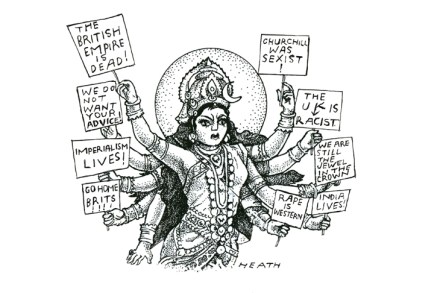
Did Winston Churchill, like Donald Trump, also like to ‘grab them by the pussy?’ Last week at the Jaipur Literary Festival, I was on a panel discussion entitled ‘Churchill: Hero or Villain?’, where the Indian biographer Shrabani Basu told a large crowd that at a suffragettes’ demonstration outside Parliament in November 1910, Churchill, then home secretary, had ‘given instructions for police that they can batter the women and assault the women and sexually assault them as well’. He allegedly told policemen to ‘put their hands up their thighs, they can grope them and press their breasts’. ‘Can I just point out that that is completely untrue?’ I intervened.

British placenames

From our UK edition

British placenames are so good you can read the map for entertainment rather than navigation. Hardington Mande-ville, Bradford Peverell, Carlton Scroop — they sound like characters in a novel. In fact, P.G. Wodehouse often raided the atlas when writing: Lord Emsworth is named after a town in Hampshire, while a village in the same county gave Reginald Shipton--Bellinger his surname. There’s plenty of silliness out there — Great Snoring in Norfolk, Matching Tye in Essex, Fryup in Yorkshire. Some good old-fashioned smut, too: Lusty Glaze, Pant, Bell End and a couple of Twatts. Kent boasts a Thong — and it’s only a mile or so from Shorne. But enough of your sniggers. Our placenames are educational, telling the history of who was where, when.

Day of infamy

From our UK edition

On 7 December 1941, without declaration of war, 350 Japanese carrier-borne aircraft struck at the US Pacific Fleet at anchor in Pearl Harbor, Hawaii — in President Franklin D. Roosevelt’s ringing words, ‘a date that will live in infamy’. For the 75th anniversary, Craig Nelson, a New York Times journalist, has, says his publisher, produced ‘a definitive account’. I disagree. Indeed, if this book were a motor car (or ‘automobile’, for it is a re-print of the US edition, with American usage and spelling), it would have to be recalled for extensive safety modifications and replacement parts.

Sins of the flesh

From our UK edition

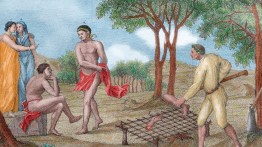
Bill Schutt has an excellent subject, and he explores it from a promising angle. Cannibalism has long interested zoologists, anthropologists, historians, criminologists, literary theorists and students of theology and blasphemy — the absurd claim that Roman Catholics were commending it in their account of transubstantiation was a favourite with 18th-century English blasphemers. Few people have tried to bring all these together, and perhaps by the end we have to conclude that there is not much connecting the very different elements at the remote ends of the scale. Still, it was worth a try. Schutt is an animal scientist, and he begins with the simpler organisms. At the bottom of the scale, cannibalism in invertebrates is actually quite common for particular purposes.

Keep the change

From our UK edition

Can we do without cash? Since 2015, digital payments in the UK have outnumbered those in cash, and we are invited by the great and the good to cheer this on. The fully cashless era will be magnificently convenient, they say, with goods delivered directly to the door: no fumbling for change, just tap and go. Some London branches of several chains (Waitrose, Tossed, Doddle) don’t accept cash any more. Many others fast-track customers who can pay by contactless means. Businesses and banks want to abolish cash because they have near-pathological fears of the black market and tax avoidance. Yet we should worry about the death of cash, because physical money possesses worth far above its face value. Cash is the great leveller.

Barometer | 19 January 2017

From our UK edition

Starting cold Why is US Presidential Inauguration Day always on 20 January? — The date was moved from 4 March in the 20th amendment to the US constitution, passed on 23 January 1933, but it is hard to find any significance to the date. The change was made in an attempt to reduce the lame-duck period of an outgoing president, though it did increase the risk of a repeat of what happened in 1841 when William Henry Harrison was sworn in. Choosing not to wear a coat, hat or gloves, he made the longest inaugural speech of any president, at two hours. Three weeks later he was reported to be suffering from a cold, which developed into pneumonia and then pleurisy, leading to his death on 4 April — although some doubt the connection with inauguration day.

Letters | 19 January 2017

From our UK edition

Particle of faith Sir: Fraser Nelson draws our attention to the most worrying aspect of economists getting it wrong, which is their reluctance to recognise it (‘Don’t ask the experts’, 14 January). Some economists, seduced by sophisticated mathematical models, aspire to the status of, say, particle physicists, who can tell us they have found something called the Higgs boson. The fact that we tend to believe the particle physicists despite being more familiar with prices, jobs and buying and selling than with quantum equations comes down to physicists having a long track record of heeding the biologist E.O. Wilson’s advice: ‘Keep in mind that new ideas are commonplace, and almost always wrong.

Monumental folly

From our UK edition

The astonishing has happened at Stonehenge. Some prehistoric force has driven ministers to make a decision. It is to spend half a billion pounds burying the adjacent A303 in a tunnel, to bring ‘tranquillity’ to the ancient place. The result has been a predictable outcry from protestors. The television historian Dan Snow has compared the Transport Secretary, Chris Grayling, with Isis in Palmyra: ‘vandals and zealots who destroy ancient artefacts’. Stonehenge drives men mad. The stones have for a quarter of a century been as impregnable to change as they have always been to interpretation. Whitehall has been unable to decide what to do with a single-carriageway road which runs 200 metres from the stones and causes hour-long traffic jams in summer.

Who commands the sea?

From our UK edition

From ‘Raiders, submarines and some naval problems’, The Spectator, 20 January 1917: At the moment the enemy’s fleet is compelled to remain in its own ports and to challenge us from safe retreats, sometimes behind lock-gates and always behind well-sown minefields. Still, the fact remains that the enemy can come out if they like, though we cannot make them do so when we like, and further that with good luck they can actually smuggle out a raider or two. We are top-dog, but up till now we have not been able to get a good bite at the under-dog, and he remains, though in a humiliating position, quite fit for work and mischief.

A shameful whitewash

From our UK edition

I have been researching and writing about black British history for over 30 years but never before have I been fortunate enough to review a 600-page book on the subject, published to accompany a recent major BBC documentary. The book and the four-part series give some indication of the extent of a history which David Olusoga presents as ‘forgotten’: the subject, he argues, has been largely excluded from the mainstream narrative of British history. Why it should be forgotten, and who might have forgotten it should give us all pause for reflection, since the denial of black British history by those who should know better could be considered tantamount to racism.

The puppet queen

From our UK edition

It is easy to see why the bare century of the Tudor dynasty’s rule has drawn so much attention from contemporary women historians. Without breaking sweat, I can think of at least ten — four of whom garland this book with advance praise — who have written biographies or studies of the Welsh upstarts, leaving aside the acclaimed fictional efforts of Hilary Mantel. For of the six Tudor monarchs who steered England’s destinies through the tumultuous 16th century, three were female. The half-sisters Elizabeth and Mary — who both loom large in Nicola Tallis’s stunning debut — need no introduction, but the third, Lady Jane Grey, the subject of her searching biography, has until now remained in the shadows.

Only obeying orders | 12 January 2017

From our UK edition

Spare a thought for the poor Gulag guard: the rifleman standing in the freezing wind on the outside of the wire, almost as much a captive of the Stalinist prison machine as the inmates he’s guarding. Alexander Solzhenitsyn, Evgeniya Ginzburg and Varlaam Shalamov have left the world a rich, searing portrait of the Gulag from the point of view of the prisoner. But the diary of Ivan Chistyakov is unique — a narrative of the brutal conditions in Stalin’s Gulag, told from the point of view of one of the captors. Chistyakov was a senior guard at the Baikal-Amur Corrective Labour Camp or BAMLag, and he wrote his personal diary in 1935–6, just as Stalin’s henchman Naftaliy Frenkel was putting his scheme for mobilising convict labour into high gear.

Red faces

From our UK edition

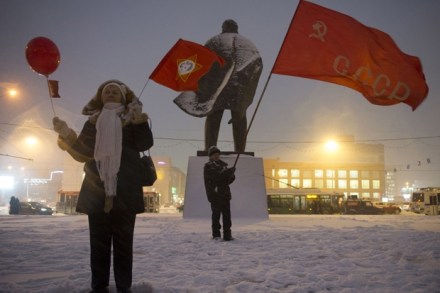
How to celebrate the centenary of the Russian revolutions of 1917? Modern Russians are deeply divided over the legacy of that tumultuous year. Russia’s few remaining liberals remember that the overthrow of the tsar in February 1917 ushered in a flowering of the artistic avant-garde, a brief period of feminism, liberal values and democracy. Putin supporters, on the other hand, have been convinced by years of state television propaganda that popular revolutions are by definition dangerous and anarchic, and usually orchestrated by dark outside forces. Whether in Maidan Square in Kiev in 2013, Tahrir Square in Cairo in 2011 or Palace Square in Petrograd in 1917, the very idea of the people taking power into their hands is anathema to the Kremlin’s ideologues.

A killing to celebrate

From our UK edition

From ‘News of the Week’, The Spectator, 6 January 1917: The war has been crowded with romantic adventures by sea and land in every part of the world, but perhaps nothing is more sensational, more reminiscent of blue lights and the accents of warning and suspense from the orchestra, than the murder of the monk Rasputin in Petrograd… Whether those who took his life did so on the grounds of private revenge or of patriotism remains to be seen. In any case, we agree with Reuter’s correspondent that the disappearance of this sinister figure is a subject for congratulation for all true friends of Russia.

Emile in exile

From our UK edition

Michael Rosen, a poet, journalist and prolific author of novels for children, has written an account of Emile Zola’s year’s exile in England between July 1898 and June 1899, as a result of his involvement in the Dreyfus Affair in France. It is not a dispassionate work of history but a homage to Zola, ‘a hero in my eyes’, for his fight against anti-Semitism. Zola not only made ‘a brave, unpopular, self-sacrificing decision to support a wrongly convicted man’, but also persuaded the socialist leader Jean Jaurès to join the fight against anti-Semitism: at the time of Dreyfus’s conviction in 1894, both Jaurès and Georges Clemenceau had called for him to be shot.

Knowing the score

From our UK edition

When I come home from work and stick my key in the door, there is a pitter-patter of tiny feet as my eight-year-old twin boys run up to me and shout: ‘Paris St-Germain won 3-1! First he scored, then he missed, then…’ They are suffering from a harmless case of sports geekery. I had it myself as a child, and have gone on to hold down a job, albeit in the dying industry of journalism. The only difference is that as a child I wasn’t encouraged to bore my dad with my findings, because helicopter parenting hadn’t been invented yet. A complicating factor in our family is that we live in Paris, and when my sons recite sports statistics in strangely accented French children’s slang I often struggle to understand them, especially at breakfast.

Red with the people’s blood

From our UK edition

Few 20th-century historians doubted that the 1917 Russian revolution was one of the most influential events of their time, indeed of all time. As the centenary commemoration approaches, however, it seems remarkable how far and how fast the ideology that inspired Lenin and millions of his worldwide followers has receded in significance. Many are the imperfections of capitalism, but almost nobody outside Jeremy Corbyn’s office any longer supposes that communism, least of all the old Soviet brand, offers a credible alternative. This would amaze our grandparents’ generation on both sides of the struggle. The novels of C.P. Snow are indifferent fiction but intriguing middle-class social history.

The invention of Santa

From our UK edition

Santa Claus ate Father Christmas. It happened quite suddenly. Well, it took about a decade, but that’s suddenly in cultural terms. Over the course of the 1870s the venerable British figure of Father Christmas was consumed by an American interloper. Father Christmas (first recorded in the 14th century) was the English personification of Christmas. Just as Jack Frost is a personification of the cold and the Easter Bunny is a rabbitification of Easter, so Father Christmas stood for Christmas. He was an old man (because Christmas was ancient) and he was plump (because Christmas was a feast). But Father Christmas did not give presents, did not come down the chimney, had nothing to do with stockings or reindeer and did not live at the North Pole.

Faith in the trenches

From our UK edition

From a letter published under the heading ‘The religion of the ordinary soldier’, The Spectator, 23 December 1916: During a discharge of gas at the beginning of July along our front, one of the cylinders was displaced by the near bursting of an enemy shell. It turned the nozzle round, and the gas began to pour into our own trench. One of my lads, who was acting as orderly, heard from the communication trench that something was happening and ran into the front line… He ran forward unprotected, tugged at the cylinder, and pointed its nozzle outwards again before he fell unconscious. He died a few minutes afterwards. Those who saw it told me it was a quite spontaneous action. This boy would have told you that if his name was on a shell, it was no use running away.