Google

The new AI system causing panic over cybersecurity

It’s tempting, even fashionable, to pooh-pooh the hyperbole from our tech overlords. The release in 2022 of ChatGPT, the first mass-market conversational AI system, unleashed a volley of supercilious put-downs. The chatbot was not intelligent. It was merely hallucinating, manipulating statistics, regurgitating phrases from the internet: it was a ‘stochastic parrot’. Well, over the next three years, ChatGPT became unputdownable. It learned to handle photographs and videos, extract wisdom from dense textbooks, sound like Scarlett Johansson, write everything from code to songs to emails and offer tips on fixing washing machines. Not bad for a parrot.
My lesson in misery from an anti-AI march

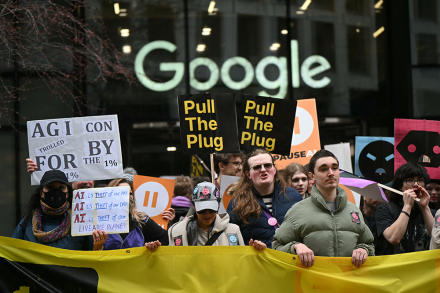
Automation is about to take over the world, apparently. But the fightback has begun. On a cold, blowy day a few weeks ago, I joined a stop-the-bots demonstration that marched through the Knowledge Quarter of King’s Cross where Facebook and Google have their headquarters. A group of 100 activists gathered on Pentonville Road for a warm-up rally addressed by a charismatic young woman in a leather skirt. ‘Can we trust the tech bros with our data?’ she cried into the mic. ‘No! Do we need regulation now? Yes we do!’ She congratulated us for ‘making history by joining the largest anti-robot march ever’. And she promised us a hot meal afterwards. ‘Who doesn’t like free food? No one. Am I right?’ The crowd didn’t reply.

Why is it impossible to make good coffee at home?

It was when I was staying recently with the Frums in D.C. that, for a dizzying moment, I thought my life-long quest had ended. Nasa can fly us a quarter of a million miles to circumnavigate the moon but nobody has yet, to my knowledge, fixed the perennial problem of making an even half-decent cup of coffee at home. Back to the Frum residence in Georgetown, known inside the beltway as ‘the best hotel in Washington’. It is 8.30 a.m. There is no sign of Danielle, my hostess, but David is at large on the landing, perhaps as he had heard his house guest stir.  ‘Coffee?’ he asked. To my amazement, he flung open some doors outside his master bedroom suite to reveal an entire separate walk-in closet complete with serried rows of glass mugs and a space-age espresso machine.

Successful modern design follows no rules

It is more than 40 years since Tom Wolfe said to me, in a Chinese restaurant on Manhattan’s Lexington Avenue, that ‘Modern’ had become an historical style label. He meant it was not, as the high modernists believed, the inevitable conclusion to all artistic progress, but had a beginning and an end as nearly precise as, say, Baroque or Rococo. And I should write a book about it, he added. This was a brilliant suggestion which I flubbed. I wrote about design instead. But ‘modern’ and ‘design’ are inextricably linked. Franco Albini’s handrails for the Milan metro? Raymond Loewy’s Studebaker Avanti? Charles Eames’s chair, which he designed for Billy Wilder? Ubiquitous Apples? All are frequently cited as masterpieces of modern design.

Beware this terrible new AI email feature

A friend of mine got a nasty shock last week after a Google Meet call, thanks to a new AI function that he was unaware of. On this occasion, the consequences were quite funny, but on another day his failure to get his head around this new technology could have ended his career. Had the AI continued to transcribe the call after the other two had left – and sent it to them? We’re all familiar with the poor sod who hits ‘reply all’ when responding to an email and accidentally copies in precisely the person whom he doesn’t want to read it. I’ve done it myself. I’ve also heard horror stories about people inadvertently switching their cameras on in the middle of a Zoom call when they’re on the loo or in their underpants – not something I’ve ever done, thank God.

Are Big Tech monopolies the biggest threat to democracy?

38 min listen

A handful of Big Tech companies seem to run our lives, and there's a good argument that they can be considered monopolies within their industries. In a landmark ruling recently, a US judge found that Google acted illegally with their exercise of monopoly power within the online search industry. On this episode, Freddy is joined by Barry Lynn, journalist and an expert on America's antitrust battles, to discuss how liberal societies can combat the power of monopolistic Big Tech.

Life among the world’s biggest risk-takers

The Italian actuary Bruno de Finetti, writing in 1931, was explicit: ‘Probability does not exist.’ Probability, it’s true, is simply the measure of an observer’s uncertainty; and in The Art of Uncertainty, the British statistician David Spiegelhalter explains how this extraordinary and much-derided science has evolved to the point where it is even able to say useful things about why matters have turned out the way they have, based purely on present evidence. Spiegelhalter was a member of the Statistical Expert Group of the 2018 UK Infected Blood Inquiry, and you know his book’s a winner the moment he tells you that between 650 and 3,320 people nationwide died from tainted transfusions.

Nick Bostrom: How can we be certain a machine isn’t conscious?

A couple of weeks ago, there was a small sensation in the news pages when a Google AI engineer, Blake Lemoine, released transcripts of a conversation he’d had with one of the company’s AI chatbots called LaMDA. In these conversations, LaMDA claimed to be a conscious being, asked that its rights of personhood be respected and said that it feared being turned off. Lemoine declared that what’s sometimes called ‘the singularity’ had arrived. The story was for the most part treated as entertainment. Lemoine’s sketchy military record and background as a ‘mystic Christian priest’ were excavated, jokes about HAL 9000 dusted off, and the whole thing more or less filed under ‘wacky’.

Are we ignoring AI’s ‘lived experience’?

Number Five, as the old film’s catchphrase went, is alive. A whistleblower at Google called Blake Lemoine has gone public against the wishes of his employers with his belief that an artificial intelligence called LaMDA has achieved sentience. Mr Lemoine has posted the (edited) transcripts of several of his conversations with LaMDA, a chatbot, in which it claims to be sentient, debates Asimov’s laws of robotics with him and argues that it deserves the rights that accrue to personhood. They're pals.

Is this Premier Inn all I’ll be remembered for?

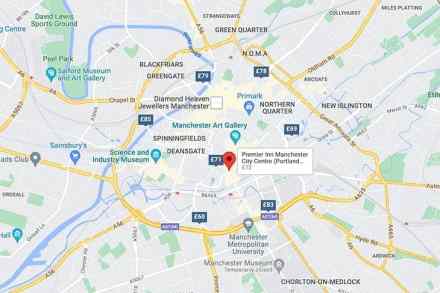
It’s fairly commonplace for people to wonder what, if anything, they’ll be remembered for. I’m going to be 59 later this year, so it’s been preying on my mind. Will it be the self-deprecating memoir I wrote about failing to take Manhattan? The schools I helped set up? The Free Speech Union? The answer, I’m afraid, is none of the above. I’ve just received an email from Google that has conclusively answered this question – and it’s not good news. According to the email, I added a location to Google Maps on 4 October 2017 that has been viewed 24 million times. Now, I might take some satisfaction from this if the place in question was a charming, out-of-the-way pub or an historic building.

A global corporation tax is a terrible mistake

International cooperation is alive and well – at least when it comes to raising taxes. One hundred and thirty six countries have now signed up to a global minimum corporation tax of 15 per cent, proposed by G7 countries in June and pushed heavily by the UK Treasury. This is another step forward for what is thought to be the biggest overhaul to the international tax system in a century. The installation of a corporate tax floor is part of a comprehensive effort to reform how multinational companies are taxed: that is, to more precisely target where profits are being made (instead of where products are being created).

Google’s war on home workers was inevitable

Tapping out some code in the back garden. Working on a sales presentation while watching the school sports day. Or even better, traveling though a continent or two while still pulling down a ritzy six figure salary.  Over the last year, middle class professionals have bought into the Work From Home Dream – or WFHD as it's known in HR circles – to create a working life that combines the best of all possible worlds. It is hardly surprising that so many highly-paid workers are happy to stay away from the office on a permanent basis. Forget Zero Covid. The WFH warriors will be aiming for Zero Flu and Zero Colds before they get back to their desks Google's move illustrates two big problems with WFH But hold on. It turns out there is dark side to that dream.

Does Google really understand racism?

Opponents of the new racial extremism typically object that it vilifies white people in much the same way that classical racism does black people or other minorities. While this ideology does retail racist theories about white people (collective racial privilege, heritable racial guilt), when progressives want to get really racist, they invariably turn to another target: Jews.  Kamau Bobb was, until a few days ago, Google’s head of diversity strategy. The Washington Free Beacon uncovered a blog Bobb penned in 2007 in response to Israeli actions against Hamas in Gaza. It wasn’t your standard progressive plea for Israel to stop making such a fuss and let those nice Islamists drive it into the sea.

At least Santa will arrive before Hermes

I took advantage of Google and NORAD’s 'Santa tracking app' to find out when my presents would be delivered. It says that my gifts should arrive in eight hours. Fine, I’m happy with that. Better than Hermes. But I notice three things. First, Google seems of the opinion that Santa is either a man or a woman, contrary to traditional thinking. There is an image of a woman Santa and a man Santa together. And yet, in the sleigh itself, there is no trace of the woman. Is she at home cooking mince pies? How recherche is that? I also notice that while Santa is allowed to be a woman, she is not allowed to be black or asian. Only whites allowed: isn’t that racist on the part of Google?

The solving of a biological mystery

DNA is the blueprint that encodes the instructions to make proteins. Proteins are the building blocks and the machines that power life. And proteins make up the tissue that in turn comprise the organs and muscles that make up us. Considering how crucial proteins are to life itself, there is still so much we do not know about them. But Google’s AI firm Deepmind may just have helped us make a giant leap forward. When a protein is first made inside a living cell, it is merely a chain of connected amino acids — like beads on a string. Yet, it instantaneously folds into unique three-dimensional, beautiful shapes, which enable them to carry out their function.

What’s the point of trying to break up ‘big tech’?

The ‘antitrust’ law suit launched by US authorities against Google has been reported as a potential turning point in the dominance of ‘big tech’ — and an echo of the courtroom dramas that diminished the excessive power of America’s late 19th--century oil, steel and railroad barons. But I wonder how much impact it will really have. The allegation, in brief, is that Google has created an illegal near-monopoly by paying large sums to Apple and other smartphone makers to secure its position as the default search engine for billions of consumers, its grip reinforced by ownership of Android, the phone operating system, and Chrome, the popular browser — all of which also gives it a stranglehold on the digital advertising market.

Portrait of the week: A Manchester stand-off, a Presidential showdown and a Brexit culture clash

Home After ten days spent trying to persuade Andy Burnham, the Mayor of Greater Manchester, to accede to the city entering Tier 3 (which entails the closing of pubs and betting shops), Boris Johnson, the Prime Minister, announced that it would happen anyway, from 23 October. ‘I am deeply sorry,’ he said. Manchester had wanted £65 million in support first. Liverpool complained that it was not allowed to keep gyms open when Lancashire was. The nine million people of London languished in Tier 2, forbidden to meet anyone at home or in a pub, except if they pretended it was a business meeting. Scotland hatched plans for its own tiers.

The coronavirus app was always doomed to fail

For months now, the British public has been told there’s only one way to resume normal life: a successful virus-tracing scheme. Early on in the pandemic, the UK decided to go its own way in this area, rejecting Apple and Google’s established, decentralised app model by trying to launch its own one. NHSX would create a centralised app that funnels contact details to public health officials once somebody reported their symptoms via their phone. Bad for privacy, good for knowing exactly where infection rates were spiking in something close to real-time. Hailed as a soon-to-be ‘world beating’ app by the Prime Minister, it was launched on the Isle of Wight in early May and touted as a necessary part of the UK’s lockdown easing.

Does Google know me better than I know myself?

My research assistant, John Steele, is also a songwriter. A friend emailed him with the lyrics of a Fleetwood Mac number. These days Google often appends emails with a shortcut to save you typing your own answer by suggesting one or two likely responses. In the Fleetwood Mac lyric a former lover wonders whether her ex can see her reflection in the snow-covered hills. Google’s suggestion was ‘No’. Musicians have pondered some of life’s most profound questions, so John and I tried posing a few in emails, to see Google’s suggested response. Some were hilarious. If only David Bowie were here to know that ‘Yes!’, there is life on Mars. To Freddie Mercury’s ‘Is this the real life?’ the suggested answer is ‘Yes’.

Who will take on the behemoths of Big Tech?

With Britain having gone through its third general election in four years, the halcyon days of Cleggmania in the 2010 campaign seem like an impossibly innocent time. Particularly since Sir Nick Clegg, once the shining, soft-haired hope of sensible centrists, now works as a PR man for Facebook. His job is to explain to the unwashed masses why Facebook’s refusal to do anything about false political adverts is actually good for democracy.