George osborne

Number crunching cuts

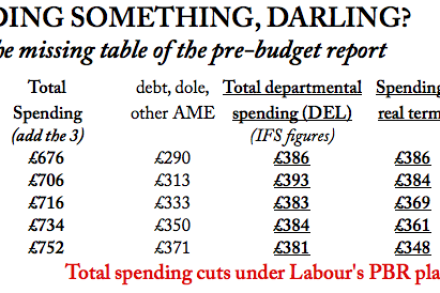
The debate about cuts so far lacks any numbers, so I thought CoffeeHouses might like some. Contrary to what he claims Darling is planning cuts – but he just didn’t print the spending totals in his Pre-Budget Report (lack of space, one presumes). The Institute for Fiscal Studies, which produces its Green Budget tomorrow, has worked out what will be left for departments after debt interest, dole et. It amounts to a 10 percent cut. Here’s the table. Yet the Tories plan for DFID to be 0.7 percent of GDP by 2013 – ie, rising by 63 percent - and health will not be cut. Cameron has indicated that he will not cut much in 2010-11, so let’s assume that the Labour spending rises for various departments go ahead as planned. Results below. The result?
Osborne’s speech contained not a whiff of radicalism

I’m afraid I did not detect a “new economic model” in George Osborne’s speech. He has said he will “eliminate “a large part” of the deficit (ie, the amount that debt goes up by) over the next parliament. In questions, he kept repeating this phrase: “a large part” - and which is woolier than Labour’s plan to halve it. When asked about this he said that he would do more than half it – but gave no indication by how much. It could be a lot, or a negligible amount. We still don’t know. Osborne said he will stick to what was, in my view, the root error of the recession: the 2 percent CPI target. Inflation was fine in the boom years – it was asset price inflation that pointed to the debt bubble.

The Tories are muddying their clear, blue water

Front page of the Independent: "Vote of no confidence in Tory economic policies".  As headlines go, it's one of the worst the Tories have had for a while - even if, as Anthony Wells and Mike Smithson point out, it's kinda misleading.  Truth is, the Indy's ComRes poll finds that 82 percent of people want "Mr Cameron to be clearer about what he would do on the economy".  And 24 percent think the Tories would have ended the recession sooner, against 69 percent who don't.  They're hardly positive findings for CCHQ, but, by themselves, they don't quite add up that that two-line scarehead.

Mandelson is spinning to his heart’s content

Peter Mandelson was doing his full Alan Rickman impression at Labour’s press conference this morning. His aim was to imply that every time Labour put the Tories under pressure they wobble. As so often since his return to British politics, Mandelson delivered lines that were so memorable that they were bound to make it into copy. He said that the Tories “would strangle the recovery at birth”, that David Cameron was “bobbing around like a cork in water”, and that George Osborne was the Tories’ “weakest link”. As I type, Mandleson’s sound bites are being replayed yet again on News 24. Now, these lines aren’t going to cut through to the British public.

Cameron has shifted the spending debate to Labour’s home ground – but the Tories still have an aggregate lead

So, is David Cameron's shift in emphasis on spending cuts a u-turn, a clarification, or something else?  Well, when it comes to existing Tory policy, it doesn't actually change much.  We were always rather taking it on trust that Cameron & Co. would cut spending by much more than Labour this year.  The cuts they've announced so far aren't really that much deeper – and most folk in Tory circles were waiting for George Osborne's potential Emergency Budget to see whether that would change.  So, when Cameron says that his party wouldn't introduce "swingeing cuts" this year, the position is still remarkably similar: we still need more details to judge the true extent – not the publicised extent – of any Tory cuts.

Clarification or u-turn?

Smarting from the savaging he received in Mo, Peter Mandelson characterised David Cameron’s "no swingeing cuts” comment as a u-turn, and compared Cameron and Osborne to Laurel and Hardy. This is a bit rich considering the government’s obvious confusion over the timing and extent of cuts, and that the immortal line “That’s another fine mess you’ve gotten us into” should be the Tories’ campaign slogan. Cameron’s comments are a clarification, not a u-turn. As Jim Pickard notes, Tory policy has to respond to last week’s withered growth figures.

Out of recession and into debt

The deficit is in the Tories' crosshairs this morning. George Osborne pens an article in the Times, castigating Brown's obsession with continuity: ‘We need a new British economic model that learns from the mistakes of the past. First, that new economic model requires government to live within its means. We entered the recession, after years of growth, with one of the highest deficits in the developed world and we leave the recession with our credit rating under threat. That will have potentially disastrous consequences for international confidence. If Britain starts to pay the sort of risk premiums that Greece is paying, the interest bill on a £150,000 mortgage would go up by more than £200 a month.

An election victory is only the start of the battle for Cameron

The News of the World has done its poll of marginal seats today (story here, Anthony Wells here) – a hugely expensive operation, but worthwhile because British elections are decided in marginal seats. National polling, while interesting, can be a misleading indicator of outcome. The result is that the Tories have a safe lead of 13 points (take a bow, Lord Ashcroft), but would still end up with just a 38-seat majority due to Westminster’s unfair voting system. As I say in my column, this is nowhere near a ‘safe’ majority, because it means the government can be defeated by 20 rebels.

Darling talks sense on public sector pay

How things change.  A few months ago, Alistair Darling would only go so far as to not rule out a public sector pay freeze.  By the time of the Pre-Budget Report, that became a 1 percent cap on pay rises.  And now, in an interview with the Sunday Times, he's talking explicitly about public sector pay cuts.  He cites the example of the private sector, where workers have accepted cuts to hang onto their jobs. It certainly makes sense.  Wages make up such a hefty proportion of public spending, that any serious plan to cut the deficit will have to take them into account.

Labour have Osborne in their sights (and on their fridges)

It's only a small thing, but does anyone else find this detail from today's Times interview with Alastair Campbell a little, erm, peculiar: "On the [Campbell] fridge is a Christmas card from David Miliband, a clipped photo of George Osborne in the Bullingdon Club shooting pheasant, a GCSE revision schedule. It is the type of handsome but unostentatious London professionals’ house that the Blairs once owned in Islington." I mean, it's no secret that the Labour hierarchy loathes the shadow Chancellor – but putting what I assume is this photo on your fridge?  Armchair psychologists, the comments section is yours...

Why Osborne is getting it right on banking

Oh dear. After Massachussetts, it seems like the usual sneering about "populist" politicians, and about voters who aren't happy with the bankers, is back.  So here are a few facts of life for those knocking people who think the banking sector could still do with a lot of fixing: 1) The financial performance of the financial services industry over the past decade, in aggregate, has been shocking. Someone who had invested in the US or UK stock market would have seen their investment in real terms (net of inflation) fall by over a third. Shareholders have been brutalized for the best part of a generation now.

Will the civil service help Cameron rein-in his frontbenchers’ spending ambitions?

In his Telegraph column today, Ben Brogan asks one of the most important political questions of all: do the Tories have a plan for dealing with the mess they face in government?  They talk tough on debt and spending, for sure, but the details are still kinda lacking.  Is there anything behind the rhetoric?  And, if there is, will they pull it off?   Of course, the only proper answer is: let's wait and see.  The proof of this particular pudding will come in the event of a Conservative election victory and, then, in the Emergency Budget that George Osborne has pencilled in for June or July.

Shining a light into government

I wouldn't normally start the day by linking to a public sector website – but this one is actually worth your time.  It's the launch version of data.gov.uk, created with the help of Tim Berners-Lee among others, which aims to present statistics about government performance in a straightforward, easy-to-access way.  You'll get a sense of what's there by rummaging around this page: there's stuff on benefits, deaths, immigration, traffic, and so on. Ok, so it's not perfect.  You'd hardly call the current crop of data exhaustive, and you could complain that much of it was available previously if you knew where to look for it.

Making social reform affordable

Last week we heard that the Tory leadership are considering limiting their £20-a-week marriage tax break to make the policy more affordable.  And, today, Iain Duncan Smith outlines just how that might work.  In his latest report for the Centre for Social Justice, he sets out a range of costings for the policy: For all married couples: £3.2 billion For married couples with dependent children or in receipt of Carers Allowance: £1.5bn For married couples with children under 6: £0.9bn For married couples with children aged 0-3, the most important years for a child’s development: £0.

Osborne looks to Sweden, but let’s not turn Japanese

The Tories have said plenty to dismay me in the last few weeks, so I was delighted to pick up the FT today to see George Osborne talking sense – and boldness. Given that we have to increase taxes, it’s an obvious one to raise. The “too big to fail” principle means that the state now provides de facto insurance to banks – so it’s reasonable that they pay for that insurance. The whole tone of Osborne’s interview is reassuring, especially as he indictates he is studing the aggressive Swedish reponse to the fiscal crisis. He indicates Tories are looking at plugging the deficit with 80 percent cuts and 20percent tax rises – even more radical than the 70:30 split which (as James told us back in October the Tories were then thinking about.

A sensible Tory rethink on marriage tax breaks

There's something quite refreshing about David Cameron's plan to offer a tax break to married couples.  It says, simply: this is what I believe.  And it does so in spite of polling data and strategic arguments to the contrary.  This is one area where you certainly couldn't accuse the Tory leader of caring too much about what other people think.  But refreshing or not, that doesn't make it good policy.  Of course, there's a tonne of empirical data which demonstrates the benefits of marriage.  That's important and persuasive.  But, as I've written before, there are reasons to doubt the efficacy of a tax break in particular.

Cameron has the positioning right – but fiscal questions remain<br />

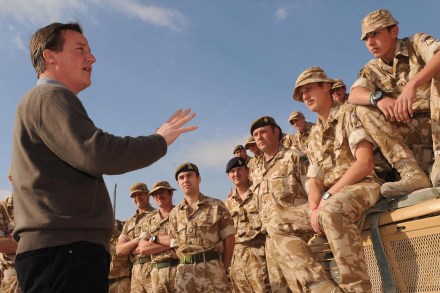
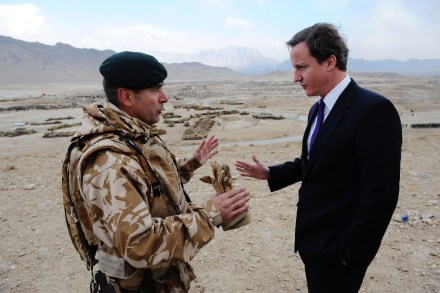
Here, CoffeeHousers, is my take on this morning's Cameron interview: 1. General demeanor: excellent, articulate, confident. The complete opposite from Brown. It does make you think that he should wipe the floor with Brown in the TV debates. 2. “Last week we saw William Hague and George Osborne going to Afghanistan together. First shadow Chancellor, the man who is going to be in charge of the money, on the frontline seeing what is going on in Afghanistan”. Indeed, but the NHS pledge and deficit cut pledge imply deep cuts to the military. To govern is to choose, and Cameron has made his choice: NHS spending before the military.

Security and Defence Review 101

Defence geeks are waiting to see how the Conservative Party intends to conduct a Security and Defence Review, if they are elected. By the time a new government comes to power, the Ministry of Defence will in all likelihood have produced a Green Paper, setting out initial thoughts on the future of the military, which is meant to lead on to a more substantive Strategic Defence Review.  But if the Tories want a process (and ultimately plans and ideas) that encompasses not only the MoD, but also the Foreign Office, DfiD, the security services and even parts of the Home Office, then a new kind of institutional vehicle will have to be set up. There are, broadly speaking, three options.

In preparing for war, the Tories differ from Labour in one respect – they would be prepared

In today's Times, and on the occasion of George Osborne and William Hague's visit to Helmand, the Tories are publishing proposals for how to improve the Government's approach to post-conflict operations. Their central idea: to create a stabilisation force in the military, complete with the necessary expertise, training and so on to win the peace after combat. If it was not already abundantly clear, the Iraq Inquiry has shown how ill-prepared the British state – civil service, military and government – was for post-combat reconstruction. Though much has changed since the Iraq War – e.g.

Endangering impartiality

Labour’s rapid rebuttal service will respond to the Tories’ policy blitz by questioning George Osborne’s spending pledges, of which more later. No objection can be raised against this action except that the government enlisted the Treasury to deliver very detailed costings under the Freedom of Information Act. The Times reports that the Tories are understandably livid: impartiality has been compromised. A spokesman said: “We are concerned at any collusion and abuse of the FOI system which has involved ministers requesting costings of what are complete misrepresentations of Conservative policies, which were subsequently released.