Free trade

White smoke on a US trade deal

15 min listen

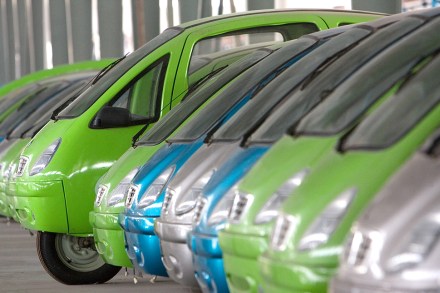
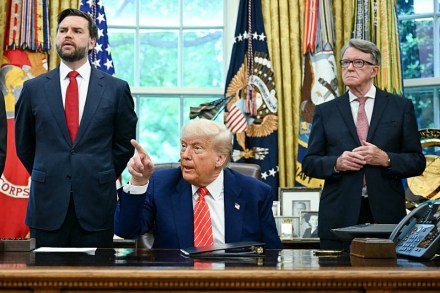
It’s a massive day for the Labour government and for Keir Starmer, as the UK becomes the first country to sign a trade deal with the US following the tariff turmoil of last month. Donald Trump described it as a ‘full and comprehensive deal’ … although we are still waiting for some of the details to be thrashed out. What we do know is this: the 25 per cent tariff on UK steel and aluminium has been removed and the rate on most car exports has been slashed from 27.5 per cent to 10 per cent. In return, the UK is removing the tariff on ethanol for US goods and has agreed ‘reciprocal market access on beef’. So far there is no word on the digital services tax, and Britain is still liable to pay the 10 per cent baseline tariff rate.

Do the Tories hate free trade? Plus, Reform hits new polling high

15 min listen

Lots to talk about today, including new polling which puts Reform on 29 points compared to the Tories on just 17. We’ve also just had the first PMQs since the local elections. But the trade deal announced yesterday between the UK and India is dominating the headlines, with many concerned about some of the concessions made – namely the decision to exempt some short-term Indian workers from national insurance as part of the new agreement. This comes barely a week after the local elections, where immigration has been widely considered the most salient issue.

Why Trumpism won’t fix Clintonomics

From our US edition

As a longtime critic of the Clinton administration’s “free trade” agreements, I’ve lately been mocked by liberal friends who suspect I’m sympathetic to the “plan” hatched by Donald Trump and his senior advisor on trade, Peter Navarro, to “ruin” the country with indiscriminate import tariffs. This sort of jokey ridicule goes with the territory when you jab at neoliberalism from the left. Bill Clinton still has legions of fans among the Democratic party establishment and its media acolytes, and it’s hard for them to face up to the fact that the former president’s economic policies have led directly to Trump’s election as president not just once, but twice.

trade

Tariff haters don’t live in the Rust Belt

From our US edition

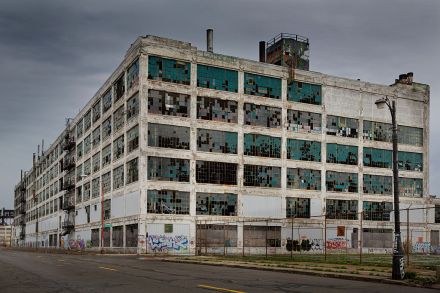
There is a vacant lot at the edge of downtown Philipsburg, Pennsylvania, my hometown. Three years ago, a handsome, sturdy brick factory building stood in that lot, albeit most of the windows were broken, as it had been abandoned for years. After it closed, the building became a favorite hangout for ne’er-do-wells, whose act of arson forced its recent demolition. For decades, though, the clothing factory employed thousands of people and made downtown hum, as workers crowded the restaurants and took care of errands on their lunchbreaks. They – along with the hundreds of people employed by a cigar plant on the outskirts of town – also bought houses and rented properties here and supported locally owned pharmacies, barbers, hardware stores, grocery stores, and the hospital.

Who did Bill Ackman think he was electing?

From our US edition

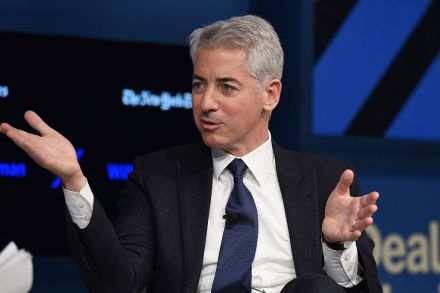
To take on America’s entire governing class and win, Donald Trump proved that he had an inhuman level of willfulness and sangfroid. Those are qualities that cut both ways, however, as the investor Bill Ackman is now discovering.  Wall Street has lost more than $5 trillion in value since the announcement of the new tariff regime last week, but Mr. Trump, speaking on Sunday on Air Force One, appeared deaf to all appeals. How big of a sell-off would the President be willing to endure, a member of the press pool asked. “I think your question is so stupid,” he replied. Many of Trump’s newfound admirers are panicking. Among them is Bill Ackman, manager of the hedge fund Pershing Square and a prominent Democrat defector in last year’s election.

Trump is playing a high-stakes game of international poker

From our US edition

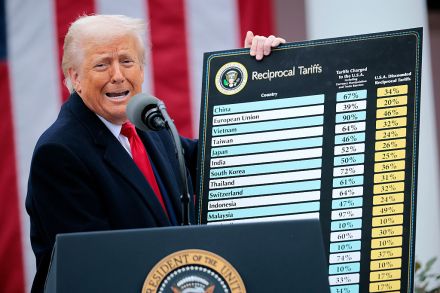
On what he called “Liberation Day,” President Trump announced a new tariff schedule. While the markets had been up in anticipation, they are down sharply, with the Dow dropping 2,200 points, perhaps surprised by the extent of them. Basically, Trump has laid tariffs equal to about half what other countries charge on US exports, inviting them to lower theirs in exchange for reciprocity. What the final result will be is anyone’s guess, for the Trump tariffs are chips in a high-stakes game of international poker. They have already had an effect. Canada has promised retaliatory tariffs while Israel has dropped all tariffs on US goods. A tariff is a tax laid on goods passing through a port.

trump
trump

Trump is playing a high-stakes game of international poker

On what he called “Liberation Day,” President Trump announced a new tariff schedule. While the markets had been up in anticipation, they are down sharply, with the Dow dropping 2,200 points, perhaps surprised by the extent of them. Basically, Trump has laid tariffs equal to about half what other countries charge on US exports, inviting them to lower theirs in exchange for reciprocity. What the final result will be is anyone’s guess, for the Trump tariffs are chips in a high-stakes game of international poker. They have already had an effect. Canada has promised retaliatory tariffs while Israel has dropped all tariffs on US goods. A tariff is a tax laid on goods passing through a port.

Give Trump’s tariffs a shot

From our US edition

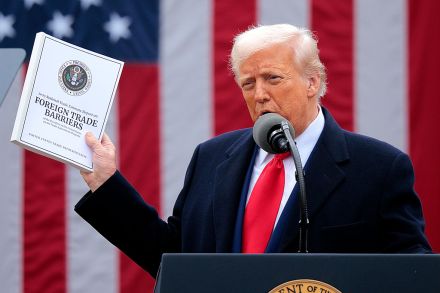
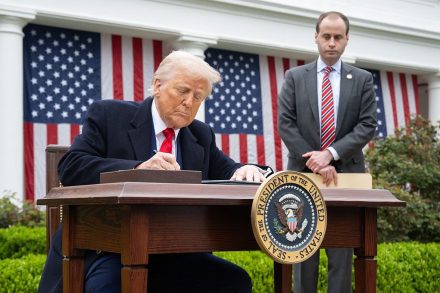
So the big question is: will it work? Will Trump’s protectionist policies, announced with some fanfare at a Rose Garden event at the White House yesterday, increase American prosperity? Or will they harm the economy?  Opinion on that matter is sharply divided. In one corner we have the free traders. They are wringing their hands and warning about higher prices, disruption of international trade and a trade war no one can win.  In the other corner are – what to call them? Most are not “anti-free traders” or “economic protectionists” (though some are).  Let’s call them “fair traders.” They like the idea of free trade – in theory. What they don’t like is the ethic of “free trade for thee but not for me.

tariffs grandeur

The grandeur of Trump’s tariffs

From our US edition

The first thing revealed by the high and wide-ranging new tariffs President Trump announced on “Liberation Day” is just how limited other recent American presidents have been in their thinking. Their ambition was to get elected and re-elected, then retire comfortably into a tranquil post-presidency. They would finish their days lending their names to charities and writing their memoirs (or rather, commissioning ghostwriters to fulfill their publishing contracts).   The idea of destroying and remaking the global economic order never crossed their minds. But Trump is thinking bigger. He doesn’t want to go to his grave as just another has-been ex-president.

Tariffs make sense in a world of predatory mercantilism

From our US edition

The classical defense of free trade, the one found in Econ 101 textbooks and Ricardo’s comparative advantage model, goes something like this: countries should specialize in what they can produce most efficiently, export the surplus and import the rest. Trade allows global output to increase, everyone gets richer and any government interference – like tariffs or subsidies – just gums up the works. But that’s not the world we live in. David Ricardo, the early 19th-century British economist who developed the theory of comparative advantage, illustrated it with a now-famous example: even though Portugal could produce both wine and cloth more efficiently than England, both countries would benefit if Portugal specialized in wine and England in cloth, then traded.

tariffs

Was ‘free trade’ really working?

29 min listen

Oren Cass, founder and chief economist of think-tank American Compass, sits down with Freddy Gray at the ARC conference in London. They react to the announcement by President Trump over the weekend of reciprocal tariffs: the decision by the US to match import duties levied by other countries.  What's the strategy behind Trump's decision? And what could the consequences be for American companies and for global trade? They also discuss the broad political consensus behind free trade in the US since the 1990s. Given the 'lived reality' that faced many American investors and companies - for example competing with Chinese Electric Vehicles - was the free trade really working anyway? Produced by Natasha Feroze and Patrick Gibbons.

It’s time for the US to revoke China’s ‘normal trade’ status

From our US edition

In April 2022, six weeks after Moscow’s invasion of Ukraine, President Biden signed legislation to suspend Russia’s Permanent Normal Trade Relations (PNTR) status. “Revoking PNTR from Russia,” he said, “is going to make it harder for Russia to do business with the United States… The free world is coming together to defeat Putin.” PNTR status, also known as Most Favored Nation (MFN) status, is a designation granted among World Trade Organization members. Receiving nations are awarded all trade advantages that any other nation receives. Revoking PNTR status from Russia was a strategic move. It opened the door to deliver comprehensive economic strikes against Moscow and sent a clear signal to markets.

Families are in, free trade is out at the ISI conference

From our US edition

Cockburn last weekend headed over to the Intercollegiate Studies Institute’s American Economic Forum. The speakers were on fire with ISI's particular brand of pro-working-class zeal, and Cockburn was lit at the VIP reception bar. Since Johnny Burtka took the helm at ISI, the right-leaning think tank has acquired a more socially conservative, economically protectionist flair, in line with Pat Buchanan, the founder of the magazine where Burtka used to work, the American Conservative. After dodging the Vice News journalists begging for an interview, Cockburn made his way over to a speech by former Trump administration trade representative Ambassador Robert Lighthizer.

rick santorum

Revealed: How the UK-Australia deal was struck

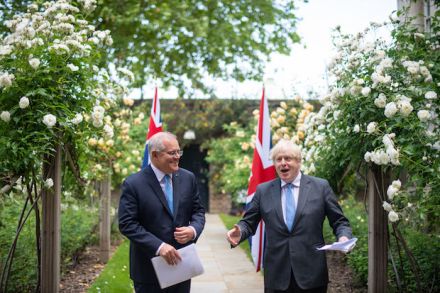
The basis of the UK’s first bespoke trade deal since leaving the EU was finalised with Australia over two dinners. One took place in the garden of the residence of the Australian High Commissioner to the UK, where guests were fed Australian lamb. The other in Downing Street where Welsh lamb was on the menu. They were menu choices that pointed both to what the deal would achieve – zero tariffs, including on agricultural goods – and the main point of contention in a negotiation that has spanned nearly a year since talks began last June. In that time, there has been a Cabinet row over protectionism on Australian meat imports and a diplomatic incident that nearly hampered the talks.

The emptiness of the UK-India trade deal

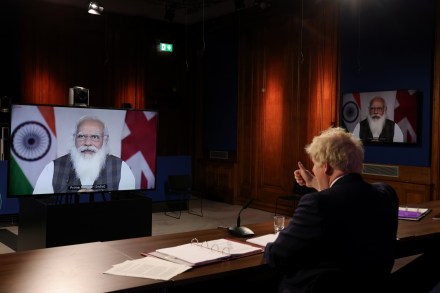
Britain and India have been trading for over 400 years. For 190 of those, between 1757 and 1947, the subcontinent was close to being a captive market of the United Kingdom. Today commercial turnover between the two nations is a mere £23 billion — a tenth of the goods and services traffic between Britain and the European Union. For many Leave voters, Boris Johnson included, expanding trade ties beyond the EU’s borders was a major motivation for Brexit. India was seen as both an exciting emerging market but also a nation that is culturally entwined with this one. However, five years after Britain voted to depart the lucrative single market, all Johnson and Narendra Modi have been able to conjure up is a below-expectation 'enhanced trade partnership'.

What the UK wants from a trade deal with the USA

On Monday, the Department for International Trade released its negotiating objectives for a UK-USA free trade agreement. The 184-page document explains in detail what the UK wants to get out of a trade deal with America. The British government will try to angle the talks, which begin this month, towards securing a comprehensive arrangement - that is, a deal that covers a broad range of areas including digital, finance, tech, manufacturing and agriculture. If secured, it estimates this could translate into a £3.4 billion boost to the UK economy. The government has put its 'leveling up' agenda at front and centre of these trade talks, laying out how each region potentially stands to gain from securing a deal with the USA.

Brexit talks resume – and the war of words is back on

Downing Street briefings that the EU is 'moving the goalposts' for a free trade agreement and is belatedly demanding that the UK should not be compelled to maintain standards on state aid, competition, workers rights and environment seem either flaky or deliberately designed to once again cast Brussels as a duplicitous enemy. If you look at the March 2018 EU Council guidelines (below) for the future relationship between the EU and the UK and the actually-agreed framework for the future relationship agreed in October 2019 (also below), the importance for the EU of maintaining a level playing field between the UK and EU is explicit.

The free trade deal Britain must sign up to after Brexit

Now the UK is leaving the EU, Boris Johnson's government can start planning a serious trade strategy for life after Brexit. So far the focus has been on a UK/US free trade agreement. But before that, the initial challenge for Britain will be to establish a rational set of priorities. First, the government must ask what resources is it prepared to commit to trade policy? Second, it needs to establish what trade agreements would be most beneficial to the UK economy. After all, there’s no point in giving priority to a laborious trade negotiation with, say, Burkina Faso, if the benefits of that agreement would be very limited. And third, how difficult would it be to conclude a free trade agreement with those priority countries?