Food

The real food of Venice

A few years ago, I moved to Newlyn, a fishing village in west Cornwall. I didn’t understand why I moved to Newlyn until I returned to Venice. I take almost all my holidays in Venice, and it is a cliché that Venice only slowly reveals her mysteries. You must fight your way past a mass of Renaissance portraiture and mirrored palaces but the mystery it showed me this time is this: like Newlyn, Venice is a fishing village. Venice got rich in the thirteenth century, monopolized the trade routes to the east for two centuries and covered itself in Istrian stone, which Newlyn didn’t. But it’s still a fishing village, founded by people running away from barbarians, into the mud flats of a lagoon to fish for crabs. It is easy to forget that — unless you look for Venetian cuisine.

venice
table

Table talk

I grew up in rural Connecticut, in a remodeled cow barn where my family sat at an antique hutch table for meals. The table with four comfortable Windsor chairs fit into a niche. My sister Christina and I weren’t allowed to join my parents for dinner at the table until we could hold a conversation. For me, that was at five. The rule came from my father, as that was how he’d been brought up. Once, when we were in our early teens, I whispered to Christina, “It’s King Arthur’s round table” — our father’s middle name was Arthur. I must have learned some British history and was probably showing off. My firm but gracious father wasn’t a king.

lamb

Spring’s perfect roast

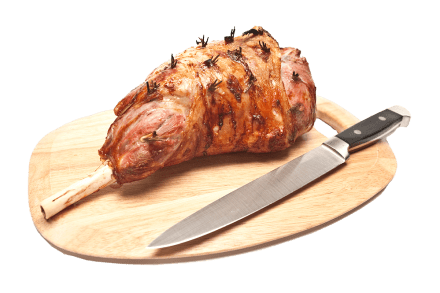
When I first moved to the country, I was intrigued by the sight of people walking sheep on a leash round and round the front garden of a neighboring farmer. City girl that I am, I wondered if they were receiving some kind of special therapy. Equine interaction is supposed to help with certain anxiety disorders, why not sheep-walking for, say, insomnia? It turned out, however, that the sheep-walkers were members of the local 4-H club preparing to show their market lambs at the fair, an event I was later privileged to witness. But I was put to the blush when the judge, a tall, competent-looking man in a checked shirt and green boots, commented loudly on the fine chops displayed by the winning entrant.

Be my Valentine

I don’t know when my father showed André Fleuridas, a friend, the chunk of jade he’d brought back from Burma, where my father was based as a war correspondent during World War Two. Nor do I know how my parents’ friendship with Bonnie and André Fleuridas began. I can only guess. It might have been through art, as both my father and André were artists, and in Weston, Connecticut, where I grew up, artists occasionally gathered in each other’s studios to draw or paint from live models. Or they might have met at the Weston firehouse where artists, writers, musicians, actors and TV news anchors made up, along with farmers, Weston’s all-volunteer fire brigade.

valentine
waffle

Welcome to Waffle House

"Snack bar,” “coffee shop” and such phrases once signified small eateries where customers sat on stools at a counter or in simple booths. Their orders were taken and served by waitresses in white aprons, and prepared by a short-order cook in a white paper cap. Hotel lobbies, railroad-station waiting rooms and airports all had them: private enterprises in public spaces purveying a cup of coffee and a donut, bacon and eggs, ham and cheese on rye, a hot dog, a hamburger, maybe a milkshake or an ice cream sundae. Little of this (for most were mom-and-pops) traveled well into the age of industrialized, assembly-line, eat-on-the-go feeding signified by the phrase “fast food.

pan

The pan handler

I have become a pan handler — a handler of cast-iron pans. I can think of few hobbies that are as rewarding as collecting and cooking on cast iron. Skillets, griddles, muffin tins, Dutch ovens, waffle irons, corn-stick pans and much else: there was a time when America produced the finest cast-iron cookware in the world. The iron ore was abundant. So was the coal to melt it. Foundries went up across this great land. American cuisine developed around it. From fried chicken to cornbread, the American menu should still be cooked on cast iron. Southern cooks never forgot this. The same goes for soul food; black America has always prized its cast-iron inheritance. Now I find I have little need to cook on anything else.

Marmite man

Marmite is one of very few manufactured foods to have become an idiom. British people think of the black stuff as a national idiosyncrasy, entirely unknown to horrified foreigners: there are many videos on YouTube in which outsiders have Marmite inflicted on them for the first time. In fact, there are a large number of pastes based on yeast extract in different countries, each with its passionate devotees. British Marmite may have been the first to go into production, but it did not stay unique for long. A German chemist, Justus von Liebig, influential in the propagation of meat essences, discovered that yeast could be concentrated.

marmite
millennial

The millennial kitchen

However else we may criticize the late 90s and early 00s — its politics, its fashion, its music — this was undeniably the golden age of the celebrity chef. Barefoot Contessa, 30-Minute Meals and The Iron Chef franchises all debuted in the first decade of this millennium, minting stars like Bobby Flay, Guy Fieri and Nigella Lawson. I once found a collection of my brothers salivating over Giada de Laurentiis making meatballs on Everyday Italian, though they’d never demonstrated more interest in cooking than microwaving the odd Hot Pocket. The mid-aughts brought on the glory years of the “hands and pans” videos: the aerial-view clips of disembodied hands assembling cheeseburger pretzel balls or eighteen-layer taco dip.

How to survive eating out

Tennis — as the New England poet Robert Frost remarked in defense of formal verse — is more fun with a net. Creativity does indeed flourish within constraints. Soviet censorship brought about samizdat. Prohibition brought about bathtub gin and any number of fabulous cocktails designed to mask its unsubtle notes of paint thinner. The greatest human spirits would view the new era of show-your-papers dining not as a hardship, but as an opportunity. In our brave new world, some don’t mind handing over papers in exchange for a mess of restaurant-prepped pottage. And yet there are ancien régime sticklers for propriety who think that the use of QR codes to gain access to food indoors is not quite comme il faut (if you’ll pardon their French).

dining

Making a raclette

Cheese, potatoes, sausage and bacon for dinner? Let’s just throw in bread and heavy cream for the sake of it. Sounds like a recipe for a heart attack or stroke? Why do the Swiss and French then double up — or even triple up — on these carbs and calories when cold weather comes? The answer is easy and old; the combos are delicious, divine and de rigueur, filling the body’s need for cozy food and energy to shovel snow and ski. The French and Swiss still argue about which country invented raclette.

cheese raclette

What’s good from the goose

One of the more curious habits of the British is their tendency to publish opinion polls in national newspapers about their own food habits. Which way round, for example, are you meant to dress your scone? Is it clotted cream first, then jam — or jam first and cream second? Well, the Queen does it jam first, so that must be the way. Or that other national debate, tea and then milk, or the opposite? When I first arrived in the UK thirteen years ago, I was amused to see how worked up the British get about such questions. Try asking them sometime and see what happens. A new poll reveals that 58 percent of the British public admit to preferring roast potatoes over turkey. “How could you?” we’re supposed to gasp. “Everyone knows Christmas dinner is about the turkey!

goose

In defense of the English original sandwich

Hannah Moore’s June Spectator piece on sandwiches made me hungry. Then it made me think. Ms Moore makes a sound distinction between modern Britain’s plastic-boxed, triangular ‘sandwich’ and the custom-made, piled-high, endlessly imitated, seldom-matched product of a good New York or Chicago delicatessen. Why, one wonders, do the Brits put up with it? Landing in countless foreign ports over the years, for business or pleasure, I’ve always wondered, pretty much before wondering about anything else, ‘What’s the food like?’ Almost always, I’ve liked what it was like. In the age of real borders and undiluted ethnicities, food was a powerful expression of locality.

sandwiches

Burrata inamorata

Wise men say only fools rush in. But in this particular instance, I really couldn’t help falling in love on the spot. Like a zillion others, the story starts on a night out. When my party, dripping with rain, arrived at the restaurant, our table wasn’t ready, and they ushered us to wait at the bar The bar was a happening kind of place. Instead of looking up at shelves of bottles and bartenders mixing drinks, it looked down onto the kitchen area, which was built around a giant wood fire over which five or six cooks labored frenetically. The flames blazed openly, fed from the picturesque log stack that lined the back wall of the dining area.

burrata

Bread is the staff of life

I cannot claim the gift of prophecy, but early in 2020 — before lockdown panic-buying and the warnings of a dire wheat harvest causing bread-price rises — I became a bread-maker. I dug around on the internet for a good recipe for sourdough, and found one padded out with the usual bloggery and waffle. Absent the philosophy and the pious musings, it gives a clear, sensible route to bread self-sufficiency. Sourdough doesn’t need bought-in yeast, only a ‘starter’ of flour and water. This is often called a ‘mother’, and attracts wild yeasts as it develops; after five days in the jar it is a gently bubbling ferment of living yeasts, and you keep it going by adding flour and water to it day by day.

bread
French

In search of lost French restaurants

Readers of a certain vintage will recall when any listing of fancy restaurants in a big city had a heavy French accent. Look at the ‘Let’s Eat Out’ section at the back of an old issue of Gourmet magazine from the 1970s for the evidence, at least for New York but, if memory serves, it was true for London as well. (The Italians probably ran second, then the Chinese, then a big falloff to other countries but still mostly European ones.) The way it worked at Gourmet — you got a listing if you bought an ad — only understated things. Lots of good places never advertised at all or simply did not aspire to the tony status that association with the likes of Gourmet conferred. Names like Le Chamberlin, La Caravelle, Le Chantilly, Mon Paris, announced their sole culinary allegiance.

The American dream has no time for offal

You can get goat in parts of New England. Consumers of Portuguese origin create a market unparalleled elsewhere in the US. In Boston, as I recall, Savenor’s used to sell camel and kangaroo. Few meats are too un-American for New York City. Ottomanelli, purveyors to whatever is left of the Four Hundred, still has venison of the quality they sold to the Upper East Side in the Gilded Age. Los Paisanos in Brooklyn stocks alligator, turtle and caribou. But the great days of the 1950s, when a club in New York served porcupine, caribou, muskrat and armadillo, are fled. With the closing of the American mind has come the narrowing of American appetites. Americans’ self-image is of enterprise, pioneering, innovation, adventure and the call of the wild.

offal

Coffee with Coleen

I’ve eaten a lot of breakfasts in my time — hell, it must be approaching 20,000 by now — and few if any have equaled those consumed at Coleen’s Kitchen on Main Street in the lived-in Erie Canal village of Brockport, New York. It takes a few minutes before you sense that there’s something not quite wrong about Coleen’s. Upon entering the restaurant you pour your own coffee at the beverage station. Maître d’ Coleen directs you to your seat. She hands you the extensive four-page menu, which warns that ‘you will be charged 59 cents if you ask what kind of bread I have’. Read it well and don’t waste Coleen’s time, you lazy bum! Waitress Coleen takes your order.

coleen

The culinary wisdom of charity cookbooks

Joy’s Toasted Parmesan Canapés: mix four tablespoons grated Parmesan cheese with half a cup of grated Swiss (or any other mild cheese that will melt), add mayonnaise enough to make a spread, season with salt and oregano or basil, spread on bite-sized rounds or squares of thin-sliced white bread, top with a slice of green olive (optional), broil until bubbly, serve immediately. Caveat, sophisticates: the ‘Parmesan’ likely as not was that pale yellow powder dispensed from the green Kraft cylinder, the Swiss was from Wisconsin, the mayonnaise was aka Miracle Whip Salad Dressing, the spices dried ones from the McCormick jar and the bread courtesy of Pepperidge Farm (if you were lucky). Not a whiff of anything cordon bleu or ‘artisanal’ here, the latter a term not yet dreamt-up c.

cookbooks
white castle

The man in the White Castle

The world’s first fast-food restaurant chain. The first to sell over a billion hamburgers, to invent the carry-out and to offer discount coupons in the newspapers. Jewel of the American Midwest. Celebrating its centenary. Better burgers than McDonald’s, according to Consumer Reports. Still run as a family business. Some 377 US locations, and growing. Obsessively loved by some, faintly ludicrous to others with its trademark enamel-glazed, faux-brick architecture and miniature square patties, White Castle is the Rodney Dangerfield of greasy spoons. It gets no respect.

My night at the Cheesecake Factory

The most exciting arrival in years on the DC dining scene is coinciding with the end of the pandemic. Not since the launch of the DC Michelin guide has the buzz been as strong. Nestled adjacent to the Old Ebbitt Grill, it’s sure to be a welcome addition to the Power Lunch scene among the Jos A. Bank-clad downtown crowd. Yes, the Cheesecake Factory has opened their new location just a few blocks from the White House. Truth be told, DC being a city full of cynical people who think they live in a West Wing episode and that the height of dining is Cafe Milano, it’s not actually clear to me that DC deserves a Cheesecake Factory. But it brings a level of class, sophistication and culture to the nation’s capital that we haven’t had since Billy Carter.

CHEESECAKE