Food

In search of the quintessentially British afternoon tea

It is a strange coincidence that both my sister and I, born and raised in Scotland, have married Americans. I live in New York. Lily lives in Nebraska. But we were both in our mother country over the summer visiting family and keen to make the most of our British culinary tradition. There is more to miss than you’d think. Diluting juice, which the English call “squash,” fruit flavoring added to water. A Sunday carvery, roasted meat and potatoes, with gravy and vegetables, complete with Yorkshire pudding. Fish and chips. Real chocolate. Decent Indian food. Breakfast cereal not coated in fructose. Tea worthy of the name. And above all, freshly baked scones. Americans may think they have scones rhyming with “stones.

tea
Easter

How eggs became the symbol of Easter

Thirty feet in the air off a northern Canadian highway stands the giant Vegreville Easter egg, rotating gently in the wind. The egg is eighteen feet wide, nearly twenty-five long and designed to turn with the breeze like a weathervane. It is decorated in a traditional Ukrainian pysanka pattern with thousands of gold, black and white aluminum triangles, for the egg is an homage to the Ukrainian immigrants who settled the area long ago. It is a technical feat: the tile- cutting technology developed to produce the mosaic on the egg’s curved surface was later used to tile the exterior of the Space Shuttle. Whatever day of the year you may spy it, it is undeniably an Easter egg.

Opening a bottle with… Angela Hartnett

Quizzed on how to assimilate to new cultures, travel writer and celebrity chef Anthony Bourdain once said: “Drink heavily with locals whenever possible.” The “Opening a bottle with…” series is about getting pickled with people far cooler than I am, in new places. To me, booking a ski trip at the start of the year is the ultimate luxury. With my birthday falling on the first of January, when the ball drops, I feel a sense of melancholy. As hangovers descend and diets begin, I want to carry on celebrating.  In European ski resorts, they keep the festivities going well into March. Christmas lights and religious displays stay twinkling. Fresh snow combats the winter blues. Everyone’s happy to share a bottle of good wine.

angela hartnett

Ringing in the Chinese New Year with homemade dim sum

My husband and I live in a rural village about an hour from London. The nearest grocery store is a twenty-minute drive. I haven’t ordered takeout in six years. I spent a good few years craving Thai and Chinese food, and then we stumbled across a recipe in the Daily Telegraph for homemade dim sum. “But we don’t have a bamboo steamer,” I said. This seemed an insurmountable hurdle. “We can just get one on Amazon,” said my husband. And so we did. Making dim sum at home has been a pleasure beyond my expectations. They are surprisingly simple to make, and once you get the hang of it, not too laborious. The recipe we use is a classic combination of pork and steamed cabbage.

dim sum
coal

The wonder of cooking with coal

The grandest compliment ever paid me came near the end of a small dinner party last winter from guest and friend Jeffrey who, on settling into an old wing chair as his host stoked the fire with coal, remarked: “I feel like I’ve just stepped into an Evelyn Waugh novel.” It was, he said, the coal. About as close as anyone these days will have come to a domestic coal fire is the screen image of one in Downton Abbey or its predecessor, Upstairs Downstairs. Those television “fires” were all actually gas ones made to imitate the look of coal. In Waugh’s time in houses like that, they all would have burned the real thing.

gluten

The possibilities of gluten and dairy-free cooking

My sister recently gave up gluten and dairy on doctor’s orders. In a show of support, my whole family has been exploring ways to make shared meals more tolerable for the poor woman, suddenly deprived of the two best food groups. We’re revisiting family recipes for breakfasts, sides and desserts: my grandmother’s strata, with its layers of cheese-soaked bread, is out altogether, while mashed potatoes go without butter and pie goes without crust. It’s easy to make your first GF/DF meal. The first time my sister came over for dinner after starting her new lifestyle, we smoked a pork shoulder and ate it with mayo-based coleslaw and baked beans: a classic BBQ! Meat and potatoes are GF/DF, as are stir-fried veggies and rice, and bacon and eggs.

Eating my way through Sicily

I arrived home six pounds heavier after three weeks in Sicily. That is the weight of a gallon of milk. Eight cans of beer. Or a small Yorkshire Terrier. I could try blaming the Cerebrus heatwave on my filthy granita habit and lack of almost any bodily movement (and it didn’t help) but the reality is this: Sicily is the fantastical realm they say it is and stupendously beautiful. And the food is even better.  Roman, Arab, French, Greek and North African influences spectacularize every meal. Almond milk granita is spooned into glistening brioche rolls before you can wipe the sleep from your eyes. Chocolate cannoli appear out of nowhere at breakfast. Arancini oozes globs of molten cheese in a manner that’s, quite frankly, sexy.

sicily

Cooking for busy people

What do I cook when I don't feel like cooking? Scrambled eggs. Beans on toast. Canned soup. But Caro Chambers, recipe developer, Substack author and mom of three little boys, might instead go for Jerk Chicken with Coconut Rice and Strawberry Salsa, or Lamb Pita with Dilly Minty Yogurt Sauce, or some other recipe with prepositions in the title, from her popular Substack “What To Cook When You Don’t Feel Like Cooking.” Once a week, she releases a new recipe to her 112,000 subscribers, who pay $5 per month for fifty-two new recipes per year plus access to the archives. “If you want something done, ask a busy person,” said either Benjamin Franklin or Lucille Ball. This could be Chambers’s slogan.

cooking
new year's

How to plan a suitable feast for New Year’s

It is commonplace that the December run-up to the holiday season (aka the Christmas season) is heavy with festivity. The well-lubricated office Christmas parties of yore were legendary, while at home the domestic calendar brimmed with all sorts of communal gaiety. This all occurred during Advent, which in the old Christian dispensation was a penitential season. Except when among the most devout, I was never able to see that this much dampened the fun. As the marketers now see it, the season of getting and spending stretches from somewhere around Halloween right up to Christmas when, all of a shameless sudden, it’s on to Valentine’s. This leaves New Year’s curiously — sometimes on the coldest night of the year — out in the cold.

Deck the halls at Rolf’s

It’s a common lament each year — starting around October, people love to complain that the Christmas season continues to creep further and further into the fall. But for some, that creep is a welcome one. If that’s you, I know a place. At 3rd Avenue and 22nd Street in Manhattan, you can get your Christmas fill for around six months of the year — at least if you wander into the narrow German restaurant on the corner. You might almost miss it if you walk by during daylight hours. At night, it’s hard to miss. In this rather unsexy portion of Manhattan, Rolf’s has been a New York institution since 1968.

rolf's
roman

Surviving the holidays with Alison Roman

The holidays are here. If you’re like me, you may view the year’s major baking season with slight dread, not because you’re a Scrooge, but because you lack confidence, patience or skill as a baker. Recipe developer and cooking influencer Alison Roman has written a cookbook for people like us, who find the “science” of baking frustrating compared to the “art” of cooking. The cookbook, Sweet Enough, affirms this preference; in a section called “What I Hate about Baking,” Roman lists gripes: “I hate when I mess up and feel like I wasted hours of my life.” Same. But this book, written with non-bakers in mind, is for the most part flexible and forgiving, and may well become your companion this December.

Tribeca’s fine dining l’abeille strives for comfort while pushing boundaries

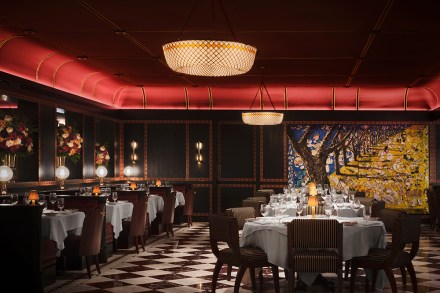
When New York City restaurants closed their doors in March 2020, Rahul Saito and his husband Howard Chang took a radical step. They brought the dining-out experience home, hiring Mitsunobu Nagae, then the chef de cuisine at the Michelin-starred Shun, to prepare weekly dinners in their Manhattan apartment.   The food was unfussy, yet profound. “There was a gazpacho, very simple, a cherry gazpacho,” recalls Chang, thirty-two. “It felt like something you could make at home, but the taste and depth was something I’d never experienced. That’s when I was like: This guy really has something.”   Inspired, Chang and Saito, who both have backgrounds in finance, approached Nagae, thirty-six, to suggest they open a restaurant together.

abeille

In praise of corn, a Thanksgiving essential

The Indians, as we innocently called them in the days of my youth, put their name to it: “Indian Corn.” Somehow, “Native American” or “First Peoples Corn” just doesn’t do it, so here let us observe this now-verboten usage. Technically, Indian Corn (known as calico or dent corn too, for its coloration and dents in the kernels) is one variety of maize, first cultivated, they say, in Mexico thousands of years ago. Columbus, who called the natives “Indians” because he was looking for India, brought back seeds to Europe in the 1490s; they did not take. The Plymouth colonists in the 1620s, from whose early travails the American feast of Thanksgiving emerged, grew Indian corn courtesy of the local Wampanoag tribe. It no doubt helped them survive when the English peas ran out.

corn
thanksgiving

A one-pan, one-pot Thanksgiving

Our first Thanksgiving together, my now-husband, then-medical-resident-boyfriend worked a shift during the family feast. I made it up to him with Melissa Clark’s one-pan, one-pot Thanksgiving for two. The recipe went off flawlessly and made the constraints of my tiny apartment kitchen feel more like a game-show challenge than a life-or-death struggle. Clark’s 2022 cookbook Dinner in One makes the same promise about 100 different meals. The game-show, can-it-be-done? energy made the Thanksgiving method fun, but could feel tedious on a Tuesday night. Is “one-pot” a theme or a gimmick? Does this constraint serve the cook and the recipe, or is it arbitrary, artificial and unnecessarily limiting?

A culinary tour of southern France and northern Spain

If I’d known what a whole monkfish looks like, I would never have ordered it. It was only weeks later that I saw a picture of the horrid creature: small, wicked eyes, prehistoric head, skin like rusty medieval armor and a gaping mouth overflowing with jagged teeth. Truly the stuff of nightmares. We’d popped over the border from France into San Sebastián, Spain, for a bite of dinner, selecting a spot a stone’s throw from the Baroque exuberance of Santa Maria del Coro. The daily special was monkfish, and for some reason — perhaps an excess of sun that day — the image that came to mind was, inaccurately, that of the innocent red mullet. The daily special in a fishing town is bound to be fresh, so it seemed fair to give it a try.

france

The joy of baking your own bread

Flour furnishes most everyone’s kitchen. If you’re a baker or breadmaker, you will probably have several five-pound bags of it in the pantry alongside the yeast. If you don’t bake or don’t bake much, you will probably have at least a cup or two of it in the canister on the kitchen counter for thickening the gravy, frying the chicken or making the roux. Most likely, most of it will have come from wheat. Wheat has been with mankind for 10,000 years or so and was first domesticated somewhere in the Fertile Crescent, or, as our old geographies used to say, Mesopotamia, which also, it was hinted, was the neighborhood of the Garden of Eden. Wheat’s genetic diversity made it adaptable to a variety of climes and continents.

bread

Flour power: a single ingredient can be life-changing

Growing up in a “mixed” American household, of Indian, Puerto Rican and Italian descent, was deeply confusing during my formative years. I came of age in a mostly white suburb just outside New York City. In addition to my foreign-sounding name, I looked nothing like any of my classmates or the kids around the neighborhood. My olive skin, bushy eyebrows and curly hair were more reminiscent of children you’d find in the more ethnically diverse neighborhoods of Queens or the Bronx. My family spent most of our weekends visiting family and doing our grocery shopping in such areas. The array of ingredients that my Puerto Rican and Italian-American mother, Loretta, was searching for didn’t exist in our local Pathmark.

flour

A new war on obesity is underway

Consume American media for more than five minutes, and sandwiched between advertisements for KFC $5 Fill-Ups and a dramatic Golden Corral short pondering the age-old question, “Chicken tenders or baby back ribs?,” you’re bound to behold at least a half-dozen ads for prescription drugs. They tend to last longer than the straight-to-the-glutton-button fast-food commercials, and they play over and over and over again (who doesn’t know the Oh, Oh, Oh, Ozempic! jingle by now?) — and airtime ain’t cheap. “When Oprah Winfrey’s bombshell interview with Prince Harry and Meghan Markle aired in March 2021, the British tuned in, and many were gobsmacked at the number of drug commercials they saw,” Vox reported earlier this year.

obesity
mick

Camari Mick is making pastry, not solving crimes

"I was really fascinated with the process, the science behind everything,” recalls Camari Mick, the now twenty-nine-year-old star pastry chef, who studied anatomy in high school. “I love true crime: I was very into Snapped and crime junkie podcasts.” When she approached her parents, however, they asked her to reconsider. “My dad looked at my mom, looked at me, looked back at my mom and looked at me, and said: ‘Are you sure?’” At the time, Mick was running a mini-business from home, making baked goods to sell to friends, teachers and neighbors. “You’re doing really well, you clearly love being an entrepreneur, why don’t you go into this avenue?” her father asked her. His advice paid off.

roadside

Road-trip picnics are a casualty of our interstate system

Signs announcing roadside picnic tables once peppered America’s secondary roads and highways. Or so we call those byways now. Before the limited-access interstate system arrived in the 1960s, these roads were primary. America then was laced with a tangle of serviceable two-lane, hard-surfaced highways. Look at an old oil-company roadmap, if you can find one, to get the idea. Some roads were federal, some state, but all were emphatically open-access: get on anywhere, pull over wherever you like. They led through cities and towns, not around them; they traversed the countryside more than they cut through it. They required two-hands-on-the-wheel alertness in drivers, who got to know and respect the lay of the landscape.