Florence

Tuscan escapades: Villa Coco, by Andrew Sean Greer, reviewed

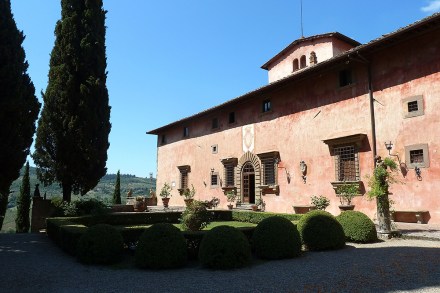
The comic novelist Andrew Sean Greer won the Pulitzer Prize for Less, a chronicle of the longings and humiliations of modern life. But now, he suspects, we’d all like an escape. ‘Whatever happened to the charm novel?’ he asks in his new outing, thinking of the lighter works of Nancy Mitford and Graham Greene. Since they are apparently out of fashion, he has decided to write his own. Villa Coco follows a young American archivist, hired to catalogue the antiques in Tuscany of an aged baronessa, known to her friends as ‘Coco’, only to find himself drawn into increasingly absurd adventures instead. He arrives in late summer, with all the American fantasies of Italy in tow: ‘A confection of movies and food... pasta and accordions and Leonardo and cheese.
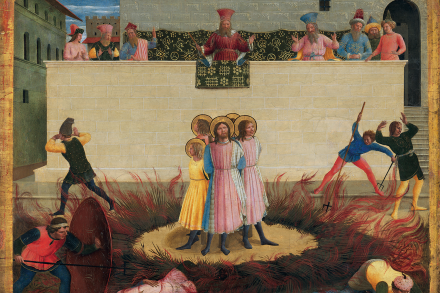
The staggering beauty of Fra Angelico

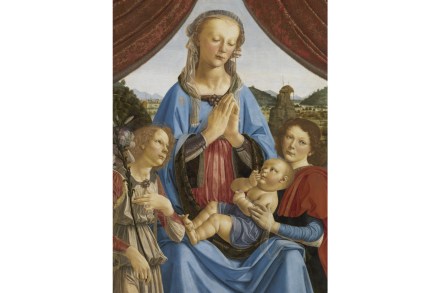
In 1982, Pope John Paul II surprised a few people by beatifying Fra Angelico, the 15th-century Dominican friar from near Fiesole. It’s not clear why he put Beato Angelico on the road to sainthood, given that the artist didn’t perform any miracles. And yet, after spending a few hours immersed in his works, which are both profoundly sacred but also staggeringly beautiful, you begin to understand the decision. He was certainly a hit with popes.

The true birthplace of the Renaissance

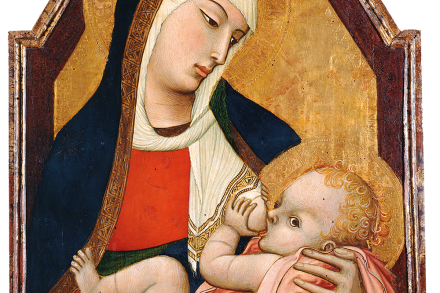
The baby reaches out to touch his mother’s scarf: he studies her face intently, and she focuses entirely on him. There is connection; there is familiarity; there is love. It could be one of the pictures on my phone from last weekend of my daughter with her six-month-old. In fact, it dates from Tuscany c.1290, and the mother and child are the Virgin Mary and Christ. It’s a small painting, tempera on wood; it’s the opener of the National Gallery’s new blockbuster, Siena: The Rise of Painting 1300-1350; and it’s there to make the show’s fundamental point, which is that its creator, the Sienese Duccio, introduced many of the painterly innovations that paved the way for the Renaissance. With this ‘Virgin and Child’, emotion takes centre stage.

Flirting in 15th-century Florence

Noel Malcolm, a former political columnist of The Spectator, the historian of English nonsense verse and editor of Thomas Hobbes’s Leviathan, has written a book on an arresting subject. Forbidden Desire in Early Modern Europe gives close and relentless scrutiny to male-male sexual relations in Europe, the Ottoman empire, north Africa and in such dispersed colonies and outposts as New England, Peru, Cape Town and the Dutch East Indies. Malcolm’s interest in the subject began with his find of a cache of documents dating from 1588. These recorded the official investigation of a male couple – a trainee interpreter for Venice’s envoy in Constantinople and the envoy’s barber – who fell in love.

Always carry a little book with you, and preserve it with great care, said Leonardo da Vinci

In 1299, Amatino Manucci, a Florentine helping to run a merchant’s business in Provence, kept at least seven ledgers and notebooks, each serving a specific purpose. One covered the firm’s trade in wool and cloth, another in wheat, barley and other victuals, and so on. It wasn’t just figures Manucci worked with. It was also financial concepts, quite advanced by the standards of that time: accounting entities and periods, profit and depreciation – notions that heralded the invention of accounting as we know it. ‘If you’ve ever tapped numbers into an Excel grid,’ Roland Allen writes in his engaging popular history, ‘you have Manucci and his contemporaries to thank – or blame.

Who would be a farmer’s wife?

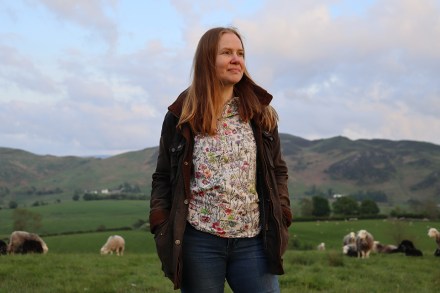
On the opening page of The Farmer’s Wife, Helen Rebanks quotes George Eliot’s famous passage from Middlemarch. Dorothea adds to ‘the growing good of the world’ through her ‘unhistoric acts’ and by having ‘lived faithfully a hidden life’. With this enchanting, funny, fearless book, Rebanks brings her own ‘unhistoric’ life unequivocally out of hiding. The blood, mud, slog, exhaustion, bureaucracy and financial angst of farming are ever-present She lives with her husband James (a bestselling writer) and their four children in the Lake District on their farm shared with six sheepdogs, two ponies, 20 chickens, 500 sheep and 50 cattle.

Violence and beauty combine in Siena

Siena, the jewel of Tuscan cities, was the mercantile and banking centre of medieval Europe. Bankers in Pre-Renaissance Siena preened themselves on their wealth and material possession. Banking (from the Italian banco, ‘counter’) is an Italian invention. Yet Dante consigned money-lenders to the seventh circle of Hell, where they are made to stare for eternity at their sacks of lucre. (Emblazoned with fancy coats of arms, the sacks would have held the equivalent of today’s venture capitalist bonus payments.) Usury was a dangerous professional game in Siena, one which invited church censure as well as personal spiritual dereliction. But without its money-making eminenti, Siena would have remained a provincial backwater, swampy with the threat of malaria.

Sixteen cathedrals to see before you die

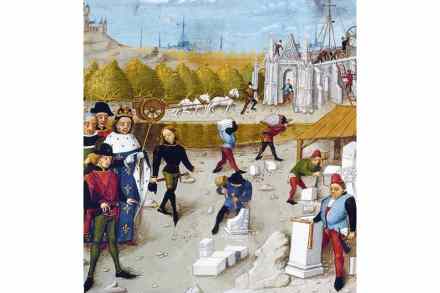
There can be no clearer illustration of the central role that great cathedrals continue to play in a nation’s life than the outpouring of grief that greeted the catastrophic blaze in Notre-Dame in 2019. President Macron described the building as ‘our history, our literature, our imagination, the place where we experienced all our greatest moments’. Indeed, it is impossible to conceive of any major European city without a cathedral at its heart. Emma J. Wells has written an accessible, authoritative and lavishly illustrated account of the building of 16 of ‘the world’s greatest cathedrals’.

How the quarrelsome ‘Jena set’ paved the way for Hitler

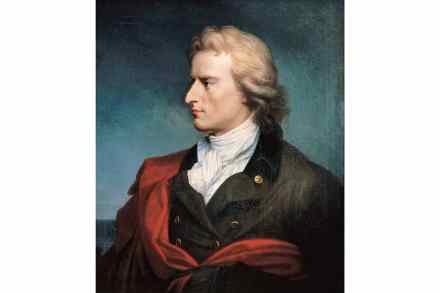
Today, the German city of Jena, 150 miles south-west of Berlin, is the world centre of the optical and precision industry; but in the 1790s it spawned an even more marketable commodity. It was then a small medieval town on the banks of the river Saale with crumbling walls, 800 half-timbered houses, a market square and an unruly university. Here, in the philosophy department, Johann Gottlieb Fichte, a young professor inspired by Immanuel Kant and the French Revolution, proclaimed from the pulpit his theory of the ‘Ich’. ‘A person,’ he roared, ‘should be self-determined.’ In an age of absolute power and the divine right of kings, the idea of free will was an incendiary device and Fichte freewheeled his way through each lecture.

Beautiful and revealing: The Three Pietàs of Michelangelo, at the Museo dell’Opera del Duomo, Florence, reviewed

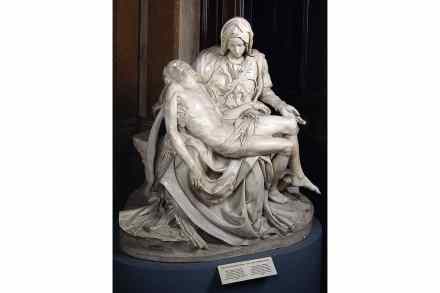
The room is immersed in semi-darkness. Light filters down from above, glistening on polished marble as if it were flesh. This is the installation for Le Tre Pietà, a remarkable micro-exhibition that has just opened at the Museo dell’Opera del Duomo in Florence. It is low in quantity, containing just three works. But stratospherically high in quality, since it comprises Michelangelo’s three versions of the Pietà – that is, the Madonna mourning the dead Christ. He carved these over almost 70 years: one in his early twenties, the next in his seventies, the last in his eighties. Admittedly, the first and the last are present only in a rather old-fashioned virtual form: high-quality plaster casts.

Rescuing Elizabeth Barrett Browning from her wax-doll image

‘Ah, did you once see Shelley plain?’ asks the speaker in Robert Browning’s poem ‘Memorabilia’ — a line which recognises how easy it is to misread a writer once they’ve passed into a hazy afterlife of fame, neglect or simple misunderstanding. Yet few of Browning’s contemporaries are as hard to see plain as his own wife: the poet who was known to her family as Ba, signed herself EBB, and published a number of popular works under her married name of Elizabeth Barrett Browning. During her lifetime she was one of the most admired poets of the age; a framed portrait of her hung in the bedroom of Emily Dickinson, and when Wordsworth died in 1850 there was serious talk of her becoming the first female poet laureate.

Why the Royal Academy is wrong to consider selling their precious Michelangelo

How much does a Michelangelo cost? It is, as they say, a good question, meaning: nobody really knows. The reason for this odd state of affairs is that almost none of them have ever been bought and sold on the open market, which is how the prices of most things are established. It’s hard to think of many examples of his sculptures being traded in that way over the past 500 years. Strangely, the main exception is the ‘Taddei Tondo’, otherwise known as ‘Virgin and Child with the Infant St John’, which, reportedly, some members of the Royal Academy are suggesting the RA should sell. If that were to happen, which I very much hope it does not, we might learn the answer to the conundrum. Probably it would be a very large sum indeed.