Exhibitions

‘I love twigs’: botanical painter Emma Tennant interviewed

Hermitage, where the heel of Roxburghshire kicks into the once-lawless Debatable Lands, seems an unlikely place to find a botanical artist. It’s hard to make anything grow here, let alone an exhibition-load of rare and sometimes exotic plants. Lorded over by Hermitage Castle, a menacing hulk of medieval brutalism described by George MacDonald Fraser as ‘shouting “sod off” in stone’, this is a remote, rarely visited stretch of the border. Once the playground of reivers, and the graveyard of their victims, today it’s a land of sheep farming, forestry plantations and cruel May frosts. But there, hunkered against the wind in the foot of the Hermitage valley, is the studio

Do we need another Lucian Freud exhibition?

Do we need another Lucian Freud exhibition? After years of exposure to his paintings of naked bodies posed like casualties of a car crash in a nudist camp, we might have reached the ‘move along, nothing to see here’ point. But it seems we can’t get enough of the monstre sacré. To mark the centenary of his birth in 1922, London is being treated to a Freud fest of no fewer than seven exhibitions, the most prestigious of which is at the National Gallery. Subtitled New Perspectives, the National’s show promises a change of viewpoint from the perspective now most commonly associated with Freud (that of looking down on figures

Brilliant and distinctive but also relentless: William Kentridge, at the RA, reviewed

William Kentridge’s work has a way of sticking in the mind. I can remember all my brief encounters with it, from my first delighted sight of one of his charcoal-drawn animations, ‘Monument’ (1990), in the Whitechapel’s 2004 exhibition Faces in the Crowd to my awestruck confrontation with his eight-channel video installation I am not me, the horse is not mine (2008) in Tate Modern’s Tanks in 2012. That marked a high point for the Tanks, since when they’ve tanked. Kentridge’s is a face you don’t forget, partly because it often appears in his own animations in the guise of his beaky alter ego Soho Eckstein, partly because of the trademark

Biomorphic forms that tempt the viewer to cop a feel: Maria Bartuszova, at Tate Modern, reviewed

Art is a fundamentally childish activity: painters dream up images and sculptors play with stuff. It was while playing with an inflatable ball with her young daughter in the early 1960s that Maria Bartuszova had the idea of filling balloons with liquid plaster instead of air. The inspiration fed her muse for 30 years, seeding the mixed crop of biomorphic forms currently filling five rooms at Tate Modern. Trained in ceramics at Prague Academy of Arts under communism, Bartuszova turned to plaster after moving with her sculptor husband Juraj Bartusz to the industrial city of Kosice, now in Slovakia, in 1963. Plaster was cheap and plentiful: a 1987 photo in

Fresh and dreamy: Edward Lear, at Ikon Gallery, reviewed

‘It seems to me that I have to choose between 2 extremes of affection for nature… English, or Southern… The latter – olive – vine – flowers… warmth & light, better health – greater novelty – & less expense in life. On the other side are, in England, cold, damp & dullness, – constant hurry & hustle – cessation from all varied topographical interest, extreme expenses…’ That choice was effectively made for Edward Lear in 1837 when he gave up the natural history studies by which he had made his name in his teens and headed south to Rome on doctors’ advice, aged 24. Prone to asthma and epileptic seizures,

When Lee Miller met Picasso

During the liberation of Paris in August 1944, the photographer Lee Miller made her way to Picasso’s studio on rue des Grands-Augustins, where she was greeted with a wide-eyed grin. ‘This is wonderful – the first Allied soldier I’ve seen, and it’s you!’ the artist exclaimed, reaching up to place his hand affectionately around her neck. Miller had just escaped house arrest for breaching the terms of her press accreditation by entering a combat zone. The PR office of the US Army had dispatched her – one of just four American female photographers they granted an official commission – to Saint-Malo in the mistaken belief that the fighting there was

Promethean grandeur: Maurice Broomfield – Industrial Sublime, at the V&A, reviewed

When Maurice Broomfield left school at the age of 15, he took a job at the Rolls-Royce factory, bending copper pipes on a turret lathe. That was what you did in Derby in 1931: Rolls-Royce was the town’s biggest employer, and entire generations expected to pass the best part of their lives behind the walls of its 13-acre plant. But Broomfield didn’t stay. Not long into his new job, he saw a photo of an ageing employee being packed off into retirement with a handshake and a gold watch. This was a person who’d never had any real control over his own life; who’d worked when he was told to,

There’s much more to Winslow Homer than his dramatic seascapes

Until the invention of photography war reportage depended on old-fashioned illustration, and even after that the illustrated press took a while to catch up. Photographic reproduction didn’t work on cheap newsprint, which demanded a crispness of definition that early photography couldn’t provide. So reports on the American Civil War in the new illustrated periodicals aimed at the middle classes continued to rely on wood engraving, and it was as a print designer that the 25-year-old Winslow Homer was sent by Harper’s Weekly to cover the fighting in 1861. Apprenticed to a commercial lithographer at the age of 19, Homer had no formal training as an artist but he had a

Guston is treated with contempt: Philip Guston Now reviewed

Philip Guston is hard to dislike. The most damning critique levied against the canonical mid-century American painter is that he is too uncontroversial, his appeal too broad, his approach altogether too winsome. None of that stopped the team behind Philip Guston Now – a travelling mega-survey of his work, which will reach Tate Modern in 2023 – from announcing otherwise. In 2020, the year the show was due to open, the curators announced that in light of the ‘racial justice movement’, the artist’s works might now legitimately be read as racist, and the show could not go forward as planned. This was and is quite obviously nonsense. The works in

A victory of the imaginatively crafted over the conceptual: In the Black Fantastic reviewed

‘These artists are offering other ways of seeing,’ says Ekow Eshun, curator of In the Black Fantastic, and from the moment you push open the Hayward’s heavy swing doors you see what he means. Outside, a world of grey utilitarian concrete; inside, a vibrant crew of invaders from planet Zog glittering like Technicolor Pearly Kings in bright carapaces of beads, sequins and buttons. The kind of thing a nimble-fingered alien might come up with if his spaceship crash-landed in a haberdashery department, Nick Cave’s ‘Soundsuits’ make Ziggy Stardust look Earthbound (see below). Brought up with seven brothers by a single mother in Missouri, Cave learned early how to pimp hand-me-downs

As cool and refreshing as a selection of sorbets: RA’s Milton Avery show reviewed

‘I like the way he puts on paint,’ Milton Avery said about Matisse in 1953, but that was as much as he was prepared to say. Contemporary critics tried to ‘pin Matisse’ on him as if art criticism were a branch of police work. He resisted, and remains a slippery customer. Post-impressionist or abstract expressionist? Colour field painter with added figures? To those who view art history as the march of progress towards modernism, he looks like a backslider. Clement Greenberg thought as much, dismissing him in 1943 as ‘a “light” modern who can produce offspring of Marie Laurencin and Matisse that are empty and sweet with nice flat areas

A showstopper is at the heart of this winning show: Dulwich Gallery’s Reframed – The Woman in the Window reviewed

Themed exhibitions pegged to particular pictures in museum collections tend to be more interesting to the museum’s curators than to the general public. But with Reframed: The Woman in the Window Dulwich Picture Gallery is on to a winner, as not only is the particular picture a showstopper, but the theme opens up a whole can of feminist worms. Whether it’s her pensive pose, her idle fiddling with her necklace or the shy look in her shadowed eyes, Rembrandt’s ‘Girl at a Window’ (1645) is impossible to walk past. Scholars continue to bicker about her status. Serving wench? Kitchen maid? Prostitute? Rembrandt’s lover? Whoever she was, hers was the face

At her best when lightly ruffling the surfaces of things: Cornelia Parker, at Tate Britain, reviewed

Cornelia Parker wasn’t born with a silver spoon in her mouth, but when she was growing up her German godparents sent her a silver spoon or fork every birthday. She seems to have had a thing about silverware ever since. She used to sell it on Portobello Market, and it formed the basis of her first large installation. ‘Thirty Pieces of Silver’ (1988) could be viewed as an elegy to the fish knife and all those other superannuated aids to aspirational dining whose genteel functions are now all but forgotten – salvers, sauceboats, toast racks, sugar tongs and those scalloped silver shells holding coils of butter beaded with condensation from

From Leonardo to Hepworth: the art of surgery

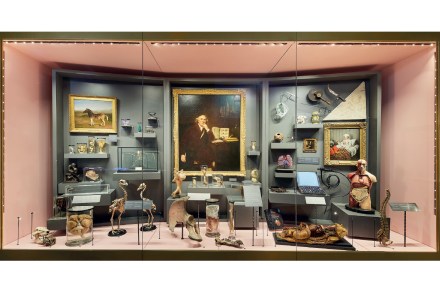
A doctor with wild grey hair and mutton chops holds a scalpel in his bloodied hand. He has paused for a moment, allowing one of his students to take his place and complete the incision. It’s a remarkably clean cut; the young man with the clamp has barely dirtied his shirt cuffs. Even so, the patient’s mother, if that’s who she is, weeps in the corner. She can see nothing but frock coats and a segment of open flesh. The 19th-century Philadelphia-based artist Thomas Eakins did not paint surgery as it was, exactly, but he did capture something of its veiled sterility. There may be no gowns or masks in

A brief introduction to Scottish art

When Nikolaus Pevsner dedicated his 1955 Reith Lectures to ‘The Englishness of English Art’, he left out the Scots. The English art establishment has never bothered with what was going on north of the border, which explains, though doesn’t excuse, the underrepresentation of Scottish art in the Tate’s so-called national collection. This leaves a gap in the story of British art that the Fleming Collection has set out to fill. Since its reinvention as a ‘museum without walls’ by director James Knox – a former publisher of this magazine – the best collection of Scottish art outside a public gallery has gone on the road. Last month saw the opening

The jewel-bright, mesmerisingly detailed pictures by Raqib Shaw are a revelation

Describing the Venice Biennale, like pinning down the city itself, is a practical impossibility. There is just too much of it, tucked away, scattered throughout the maze of alleyways and canals. And the art is no longer confined to the Biennale’s national pavilions in the gardens. It has spread, via dozens of tagalong shows cashing in on the presence of the global art world, to a motley array of disused palaces, warehouses, churches, at least one shop and a hidden garden loggia. A good way to sample it is just to follow your fancy: step through an ancient doorway and find out what is on the other side. That’s how

Artist, actor, social justice warrior, serial killer: the many faces of Walter Sickert

‘It’s too dark and life is too short,’ was Walter Sickert’s explanation of his decision to leave London in 1898. Separated from his first wife Ellen Cobden and in financial trouble, he did a flit across the Channel to Dieppe. A magnet for artists in the summer season, the town had long been a popular subject for tourist views. ‘I see my line…’ he wrote soon after his arrival. ‘Picturesque work. This place Dieppe, is my only up to now, goldmine.’ The place had already had a transformative effect on his painting. It was while spending the summer there with his mentor Whistler in 1885 that he had shifted artistic

Fascinating exhibitions – clunky editorialising: Breaking the News at the British Library reviewed

In The Spectator office’s toilets there are framed front covers of the events that didn’t happen: Corbyn beats Boris; ‘Here’s Hillary’; Jeremy Hunt wins the Tory leadership contest. The British Library has something similar at its Breaking the News exhibition. The difference is that these ones actually made it to the newsstand. It’s enough to make any passing journalist break into a sweat. ‘Titanic sinks, no lives lost’, reported the Westminster Gazette in April 1912; ‘King Louis XVI dodges the guillotine’, we are told in the 1793 issue of the London Packet. The Sunday Times’s 1983 Hitler diaries hoax appears in this hall of infamy. So does ‘The Truth’, the

Evocative tribute to the orphaned caped crusader: Superheroes, Orphans & Origins at the Foundling Museum reviewed

Instead of wasting money, like other museums, on extravagant architectural statements, the Foundling Museum in Brunswick Square has sensibly chosen to welcome visitors with a written statement. In 2014 it commissioned the poet Lemn Sissay, who spent his teenage years in a children’s home, to create a memorial in its entrance hall to the many parentless heroes and heroines in fiction. ‘Heathcliff was a foundling… Harry Potter was fostered… Dorothy Gale was adopted… James Bond was fostered…’ The list goes on, running to more than 100 names. Sissay’s mural will trigger a lightbulb moment for any dimwit like me who has failed to notice this narrative trope – and there

The exquisite pottery of Richard Batterham

Richard Batterham died last September at the age of 85. He had worked in his pottery in the village of Durweston near Blandford Forum in Dorset for 60 years continuously. It was, in its own way, an heroic life. Batterham took an astonishingly pure, austere approach to his work. Quite simply, he undertook every part of the process of making himself. He made his own stoneware clay bodies, arguing that those who used bought-in clay missed out on the beginning of the whole process and were mistaken to think that they could just inject their artistry at a later stage. He threw his pots on an archaic kick-wheel. He did