Europe

Britain’s euroscepticism hardens

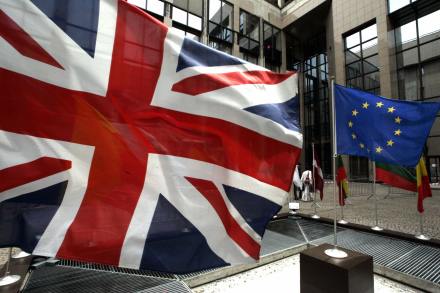
With the European financial crisis rumbling on, anti-EU sentiment in Britain is deepening. Two polls — one by YouGov for PoliticsHome and the other by Angus Reid — show that 50 per cent of the public would vote for Britain to leave the EU if there was a referendum.   Of course, this is nothing new. Brits have long been the most eurosceptic of Europeans, as Fraser noted a couple of months ago. In fact, we’re the only country where more people think our membership of the EU is bad than think it’s good: The hardening of eurosceptic sentiment does seem to be due to current events: 34 per cent

Osborne warns Eurozone that decisive action must be taken now

The UK government is becoming increasingly concerned about the situation in the eurozone and the fact that there does not appear to be the political will to address it. One government source complained to me earlier today that “unless they get their act together the eurozone are in danger of fiddling while Rome burns.” Tonight, in a major departure from Britain’s previous softly-softly approach to the issue, George Osborne is issuing a statement calling on the eurozone countries to take “decisive action” to “prevent market uncertainty doing real damage to the world economy.” The Chancellor calls on eurozone countries to: “…now set out in detail how they plan to expand

The euro's death rattle

The end might be nigh for the euro. The currency has hit an all-time low against the Swiss franc, as individual eurozone government bond yields vaulted higher due to mounting concerns about the region’s debt crisis. To spell out what this means: in Spain, 12 billion euros of interest payments will accrue for every 100 point bond rise in Germany. That is more than Spain’s annual public investment in infrastructure (8.6 billion) and its entire defence budget (7.6 billion). At the same time, Greece is heading towards disorderly default or some form of devaluation. Or both. And now Italy looks vulnerable. Well, I say that the end is nigh but,

The military's ECHR concerns

Earlier this week, there was a European Court of Human Rights ruling that is worth dwelling on. To summarise: the Court held that the UK’s human rights obligations apply to its acts in Iraq, and that the UK had violated the European Convention on Human Rights in its failure to adequately investigate the killing of five Iraqi civilians by its forces there. The judgment overturns a House of Lords majority ruling four years ago that there was no UK human rights jurisdiction regarding the deaths. The obligation on soldiers to protect the vulnerable during military operations is not, of course, new. It underlies the Geneva Conventions of 1949 (as well

Clegg: don't let’s be beastly to the eurozone

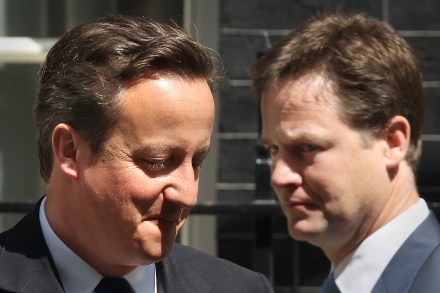
If you strain your ears, and listen very carefully above the din of the phone hacking scandal, then you may just hear Nick Clegg’s voice wafting across the Channel from Paris. Our Deputy Prime Minister is on the Continent today, delivering a speech that, in other circumstances, might have made more of a splash. This is, after all, a speech in which he stands up for the eurozone, and chastises those eurospectics — some of them within the coalition parties — who are eagerly anticipating its collapse. Or as he puts it himself: “A successful eurozone is essential for a prosperous UK. So there is no room for Schadenfreude here,

Web exclusive: Extended interview with David Cameron

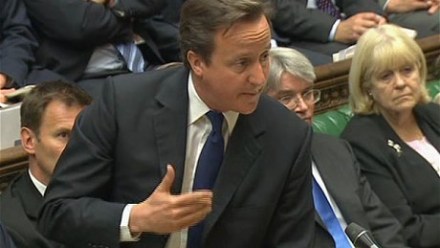
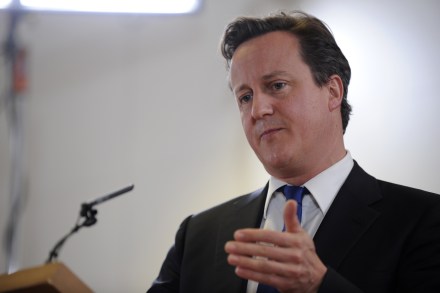
We interview David Cameron for today’s issue of The Spectator. Here’s an extended version of that interview for CoffeeHousers: The most striking thing about David Cameron is how well rested he looks. You wouldn’t guess that he was the father of a ten-month-old baby, let alone Prime Minister. He has no bags under his eyes — unlike his staff. He also seems relaxed. He jovially beckons us in to his Downing Street office and then flops down into one of the two high-backed chairs and urges one of us to take the other: ‘the Chancellor’s chair’, he calls it, with a chuckle. The last time we interviewed him, during the

Barroso's EU confidence trick

Say what you like about Jose Manuel Barroso, he’s a wily old card. The European Commission president makes public demands for Britain to surrender its rebate in European Union membership fees. The government refuses. Then, hey presto! Headlines suggesting that Brussels has been seen off. “Brussels bribe to buy off UK rebate,” says the Daily Mail. “Britain’s rebate is fully justified and we are not going to give way on it,” a Treasury spokesman tells the media. The quotation is true, Barroso did indeed offer £23 billion to tweak the UK funding formula, and a short-termist like Gordon Brown might have accepted. But the battle for Britain’s EU spending was

Personality and politics

One of the things about the press that politicians frequently complain about is that papers concentrate more on personalities than policies. But reading the latest extracts from Alastair Campbell’s diaries you see just how much personality matters. Indeed, according to Campbell, Tony Blair excluded Gordon Brown from a discussion about what to do after 9/11 not because of any difference about how to respond but because he had become fed up with how difficult Brown was to deal with on a personal level. Now, there are nowhere near the personal tensions at the top of this government that there were in the last one. But because politicians are humans and

Stand up for freedom and freedom will stand up for you (eventually)

It was hard to be a supporter of U.S. President Ronald Reagan in Western Europe. As a student living in West Germany at the time, I remember well the commonly held view of him: B-rate actor who read cue cards, a nuclear-weapons-obsessed warmonger, and not very bright to boot. Never mind that he had also been a popular two-term governor of the most populous state in the U.S. (California), because that did not fit with the bumbling cowboy narrative. When he called the Soviet Union “the evil empire” the chattering classes saw it as simplistic, unsophisticated and cringe-worthy. Not so the people caught behind the Iron Curtain who silently cheered

Europe, the times they are a-changin'

Before writing my column for The Spectator this week I asked one of the most clued-up Eurosceptics on the centre right what opt-outs Britain should push for in any negotiation over an EU treaty change. His answer, to my surprise, was “forget that, we should just leave”. This answer took me aback because this person had been the embodiment of the view that the European Union could be reformed from within. But people are dropping this view at a rapid rate for reasons that Matthew Parris explained with his typical eloquence in The Times (£) yesterday. I wrote in The Spectator this week that two Cabinet ministers now favour leaving

In for a penny, in for a trillion

The news that the EU seeks a budget of £1 trillion between 2013 and 2020 inspired disbelief rather than ire. President Barroso’s almost childlike insistence that the proposal was ‘relatively small’ was amusing, certainly not alarming. It’s a classic EU trick: pitch for 5 per cent and a string of crazy financial measures (including a ‘Tobin tax’ on financial transactions) in the hope obtaining more modest gains of say 2 per cent. Barroso will also throw the odd concession into the bargain: the announcement of a £5.4bn saving on the Commission’s staffing costs represents a concession. But, Barroso has his work cut out to secure even a 1 per cent

Treasury notes reveal Osborne’s position on euro bailouts

There has been much talk about what George Osborne told Alistair Darling about the EU bailout mechanism during those days in May between the election and the coalition being formed. But notes of a conversation between Osborne and Darling released today show that Osborne did urge Darling not to commit to anything that would have a lasting effect on the public finances. Osborne also suggested that the UK government might abstain due to the fact that the country was between governments. To which Darling’s reply was that the Cabinet Secretary’s advice was that the government was the government until a new one actually took office. It remains to be seen

Stopping Syria

Syria is still ablaze and the West seems unable to do douse the flames. And the risk of the Assad regime committing even greater violence will increase when the world’s media moves on. The reasons for Western impotence are manifold. First, for a long time Western leaders thought they could reason with Assad and therefore shied away from direct pressure. When they decided to act, they discovered that Assad is immune to European pressure because Syria does little trade with Europe. But, crucially, many Syrians are either loyal to the regime or fear triggering disintegration of the sort they have seen in neighbouring Lebanon and Iran. Finally, unlike Libya, the

Hague has been vindicated on the euro

The Foreign Secretary finds himself in the rather unique position today of trying to deal with the consequences of a crisis that he largely predicted. In May 1998, William Hague gave a speech warning that the single currency would lead to social unrest as governments tried to cope with one size fits all interest rates. It is a reminder of how much Hague was swimming against the tide of bien-pensant opinion that Michael Heseltine claimed this prediction was so extreme as to drive the Tories off the centre ground. But what is, perhaps, more interesting than Hague’s vindicated view that the euro, in a crisis, would be the ‘economic equivalent

Our politicians need to look beyond Europe

In Britain, public sector strikes always bring with them the whiff of national decline. They are a reminder of a time when the country was becoming less and less competitive and the civil service regarded its job as the management of decline, a mindset only broken by the Thatcher government.   But today Britain faces a choice almost as acute as the one it faced in the late 1970s. Is this country content with declining slightly less quickly than the continent of Europe as a whole, or does it want to equip itself for a new world in which economic power is moving east?   It is in this context

Can Cameronism be Europeanised?

In 1997 New Labour was not just a domestic programme; it was a foreign policy too. Known as the “Neue Mitte” in Germany, Blair’s Third Way soon attracted such converts as the German chancellor, the French prime minister and the Danish leader. In the end, it produced few results for Britain, failing – much as Harold Wilson did in the 1970s – to curry favour for the UK through party political links with other leaders. But for a few years, much as New Labour looked across the Atlantic to the Democratic Party, so Europe’s Social Democrats looked across The Channel. International recognition for his deficit reduction plan notwithstanding, David Cameron

The danger of unbalanced trade with China

The Chinese premier seems to like cars; the Chinese in general seem to like cars. China has bought MG in Britain and Volvo in Sweden, to which it has just added Saab. If the Chinese can make European car companies viable, then what’s the problem? Theoretically nothing: trade will help the Chinese and Europeans alike. But, as Robert Peston made clear in his questioning of Wen Jiabao, trade remains unbalanced. For example, European companies are excluded from public procurement contracts in China. It is also worth noting that China’s purchase of Spanish and Greek bonds over the past year, coupled with their promise to buy from Hungary, have made it

Badgering Spelman

The stars must be crossed for Caroline Spelman. First came the forests, then the bin collection fiasco, then the circus animals and now the FT’s Jim Pickard has news that the Cabinet will meet in mid-July to discuss whether to start a badger cull in the south-west. Badgers are one of those perennial issues of contention. As Pickard says: ‘It’s one of those classic issues where both sides have a highly convincing argument. The farmers (who have, I’m told, offered to underwrite the killing) believe that badgers have caused bovine TB among cattle herds and are pushing hard for the cull. But the animal welfare people want vaccination instead. They say

How many refugees are actually coming to Europe?

A human wave of refugees is supposedly setting off for Europe from North Africa. But what are the real figures? The first thing to note that refugees from North Africa come at a time when there has been a sharp decrease in the number of asylum applicants in the 27 EU member-states. Eurostat says that in 1992 there were 670,000 applications in the EU-15 and in 2001 there were 424,500 applications in the expanded EU-27. But according to the UN, the 27 EU member-states registered only 247,300 asylum claims in 2009 and 235,900 in 2010, a 5 per cent annual decrease. Within this group, the 15 ‘old’ EU member-states saw

Britain makes new senior diplomatic appointments

From the Number 10 website: The Prime Minister is pleased to confirm the following senior appointments: Sir Peter Ricketts, currently the Prime Minister’s National Security Advisor, to become HM Ambassador to France; Sir Jon Cunliffe, currently the Prime Minister’s Advisor on Europe and Global Issues, to become the UK’s Permanent Representative to the European Union in Brussels; Sir Kim Darroch, currently the UK’s Permanent Representative to the EU, to become the Prime Minister’s National Security Adviser; and Sir Peter Westmacott, currently HM Ambassador France, to become HM Ambassador to Washington. These changes will take effect from January 2012. These appointments were approved by the Prime Minister and for the appointment