Europe

Battle of the century

The American historian Walter Russell-Mead has a cynical — but very possibly accurate — take on what the French are trying to persuade the Germans to accept with their plan for Eurobonds: ‘France’s clear short term goal is to commit Germany to underwrite debts from weak EU states.  That not only staves off a crisis that threatens to engulf France; by putting Germany on as a co-signer for Greek, Italian and Spanish loans, France will ensure that Germany’s credit rating will not be better than France’s. The French will accept almost any German rules to limit the ability of countries like Greece to run up new debts.  It is in

Back to the drawing board as Eurobonds look dead in the water

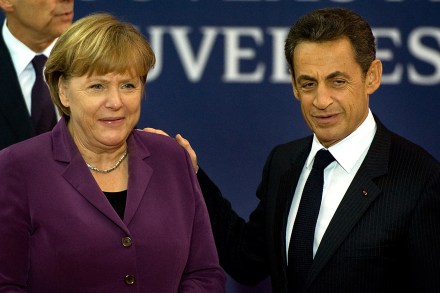
Watch her lips: no Eurobonds. Angela Merkel’s Finance, Minister Wolfgang Schauble has told Der Spiegel: “I rule out Eurobonds for as long as member states conduct their own financial policies and we need different rates of interest in order that there are possible incentives and sanctions to enforce fiscal solidity.” Merkel’s government is making its depositions ahead of tomorrow’s Eurozone summit, rebutting the moves made by other member states over the weekend to introduce Eurobonds, a step towards political integration. Those proposals were backed by Nicolas Sarkozy, with whom Merkel is meeting in private this afternoon. Interestingly, Le Monde reveals that Eurobonds are not even on the agenda of these

Desperate times

You have to hand it to the Eurocracy: it is nothing if not determined. The recent horrors on the stock market have concentrated minds in Brussels and across continental capitals. The headline news is that France, Italy, Spain and Belgium have placed a temporary ban on short-selling, but that’s just one counter-measure that has been introduced in the last 24 hours. And you’ll notice that these schemes are piecemeal; there is no grand plan as yet to calm the markets. First, Spain has bent a suppliant knee before the European Commission to secure restrictions on Romanians seeking work. This is momentous: the first time that border restrictions have been re-imposed

Regression to the Mean

Via Art Goldhammer, a new paper examining trends in public disorder across europe from 1919 to our own blessed unhappy time. Here’s the chart: The authors explain their methodology: “We look at five different types of instability – anti-government demonstrations, riots, assassinations, general strikes, and attempted revolutions – in Europe over the period 1919-2009. The data comes from a large-scale international data collection (Banks 1994), and is based on an analysis of reporting in the New York Times. The individual indicators are then aggregated by summing them up for each country and year. This gives the variable called CHAOS. Figure 1 shows how it evolved over time since 1919, presenting

Osborne's debt dilemma

If there’s one sentiment that defines George Osborne’s article for the Telegraph today, it’s that there is no need for us Brits to panic. The economic convulsions of the past few days, contends the Chancellor, serve to prove that the coalition was right to approach deficit reduction as it has. “The alternative of more spending and yet more borrowing is now frankly ludicrous,” he says, “and places those who advocate it on the outer fringes of the international debate.” He has a point. As I blogged on Saturday, there are reasons to believe that we’d be hurtling towards a credit downgrade and higher borrowing costs were it not for the

The markets wax and wane

CoffeeHouser ‘Ben G’ had it right in his comment underneath my earlier post: 24 hour news really does struggle in the face of economic crisis. This morning, all the talk was of a debt-induced apocalypse. Earlier this afternoon, the headlines were about the markets “rallying” after better-than-expected data on the US labour market. And now the BBC website’s main headline is that “turmoil in the stock market persists,” despite those very same labour market figures. Oh yes, it’s difficult to present a consistent front as the money merchants sway and buckle in the breeze. That said, the economic fundamentals remain discouraging. It shouldn’t be forgotten that yesterday’s losses were extraordinary;

Fasten your seatbelts…

It has, to paraphrase Margo Channing, already been a bumpy night — and it’s only going to get bumpier today. The latest news is how the Asian markets have trembled at what’s happening in the West. Japan’s main stock index is down 3.7 per cent. Australia’s is down 4.2 per cent. Hong Kong’s 5.3 per cent. And even oil futures joined in with the collective nosedive, which is continuing as the European exchanges open this morning. All of which adds to the catalogue of horror that was written yesterday. CoffeeHousers will read plenty of grim comparisons in the papers today, not least that yesterday’s plunge in the Dow Jones was

Capital punishment to be debated in parliament?

Sir George Young has graced the pages of the Daily Mail this morning, arguing that MPs cannot ignore the clamour for a debate on the death penalty, as examined in depth by Pete last weekend. The Leader of the House’s intervention is the greatest indication yet that parliament will discuss the issue for the first time since the passage of the Human Rights Act in 1998. This has not come as a bolt from the blue. A string of e-petitions will mature soon and capital punishment is expected to be near the top of the list, as it always is when the public is asked for its opinion. Young sees this as

Petrol woes set to continue

Despite small falls in petrol prices last month, the consequence of a supermarket price war according to the AA, motoring becomes ever more expensive. Political campaigns have opened as pressure builds at the pumps; and these campaigns have been co-opted by influential organs such as the Sun. The government has reacted: taking part in the International Energy Agency’s decision to release reserves onto the market to counter those members of OPEC that connive to sustain high oil prices. The government has also relaxed some of its windfall taxes on companies operating in the North Sea. However, supply remains uncertain, not least because so much of Europe’s petrol was sourced from Libyan light

Massacre in Hama hastens the need to tackle Assad

Syrian President Bashar Al Assad has praised his troops for ‘foiling the enemies’ of his country. Some enemies. 140 civilians are said to have died in a pre-Ramadan crackdown on protesters, adding to the toll of 1,600 civilians who have been killed since anti-government demonstrations began in mid-March. Details of the events in Hama are unclear because journalists have been kept out of Syria. But the pattern of events is familiar: protests against the Assad regime emerge; the army moves in to kill demonstrators; more protests then take place, which leads to more killings. Meanwhile, the international community stands by. Germany and Italy have called for an urgent meeting of

Bitter Turkish delights

Turkish accession to the EU is apparently no more than a dream of those who desire it at present, but it remains a point of contention across Europe. The British government, for instance, are in favour of enlargement, believing Turkey’s economy to be essential to Europe’s continued economic strength. Accession would also hamper the goal of political integration in the EU, which is expedient to Britain. Not everyone in Britain shares the government’s unqualified enthusiasm for Turkey. The Home Affairs Committee has issued a report this morning, criticising aspects of the government’s policy and insisting on careful management of accession. Specifically, the committee argues that the errors made when EU

Rengotiating the loan with Ireland

All eyes were on Greece at last week’s crisis summit in Brussels, but other indebted countries took advantage of Angela Merkel’s generous mood. In line with concessions made to Greece, the Irish secured a substantial cut in interest repayments on its bailout loan: the rate has fallen from 6 per cent to somewhere between 3.5 per cent and 4 per cent, and the loan period has been extended from seven to 15 years. This was a long-term goal of Enda Kenny’s government and the renegotiations are being heralded as a major victory. But the matter does not end there. When Kenny first tried to renegotiate the terms of its Eurozone loan in

Is Merkel getting her way?

Below, courtesy of the Telegraph, is a leaked copy of the draft proposals on managing the Greek debt crisis.There are no measures to reduce Greece’s debts to sustainable levels; subsidy is the preferred route. This will presumably hit German taxpayers the hardest, but Merkel has managed to obtain private sector involvement, a clear German objective in these discussions.  However, this course is likely to lead to Greece’s selective default as creditors buy back bonds. The European Central Bank has declared that it is happy to allow this and will continue to accept government bonds in the event of sovereign default. This is a major retreat from its earlier position and commentators are clear that the Eurozone is now flirting

Loyal Clegg's slippery tongue

Oddly, David Cameron’s most voluble supporter throughout the phone-hacking psychodrama has been Nick Clegg. The deputy prime minister took to the airwaves when no Tory dared or wanted to. Earlier today, Clegg gave a speech-cum-press conference and he defended the prime minister again, saying that he had very little to add to Cameron’s statement yesterday. He also defended Cameron over unanswered questions about Rupert Murdoch’s purchase of BskyB; Clegg said that Cameron had “nothing to do” with the deal, although he added that Vince Cable’s reservations had been vindicated. Clegg then elaborated on media regulation. Unsurprisingly, he insisted that the status quo must change. It was ludicrous, he said, that

Common Franco-German position on Greek debt

As I wrote earlier this morning, rumours of a ‘common Franco-German position’ on Greek debt were circulating in the early hours. Details are now emerging. Nicolas Sarkozy has dropped plans to impose a 0.0025 per cent levy on Eurozone bank assets, which was opposed by Angela Merkel for being much too cumbersome. In return, it seems that Merkel is prepared to consider the French-led plan of bond rollover. Merkel is also keen that private sector holders of Greek bonds pay their share of this second bailout. According to the FT, she favours a bond-swap deal, whereby bonds that will mature in the next eight years are swapped for new 30 year bonds paying a

Getting a grip of the crisis

“I’m very worried, this building [the Treasury] is very worried and this government is very worried,” said George Osborne of the unfolding crisis in the Eurozone. In an interview with the FT, the chancellor goes on to say that he is in constant contact with his continental counterparts and urges them once again to “get a grip”. Eurozone leaders are meeting today to discuss further loans to Greece. Three options are being considered: first, an extension of the European Financial Stability Facility; second, private sector creditors re-lend money for a longer period and at a lower rate; third, impose a tax on banks to secure revenue for Greece. Despite a

Gearing up for another European drama

Away from the amateur dramatics in parliament this afternoon, the government is fighting yet another battle with the European Commission over banking reform. European leaders will vote later today on proposals to introduce the rubric of Basel III across European financial institutions. Led by EU Finance Commissioner Michel Barnier and ECB Vice-President Jean-Claude Trichet, these proposals would insist that minimal and maximum capital requirements are imposed on banks. The terms dictate that banks hold 7 per cent of their top-class assets in reserve. Britain opposes the scheme, not because the requirements are too steep: the UK’s Banking Commission has suggested that banks hold 10 per cent of their assets in reserve.

Euro crisis enters a new phase

It was a problem that would be fixed with a snap of the Commissioners’ manicured fingers, but now fresh euro-storms are louring in the near distance. As predicted over the weekend, the markets reacted to the European Banking Authority’s deeply flawed stress tests with fevered concern and a clear note of contempt. The FTSE shed 90 points yesterday, with banks among the day’s biggest losers. The performance in Frankfurt and Paris was equally baleful, as investors fled for safe commodity stocks. As Fraser has noted, Allister Heath argues that the Eurozone crisis is responsible for the booming price of gold. The markets have recovered slightly this morning; but that does

Inadequate stress test inspires anti-EU sentiment across Europe

Yesterday’s European Banking Authority (EBA) stress test was supposed to restore confidence in the euro and Europe’s beleaguered financial institutions; it has had the opposite effect. Investors and market analysts are preparing for ‘Black Monday’ after only 8 banks failed the test and must now raise £2.2 billion between them to stave off ruin. A respected estimate by Goldman Sachs expected at least 15 banks to fail, requiring £29 billion to recapitalise. As the Spectator’s business blog reported yesterday, analysts feared that the EBA’s test would not be sufficiently stringent, and so it came to pass. The findings have served only to undermine confidence in institutions across the continent, many of

Multi-speed Europe

Britons are becoming increasingly eurosceptic, according to YouGov. I have previously predicted that could leave the union; but there is another option. Following the eventual resolution of the euro crisis, the EU may evolve into a much more asymmetric arrangement, with a small group of European states integrating in some areas, while other states remain outside. On the surface, this does not look like anything new. The EU already has many different levels of integration. The Schengen agreement and the euro are examples of this and the Lisbon Treaty holds out the idea of more such multi-speed arrangements. However, after the euro crisis, these will be different from those that