Eu

Three ways Britain should refuse to stick to the EU’s rules in trade talks

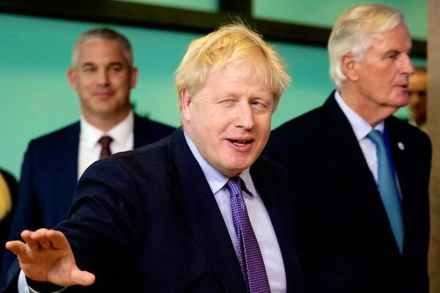
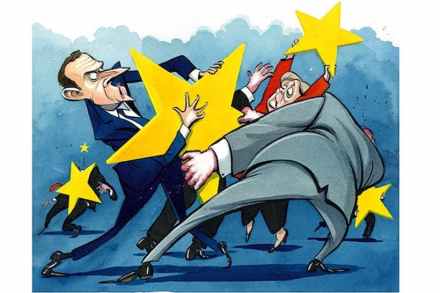
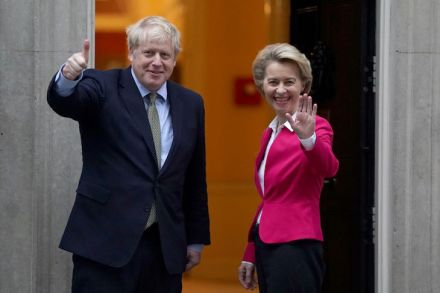
It is hard to imagine there will be much of a meeting of minds. As the new president of the European Commission Ursula von der Leyen meets with the newly re-elected British Prime Minister Boris Johnson today the pleasantries will quickly give way to a strong clash of views. With our departure from the EU set for the end of the month, trade talks are about to open. Brussels is desperate to lock the UK into its regulatory system. But quite rightly, the government is resisting that. After all, there was no point in leaving only to accept all the EU rules and regulations, except this time with no say over how they are made. In fact, the UK government should make it absolutely clear there are a whole series of industries where we are determined to break free.

Don’t worry, Frans, Britain loves Europe back

As a lifelong Europhile, I rather liked the love letter to Britain from Frans Timmermans, vice president of the new European Commission. We in this country do love Europe, its people, its culture, its quirks, its diversity. Never has Britain been integrated more closely with the rest of Europe, never have we done more trade, never have more Brits lived in Europe and vice versa. The links between our peoples have never been stronger - and, after Brexit, will become stronger still. The idea of a union of governments, however, was not a model that worked for the UK: that much was decided in a referendum and reinforced in two general elections. It’s nothing personal against Europe or the likes of Timmermans. We just value the ability to elect (or boot out) the people who make our laws.

My friend Margaret Thatcher

By the time you read this it will all be over, but will it? I’ve had a bad feeling all along about those who opposed the result of the 2016 referendum. When they don’t get what they want, they play dirty — just look what they did to Lady T 29 years or so ago. And speaking of the greatest prime minister ever, Charles Moore’s biography of Maggie, a magnificent achievement, has left me open-mouthed at his scholarship and ability to write 3,000 pages in such a relatively short time. It should be required reading in schools, but that, in turn, would require students to be able to read and concentrate, something the little darlings cannot be expected to do nowadays, what with Twitter and other such diversions that keep them occupied and as dumb as planks.

The Brexit extension waiting game

The UK and Brussels are currently engaged in a waiting game – only no one is sure who is waiting for whom. EU leaders had been expected to announce the terms and length of an Article 50 extension this Friday. However, that decision has been put on hold in light of Boris Johnson's call for a general election – with MPs voting on a motion on Monday. Speaking in Brussels following a meeting of ambassadors, Michel Barnier – the EU’s chief negotiator – said 'no decision' had been made on a way forward. A decision is likely to be made on Monday or Tuesday. EU leaders want to wait and see what happens with the election vote.

Boris has compromised, not conquered on Brexit

Reflecting on Boris Johnson’s Brexit deal, I have many questions. Why are people who rejected the possibility of Northern Ireland being subject to EU rules and regulation via a contingent backstop now embracing the certainty of that happening? How could anyone reasonably expect the DUP to sign up to something that really does make Northern Ireland a very, very different part of the Union? Something they were repeatedly promised would never be conceded. Why are none of the people who used to be furious about the '£39 billion' (actually less now but never mind) objecting to paying it now? Why shouldn’t MPs have at least a superficial analysis of the economic trade-offs made in this deal?

A Brexit deal will completely change the electoral landscape

Expect the unexpected has been the rule in British politics these last few years. But even so, few would have predicted the events of the past week. Last Tuesday evening the Brexit talks seemed dead. Even the most mild-mannered figures in Downing Street held out little hope of a deal this side of an election. That all began to shift, though, after Boris Johnson and Leo Varadkar met last Thursday. What changed was that they both realised that the other was serious about a deal. They stopped seeing each other’s proposals as a trap and began engaging with them. This doesn’t guarantee a deal, though. Boris Johnson and Leo Varadkar’s desire to get this done is a necessary but not sufficient condition for an agreement.

Is a deal really possible?

It is one of the most remarkable turnarounds in recent political history. On Wednesday afternoon, the Brexit talks seemed pretty much dead—hence my piece in the magazine this week. Even the optimists in Downing Street were struggling to see anyway through. But by Friday lunchtime, the UK and the EU were agreeing to intensify negotiations as they searched for a deal. As I say in The Sun this morning, the negotiations going on in Brussels this weekend are serious: they aren’t just for the show. This doesn’t, though, mean that a deal will definitely be done. But things are on the move. Now, the sheer pace of this turnaround is a reason for caution.

Should I return to the land of my Italian ancestors?

When I was growing up, my Italian grandfather was my favourite person. He taught me to play a mean game of draughts. He told me stories about his childhood in a remote mountain village in Abruzzo. I couldn’t hear often enough about how he got the deep scar across the bridge of his nose. He was standing as a little boy behind his father who had a pair of shears slung over his back and they fell and sliced his face. He told me they had to stick the adhesive strip of an envelope over the cut. My mother told him to be quiet every time he gave me the lurid details but I loved it. The builder boyfriend and I have been thinking a lot about our heritage. Like many Brexit voters, we find the charge of ‘little Englander’ ironic.

I’m sorry because I failed: An interview with David Cameron

‘How have you been?’ David Cameron asks, bounding up to meet me. Fine, I say, then make the mistake of asking him the same question. His face drops. ‘Oh,’ he says. ‘Well. So-so.’ Watching the political news, he says, has been getting him down (in a way it didn’t when he was in office) and if you’ve picked up a newspaper in recent days, you’ll know why. His memoir, For the Record, is out and the extracts make it sound like a 700-page apology note to the nation. He’s sorry for the referendum result. Sorry for what came after. And above all, sorry for letting villains like Boris Johnson and Michael Gove get away with it. Standing in his jogging kit, fresh from his morning run, the former prime minister still looks a bit deflated.

How it feels to be the only Brexiteers in the village

We are the only Brexiteers in the village. That, at least, is how it feels. Out they come, the far left bullies, on to the streets of Westminster waving their placards and calling for the referendum result to be cancelled. And that is bad enough. But inside the suburban Surrey homes of Middle England the enlightened liberals send out even more hostile vibes. Admit you’re Brexit and you’ll never eat my vegan lasagne again, is the message they transmit. Personally, I’m delighted to be persona non grata at the homes of my more vegan acquaintances, even the dirty ones who eat meat secretly at weekends. Why one should feel bullied in polite company is an anomaly in itself.

The EU has banned a miracle cure for laminitis

Once upon a time, in a country that didn’t run itself, a horse supplement company invented a cure for laminitis. This cure, let’s call it LamiSafe, was like the holy grail of horse-care products because when administered to ponies who previously went lame on lush summer grass, LamiSafe prevented lameness and the pony was suddenly once again able to graze safely. I bought this miracle product after my farrier recommended it and, though sceptical at first, for I have rarely found a supplement of any kind that did what it said on the tin, I was amazed to find that it worked.

The good, bad and ugly of Boris Johnson’s Brexit letter to the EU

Boris Johnson has written to European Council president Donald Tusk, setting out key aspects of his government’s approach to Brexit. The four-page letter has a number of positive points but also some worrying ones. The good bits: The letter condemns the Irish backstop as undemocratic and inconsistent with both UK sovereignty and the Good Friday Agreement. It also rightly notes that the backstop would lock the UK into a customs union with the EU indefinitely with no means of escape. The letter also states that the UK government cannot continue to endorse the commitment its predecessor made in the Joint Report of December 2017 to ‘full alignment’ with wide areas of the single market and customs union.

Is the EU to blame for football’s daft new handball rule?

It’s not often Mr S jumps to the defence of the EU, but he is prepared to make an exception. A new handball rule in football caused controversy over the weekend after a last-minute goal by Manchester City was ruled out. The reason? City player Aymeric Laporte was judged to have lightly touched the ball following a video check. So who’s to blame for the stringent new rule that cost the Premier League champions victory in their game against Tottenham? The EU, according to football manager Ian Holloway: ‘I don’t think that’s our boys making up that new change of law. I think that’s people telling us what we should do with our game. Now, they should stop doing that.

Emmanuel Macron could be Boris Johnson’s Brexit saviour

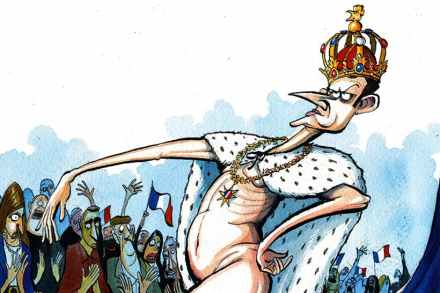
One thing on which Remainers and Brexiteers can agree is that Brexit delayed is Brexit denied. The government continues to proclaim that the UK will leave the EU on 31 October with or without a deal. But No. 10 is acutely sensitive to the possibility of a parliamentary manoeuvre designed to compel the executive, through legislation, to seek a further extension of Article 50 to delay Brexit yet again. But Boris Johnson should keep calm about this prospect, for an unlikely saviour – the president of France, Emmanuel Macron – could come to his rescue. Whatever Brexit extension legislation Parliament might push through, any further extension of Article 50 requires unanimous EU Council of Ministers’ support.

War of words | 15 August 2019

Italy is preparing to go back to the polls and this time Matteo Salvini looks set to return as the undisputed king of Italian politics. His Lega party (formerly the Northern League) has split with its coalition partner, the Five Star movement. For Salvini, the appeal of a general election is obvious: Five Star’s popularity has slumped during the 14-month government, but Lega’s has soared. It now boasts of being the biggest party not only in the north of Italy but — previously unimaginably — in the south. So Salvini can now ditch his coalition partner and seek his own majority. If he succeeds, this will cause fresh headaches for Brussels and embody a far deeper conundrum.

Two sides to every story

Maybe the equality inspectors at the corporation didn’t get the chance to vet Richard Littlejohn’s series for Radio 2, The Years that Changed Britain Forever, before it was broadcast on Sunday. Maybe the first programme (produced by Jodie Keane) was an accurate reflection of the year it focused on, 1972. But the most striking thing about it was not so much Littlejohn’s thesis, by which he declared that politically, culturally and musically it was a pivotal year in our national history, determining events that followed much later. No, it was his selection of music to accompany his thoughts about how the miners’ strike of 1972 led to the three day week, which led to the general election that destroyed Edward Heath and brought Arthur Scargill to national prominence.

Why the onus is on the EU to do a Brexit deal

In the run-up to the referendum, a common argument against Brexit went like this:  “We should not leave the EU, because if we try, the EU will be capricious and irrational, it will not prioritise the welfare of its people, it will instead punish us, we must be afraid of that wrath, forget any merit, we must be prudent”. A similar argument is often discussed at length by Sir Ivan Rogers, and repeatedly published in The Spectator. It is both right and wrong. The people who believe it are not ‘Remoaners’, as some might claim: they are patriots. But I disagree. And for me, this argument is why I voted to leave. I am an autonomous and free human being. I am also a citizen of a society. I surrender my freedoms in order to make that society function.

High life | 9 May 2019

New York   Here’s a question for you: if your wife, husband, girlfriend, boyfriend, toy boy even, lied repeatedly to you about a serious matter such as fidelity, would you continue to trust them? I suppose some fools would, but most wouldn’t. So here’s another question: how can the British people even countenance voting for those they entrusted with implementing their 2016 decision to leave the bureaucratic dictatorship that is the EU? Duh! Actually, I’d be in the UK by now and trying to stir things up, but I’m stuck in the Bagel with pneumonia, bronchitis, and all sorts of other bugs that caught up with me while in pursuit of the high life.

What a May / Corbyn Brexit deal would look like

The local election results showed that both main parties are paying a price for the Brexit impasse. This, as I say in The Sun this morning, means that the cross-party talks have a better chance of succeeding than they did. Those in the talks are more optimistic than they have been about getting some kind of agreement, if not a full-blown deal. But they know that things could change very quickly. I understand that the compromise being drawn up goes as follows. The UK would initially enter into a ‘comprehensive customs arrangement’ with the European Union. This would be very similar to a customs union.

Friends and allies

The European Union’s official goal — an ever-closer union of people — remains its single most attractive feature. Our continent is marked by its diversity: nowhere can you find a greater range of languages, histories and cultures. Closer co-operation is within everyone's interests, and the EU has done much to facilitating this. Its mistake was a lack of respect for the democratic traditions of its member states, and when it sought to impose a fixed set of rules over the most culturally and economically diverse club of nations it became a source of instability in Europe. The rise of populist parties in Europe is the most visible sign of the over-reach.