Eu

Europe’s centrists are falling one by one

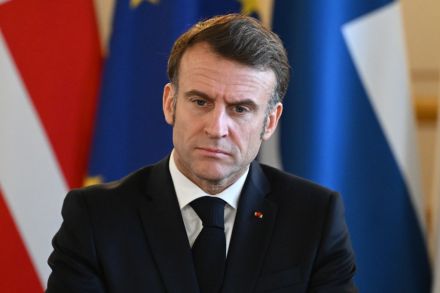
Few in France will have been as devastated by their team’s defeat in last night’s World Cup semi-final as Emmanuel Macron. The president put on a brave face, tweeting his congratulations to Spain and thanking the French team "for carrying our colors with commitment." But how Macron must have dreamed of a French World Cup triumph in Sunday’s final. He would have been in New Jersey – as he was in Moscow in 2018 when the Bleus won the World Cup –dancing a jig as his bête noire, Donald Trump, presented the trophy to his boys. Macron's presidency is ending with a whimper In a sense the French football team are a metaphor for Macron’s presidency.

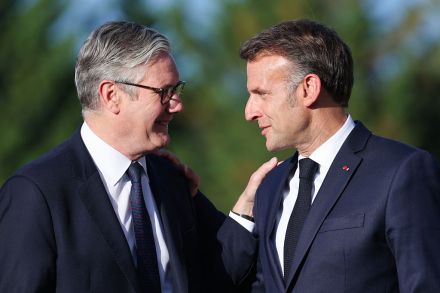
Macron Starmer

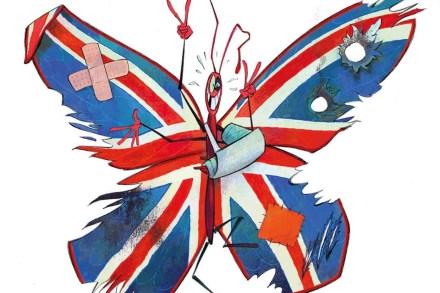
Was Brexit worth it – and can Burnham save Britain?

From our UK edition

55 min listen

For this week’s Edition, William Moore is joined by the Spectator’s assistant editor Isabel Hardman and the editor of The New Statesman Tom McTague. Plus, in a special episode this week, the Spectator’s economics editor Michael Simmons joins for the first half of the episode, before political editor Tim Shipman jumps in later on. This week: was Brexit worth it? As we approach the tenth anniversary of the vote to leave the European Union, the Spectator’s editor – and former prominent Vote Leave campaigner – Michael Gove makes the case that not only was Britain right to leave, but it has benefitted from leaving. The past decade however has been marked by domestic political chaos, so to what extent was Brexit a symptom or a cause of Britain’s structural problems?

Was Brexit worth it – and can Burnham save Britain?

Is Andy Burnham up to the job of prime minister?

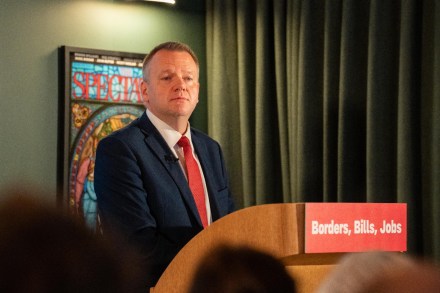
When the Labour party football team played a group of journalists at Loftus Road two years ago the hacks won 4-1. The politicians’ solitary goal came from a late penalty. When the referee pointed to the spot, the center-forward stepped up, elbowing well-known politicians such as Ed Balls, David Miliband and Sadiq Khan out of the way in his bid for glory. There was a notable absence that day. “Keir [Starmer] had been due to play, but he didn’t turn up,” a witness recalls. “If he had been there, he’d probably have grabbed the ball and there might have been a tussle.” Instead, Andy Burnham said: “This is mine,” and calmly slotted it into the corner. “It was a perfect penalty,” says the witness.

Andy Burnham

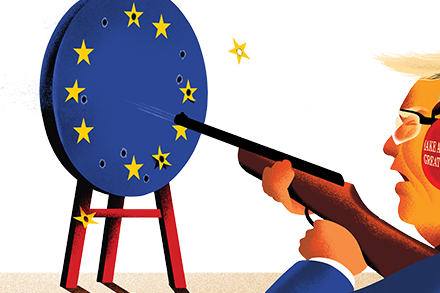
Trump, Europe and the power of delusions

German Chancellor Friedrich Merz suggests to a classroom full of youngsters that Donald Trump has been “humiliated” by his war in Iran – and the President cancels deployment of the long-range missile systems around which Germany had planned its defense strategy for the coming decades. Spanish Prime Minister Pedro Sánchez observes a strict neutrality on Iran, declaring his country’s bases out of bounds – and Trump urges Spain be kicked out of NATO. British Prime Minister Keir Starmer hesitates to sacrifice his country’s navy in a war on which he wasn’t consulted – and Trump mocks him in public for a week.

europe

EU déjà vu: the emergency brake is back!

From our UK edition

13 min listen

Charles Grant from the Centre for European Reform and Tim Shipman join James Heale to reflect on the rumours about Britain's latest set of negotiations with the European Union. There are reports that the EU may be willing to accept some form of mechanism, that the UK could use, should Britain ever wish to temporarily halt the number of inbound students. Perhaps we could call such a mechanism an 'emergency brake'. Sound familiar? What does this tell us about the dynamics of the EU, how the UK-EU relationship works – and how inevitable was the result in 2016? Produced by Patrick Gibbons and Megan McElroy.

EU déjà vu: the emergency brake is back!

Brussels is making your perfumes worse

From our UK edition

‘Heliotropin,’ said the Frenchman mournfully. I was midway through lunch in Mayfair with Benoit Brosseau, whose father, Jean-Charles, created the fragrance Ombre Rose, and who now leads the company of the same name. I had asked the question I always put to fragrance people, in the full knowledge it will make them either sad or furious: how do they cope with Ifra, the Brussels-based regulatory, or representative, body of the fragrance industry? One of the latest in the list of ingredients Ifra may be curbing is based on heliotrope, which not only gives a powdery aspect to scent, but conjures up the elusive smell of cherries. (If you know that marvellous, evocative Guerlain scent L’Heure Bleu, that has it.) M. Brosseau was fed up.

Is Labour sleepwalking back to the EU?

From our UK edition

Two big topics on the agenda today as Keir Starmer has his pitch – again – on the cost of living. He told us towards the start of the year that every minute not spent tackling the cost of living was a minute wasted, so what has he been doing in all that time? Also today, ahead of her Mais Lecture this week, Rachel Reeves has been laying the groundwork for closer ties with the European Union. This does seem like a change of rhetoric from the Chancellor, who is openly suggesting that Brexit was a mistake. So what would closer ties look like? And is this the only lever that remains for her to deliver growth? James Heale and Tim Shipman discuss. Produced by Megan McElroy.

Revealed: Keir Starmer’s new plan to get closer to the EU

A Labour MP, reflecting on the problems the Prime Minister faces over the war in Iran, observed this week: ‘Keir got it right, but things keep going wrong.’ His point was that Starmer kept Britain out of the Israeli-American air strikes, a position popular both with the parliamentary Labour party and the electorate, yet the impact of that conflict has laid bare three serious problems at the heart of the British state. First, there has been a fracturing of relations between Starmer and Britain’s defence chief, Air Chief Marshal Sir Richard Knighton. Second is the vulnerability of the economy to energy price shocks. Third is Ed Miliband’s net-zero crusade, which has put further pressure on the cost of living, Starmer’s biggest domestic problem.

Trump is right about greenhouse gases

Irresponsible Trump, responsible China: that is the message the BBC's climate editor seemed to be sending us by juxtaposing the news that the President had repealed Barack Obama’s "endangerment finding" and that China’s carbon emissions fell slightly last year. Trump’s critics like to portray him as a rogue figure in a world which is otherwise committed to reaching net-zero greenhouse gas emissions. But is there any truth in that? The endangerment finding does not appear to have had any obvious impact on US emissions The endangerment finding was a piece of legalese issued in a 2009 ruling by the Environmental Protection Agency (EPA).

Justin Marozzi, Lisa Haseldine, William Atkinson & Toby Young

From our UK edition

32 min listen

On this week’s Spectator Out Loud: Justin Marozzi analyses what Trump’s coup in Venezuela means for Iran; Lisa Haseldine asks why Britain isn’t expanding its military capabilities, as European allies do so; William Atkinson argues that the MET’s attack on freemasonry is unjustified; and, Toby Young explains why the chickenpox vaccine is a positive health measure. Produced and presented by Patrick Gibbons.

Brexit’s back – and so is Truss

From our UK edition

16 min listen

There has been a flurry of UK-European activity across Britain this week, with the German state visit in London, the Norwegian Prime Minister signing a defence agreement in Scotland and the British-Irish council meeting in Wales today. Perhaps then it's inevitable that speculation over closer ties between the UK and the EU has re-emerged. Could Labour seek to rejoin the Customs Union? Would this help or hinder Reform? And would the EU even stomach it? Plus – Liz Truss launches a new show today. Will she say anything new? James Heale and Charles Grant from the Centre for European Reform join Patrick Gibbons to discuss. Produced by Patrick Gibbons.

Macron has declared war on free speech

Emmanuel Macron says Europeans should stop relying on social media for their news and turn back to traditional public media. Speaking in Paris on Wednesday, he said people were “completely wrong” to use social networks for information and should instead depend on journalists and established outlets. Social platforms, he argued, are driven by a ‘process of maximum excitement” designed to “maximize advertising revenue,” a system he said is “destroying the foundations of democratic debate.” He accused X of being “dominated by far-right content” and added that the platform was no longer neutral because its owner had “decided to take part in the democratic struggle and in the international reactionary movement.” TikTok, he warned, was no less dangerous.

Migration, the customs union & a £40bn black hole?

From our UK edition

14 min listen

There are reports that the OBR will downgrade Britain’s productivity growth forecasts, increasing the size of the black hole facing the Chancellor at the end of the month. This continues the spate of bad news for the Chancellor on the economy – but can we trust the figures? James Heale and Michael Simmons join Patrick Gibbons to talk about what this means ahead of the budget, whether anger over the money wasted on asylum hotels can be linked to the cost-of-living crisis and what Rachel Reeves is doing in Saudi Arabia this week. Plus: is a debate over the customs union really what Britain wants right now? Produced by Patrick Gibbons.

Obsolete message: Led By Donkeys in conversation, reviewed

From our UK edition

https://www.youtube.com/watch?v=xVdR7DvLbjw The founding members of Led By Donkeys granted a public interview last Thursday at a theatre in Walthamstow. They were questioned by Guardian columnist Zoe Williams. Seated on squashy sofas, the four men looked like an ageing boyband who met at public school. James Sadri, suave and handsome, seems to be the boss. Ollie Knowles is the ebullient charmer. Ben Stewart, who scowls as he talks, is the grumpy technical wizard. And Will Rose, who says very little, seems to be the token northerner. The Donkeys specialise in harmless political pranks. Their approach is new but their content is stale.

Moldova has been saved from Russian influence, but at what cost?

From our UK edition

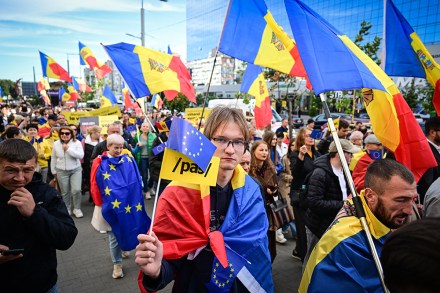
The European Union, guardian and champion of democracy, rightly takes a dim view when ruling parties ban their opponents, refuse to open polling stations in areas likely to vote against them, censor opposition news channels and allow a large staff of foreign election monitors to police social media in the run-up. If Serbia, say, or Georgia tried systematic election rigging of this kind, Brussels would be the first to call foul and disregard the result as illegitimate. But when it’s the EU that’s running the interference, as in Moldova this week, the rules are apparently quite different. This week the pro-EU party of Maia Sandu, Moldova’s President and a former World Bank official, won a slim majority in a general election.

Poland’s Nawrocki heralds a more mature populism

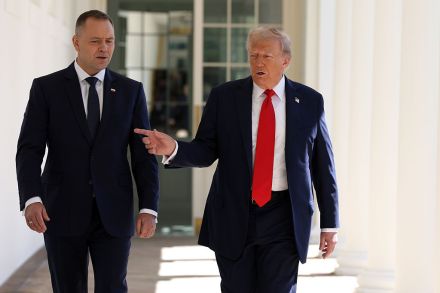
Yesterday, September 3, President Trump welcomed Karol Nawrocki, the newly inaugurated president of Poland to the White House. It was a stirring occasion, replete with a surprise military fly-over of F-16 and F-35 fighter jets flying in “missing man” formation to honor  Major Maciej “Slab” Krakowian, the Polish pilot who died in a crash in Radom, Poland, last Thursday.  Nawrocki, who narrowly won the presidency in June, is often described as “the Polish Trump.” It’s an accurate epithet. Nawrocki is as much a “Poland First” president as Trump is an “America First” president. The 42-year-old historian (Nawrocki holds a PhD in history) supports a list of policy initiatives that could have come right out of the MAGA playbook.

Nawrocki Trump

Labour goes on the Farage offensive

From our UK edition

12 min listen

As James Heale writes online for the Spectator today, 'two issues continue to plague the government': how best to attack Nigel Farage. and how to frame an incrementalist approach to policy 'when the national mood favours radical change'. Nick Thomas-Symonds, the Cabinet Office minister responsible for UK-EU relations, attempted to tackle both today as he came to the Spectator to set out Labour's Europe strategy. Labour are pursuing 'pragmatic alignment' – what they argue is greater co-operation when beneficial to the British interest. But what does this mean? James joins Michael Simmons on the podcast to unpack the speech.

How Giorgia Meloni became Donald Trump’s EU whisperer

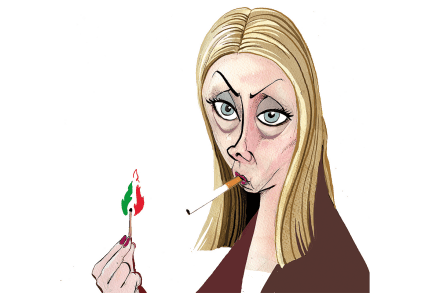
Henry Kissinger once complained: “Who do I call when I want to speak to Europe?” Today the answer would be Giorgia Meloni, Italy’s first female Prime Minister, who has emerged as the most important leader in the European Union. No Italian leader has filled this unofficial role before: it is usually reserved for the heads of the bloc’s two largest economies, Germany and France. Yet Meloni has capitalized on the weakness of their leadership. French President Emmanuel Macron may delude himself that he is Napoleon or Jupiter, but in reality he is the deeply unpopular head of a lame-duck government. To borrow a phrase from Donald Trump, he doesn’t “have the cards.” Meanwhile, Germany’s Chancellor, Friedrich Merz, heads up a flimsy coalition.

Meloni

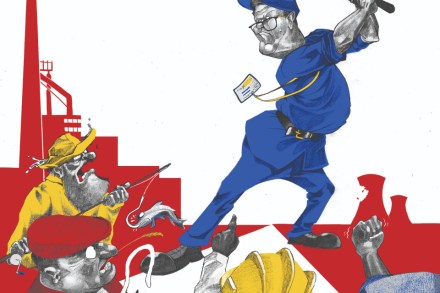
Michael Gove on Starmer vs the workers: why Labour needs to learn to love Brexit

From our UK edition

20 min listen

Spectator editor Michael Gove joins Natasha Feroze to talk about his cover article this week: 'Starmer vs the workers', the real Brexit betrayal. Michael puts forward his arguments for why Labour should learn to love Brexit, should take back control to protect British jobs and industries, and could use Brexit as an opportunity to harness AI and science & technology. Plus, has the UK-EU deal brought back 'happy memories' for the former prominent Brexiteer? Produced by Natasha Feroze and Patrick Gibbons.

What has reaction been to the UK-EU deal?

From our UK edition

18 min listen

Fallout continues from yesterday's summit and the announcement of a deal between the UK and EU – or is it fair to call it 'fallout' as, despite criticism over the deal from Nigel Farage and Kemi Badenoch, has the public got Brexit fatigue?  James Heale and Michael Simmons join Patrick Gibbons to talk about the reaction to the deal. Fisheries has taken up most discussion but Michael points out a lesser talked about commitment to energy policy. And, with the government keen to talk about it in tandem with recent deals with India and the US – and Gulf states soon, according to Rachel Reeves this morning – what's the political narrative around the summit? Produced by Patrick Gibbons.