Ed miliband

Election podcast special: eight days to go

In today's election podcast special, Fraser Nelson, James Forsyth and I discuss David Cameron's 'tax lock' pledge, Ed Miliband's promise on tax credits and why his interview with Russell Brand was such a bad idea. We also look at the latest opinion polls which suggest Scottish Labour is set to be wiped out next week, and discuss why there might be some good news in store for the Scottish Tories.

Labour’s ‘secret plan’ attack exploits Tory silence on welfare cuts

A common technique in gothic horror novels is to avoid describing whatever monster the author is trying to scare readers with. The imagination is even more powerful than the pen, and silence on the details of the beast means those reading will concoct their own personal nightmare as they read on. This was always the risk with the Tory refusal to set out the detail of the £12 billion of welfare cuts they plan to make in the next Parliament. Ed Miliband is trying to exploit that lack of detail today by launching a ‘dossier’ that sets out the ‘secret plan’ the Tories have on welfare cuts. In his speech this morning, the Labour leader said: ‘Today we show what another five years of Tory government would mean. A Tory secret plan.

Russell Brand kicks back at David Cameron

Yesterday David Cameron described Russell Brand as a 'joke' after it was revealed that Ed Miliband had paid a late-night visit to the comedian's home for an interview: 'Russell Brand is a joke. Ed Miliband meeting him is a joke. This election isn't funny.' listen to ‘David Cameron says Russell Brand is a 'joke'’ on audioBoom Brand has now responded and has ridiculed Cameron for claiming to be a football fan when he was once a member of the elite Bullingdon Club.

Campaign kick-off: eight days to go

There will be more promises from the party leaders today — plus a comedic twist. David Cameron will pledge a five year ‘tax lock’ that will be enshrined in law, while Ed Miliband will attack the proposed £12 billion welfare cuts and promise to raise working-age tax credits in line with inflation. And then we have Russell Brand. To help guide you through the melée of stories and spin, here is a summary of today’s main election stories. 1. The taxman banished David Cameron doesn’t appear to feel confident that the electorate believes his promises.

Like it or not, Russell Brand is the future of media (Ed Miliband seems to like it)

I write at a difficult time. The balls are in the air, but we know not where they will land. Perhaps, by the time you get to read this, more will be clear. Right now, however, we know only that Ed Miliband has been interviewed by Russell Brand. We do not yet know what he said. Or what Brand said. Probably he said more. ‘That was interesting enough, but Russell Brand was a bit restrained’ is something that nobody has said, after any conversation, ever. Most likely he’ll have quite liked Ed Miliband. They’ll have friends in common. Probably even girlfriends, what with them both having such voracious sexual appetites.

Numbers, not arguments about legitimacy, will decide who enters No.10 after May 7

Lyndon Johnson’s first lesson of politics was to be able to count. It’s something that many of those commenting on the various post-election scenarios could do with remembering. Let’s start with those who think that there is some overriding importance in being the largest single party and that this gives you the right to form a government, even if you lack a majority. It is never clear what people expect the other parties to do in such a scenario. Assume, for example, that after the election the Conservatives are the largest party but without a majority, and there is an anti-Conservative block that is larger. Do we really expect the anti-Conservative parties just to shrug their shoulders, say ‘oh well’, and put the Conservatives into power?

Election podcast special: nine days to go

In today's election podcast special, Fraser Nelson, James Forsyth, Isabel Hardman and I discuss David Cameron's ramped up rhetoric on the SNP threat to the Union, the Tories' promise to create 50,000 new apprenticeships from Libor fines and Labour's latest attempts to talk about controlling immigration. We also briefly look at the Liberal Democrats 'red lines' for future coalition negotiations and Ukip's attempts to woo voters in the north.

Why would Ed Miliband even want to woo Russell Brand?

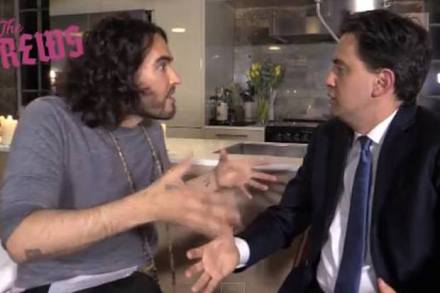
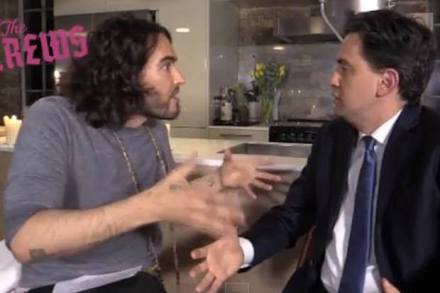
The Sun reports this morning that Ed Miliband recently made a late-night visit to Russell Brand's £2 million home. Details on what was discussed remain unknown, although Labour has now confirmed that rather than Miliband's own François Hollande moment, or a pre-emptive mansion tax inspection, it was in fact an interview. A friend of mine lives opposite Russell Brand and snapped this picture of Ed Milliband leaving his house...urm pic.twitter.com/kHGVWFbpVZ — Elisa Misu Solaris (@ElisaMisu) April 27, 2015 However, if Miliband is to appear in an episode of Brand's online show The Trews, it's unclear what the Labour leader hopes to gain from it. Is this really an endorsement any serious potential Prime Minister would want?

The planning system distorts the housing market more than anything Miliband could dream up

How foolish of Ed Miliband to try to pervert the free market in housing with his rent controls. There is a slight problem with this analysis, which we have heard ad nauseam from the Conservatives and from the right in general over the past 24 hours. We don’t have a free market in housing and we haven’t had for at least 65 years, when the planning system came into being. Yes, rent controls would come with the risk of reducing the supply of rental property, pushing up rents and creating a black market in properties sublet at lower than the officially-approved price. But the effect of Miliband’s reforms (which in any case stop short of rent control) would be extremely modest compared with the effect of the market-distortions caused by the planning system.

If Ed Miliband makes ‘Islamophobia’ illegal, I volunteer to test the new law immediately

I am out of the country at the moment and I see that Ed Miliband has used the opportunity to ‘say’ in an interview with the ‘Muslim News’ that he will outlaw ‘Islamophobia’ if he becomes Prime Minister. I use ‘say’ because ‘Muslim News’ has never seemed to me an especially reputable outlet for news, Muslim or otherwise. And I say ‘Islamophobia’ in scare quotes because, well, the term deserves them. There are many things to say about this, but allow me confine myself to three points: If Ed Miliband does become Prime Minister and chooses to make ‘Islamophobia’ illegal would he mind letting us know what he thinks ‘Islamophobia’ is? After all a ‘phobia’ is an irrational fear.

Note from Mandelson’s firm warns that SNP will drag Labour to the left

Peter Mandelson and Ed Miliband appeared to have been undergoing a certain rapprochement during this campaign. Mandelson declared recently that Miliband has 'way exceeded my expectations'. But a briefing note from Global Counsel, of which Mandelson is chairman, is bound to be seized on by the Tories. The note is entitled ‘Why the SNP will win whatever happens on May 7th’ and goes on to discuss what might happen if the Nationalists end up holding the balance of power in a hung parliament. It warns that ‘English dissatisfaction is likely to grow over time with the consequences of Labour government being sustained in power by the SNP’. It also predicts that the SNP will 'pull the Labour party to the left, away from the centre ground of English politics.

Campaign kick-off: 10 days to go

With just under two weeks to go until polling day, the promises, threats and reassurances will kick up a notch as we enter the final stretch of the campaign. The Tories have another 5,000 businesses to back up their case for reelection, while Labour is turning to its favourite weapon of market intervention towards housing. To help guide you through the melée of stories and spin, here is a summary of today’s main election stories. 1. Building for Britain The Tories have tried to paint themselves as the party of home ownership throughout this campaign. But Labour is attempting to seize that mantle with several new policies on housing today. First up, a pledge to scrap stamp duty for first time buyers on properties up to £300k.

Ed Miliband is right – first-time buyers need a tax cut

I hate to admit it, but Ed Miliband has a point about the need for raising the stamp duty threshold to £300,000 for first-time buyers. (The FT has the story tomorrow, and Sky News has the £300k detail). The tax was invented to give the government a slice of the more expensive housing transactions –  the higher-rate threshold of £250k was introduced in 1997 when the average house cost £60k. Now, the average house is closer to £250k. This failure of stamp duty thresholds to rise with the market has been a way for Chancellors to cash in on the asset bubble. Stamp duty cost homebuyers £9.5bn last year - Osborne plans to jack this up to £18bn by 2019/20.

This election will be decided by the undecideds

The polls could hardly be closer than they are at the moment and the parliamentary arithmetic looks like it is going to be remarkably tight, there’ll be only a few seats in it as to whether it’ll be Cameron or Miliband as Prime Minister. Yet, campaign aides on both sides have been struck by one thing: the large number of undecideds. One recent poll suggested that as many as one in five of those who intend to vote are still undecided. How this group breaks will determine the result. As one close Miliband ally put it to me, ‘The defining moment of this campaign hasn’t happened yet’. The Tory hope is that an unrelenting focus on the economy and the threat it that any Labour SNP arrangement would pose, will nudge these undecideds into their column.

Miliband avoids the Scottish question

On the Andrew Marr show this morning, Ed Miliband fended off questions about any post-election deal with the Scottish National Party. He had two lines of defence. First, he said he wasn’t going to pre-empt the election result and that he was fighting to win the election everywhere including Scotland. Second, he was adamant that ‘I’m not doing deals with the Scottish National Party’. But there was no explanation of how he would pilot legislation through the Commons without their support. listen to ‘Ed Miliband on the Andrew Marr Show’ on audioBoom When it came to the economy, Miliband refused to admit that the last Labour government spent too much, saying the financial crisis had caused the deficit not the other way round.

Miliband’s position on Libya is deeply hypocritical

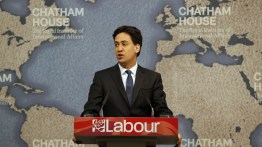
What Ed Miliband lacks in charisma, he is attempting to make up for in polemic. Tragically for the UK's future, this represents an 'Americanization' of British electoral politics. In all likelihood, its origins are David Axelrod cynically taking a page out of the Republicans' playbook. Fortunately, repeated screaming of 'Benghazi' as if it were a primordial voodoo incantation, is unlikely to work on this side of the Atlantic. Speaking at Chatham House on Friday, Miliband sought to pre-empt his critics by laying out a cohesive vision for foreign affairs - usually considered his weakest policy area.

Ed Miliband should be careful when discussing foreign policy errors

If someone accuses you of doing something that you haven’t done, there’s a really easy way of convincing them that you are not in fact guilty. The first thing you can do is deny the accusation. Very clearly, emphatically and categorically. Let me give you an example taken completely at random: 'Are you accusing David Cameron of being personally to blame for the refugee crisis in Libya and hence the deaths of hundreds of desperate people in the Mediterranean?' Now, can anyone think of a good way of answering that question which would be unequivocal and make it clear beyond any doubt whatsoever that this is not in fact what you are doing? One suggestion might be to say something roughly along the lines of this: 'No, I am not.' See, it’s really easy.

Who is rallying behind Ed Miliband: the undecided voters or Labour supporters?

As polling day nears, everyone is trying to work out which way undecided voters will break. Contrary to what many predicted, Labour and Ed Miliband have had a pretty decent short campaign, although this hasn't yet led to a polling lead. But the key question is whether Miliband is winning support from the undecided voters. A recent poll from ComRes showed that the Labour leader isn’t viewed particularly well among this group. 28 per cent said they would want to see David Cameron run the country, compared to 16 per cent for Ed Miliband. This isn’t much of a change since before the campaign began. In March, 12 per cent of undecided voters said they would prefer to see Miliband in charge.