Economy

Aussie rules | 19 January 2011

William Hague has been visiting Australia in the last couple of days, alongside half of the National Security Council. But you would not know it. Except for a few comments in the blogosphere, there has been little write-up of the visit in the newspapers. In many ways this encapsulates one of the government's key foreign policy dilemmas. Many of the world¹s problems require cooperation with the US, Europe and the BRICs ­ but especially the BRICs, who, for all their flaws and faults, are the fast-growing countries on the planet. If you want to force an end to Iran¹s illegal nuclear enrichment programme, then you need China. If you have any hope of stabilising Haiti, then you cannot do it without Brazil.

Miliband can’t credibly complain about both inflation and growth

Today’s shocking inflation figures have sparked a fascinating debate. I laid out my take earlier, and I thought CoffeeHousers may appreciate a different perspective. Matthew Hancock MP is a member of the Public Accounts Committee, former economist at the Bank of England and former chief of staff to George Osborne. Fraser Nelson. Last week, growth. This week, inflation. Ed Miliband is complaining about both. But the trouble is: the two can’t be taken in isolation. For the main weapon against inflation is for the Bank of England to raise interest rates. Yet the main weapon to support growth is for the Bank of England to keep interest rates lower for longer. You can’t credibly complain about both.

Laws: the 50 percent rate should be abolished asap

David Laws has penned a robust defence of the coalition’s economic policies for The Guardian. He points out that the big dividing lines in politics are on the economy and then goes onto say: 'Ed Miliband is betting that economic recovery will be derailed, and while trying to reconcile many divergent views in his party, he has generally taken the position that cuts should be delayed and that high tax rates (including the 50% tax rate) should be retained. Ed is getting all the big economic decisions wrong, and leading his party into an economic policy cul-de-sac.

Labour may be doing alright, but Miliband is still dodgy on the public finances

Ed Miliband's leadership may be young, but his trickery on the public finances is already well worn. We got it all in his interview with Andrew Marr earlier – and then some. There was the claim that Labour "paid down the debt" (that I dealt with here). There was the claim that Labour's spending was responsible (my response here). And there was a straight-up lie about Miliband's forecast for a double-dip. So far, so Brown. What caught my ear, though, was this exchange: Andrew Marr: I mean Tony Blair said in his memoir that by 2005, he was worried that the party was spending too much. And Alistair Darling said actually it was about 2007, he was worried that the party had been spending too much - before the crash happened.

Breaking the curious silence on upcoming tax changes

This week, Nick Clegg added his name to the fast-growing list of politicians addressing the critical question of living standards. His phrase of choice was ‘alarm clock Britain’, in effect his version of Ed Miliband’s ‘squeezed middle’. It is, of course, a clunking label for what is a serious topic (hardly the first time a politician has achieved such a feat). But quibbles over terminology aside – and as Miliband’s article on Friday confirmed – these are the first serious shots in the political battle to frame the coalition’s crucial March Budget.

Miliband in denial

Did he get cold feet? Or was his new spin-team overenthusiastic in their pre-briefing? We were told we'd get an apology from Ed Miliband in today's speech, but instead he entrenched himself in his position that Labour did nothing wrong on the deficit. I'm surprised at this decision. Surely Ed Miliband understands, as his Shadow Chancellor understands, the central importance to an opposition party of economic credibility. That credibility will not return while Miliband bases his economic argument on a denial of the facts. First, and critically, he argues that Britain's deficit was not a problem going into the crisis. Not only is this disputed by an impressive array of domestic and international experts, from Tony Blair to the European Commission and Mervyn King.

King’s inflation nation

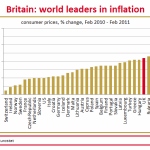
If Mervyn King and his team are trying to deal with Britain's debt crisis by letting inflation rip, I do wish they would just say so - rather than go through this monthly farce. Yet again, base rates have been left at an absurd 0.5 per cent, in an economy expected to grow by a full 2 percent this year but with inflation at 3.3 percent or 4.8 percent depending on how you measure it. Petrol prices are bad, but now they are matched with soaring prices elsewhere - from train travel to groceries. Here's a list of some price rises confronting shoppers:   Add Osborne's VAT rise to non-food items and we will see CPI inflation soon at 4 percent, twice the Bank of England's much ignored target. Here's what puzzles me.

Five more things you need to know about the IDS reforms

Last November, I put together a ten-point summary of IDS's benefit reforms – so why add five more points now? Two reasons. First, it's worth dwelling on what, I believe, will be one of this government's defining achievements. Second – and far more prosaic – the Insistute for Fiscal Studies released a report on the matter yesterday. The following points have all been harvested from that document, and represent the IFS's judgement, so to speak. Only one judgement among many, but one that warrants some attention. Here goes: 1. Who gains and who loses (in financial terms)? This question courses through most of the IFS report, and stands out in most of the news coverage this morning.

The China arms embargo should be discussed – though not lifted

Today's Times splashed on the spat between Britain and EU foreign policy "czar" Catherine Ashton over the embargo barring arms sales to China. The embargo was put in place after the Tianamen Square massacre and has remained in place, largely at US insistence, ever since. But is it the right policy? The policy has not prevented China from becoming a military power — its annual defense budget officially stands at $70 billion, although the Pentagon believes the real figure to be twice as high. China is developing carrier-killing missiles that even NATO does not have, and will soon sell weapons rather than seek to import them. There is, of course, a moral argument: the sanctions were put in place because of China's human rights violations.

A shock for Dave

Wow. Dave had a real wobble at the start of PMQs today. Ed Miliband stood up, looking as mild as a puppy, and asked about the ‘tip’ of two million quid recently paid to the boss of Lloyds. ‘In opposition,’ said Ed, ‘the prime minister promised, “where the tax-payer owns a large stake in a bank, no employee should earn a bonus of over £2,000”.  Could he update us on how he’s getting on with that policy?’ He was already seated when the first peals of laughter echoed around the chamber. Dave had stood up but he didn’t speak. Nothing came out. Silence seemed to have mastered him for a micro-second.

Clegg: time to air our differences

Why vote Lib Dem? Even Nick Clegg is now asking that question. After 8 months of broken pledges, deep cuts and atrocious polling (due to reach its nadir tomorrow in Oldham East and Saddleworth), Clegg worries that his party is losing its identity. Speaking to the Guardian, Clegg reveals that he hopes to arrest decline by expressing publicly his private differences with David Cameron. This is not defiance from Clegg but a statement of positive intent. Taking brave decisions, he says, has proved that the Liberal Democrats can govern and that coalition works; the government’s strength is sufficient to withstand disagreement. That’s all very well, but Clegg needs more than mere differences: all politicians have their differences.

Mixed attitudes towards the cuts

Forget the voting intentions, the real action in YouGov's latest poll comes in the supplementary results. There, as Anthony Wells suggests, are attitudes towards spending cuts that will both perturb and hearten the coalition. Let's take the bad stuff first: "Asked if the government’s cuts will be good or bad for the economy only 38% now think they will be good, compared to 47% who think they will be bad. In comparison between October and December last year it was roughly even between people thinking the cuts would be good and those thinking they would be bad. On whether the cuts are being done fairly or unfairly, 57% now think the cuts are being done unfairly, again the highest we’ve shown so fair.

The crash from an Austrian perspective

It’s not all politics at Westminster. There’s a pretty good think-tank scene too, with lectures on topics that you’re unlikely to read about in the newspapers. One took place today: the Adam Smith Institute hosted a lecture by Steven G. Horwitz, from St. Lawrence University, entitled “An Austrian perspective on the great recession of 2008-09”. As many CoffeeHousers will know, "Austrian" refers to von Mises, Hayek and the others whose analysis of bubbles and crises certainly seems to fit current events. My colleague Jonathan Jones was there, and took some notes – which I have moulded into a six-point briefing.  It’s not often we do a post based on a think-tank talk – we may do more, if CoffeeHousers find them useful.

Johnson running out of his nine lives

Ed Miliband's press conference today was a classic example of clever opposition politics. He and Alan Johnson said that Labour would continue the bonus tax on the banks for one more year. This policy has the twin advantage of maximising the coalition's discomfort over the whole issue of bankers' bonuses and expiring well before the next election. The rest of Miliband's press conference was devoted to an attempt to defend the record of the previous Labour government. Miliband kept making the valid point that in the years before the crash Cameron and Osborne weren't saying that Labour was spending too much but were instead committed to matching Labour's spending plans.

China in a bullshop

As if to illustrate Pete’s post about the rise of China and India, Chinese Vice Premier Li Keqiang has just finished a visit to Spain during which agreements worth 5.7 billion euros were signed. The Chinese delegation is said to have committed itself to buying six billion euros of Spanish debt, which helped calm markets and provided some relief for Spain’s recession-hit economy. Around the time that the Soviet Union collapsed, the Chinese used to say only they could save communism. Twenty years on, it seems only they can save capitalism. The Spanish are certainly in no doubt about the importance of their newfound Chinese friends. The left-leaning Spanish newspaper El País wrote that that Li was received in Madrid as "a new Mr.

From the archives: Protesting the price hikes

The week began with grim projections about petrol prices, and has been coloured by the twin topics of tax and inflation since. So, a decent opportunity to look back on the fuel protests of 2000, in the latest shot from the Spectator archives. Here's a piece from the time, by Coffee House regular, and Spectator theatre critic, Lloyd Evans:   Do you want a smack in the mouth?, Lloyd Evans, The Spectator, 16 September 2000 As I write this, the gravest crisis in our island story is unfolding before my eyes. The great four-star emergency of September 2000. Where it will lead, no one can tell.

The rise of China and India, by numbers

We're used to seeing growth forecasts for the next few years, but here's an altogether rarer beast: forecasts stretching all the way to 2050. They were released by PricewaterhouseCoopers last night, and I thought CoffeeHousers might appreciate seeing them in graph form. Naturally, slap health warnings aplenty across this – economists barely know what will happen this year, let alone decades hence – but some of the trends are still pretty striking. Here's a round-up: 1. This first graph suggests that – allowing for the relative values of different currencies – China’s GDP will top the US’s around 2020. India's does likewise just before the 2050 endpoint:   2.

King’s ransom

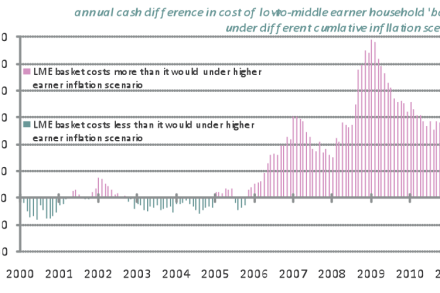
How much bigger does Britain's inflation have to become before Mervyn King realises it’s a problem? The VAT rise should have lifted prices by 2.1 percent – but shopkeepers over Britain have been applying far larger rises. Why? Because one of the most important factors in economics – expectation of inflation – is back. People are bracing themselves for another year of rising heat, transport and staff costs – so retailers hike up prices in anticipation, and a vicious spiral of inflation begins. The Retail Price Index was up 4.8 percent last November, and Consumer Price Index 3.3 percent. The price of this failure of monetary policy is paid by ordinary taxpayers, whose wages stand no chance of keeping up with the rise in prices.

Will Osborne be vindicated in 2015?

VAT, VAT, VAT – but what's this? The main headline on today's FT doesn't mention the sales tax at all, and the piece below it only does so in passing. Instead, a declaration that "UK austerity measures [are] expected to pay off," based on a survey of economists conducted by the paper. Although those polled have concerns about inflation and the eurozone, only 13 percent say that George Osborne needs a Plan B for dealing with the public finances. As always, we shouldn't place too much stock in this kind of thing. Some economists will back the coalition, others will back Labour; some will be right, others will be wrong. But, today of all days, the coalition will appreciate a presentational leg-up such as this.

Osborne and Johnson battle over the new tax divide

Now here's a thing: a radio appearance by Alan Johnson that actually clarified some details about Labour's economic policy in the Miliband era. Sure, the shadow chancellor spent most of his time on the Today Programme setting about the coalition's VAT hike, with all the usual arguments about jobs and growth. But there was also confirmation that Labour's deficit reduction plan would split 60-40 between tax rises and spending cuts, and that they would raise national insurance levels rather than VAT. It repositions the argument some way beyond the simple Do/Don't divide that was developing around VAT. Now there are two choices for voters to make. Do they prefer a deficit reduction plan which, for the first time, emphasises tax hikes over spending cuts?