Economy

The Big Society in 1997

Titter ye might. The Big Society? In 1997? If the idea was of, erm, limited electoral worth in our last general election, then it was certainly of little use when Tony Blair hurtled into power all those years ago. Yet there is was, mostly speaking, in the "Civic Conservatism" espoused chiefly by David Willetts. Danny Finkelstein, writing for the pre-paywall incarnation of Comment Central, has already alluded to the intellectual debt that Steve Hilton et al owe to Willetts' thinking back in the 1990s. Fraser did likewise in an interview with Willetts from four-and-a-half years ago. I mention this now for two conjoined reasons.

This Ed’s no Goliath

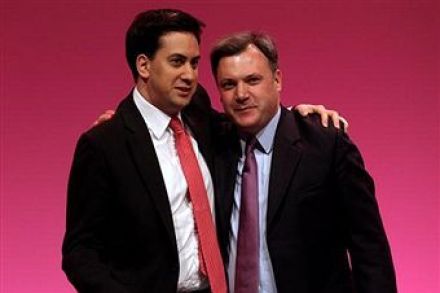
Ed Milliband took up his position at PMQs today flanked by Caroline Flint and Ed Balls. Between a rock and a hard face. His proximity to so many colleagues who wish him ill can hardly have helped his performance. He was like a stale doughnut. Layers of stodge surrounding a hole in the air.   His battle-plan wasn’t entirely useless. He wanted to tempt the prime minister into foolish speculation about the causes of last quarter’s poor growth figures. Cameron stood up and admitted that the numbers were pretty lousy whether the weather were blamed or not. And that whether-the-weather left Miliband completely stuffed.

Winning in 2015

Danny Finkelstein’s column in The Times today (£) is well worth reading. Finkelstein sets out two worries, first that the Tories do not have enough of a strategy for winning re-election and second that the NHS reforms might compromise Cameron’s standing as a different kind of Tory. On the latter point, Finkelstein is echoing the views of an increasing number of Tory MPs and ministers. They worry that these poorly understood reforms have put the NHS back on the political table and that, as is so often the case when this happens, the Tories will suffer. Finkelstein’s first worry is that if the government sets out deficit reduction as its raison d’etre then, when that is achieved, as it should be by the next election, it loses its purpose.

A businesslike State of the Union address

https://www.youtube.com/watch?v=nZ5DMpNznlA Jobs, people, work, new, years, make. You can get a good sense of Obama's State of the Union address purely from its most frequently used words. Yes, this one was all about the future, and – another popular word – "investing" in it. As the President himself put it, sounding like some freakish amalgam of David Cameron and Gordon Brown, "If we make the hard choices now to rein in our deficits, we can make the investments we need to win the future." The President wasn't short of ideas for the investment half of that equation, even if – as others have noted – there was an absence of specifics.

Why our national debt went up by £1,300 billion today

It's not just the growth figures, you know. Today, the Office for National Statistics also released its latest estimates for the state of the public finances. Among the headline findings was a crumb of consolation for the Treasury: it is on track to meet its borrowing target for the financial year. But that's by the by when compared to this other snippet from the ONS release: our national debt went up by £1,300 billion in December. Don't worry, though – it's not really as terrible as all that sounds. What's happened is that the human calculators have finally worked out how to account for Lloyds and RBS on the public balance sheet. This isn't new debt. It's simply a grand liability that wasn't included in the official statistics until now.

Call in a bulldozer for growth

As the coalition considers how to develop a growth strategy, it would do well to call in Paddy Ashdown and hear about the 'Bulldozer Initiative' he launched while in Bosnia working for the United Nations. Not a highway programme, the Bulldozer Initiative was instead one of the smartest pro-business schemes I have seen. And something like it is now needed here. The brainchild of a French businessmen and based on the ideas of Peruvian economist Hernando de Soto, it involved building a partnership between politicians and businessmen to identify specific legislation and regulations that prevented companies from expanding their businesses and creating more jobs.

Ed Balls: I don’t think a double dip is the most likely outcome

And this, folks, is a day where Ed Balls is having his cake and eating it too. Not only is he basking in the grim light of the growth figures, but he is using the opportunity to recast his own stance on the economy. Speaking on the Daily Politics just now, he de-emphasised the argument that in-year cuts were to blame for today's numbers, instead claiming that people have "changed their behaviour in anticipation of what's coming in the future." And, more ear-catching still, he added: "I don't think [a double dip] is the most likely outcome." This, as Fraser suggested earlier, is surely necessary caution on Balls's part. He can't go too far with the dread warnings, lest the economy pick up again next quarter.

What to make of the GDP fall?

"Recession here we come, a snow-dabbed double-dip" tweeted Faisal Islam, Channel Four's economics editor. He summed up much of the hysterical reaction. It may spoil a good story, but here is what I suspect the broadcasters won't tell you today. 1. Erratic GDP swings are common when recovering from a recession. Remember how stunned everyone was with the surging quarter three data? Now, we're all shocked by plunging quarter four figures. I'd advise CoffeeHousers to treat these two imposters just the same. After the 80s recession, quarterly growth rates swung between -0.7 percent and 1.5 percent. Following the ERM-induced recession in the 90s, growth rates swung between -0.2 percent and 0.5 percent. A swallow does not make a summer.

Outgoing head of the CBI slams the government on growth

Richard Lambert has launched an uncompromising but constructive assault on the government’s growth strategy, or lack of it. He said: “The government is…talking about growth in an enthusiastic and thoughtful way… But it’s failed so far to articulate in big picture terms its vision of what the UK economy might become under its stewardship. “What I feel is that a number of their initiatives – I’m thinking of the immigration cap, I’m thinking about their move on the default retirement age, about the carbon reduction commitment - have actually made it harder for companies, or less likely for companies to employ people. And what we want, actually, is a sense of direction, a sense of ambition.

The government must continue to liberalise Europe’s market

For a long time, the terms of Britain's Europe debate has been about the merits - or otherwise - of membership. This has occluded discussion about the need to promote a deregulated and economically liberal single market, for which the Conservatives have fought so successfully since Britain joined the then EEC in 1973.   Now Lord Brittan has shown the way. In a speech to Business for New Europe, he takes aim at the many illiberal practices that hamper economic development across Europe and hurt British business: “Portugal still has rules governing the minimum distance requirements between driving schools; and in Greece, directors of dancing schools need to live within a set distance of the school!

The Irish government folds

Yesterday, Brian Cowen resigned; today his government has imploded. The Green Party, which was bolstering Cowen’s ruling coalition (if such a phrase is applicable in this instance), have left the government. The Fianna Fail-led coalition is now two votes short of a majority, and therefore the finance bill may not pass in its current form. If that is so, Ireland may return to the precipice on which it found itself a couple of months ago, and its principal creditors and trading partners with it. But there is more to this than balance sheets. In his statement, the leader of the Greens said that the people had lost confidence in the political process. It’s hard to demur.

Exposing the con man

  To the chagrin of CoffeeHousers, I have long rated Ed Balls and his abilities. He has a degree of brilliance, albeit tragically deployed in the services of a destructive economic agenda. But as we welcome him back, it’s worth reminding ourselves that his abilities are of a specific type. He understands economics (even though he did PPE) but his speciality is in creative accounting. His only tactic is to spend, borrow and cover both up by cooking the books. He is a trickster, not an economist. More Arthur Daley than Arthur Laffer. In my News of the World column today (£) I say he is dangerous to Labour as well as the Tories, perhaps more so. But it’s worth recapping what we’re dealing with.

How things are different now that Balls is shadow chancellor

The timing could hardly have been more resonant. On the day that Tony Blair is paraded, once again, in front of the Iraq Inquiry, Team Brown is firmly back in charge of the Labour party. For, I'm sure you've noticed CoffeeHousers, three of the four great shadow offices of state are occupied by former members of the Brown coterie: Ed Miliband, Ed Balls and Yvette Cooper. The fourth belongs to someone who doesn't sit easily in either half of the TB-GB divide: Douglas Alexander. The question, of course, is what this means for Labour's economic policy. And the answer according to Miliband is "nothing much". The Labour leader has been keen to stress that his party's fiscal plans remain largely unchanged by Balls' ascension.

The Tories waste no time in getting stuck into Balls

One thing worth noting before we discuss Balls’ appointment is that the reasons Johnson have resigned are personal. It is not about his competence or otherwise. The Tories are wasting no time in getting stuck into Ed Balls. One just said to me, ‘the man who created this economic mess is back. He designed the fiscal rules that failed, he designed the FSA that failed…’ Certainly, the Tory attempt to make Labour’s economic record the premier political issue has just become a lot easier. Balls will be a more aggressive opponent for Osborne. But I suspect that he will prefer facing Balls to Yvette Cooper.

Renaissance Balls

Balls is back. The author of Gordon Brown's economic policies for 15 years. The man who bears more responsibility for anyone else - other than Brown - for the asset bubble and the consequent crash. But I suspect that, right now, Theresa May is doing cartwheels and George Osborne cursing. Balls, for all his many drawbacks, is the most ferocious attack dog there is. His brilliance (and I hate using that word) at using numbers as weapons far surprassed anything the Tories could manage in Opposition. His policies are reckless: to borrow, and to hell with the consequences. His modus operandi is to launch around-the-clock attacks. He has powerful media contacts, and uses them to full effect. He is the most able fighter in Labour's frontbench, as he proved in the leadership contest.

Balls replaces Alan Johnson

Ed Miliband has just taken the biggest risk of his leadership in appointing Ed Balls as his shadow Chancellor. Balls’ is not a man who take orders and his view on the deficit is noticeably different from Ed Miliband’s. He is also the person most closely associated with Gordon Brown’s economic record. George Osborne will relish this fight. During the vacuum between Ed Miliband winning the leadership and the shadow Cabinet elections, Osborne prepared for facing Balls. He told friends, ‘we’ve circled around each other long enough. It is time to get on with it now.

Aussie rules | 19 January 2011

William Hague has been visiting Australia in the last couple of days, alongside half of the National Security Council. But you would not know it. Except for a few comments in the blogosphere, there has been little write-up of the visit in the newspapers. In many ways this encapsulates one of the government's key foreign policy dilemmas. Many of the world¹s problems require cooperation with the US, Europe and the BRICs ­ but especially the BRICs, who, for all their flaws and faults, are the fast-growing countries on the planet. If you want to force an end to Iran¹s illegal nuclear enrichment programme, then you need China. If you have any hope of stabilising Haiti, then you cannot do it without Brazil.

Miliband can’t credibly complain about both inflation and growth

Today’s shocking inflation figures have sparked a fascinating debate. I laid out my take earlier, and I thought CoffeeHousers may appreciate a different perspective. Matthew Hancock MP is a member of the Public Accounts Committee, former economist at the Bank of England and former chief of staff to George Osborne. Fraser Nelson. Last week, growth. This week, inflation. Ed Miliband is complaining about both. But the trouble is: the two can’t be taken in isolation. For the main weapon against inflation is for the Bank of England to raise interest rates. Yet the main weapon to support growth is for the Bank of England to keep interest rates lower for longer. You can’t credibly complain about both.