Economy

David Cameron’s dreams and nightmares are written into today’s employment figures

It is almost a cliche to describe jobs figures as a "mixed picture" — and yet that's exactly what today's are. Beneath the headline finding that the number of unemployed people has risen above 2.5 million, are numbers that will fuel not only David Cameron's happiest dreams, but also his most paranoid nightmares. Let's start with the nicer stuff first. The graph above shows the cumulative change in employment levels since the recession started to take hold in 2008. What it shows is something that often goes ignored: that is was the private sector, not the public sector, that took the greatest hit from the crunch.

The EU wants concessions out of Ireland

The mood in Dublin is febrile, despite the gloom of 14 percent unemployment. Everyone has advice for Enda Kenny on how to revive the Celtic Tiger. This morning, 17 prominent businessmen and public figures submitted A Blueprint for Ireland’s Recovery to the Department of the Taoiseach. The Irish Times reports that the authors propose deeper spending cuts and greater efficiency in the public sector. This is a different approach from influential Irish Economist Colm McCarthy, who argued on Sunday that ‘fiscal stringency is not enough to resolve the crisis’ because the banking restructure (contained within the IMF/EU bailout) is ‘impractical'. Enda Kenny, it seems, agrees with McCarthy, which is why he went to Brussels last week to renegotiate the 5.

A model council

Councils from Liverpool to Bromley have cut voluntary sector funding; but Reading Borough Council is defying the trend. It will increase its voluntary sector funding by more than £200,000 in 2011-12. This will be achieved by transferring £956,000 in loose grants to strict revenue contracts, which deliver greater value for money. This is part of a wider administrative rationalisation that raised an extra £181,000 for local groups, which will now apply for cash on a clearly specified basis to ensure that frugality survives the current efficiency drive. An efficiency drive was certainly needed.

Are two Eds better than one?

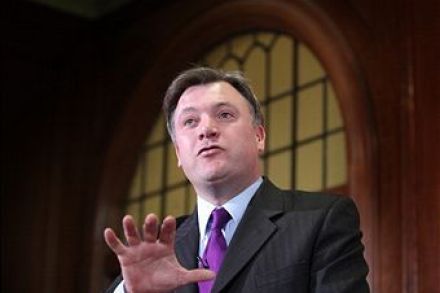
This was the question raised by today’s joint Balls Miliband press conference. The two Eds are very different in both body language and temperament. Balls is the far more pugilistic politician, always looking to dispute the premises of a question and happy to use aggressive language. While Miliband is far more of a conciliator, looking to find consensus and using only gentle humour. They even stand at the lectern in different ways: Balls hunched over his, leaning into the fight. Miliband hanging back from his, and taking a gentle step towards it when answering a question. The danger for Miliband is that Balls appears to be the alpha male, the one taking the fight to Labour’s enemies.

Balls and Miliband fail the credibility test

Eds Miliband and Balls gathered the press corps together this morning to broadcast a straightforward message: oh yes, we do have an alternative. And the shape of that alternative? A repeat of the one-off tax on bankers' bonuses that, Balls claimed, raised £3.5 billion last year. The money would be used for an entire buffet of economic delights, from the creation of new houses to the funding of job schemes for the young. The upshot, apparently, would be 110,000 new jobs. Nice work, as they say — if you can get it. But there are a couple of problems with all that, the first of which Labour has pre-empted. It is that last year's bonus tax may not have raised as much as £3.5 billion, after all.

Our monetary policy needs sorting — and quick

Today’s decision to leave base rates at an emergency 0.5 per cent — the lowest since the Bank of England was founded in 1694 — shows how Britain is running out of options. Not even Mervyn King would deny that Britain has an inflation problem: global prices may be up, but the UK seems to have been hit worse than almost any major economy, as I blogged yesterday. With food prices up by 6.3 per cent and CPI inflation by 4.1 per cent, what’s happening to prices? The below graph, again out today from a FTSE350 survey, suggests that pay is up by just 0.5 per cent in the private sector. And it’s even worse in the manufacturing sector.   You could argue that one should not compound this pain by jacking up debt interest.

Cuts? Regulation needs to be cut

The cuts in spending are going to feel very unpleasant indeed. Rising interest costs, resulting from past expansions in public debt, are going to crowd out other parts of the budget. It is proving difficult to curb the cost of transfers, such as benefits and pensions, and this combines with the ring-fencing of health and development spending to leverage the cuts in unprotected departments. But, as I show in my report published today by the Centre for Policy Studies, the stark reality is that the spending clock is only being turned back to 2008-09, not to the dark ages.   In fiscal year 2014-15 the government plans to spend £758bn, equivalent to £647bn at 2009-10 values.

Abel fights back

One of the hardest tasks of any opposition is to gain the trust and credibility to run the economy. After what happened over the last few years, Labour have an enormous credibility gap. Ed Balls’ decision to oppose any measure to deal with the deficit has reduced Labour’s economic credibility still further. So too has the two Eds’ decision to make attacks based on mis-truths, like denying there was a structural deficit before the election; or attacking the coalition for cutting bank taxes, when it is actually putting them up; and like backing another bonus tax, despite opposing it at the election, and despite Alistair Darling’s careful explanation of why it won’t work.

A princely problem

Tonight’s Six o’clock news had a long package on Prince Andrew that ended with Laura Kuenssberg reporting from Downing Street on the government’s attitude to the prince. The fact that the government is now so much part of this story is due to an unforced error on its part.   It was the briefing yesterday about how if more came out then Andrew would have to resign as trade envoy that pushed the government right into the middle of this sorry story. This set journalistic hares running and had everyone demanding to know what the government’s position was. The government, which had got involved in this story more through cock-up than anything else, quickly rowed back on Sunday's lines.

Osborne’s political economy

George Osborne’s speech to the Tory spring conference today showed the classic left-right way in which he wants to frame the political debate about the economy ahead of the Budget on the 23rd of March.  In a move straight out of the election-winning centre-right playbook of the 80s, he attacked Balls and Miliband as “Two left-wing politicians who don't understand anyone who wants to get up and get on, anyone who want a better life for their family, anyone who want to create wealth, and start a business, and create jobs, and leave something to their children.

The economic case for HS2 explained

Matthew Sinclair’s piece on high-speed rail makes two main criticisms, both of which have already been addressed in the material published earlier this week for the consultation – but I would like to explain our approach again here.   First, Matthew criticises our forecasts. He would prefer us not to forecast demand beyond 2026, but HS2 would be a long term investment and would bring benefits for successive generations over many decades. It would be absurd to forecast only 10 years ahead. Therefore, we have taken a longer term but still realistic view. Demand for long distance rail travel more than doubled between 1994 and 2009 – an annual growth rate of around 5 percent. We have predicted a far slower growth rate than this: approximately 1.4 percent.

Plurality or not?

With all the provisos attached to News Corp’s takeover of BSkyB, opposition to the deal has surely now been diluted. But there are, perhaps, two groups who can still legitimately complain about the outcome.   Firstly, those of us who believe that unrestricted freedom of speech is vital in the TV broadcasting arena. The Murdoch empire has had to surrender its news channel in order to, essentially, buy a profitable platform for broadcasting sport and movies. This is seriously disturbing for anyone who feels that the BBC’s output of ‘neutral news’ needs to be challenged. The only major independent broadcaster – ITV – gave up long ago with their own news channel. Only Murdoch ran an alternative news platform, and at a massive loss.

The strong business case for HS2

Matthew Sinclair argues that the government’s plans for high-speed rail would not create enough jobs to justify the government spending money on the project. But his argument is disingenuous as he is not comparing like for like. He is comparing predictions about jobs created directly by high-speed rail with predictions about jobs created indirectly by investment in the wider economy. The 40,000 jobs created directly by high-speed rail are simply the tip of the iceberg – tens of thousands more will be created by the investment boom in the cities the new line will link up. These are the jobs being created by the “wider economy” that he mentions, but which the government does not attempt to quantify.

Osborne goes on the offensive

Attack, attack, attack. That's the temper of George Osborne's article for the Guardian this morning, which sets about Labour's economic credibility with a ferocious sort of glee. Perhaps the best passage is where he asks how many times Labour can spend their ubiquitous "bank tax," but this is more pertinent to the recent debate: "Where does all this leave Ed Miliband's newfound enthusiasm for the "squeezed middle"? Let's pass over his failure in every interview to define it – his last effort included around 90% of taxpayers. Where we can all agree is that these are difficult times for family incomes. There are two root causes. One is global: rises in food and commodity prices.

The need to address National Pay Bargaining

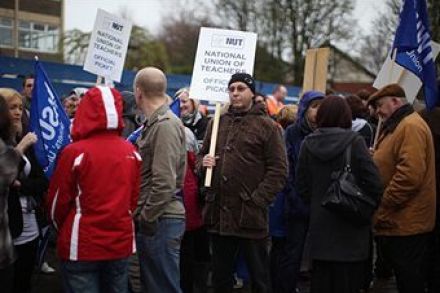
National Pay Bargaining is one of the major impediments to rebalancing the national economy and improving the quality of public services. But as Julian Astle, the head of the Liberal think tank Centre Forum, notes the coalition is doing little about it. It knows that the public sector unions will go to the wall for national pay bargaining and so are holding off. Gordon Brown flirted with doing something about national pay bargaining, announcing a review of it in the 2003 Budget. But he then backed away from the issue. One area where the coalition is chipping away at national pay bargaining is schools. Academies and free schools have the right to set their own pay and conditions. But, interestingly, academies tend not to use these freedoms.

Three charts that complicate a simple focus on growth

GDP growth figures have become the barometer of choice for commentators trying to tell the political weather – a good measure of how the public will eventually fall in the faceoff between Osborne and Balls. The story goes that a return to sustained growth will mean a return to rising living standards.  That means a vindication of the government’s position, and a victory for the Chancellor. As a simple story, that makes sense if the pressures now facing Britain’s households are straightforwardly growth-related – if, in other words, we’re in a post-recession hangover that will vanish when growth returns. But there’s now mounting evidence of a deeper problem for living standards in the UK economy. Take the chart below.

Why Ed Balls shouldn’t brag if the OBR downgrades its growth forecasts

Some speculation (£) today that the Office for Budget Responsibility will shortly downgrade its 2011 growth forecast – and hence the growth forecast in next month's Budget. If so, then you can expect Ed Balls to crow on and on about it. He did, after all, prime the attack in his recent clash with George Osborne across the dispatch box: "With consumer confidence falling, with inflation rising, with no bank lending agreement, no plan for jobs, no plan for growth, no plan B - does he really expect us to believe he can meet this forecast for economic growth this year or will he have to stand here at the Budget in six weeks' time and downgrade his very first growth forecast?

Inflation: how the nightmare will continue

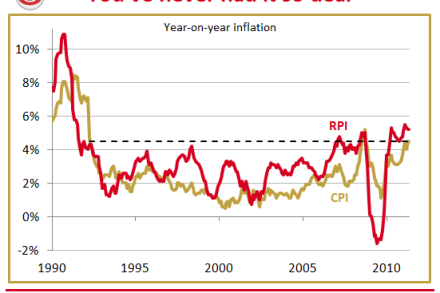
Each month, inflation numbers come out and seem to surprise everyone - except the chosen few who have access to the forecasts. So I thought we’d share with CoffeeHousers what is all too seldom put on public record: forecasts for inflation and base interest rates. It might be useful to anyone thinking of taking out a fixed rate mortgage deal. These forecasts are from Michael Saunders at CitiGroup, whom I regard as one of the best in the business. Pretty much every analyst thinks that interest rates will soon start a relentless march back to 5 per cent, so these 3 per cent fixed rate deals we’re getting right now will soon be a distant memory. He envisages CPI hitting 5 per cent, more than double its target, but not quite getting back to target.

It’s the Q1 2011 growth figures that matter now

The Office for National Statistics' preliminary figures for Q4 growth, released a few weeks ago, were a curious beast. They they were, suggesting that because of a snow-laden December our economy had started shrinking again, to the tune of -0.5 per cent. And yet so many other indicators were doing rather nicely: from activity in the services sector to the Exchequer's tax take. Many people, myself included, suspected it was only a matter of time before the ONS revised that -0.5 figure into more positive territory. Now time has passed, and the ONS has just revised the Q4 figure downwards, not upwards. Their preliminary figure wasn't quite right, they say. It should have been -0.6 per cent. Given that the snow was thought to reduce GDP growth by 0.

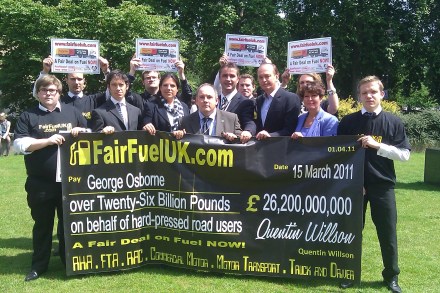
What price a fuel duty stabiliser?

Last we heard, the government was considering what it should, and could, do to suppress rising fuel prices. I wonder whether they have now pencilled something into March's Red Book. You see, after a swell of speculative fear triggered by events in the Middle East, the cost of oil is going up, up, up. Brent Crude touched $120 a barrel yesterday, the highest price since August 2008, although it eventually settled to around $111. Some observers predict it will soon exceed the previous record price of $150. Naturally, this threatens to unstitch the delicate fabric of the global economy – drastically rising oil prices could bring pervasive stagflation in their wake. But there are also more parochial concerns, not least what all this means for motorists.