Drinking

A civilised drinker’s guide to Soho pub etiquette

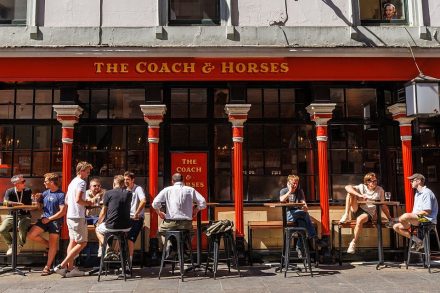
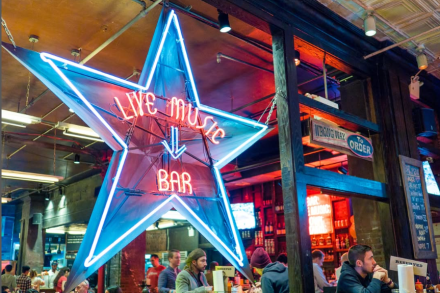
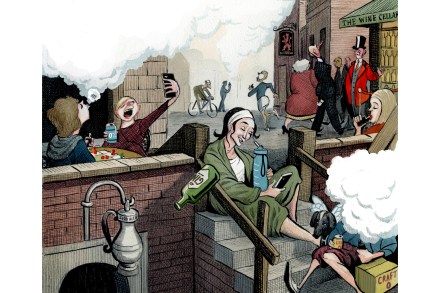
I've been spending a lot of time standing in Soho this summer. No, not leaning on a lamppost next to Walker's Court and the staircase that says ‘girls upstairs’. Instead, outside my favourite pub, with a whiskey in a plastic glass, getting grumpy that there's nowhere to sit and the music inside is too loud. I'm only thirty-five but after nearly twenty years working in hospitality, can I please just have a chair? Around me everyone else is perching, leaning, shifting from foot to foot, vapes in hand, moaning about the security guards. But we put up with it. You'll probably find us there tomorrow.

In defence of drunken freshers’ weeks

I don’t remember much of freshers’ week at Edinburgh. Friends have helped to fill in the blanks. I vaguely recall a police officer handing out vodka shots to show how easy it was to fail a breathalyser test. A famous DJ had his set in the union cut short because he played the song ‘Blurred Lines’. It had been banned by student politicians. I have hazy memories, too, of my first interactions with posh English women. One assumed I must be gifted since I’d made it into university from a Scottish state school. Another asked if I was limping because I’d overdone it at the ‘introduction to reeling event’ (I have cerebral palsy). Posh English men were no better. At a party exclusively made up of Old Harrovians, I was laughed at when I got out my Android phone.

How private equity changed the world

The 50th birthday of New York private-equity giant Kohlberg Kravis Roberts – founded with $120,000 by the cousins George Roberts and Henry Kravis and now holding $758 billion of assets under management – is a moment to ask whether the modus operandi the firm pioneered has been good or bad for the world. Private-equity buyouts of underperforming public companies have certainly been a catalyst for sharper corporate performance across every western economy. But with what impact on society? Some buyouts also provide cover for ‘sin’ businesses that harm the planet or deny workers’ rights. KKR itself will never live down the book title Barbarians at the Gate, referring to its ruthless 1988 takeover of RJR Nabisco.

Americans have perfected the art of countertop cuisine

From our US edition

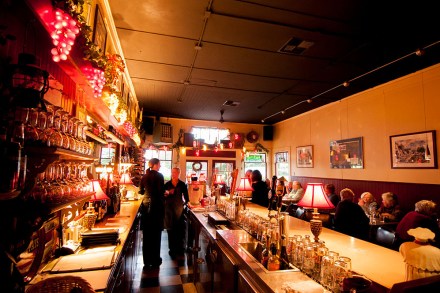
There are many reasons to admire America, and also a few reasons to disapprove. On the plus side there is free speech, the right to protect oneself, a relatively dynamic economy and 198 versions of beef jerky. On the downside, an inconsistent attitude to turning right at lights, too much fructose and the possibility of a civil war on the way. However, on a recent long trip up the American West Coast, from palm to pine, I came away realizing that America has one great advantage over Europeans: a serious understanding of the concept of eating at bars in restaurants. By which I don’t mean nibbling nuts and necking a cocktail while waiting for a table. I mean actual eating, of a proper meal, while seated on a barstool.

The proof is in the glass

From our US edition

Here we are at the beginning of a new year. Since I don’t have any childcare “learing centers” to offer my readers, I thought, the weather being frigid here in the northeast, I would reach out with the warmth of – no, not “collectivism,” to which I am allergic – but of some recent discoveries in the world of wine. Much cheaper, believe me, and much more palatable. It is only fairly recently that the Santa Cruz Mountains have come into their own as a California wine-producing region. I was deeply impressed by the 2021 Estate chardonnay from Rhys Vineyards. Sourced from three spots in the mountains, with elevations ranging from about 700 to 1,400 feet on a variety of soil types, this chardonnay is exceptionally well-structured.

Dive bars will save the West

From our US edition

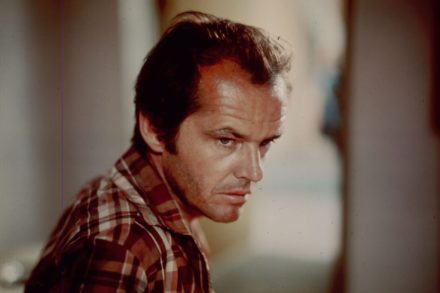
On the wall of a dive bar in Washington, DC, hung a poster for Michelangelo Antonioni’s The Passenger. The bar had the same name as the film. The movie (more boring to watch than metal melting) follows a disillusioned Anglo-American journalist roaming the African desert, indifferent to the landscape and the war he’s supposed to report on. He trades identities with a dead arms dealer and leaves behind his wife, job and old life, thinking that doing so will fix the emptiness. It doesn’t. He is incapable of caring. He has no convictions, not even when living in danger, not even when he meets someone new. The Passenger tells the story of Western men who have become indifferent observers with no cause to embrace, men who seek meaning in escape rather than responsibility.

Jack Nicholson in “The Passenger” (1975) by Michelangelo Antonioni (Getty)

I tried the world’s worst drink

From our US edition

I am standing in a sunny courtyard in the little town of Gijduvan, waiting for a drink. Just in case you don’t know, Gijduvan is a way station on the old Silk Road, in the far west of Uzbekistan: it is known for ceramics, Sufi mystics and loud celebrations of the Persian spring festival, Nowruz. As part of this festival, the locals make a special soup/beverage called sumalak. The recipe, I’m told, dates to Zoroastrian times – more than 3,000 years ago – and includes “wheat sprouts,” “cottonseed oil” and, I am not joking, “stones.” I can already see the sumalak bubbling away in a vast steel pot. It looks like viscous brown cow slurry. To be honest, I’m not brimming with eagerness.

drink

Sad: DC only joint-second in national excessive drinking

From our US edition

District winos Washington second for excessive drinking – behind Montana Cockburn’s malign influence appears to be spreading its way across the capital: new data reveals that DC is now tied second in the nation for having the most excessive drinkers, alongside North Dakota and Iowa. Only Montana has the district beat, according to a 2025 update to the County Health Rankings and Roadmaps report from the University of Wisconsin’s Population Health Institute.

Could I limit myself to 100 bottles of wine in a year?

Back in January, I wrote about my new year’s resolution to cut down on my drinking. The thought of total abstinence was too bleak, so my plan was to limit myself to 100 bottles of wine in 2024. Not quite the NHS’s recommended limit of 14 units of alcohol a week – roughly one-and-a-half bottles – but not a million miles away. I envisaged taking Mondays, Tuesdays and Wednesdays off and then confining myself to half a bottle a day for the remainder of the week. Although I also intended to do Dry January, thereby building up an eight-bottle credit. So 100 bottles in 11 months was my aim. Surely that was achievable?

Elon’s America, Welby’s legacy & celebrating Beaujolais Day

45 min listen

This week: welcome to Planet Elon. We knew that he would likely be a big part of Donald Trump’s second term, so it was unsurprising when this week Elon Musk was named – alongside entrepreneur Vivek Ramaswamy – as a co-leader of the new US Department of Government Efficiency, which will look at federal government waste. When Musk took over Twitter, he fired swathes of employees whose work was actively harming the company, so he’s in a perfect position to turn his sights on the bloated federal government. It is, writes Douglas Murray, a once-in-a-generation opportunity to strip a whole layer of rot from the body politic. But can he translate his success in the private sector to the public sector?

What’s behind all the buzz about non-alcoholic beer?

From our US edition

There’s nothing quite like the third swig of a gin and tonic at the end of a long summer’s day. Or of an Old-Fashioned combating Old Man Winter’s chill. The bite on the tongue. The slow burn in the belly. The gradual easing of emotional and physical tension. Except for the hangovers. There’s nothing quite like those, either. As I — sigh — age, I’ve developed a relationship with alcohol that has become increasingly love-hate: I love it, it hates me. A slight intolerance to booze, German/Irish heritage notwithstanding, has always given me a rosy flush that on round three deepens to an unflattering scarlet that could be mistaken for theatrical rouge.

non-alcoholic

Drinking during pregnancy just isn’t the same

From our US edition

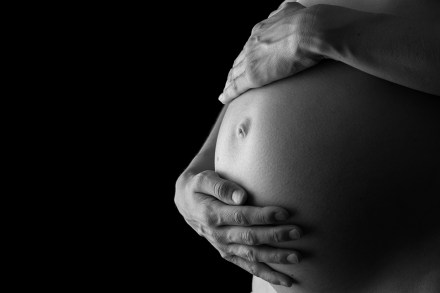
There are many cruel ironies in life. One of them is getting pregnant (and intending to keep it) at just the age at which you begin to understand how and where to drink good booze and feel justified in spending money to do so. So, finding myself with a bun in the oven just after my forty-first birthday this summer, I had to bring to a screeching halt the habits of the last few years: drinking really good wine, sometimes quite a lot of it, fairly regularly. Indeed, I spent the first week of pregnancy in the Languedoc drinking a bottle a night, plus the odd gin and tonic, because of course I didn’t know. Just last year I made a special journey to an industrial park outside Brussels to collect six bottles of 2013 white Bordeaux — it was that good.

pregnancy

How Britain sobered up

36 min listen

This week:  The Spectator’s cover story looks at how Britain is sobering up, forgoing alcohol in favour of alcohol free alternatives. In his piece, Henry Jeffreys – author of Empire of Booze – attacks the vice of sobriety and argues that the abstinence of young Britons will have a detrimental impact on the drinks industry and British culture. He joins the podcast alongside Camilla Tominey, associate editor of the Telegraph and a teetotaler. (01:27) Also this week: could Mongolia be the next geopolitical flashpoint?

Could a 100-bottle limit help me cut down on drinking?

My New Year’s resolution is to cut down on my drinking. I’m not talking about bringing it within the NHS’s recommended limit, obviously. I’ve never met anyone who confines their alcohol intake to 14 units a week, which amounts to a bottle and a half of wine, ideally spread over many days. I’m thinking of something more in the region of two bottles a week. Why not simply stop altogether? Partly because I’ve tried that before and don’t have the willpower. The longest stretch I’ve gone without a drink was in the two years leading up to my marriage in 2001, because I didn’t think Caroline would go through with it if I didn’t take the pledge.

Could I be pregnant?

At the age of 59 I thought it was time to get my body thoroughly examined. So last week I trotted off to a health clinic in west London. Not surprisingly, I got a mixed report. Mostly As and Bs, a couple of Ds, and several must-try-harders. The health check consisted of an hour with a man in green hospital scrubs, who I think was a nurse, followed by an hour with a female doctor. It was all trundling along nicely – my weight and BMI were both within the ‘healthy’ range – when something unexpected happened. After attaching electrodes to my body for the purposes of carrying out an ECG, the nurse asked me if I was pregnant. ‘I’m sorry?’ ‘Are you pregnant?’ he repeated.

How much do students drink?

Union booze Several universities have renamed freshers’ week ‘welcome week’ in an attempt to dissociate it from heavy drinking. How much do students drink? – A survey last year by the group Students Organising for Sustainability found that 81% regard drinking and getting drunk as part of university culture. – 53% reported drinking more than once a week. – 61% said they drink in their rooms or with other students before going out for the night to a pub or club. – 51% said that they thought getting drunk would ensure they had a good night out. – 13% said they took illegal drugs. Round the houses Councils are to be allowed to charge more council tax for second homes. How many second homes are there in England? – There are 3.

A drinker’s guide to flasks

From our US edition

During a recent chat with my twin brother, I told him about a wholesome community event I was preparing to attend. Being the evil twin, he joked, “You should bring a flask.” This idea got us talking about just how, when, and where one is supposed to use a flask. Is one supposed to use a flask? My experience has often been that flasks are shady things, carried by alcoholics or sipped from covertly at events that would be intolerable without a numbing agent. Yet I wonder sometimes if any public behavior these days is really off-limits. America’s major cities all reek of weed, a cohort of busy moms recommends micro-dosing psychedelics, it’s socially acceptable to self-identify as a cloud, and people actually vape in public.

Fetterman blasts Dr. Oz for drinking wine at a football tailgate

From our US edition

John Fetterman has prompted a fierce debate in the hotly contested race for Pennsylvania’s US Senate seat (the Cook Political Report just moved the race from “leans Democrat” to “toss-up”) by attacking his opponent, Dr. Mehmet Oz, for drinking wine at a Penn State football tailgate: https://twitter.com/JohnFetterman/status/1577304936345387009 Pennsylvania natives quickly came to Oz’s defense. The American Thinker compiled a list of spot-on responses, including one “Pennsylvania regular” who said she would totally drink wine because “Beer makes me have to pee.” Others pointed to the fact that Pennsylvanians are, in fact, normal people, and drink wine like those from other states. They even have wineries in Pennsylvania — 400 of them!

football

Royal drinks for raising a glass to Her Majesty

History suggests the Royal Family have always been enthusiastic drinkers. The most obvious example is Henry VIII, a monarch who proved to be excessive in everything he did, and spent an estimated £6m a year on booze. And in more recent centuries you’ll discover an ongoing Royal appreciation. Queen Victoria for example was an eminent imbiber of alcohol, her preferred poison being an unusual mix of whisky and red wine. Together. In the same glass. She was particularly partial to Vin Mariani, a drink made by Angelo Mariani by steeping cocoa leaves in French red wine for six months. Alleged to be the original recipe for Coca-Cola, each fluid ounce once contained 7.

In search of Britain’s oldest pubs

‘When you have lost your inns, drown your empty selves, for you will have lost the last of England.’ So said Hilaire Belloc. Thankfully there’s little sign of England, or indeed Britain, being down to its last pub – but which was its first? As ever with these debates, a definitive answer is hard to find: accurate record-keeping wasn’t a priority several centuries ago, when the pubs pulled their early pints. But here are a few of the boozers with a claim to be the country’s oldest.