Democracy

Hong Kong justices decide to keep Jimmy Lai in jail

From our US edition

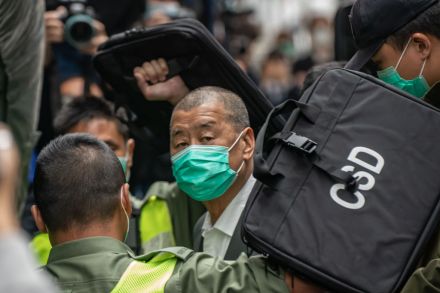
Hong Kong’s top court decided Monday to uphold Jimmy Lai and six other pro-democracy activists’ convictions for their campaigning during the anti-government protests that rocked the city in 2019. In a unanimous agreement, the court dismissed the bid to overturn the convictions of the seven activists.   Among the justices who voted to uphold the conviction was British justice David Neuberger, who is still serving as non-permanent judge in the former British colony.   Lai, seventy-six, the founder of the pro-democracy newspaper Apple Daily, was found guilty in 2021 of organizing and participating in an unauthorized assembly in August 2019 during months-long pro-democracy protests in the China-ruled city. He was sentenced to seventeen months in prison.
jimmy lai

The new alliances dedicated to destroying democracy

After staging a failed coup and going to prison, the Venezuelan army officer Hugo Chavez ran to be president in 1998, campaigning against corruption and offering revolutionary change. His nation was seen as a prosperous beacon of stability, built on its great oil wealth, envied by many people elsewhere in the region. He won by promising to tackle the inequality that scarred it so badly and take on the oligarchs enriching themselves through favours and nepotism. Western celebrities, journalists and politicians, from Sean Penn through to Jeremy Corbyn, started flocking to South America to hail their new progressive hero supposedly fighting for social justice.

Vice President new car smell kamala harris

The Democrats do not care a whit about democracy

From our US edition

The events of the last few days have made incontrovertible something that candid observers have known for some time now: that the word “democracy” in the maw of Democrats bears the same relation to really existing democracy that the Russian word “Pravda” bore to really existing truth in the Soviet era. If you look it up, you’ll see that “Pravda” means “truth.” At least, that’s what the dictionary says it means. But anyone on the ground, experiencing the full-court press of Soviet disinformation knew that the newspaper Pravda deployed the word “truth” only to undermine it. It was necessary to pay lip service to the charade.

Who’s the real threat to democracy?

From our US edition

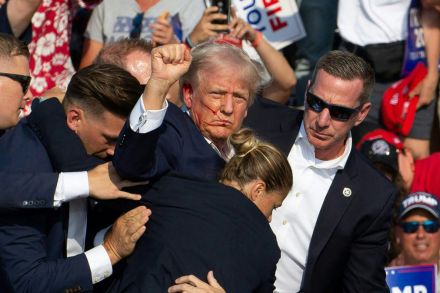
Last week at a fundraiser, Joe Biden said that it was time to get beyond his poor performance at his June 27 debate with Donald Trump. Now, said Biden, “it’s time to put Trump in a bullseye.”  Politico described that as a “forceful message from Biden.” I guess someone was paying attention. Shortly after 6 p.m. ET last night, just minutes after Donald Trump took the stage at a rally in Butler, Pennsylvania, several shots rang out. One person was killed, two were seriously wounded. The real target, of course, was the former president. He escaped with a flesh wound to the top of his right ear. Images of a defiant Trump, bloodied but waving his fist in the air as he was shuttled off stage by a gaggle of Secret Service agents, have flooded the internet.

democracy

The Biden-Trump debates won’t measure up to the past

From our US edition

It’s happening. Presidents Joe Biden and Donald Trump will debate. Of course, the Biden team is making sure the debates are dominated by the left-wing media and held in studios with no citizens present. Given this surprisingly undemocratic arrangement, it occurred to me it might be useful to look at the most famous candidate debates in American history. In 1858, while running for the US Senate in Illinois, incumbent Senator Stephen A. Douglas agreed to debate his opponent, Abraham Lincoln, seven times — once in each congressional district in which they had not yet spoken. Douglas was frustrated. Lincoln had spoken in Springfield and Chicago one day after Douglas and just torn apart all of Douglas’s arguments leaving him with no chance to respond.

A Hindu Cromwell courteously decapitates hundreds of maharajas

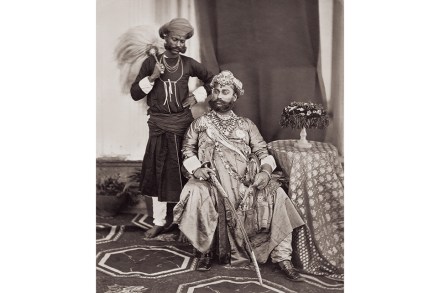
On 25 July 1947, in the searing heat, almost 100 princes bedecked in jewels gathered in a circular room in New Delhi. Some of them ruled over principalities of less than a square mile; others over an area larger than Korea. All of them had been Britain’s close allies for more than a century and, now that the British were leaving India, many looked forward to regaining their states’ independence. But on that fateful day, as Lord Mountbatten swaggered around in his ivory white uniform, anxious murmurs rippled through the throng. A cousin of George VI, and related to virtually every royal in Europe, the viceroy was no republican; yet he was about to set in motion one of the great revolutions in world history.

Why did the Weimar Republic descend so rapidly into chaos?

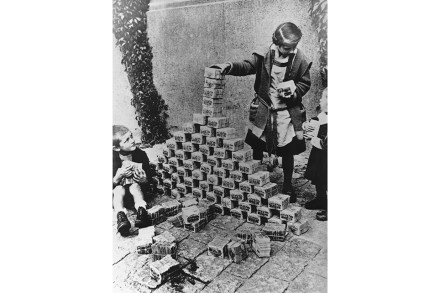
‘Thirteen wasted years’ bellowed Adolf Hitler at receptive audiences in the spring of 1932. He was talking about the first full German democracy, the Weimar Republic. Proclaimed in November 1918, it was born out of a desire to do things better after the horrors of the first world war and was an ambitious attempt to establish one of the most progressive states in history. ‘Democratic chaos,’ sneered Hitler, ‘unmitigated political and economic chaos.’ Much of the electorate agreed. Less than a year later, Hitler became chancellor and immediately set about fulfilling his electoral promise to destroy democracy. The short and tumultuous story of the Weimar Republic continues to fascinate.

Ukraine’s vitality is its greatest strength

From our US edition

Lviv, Ukraine Deep in a forested park, hundreds of people — men, women, children — in traditional embroidered clothes danced, clapped, and sang in a wild circle around fiddle-playing musicians. It was war, but it was also Easter, celebrated then according to the old calendar by the Greek Catholics of Lviv.  In that forest grove on a chilly afternoon, I stood next to Linda Netsch, a professor at Harvard Law, who had just arrived by train to give wartime guest lectures at Lviv’s Ukrainian Catholic University.  “Now I know why Russia cannot defeat Ukraine,” she told me as she pointed at the crowd of people dancing on the chilly grey afternoon while a friend poured me a whiskey. “It’s this. This is real power.

ukraine

In defense of America the arms dealer

From our US edition

As the world enters a new era of great power competition, countries are arming themselves at a rate unseen since the end of the Cold War. The war in Ukraine, China’s increasing belligerence and angst over rogue states like Iran and North Korea are driving defense spending and weapons purchases the world over. Amid all this, the United States does not have the luxury of being too picky as to who among its friends gets the weapons they need to defend themselves. Nor can Washington continue to avoid drastic reforms to its arms export controls to face the challenges of the twenty-first century. Standards are necessary — they are what should set America apart — but they must not become so onerous that the security of the US and its partners suffer.

Democracy in Peru is under attack

From our US edition

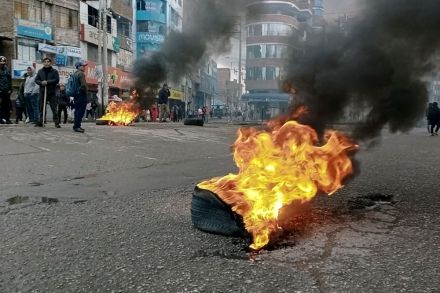
For over a month, Peru has been in a state of near-constant unrest. In December, as the legislature threatened to impeach President Pedro Castillo for, among other things, allegations of corruption, Castillo tried to dissolve the legislature and “govern through decrees.” By all measures, this was an attempted coup, and it resulted in his impeachment (by a vote of 101-6), arrest, and condemnation from left and right. In his place, Vice President Dina Boluarte was sworn in as president, having denounced her former boss’s attack on the country’s democracy. This was a success in a country that has seen six new presidents in the past seven calendar years. The Congress has repeatedly been at odds with the president, and scandals have rocked administration after administration.

Democracy by numbers

From our US edition

The world of 2023, which scarcely speaks for the intelligence, the competence, or the success of the human race, does revive the age-old question of whether the individual is wiser than the species. One answer, stated in its simplest form, is the old saw that two heads are better than one. But is that true? And if so, are three heads better than two, und so weiter? Where do we come to the end of this? The key to the conundrum relates to government. Does oligarchy provide wiser rule than monarchy, aristocracy than oligarchy, and democracy than aristocracy? Consider the history of Britain and British government over the past centuries. Has democracy, in progressively greater measure, improved the management of British affairs since the eighteenth century?

democracy numbers

Among Dubai’s weary migrant workers

From our US edition

The E100 bus is not somewhere you will find an Emirati. Departing about every thirty minutes from 4 a.m. onward and taking passengers from Abu Dhabi to Dubai for just 25 AED ($7.80), this is not a place for the rich. It is the domain of the weary peoples, the migrant workers who make this minuscule monarchy work. At 5:13 a.m. in late December, this crowd was ready to go. Bags packed for whatever indignity might come next. They were ready long before most Emiratis are awake because, for them, the United Arab Emirates is an opportunity.

Zelensky spoke to the American soul

From our US edition

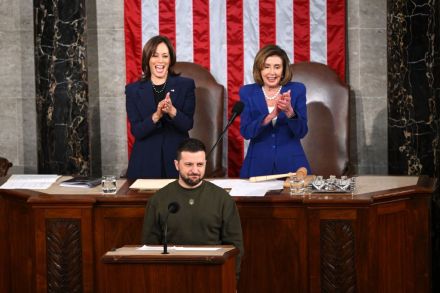
When Volodymyr Zelensky entered the chamber to address Congress, the applause and cheers took on a particularly emotional character. It was not the stilted, forced applause that the president receives at the State of the Union; it was an affectionate show of admiration for a man who has come to embody the twenty-first century struggle for freedom. Though delivered to Congress, the opening words of the Ukrainian president’s speech revealed his true audience: “Dear Americans... all those who value freedom and justice.” It was a speech for all of us. He pulled the dusty tarp off of America’s deepest identity as the shining light of liberty in a world of tyranny.

volodymyr zelensky

Voting with a vengeance

From our US edition

Weeks have passed since I voted in the November election, and I'm still ticked off. You would be too if it happened to you. Once upon a time — that is, before 2022 — New York was one of the friendlier states toward third parties. Whether Green, Constitution, Socialist Workers, Libertarian or Communist, all were welcome on the ballot so long as they passed an easily surmountable petition threshold. This pro-participation access was called “democracy.

voting

Why the lame-duck Congress is a threat to democracy

From our US edition

President Joe Biden warned Americans before the midterms that democratic self-government was “under assault” by candidates who refused to accept that Donald Trump lost the 2020 presidential election. Biden echoed others when he argued that such Republicans were “determined to succeed in thwarting the will of the people.” Polls show that most Democrats and Republicans alike worry about the future of our democracy — though they disagree over what threatens it. But this debate misses a more immediate danger: lame-duck lawmakers still making decisions while in office. The current Democrat-controlled lame-duck session alone is expected to address legislation involving such major issues as gay marriage and defense spending.

Democrats made Kari Lake a star

From our US edition

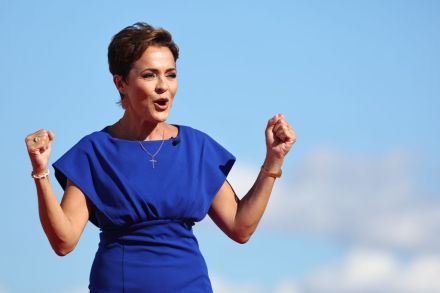
In the lead-up to the 2016 presidential election, the national media and the Hillary Clinton campaign devised a plan to elevate Donald Trump and so-called “lunacy” over a field of up-and-coming Republican politicians. According to New York Times journalist Amy Chozick, who was embedded with Hillary Clinton’s campaign from inception to death, campaign manager Robby Mook called a meeting with an agenda of specifically asking “How do we maximize Donald Trump?” Chozick also noted how Mook “salivated when a debate came on, and Trump would start to speak. ‘Shhhhh,’ Robby said, practically pressing his nose up to the TV. ‘I’ve gahtz to get me some Trump.’” We all know how that worked out.

kari lake

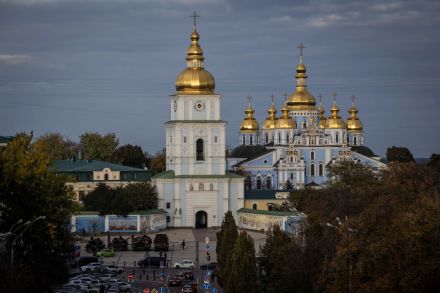
Homage to Kyiv

From our US edition

It was 11:15 p.m. in Kyiv, just after the curfew, and the military had set up its checkpoints on the city streets. Finding your way home after hours can be a hazardous business. The city is paranoid about assassins and saboteurs, and in wartime few are above suspicion. Things were looking ominous until my friend Sasha declared: “we are late for breakfast.” The guards waved us through. This was the daily password, shared with those important enough to move around after curfew. Checkpoints and curfews were a few reminders of the war in Kyiv, where I was just before last week’s deadly air strikes. In the capital city, life was approaching some form of normalcy.

kyiv

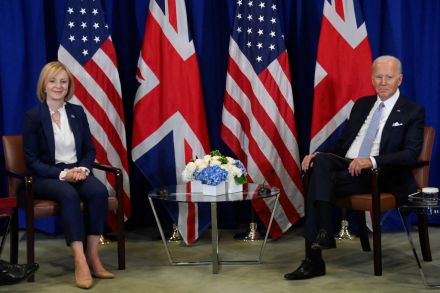
The slumber of the Anglosphere

From our US edition

The countries we call Anglo-Saxon (Great Britain, the Commonwealth and the United States) have been known for centuries for their ability to govern themselves democratically, peacefully and efficiently. In the twenty-first century they have been doing less well. Britain and America are both in dreadful straits politically, economically and socially. The implosion of Boris Johnson and the search for a satisfactory successor have revealed the leadership of the Tory Party as a hapless and embarrassing collection of mediocrities devoid of coherent ideas. Across the Atlantic, one of the two major parties is a gerontocracy at the top and a gang of urban guerrillas with Molotov cocktails at its base.

anglosphere

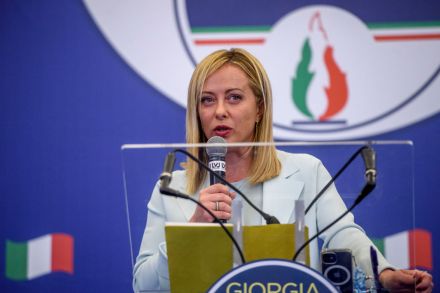
Giorgia Meloni is no springtime for Italian fascism

From our US edition

Is it springtime for fascism in Europe? First, it was Sweden. Now, it’s Italy. To judge by the reaction to Giorgia Meloni’s victory in the Italian elections on Sunday, the moment to say arrivederci to democracy has arrived. “Giorgia Meloni will be a minister-president whose political examples will be Viktor Orbàn and Donald Trump,” Katharina Barley, the vice-president of the European Parliament, declared. Maybe so, but will she actually be able to transform her country? Fratelli d’Italia, the Brothers of Italy, is a nationalist party that traces its roots back to Mussolini and is led by the charismatic Meloni. It's about to play a starring role in the Italian political firmament.

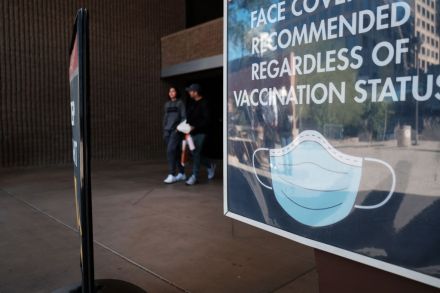
Exhausted by America’s culture of fear

From our US edition

When I try to sleep at night, I can't relax. I blearily turn on the TV, but I can't change the channel. My TV is telling me I am going to die, maybe from Covid (they say there's a new variant, you know, called Monkeypox); maybe from climate change because it is likely already too late. Before I drown because of climate change, I'll be hungry because supply chains don't work anymore, and inflation is stripping away my purchasing power, and some sort of fascist coup will happen, and I'll probably have to wear all gray clothes all the time like in the dystopian movies. Then there are the TV diseases, bowel disorders and skin problems that medicines I can't afford might fix except side effects can include blindness, paralysis, saying thingstoofasttounderstandanditallisjustablur of fear.