Conservative party

The Tories’ tax question

So should the Tories announce tax rises ahead of the next election?  According to Andrew Grice in today’s Independent, they’re certainly thinking about it: “There is a growing recognition among shadow Cabinet ministers that, if they win power, spending cuts could only be half the picture, as they would also need significant tax rises to fill the black hole in the public finances. That is why Mr Cameron and George Osborne won’t rule out tax increases. The big debate among the Tory high command now is whether to announce some tax increases before the general election. Mr Cameron is reluctant to unveil a detailed ‘shadow Budget’. But there appears to

Public scepticism about Labour’s record on education

Isn’t it funny how things work out?  I imagine the government once thought they’d get credit for the ever-improving GCSE and A-level pass rates, but now results day just rekindles the debate about slipping standards – and rightly so.  Ed Balls may have tried to divert attention on to the Tories this morning, but he can’t really escape the verdict of this ComRes poll commissioned by Newsnight.  Here are the main results: 67 percent of respondents said Labour hasn’t lived up to Tony Blair’s “education, education, education” vow. 52 percent said Labour hasn’t improved the overall quality of education.  41 percent said they have. 47 percent said the standard of

Is Theresa May priming a second Freud Review?

In some respects, Theresa May has delivered an effective speech on unemployment and the benefits system today.  It touches on all the tragic indicators – the 6 million people on out-of-work benefits, the high levels of youth worklessness, the shocking consequences of welfare ghettoes etc. – and re-states, in no uncertain terms, the Tories’ commitment to welfare reform.  She even partially responds to those critics who thought she’d been drafted into the shadow welfare role to be “softer” on single mums than Labour, by instead attacking the state for encouraging lone parents “not to bother trying to work until their youngest child was sixteen”.  But perhaps the most crucial passage

Dan Hannan and Enoch Powell: make your own mind up

Here’s footage of Dan Hannan’s month-old US interview in which he cites Enoch Powell as an influence, and which has received quite a bit of news attention today: To my mind, there’s little more to add to this than the points made by Spectator’s very own Alex Massie and those made in two excellent posts (here and here) by Guido.  To wit: Hannan has always been clear that he doesn’t endorse Powell’s views on immigration, but has instead been influenced by his views on the size, scope and role of the state.  Whatever you may think of those views, they are hardly controversial.  Indeed, as Guido points out (via Mark

The case for naval investment

Over at ConHome, Tim Montgomerie debates Will Inboden’s review of the main themes of the Tories foreign policy. I urge CoffeeHousers to read both articles, but the section on the relationship between energy and defence struck me particularly, recalling Liam Fox’s 2006 Chatham House speech on the subject. Here’s the premise of Fox’s argument: “We are all competing for the same natural resources to feed the economic system. The potential for terrorists or even nation states to interrupt this supply to cause widespread – rather than just local – disruption increases enormously.” Fox pointed out that global energy competition requirements had evolved beyond Britain’s defence strategies and capabilities. Nowhere was

Nobody’s special

In The Times today, Danny Finkelstein defended the most hated profession in contemporary politics – the Special Advisers, or SpAds. Booo, hissss. The case against was (again) laid out by a number of former senior officials, with ex-Cabinet Secretary Andrew Turnbull telling a Lords committee recently that he did not like  SpAds rising to become Cabinet ministers by the time they were 38 “without touching the sides of real life”. Booo. Hisssss. Boooo. But how many of the current Shadow Cabinet do you think have been SpAds in the past? Come on, what do you think? Half? A third? Out of the 28 members of the Shadow Cabinet, including David

On August opinion polls…

Do check out Mike Smithson’s latest post over at Political Betting, in which he relays an email he received from Nick Sparrow of ICM.  Sparrow highlights the close fit between August ICM polls in the years before elections and the actual election results themselves: “August 1996 poll suggested that Labour were ahead by 12%. The result – Labour won by 13% August 2000 poll suggested that Labour were ahead by 10% The result – Labour won by 9% August 2004 poll suggested that Labour were ahead by 3% The result – Labour won by 3% August 2009 poll suggests that the Tories are ahead by 16% The result – ?????????”

Man on wire

It’s a fairly quiet day in Westminster, so Chris Grayling’s comparison between Britain and the gangland ghettos portrayed in The Wire is probably getting more attention than it would normally – after all, it’s not like the Tories haven’t majored on the “Broken Britain” theme before now.  But, even so, I think he may have erred in mentioning the acclaimed US TV series.  While superb, it is, don’t forget, the show that the chattering classes love to chatter about.  So, now, much of the coverage is about the TV programme rather than the problems Grayling is highlighting.  As Paul Waugh points out over at his indispensable blog, Grayling’s appearance on

Would Cameron govern differently?

In an episode of Yes Prime Minister, a tobacco mogul asks Sir Humphrey: “Does he carry any clout in Whitehall?” The Mandarin replies: “None at all, he’s only a minister.” The context has changed but the essential truth remains – most Cabinet ministers have no clout in government whatsoever. That at least is the view of four former Sir Humphreys. Lords Turnbull, Wilson, Butler, and Armstrong are quoted in the Guardian saying that New Labour has centralised government around a clique of special advisers. The result? The marginalisation of the cabinet and the breakdown of what they term ‘the efficient and proper conduct of government’. Not even Jonathan Powell denies

Cameron must set out health plans

For some time now at Coffee House, we’ve questioned the sense of Cameron’s pledge to increase NHS spending in real terms. And in today’s Independent, a ComRes poll suggests that 62 percent of Tory MPs do not think the NHS should receive guaranteed spending increases. Indeed, their opposition to Mr Cameron’s plans runs deeper: only 33 percent believe the current model of care free at the point of delivery is sustainable. Additionally, the Independent quotes an anonymous Tory MP saying:  “The hope is that we would be more radical on health in office than we say now, that he [Mr Cameron] is anxious not to frighten the horses. But there

Gove pushes his agenda

If you can divert your attention away from the Ashes for a second, then I’d recommend you read John Rentoul’s fascinating interview with Michael Gove in today’s Independent on Sunday.  The two most eye-catching passages concern Gove’s “ultra-Blarism” and his thoughts on foreign policy.  The Blairism first: “And when I ask if it is wise to paint himself as a Blairite, given the former prime minister’s latter unpopularity, he says: ‘He’s not as popular as he deserves to be, and he’s emphatically not as popular within Labour as he deserves to be – amazing ingratitude on their part. But if someone were to look at some of the views that

Tories more trusted on NHS than Labour

The Tories will be pleased.  After the #welovetheNHS brouhaha of the past couple of weeks, a ComRes poll in tomorrow’s Independent on Sunday gives them a healthy lead on the NHS.  In response to the statement “The NHS would be safer under Labour than the Conservatives,” 39 percent of respondents said they agreed, while 47 percent said they disagreed.  That’s an 8 point advantage for the Tories. It’s pretty devastating stuff for Labour, but – oddly – comes in one of the Tories’ weakest policy areas.  Let’s hope this encourages Cameron & Co. to think and talk more about health service reform.

Do the Tories need an “-ism”?

So what overarching theory do Cameron & Co. believe in now?  Is it Phillip Blond’s “Red Toryism”?  Are they still invigorated by “libertarian paternalism”?  Or have they struck on something else?  This week’s Bagehot column in the Economist gives us a useful overview of all the -isms the Tories have gone through recently, before landing on a conclusion that the policy wonks in CCHQ may not like: “The Tories should stop worrying about whether their view of the world works in theory, and concentrate more on generating ideas that will work in practice. They can live without an ideology; what they urgently require is balls.” Bagehot’s take is certainly attractive. 

The biggest failure of the Tory opposition years

Fantastic, thought-provoking stuff by Matthew Parris in the Times today, as he looks back on the past 12 years of Tory opposition and asks: “Just what did they achieve?”  His response is generally unfavourable: that, until more recently, the wilderness years have largely been wasted years.  And he highlights the Tories’ inability to take on Labour over their wasteful spending and burgeoning deficit: “But it was on the central domestic question of the era that the Tories’ nerve failed almost fatally. At first new Labour held to the tight spending plans that it inherited from John Major’s outgoing administration. Then the Government let go. The letting go was, in retrospect,

Widdecombe: I’ve just had enough

It’s worth reading Iain Dale’s interview with Ann Widdecombe in the latest issue of Total Politics. Widdecombe is, of course, standing down at the next election, and much of the interview concerns her future plans: she wants to appear on Strictly Come Dancing, for instance, perhaps as the feminine answer to John Sergeant. But, naturally, the outspoken MP makes some forceful points about the current state of British politics. Her conclusion?  That things are so bad she’s had enough. First, she attacks Cameron’s ‘A-list’ candidate selection policy: ‘We have gone for category rather than ability. We’re looking for more women. I’m all for more women, I’m all for more members

Labour may not be able to exploit one of the Tories’ biggest weaknesses – but that doesn’t mean others won’t

Here at Coffee House Towers, we frequently point out the risks with the Tories’ pledge to keep on increasing health spending in real terms.  As I suggested last week, the two main problems are that it plays up the Brownite idea that spending is a good thing in itself, and it could force the Tories into a position from which they can’t row back in government.  Now, in a acerbic article in the Guardian – in which he describes Tory policy as “an incoherent mishmash of ideas designed by focus group” – Larry Elliot kicks off by highlighting the confusion the Tory line creates: “On Tuesday night David Cameron warned

The Tories have been put on the back foot, but don’t expect permanent damage

There’s plenty to be sceptical about with this #welovetheNHS Twitter campaign – not least the manner in which it’s falsely polarising the debate into “lovers” or “haters”, given that 140-character “tweets” hardly allow for nuanced arguments.  But, as Fraser pointed out last night, there’s little doubting that it’s a spot of good luck for Gordon Brown: a campaign by the left, for the left, which he managed to seize on with uncharacteristic speed.   Indeed, Brown beat David Cameron to the punch for perhaps the first time in months, and has put the Tory leader on the defensive.  Hence Cameron’s blog post last night, which set out his own #reasonsforlovingtheNHSbutstillwantingittoimprove,

Cameron plans to cut ministers’ pay

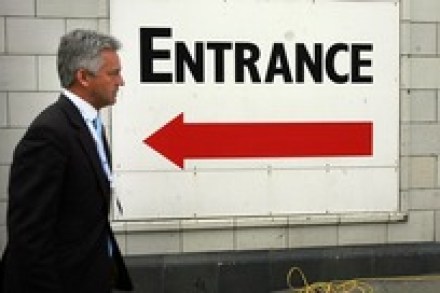
Poor old Alan Duncan might have to survive on emergency rations. The Guardian reports that David Cameron is planning to cut ministerial pay if the Tories win the next election. Here are the details: ‘David Cameron is planning to make his ministers take significant salary cuts if he forms the next government, senior sources have told the Guardian. The Conservative party high command have calculated that if they are to push through cuts in public services, their politicians have to show they are prepared to “take a financial hit”. A pay cut would also help the party as it attempts to renegotiate public sector pay deals. One senior Tory said

The Tory grassroots deliver their verdict on Alan Duncan

The Tory grassroots have spoken, and they want Alan Duncan out.  Here are the main results from a poll which has just been published over at ConservativeHome: “A ConservativeHome.com poll of 1,622 Tory members carried out today finds 65% want Alan Duncan to resign and 55% think he should be sacked. A massive 91% think he should be moved from his current job where he has a role in deciding Conservative policy on MPs’ expenses and allowances. 61% are dissatisfied with Alan Duncan’s performance. 31% are satisfied.  This makes him the least popular member of the shadow cabinet. 38% agreed that ‘Alan Duncan was telling the truth – the antagonism

Mandy: Brown would “relish” televised debates with Cameron

So Mandy’s brought up the idea of a public debate between Brown and Cameron again, claiming – in interview with Sky (see footage above) – that the PM would “relish” the opportunity to “take the fight to the Conservatives”.  If you remember, the last time Mandy mentioned it, Downing St quickly moved to dampen all the speculation – the rumour was that Brown was going to challenge* Cameron to a series of debates in his conference speech, and was irritated at the PoD for giving the game away so early.  But now that Mandy has made the same point again – indeed, even more forcefully this time – I reckon