Conservative party

Is Osborne worth it?

Fresh from winning GQ’s Politician of the Year award last week, George Osborne now has an accolade he may be even happier with: heavy praise from both Peter Oborne and Matthew Parris.  Both commentators write columns today which dish out the superlatives for Osborne’s response to the fiscal crisis, and suggest he has been vindicated by events.  Here’s the key passage from Oborne’s article, by way of a taster: “Slowly Osborne began to win the argument. First (as I revealed in this column last March), Bank of England governor Mervyn King sent private warnings to the Treasury that he feared extra public spending would damage the official credit ratings that

Will the Tories abolish the RAF?

Over at his new blog for the Wall Street Journal, Iain Martin ups the provocative factor by asking: “Will the Tories axe the RAF?”  Here’s the key passage: “It has long been the dirty little secret of the U.K. defence establishment that a way to streamline the command structure, reduce duplication and slash costs is to close the RAF. There are two options for how it could be done: 1) Abolish the traditional three services and switch to a single marine corps model, with all three services effectively merging under new leadership. Or, 2) Split the RAF’s capacity between the two remaining services, giving the army the lift and delivery

Another calamitous set of polls for Brown and Labour

A Populus poll for The Times shows that the Conservatives are more trusted to run vital services than Labour. Here are the details: ‘The Tories are now in a strong position on most public services, which have traditionally been vote-winners for Labour. On doing the best job of improving the NHS, the Tories are on 37 per cent (up 10 points since last March) against 34 per cent for Labour (down 1 point). The Tories are in the lead on: managing the economy (42 per cent against 33 per cent for Labour); improving standards in schools (39 against 33 per cent); getting the balance right between taxes and spending (38

An April election is on the cards

A couple of weeks ago, Kevin Maguire told us that No.10 is thinking about a March or April general election.  And now Steve Richards follows up by suggesting April is most likely: “Speaking to influential ministers and aides I get the impression that their favoured month for an election is next April. In theory they could hold out until June, but that would mean going to the country in the immediate aftermath of the May local elections when Labour is expected to do badly. This option is already ruled out. There will be no June election. Obviously a general election could be held on the same day as the May

The Baroness Scotland’s housekeeper scandal exposes the mess our immigration system is in

The news that the UK Border agency will launch an investigation into allegations that the Attorney General, Baroness Scotland, employed an illegal immigrant is, obviously, highly embarrassing for the government. With his customary lack of style, the Tories’ attack-dog Chris Grayling commented: “This is a Government that says all small employers should be prosecuted if they don’t know the immigration status of their employees and yet we have senior ministers who can’t be bothered to make the checks themselves. There is a real ‘one rule for them, one rule for us’ attitude at the heart of this Government and it is a disgrace.” That overstates the case. I can’t imagine

Why ministers block cuts

After Michael Fallon’s claim last week that the shadow cabinet hasn’t got “the faintest idea” of the commitment necessary to tackle the debt crisis, this anecdote from Benedict Brogan’s column should act as another warning to David Cameron: “Whitehall is gripped by short-termism, yet in a world dominated by the targets culture introduced by Labour, is this any surprise? When ministers themselves prioritise short-term results that can be ready for the Six O’Clock News or the autumn conference, how can the Civil Service hold out for the long view? Take the permanent secretary I know who was asked by Gordon Brown to deliver a 5 per cent real terms cut

Clegg: Are you one of the millions who turned to new Labour in 1997?

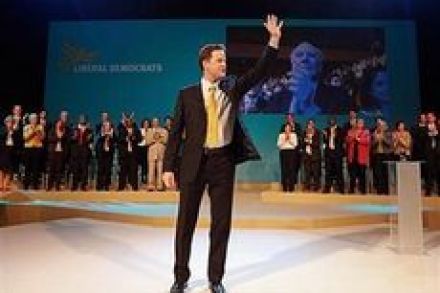
Nick Clegg joins the ‘progressive’ debate with a double of salvo in The Times and in a pamphlet, titled ‘The liberal moment’, published by Demos. The philosophically anachronistic Labour party is his target. He writes: ‘The contrast between Labour and liberals is starkest in their different approaches to power. While Labour hoards at the centre, liberals believe that power must be dispersed away from government – downwards to individuals and communities, and upwards to the international institutions needed to tackle our collective problems. State-centered, top-down solutions are wholly out of step with the demands of our age. Devising a fairer tax system, protecting civil liberties, reforming our clapped-out politics, breaking

All political parties must face up to the debt crisis’ severity 

The Independent’s Hamish McRae writes a superb column today on just how far the next government will have to go to tackle Brown’s debt crisis.  His main point is that unless severe action is taken over the coming years, we’ll be stuck in a perilous position by the time the next global downturn hits.  But it’s this passage which stands out: “To what extent will the deficit fix itself, and how much more needs to be done? We don’t have to do the full 13 per cent of GDP and the present government proposed in the Budget that it should cut about half, 6.4 per cent of GDP, of that

Losing perspective 

At The Spectator, we’ve been so close to the spending debate that one worries about losing perspective. But this post from Faisal Islam gives one a sense of just how important today’s revelations are: “We have never seen this level of detail on a budget situation before. Much of what was implied or left out of the budget is stated in astonishing detail here. It is a total disaster for the treasury and the government, but some will argue the Tories have taken a big risk with financial confidence in publishing it.”

The Tories’ Treasury mole exposes Labour’s cuts deception

On July 2nd, Gordon Brown told the House of Commons: “I have always told the truth and I’ve always told people as it is…we don’t want to have the 10 per cent cuts the Conservatives are talking about.” The Tories’ extremely destructive Treasury mole has leaked documents proving that Labour has been planning substantial cuts in front line services since before the budget. The DEL figures, printed below, are key: suggesting that a cumulative 9.3% cut was planned for 2011-2014, and Paul Waugh is right to point out that these revelations may explain why the government delayed its comprehensive spending review. This leak is such a coup for the Tories

Europe rears its head once again for the Tories

One of David Cameron’s chief successes has been to marginalise Europe as an issue. But the expulsion of Edward McMillan-Scott MEP from the Conservative party, for refusing to withdraw allegations he made against Michal Kaminski, the leader of the controversial Eurosceptic grouping of which the Tories are members, has disinterred the fractious European problem. The Europhile McMillan-Scott launched a pointed attack on the Tory leadership and its European policy on this morning’s Today programme. He said: “I think David Cameron has got most things right on Europe, but this partnership (the grouping) matters…What we will see is the party becoming much more Eurosceptic than it seems now. If all European

Cable: no budget should be ring-fenced

Vince Cable has joined the cuts debate, arguing that the “time for generalities is over” and that “politicians must not shy away from explaining in detail how they will tackle the problem of deficits and debt”. He identified 9 areas for specific savings: public sector pay and pensions, centralised education, family tax credits, defence procurement, quangos, asset sales, ID cards and the NHS super computer. Crucially, he stated that no department should be “ring-fenced”, and proposed cutting fees paid to hospitals and scrapping the strategic health authority, a move backed by Michael Fallon in a Telegraph article last week. Indeed, it’s striking how much common ground there is between the

Osborne: Tories will hold emergency Budget if they win the election

George Osborne has just announced at The Spectator’s inaugural conference, Paths to Prosperity, that there will be an emergency Budget in June or July of 2010 if the Tories win the election. Osborne told Andrew Neil that the aim of this Budget would be to reduce borrowing for fiscal year 2010-11, which will already be under way at that point, and for the years thereafter. Presumably this will be done through a combination of tax rises, spending cuts and asset sales.

The irrefutable fact about cuts is that they are needed now

I did Lord Myners a disservice by suggesting he’d gone off message by saying that spending would continue until recovery was “firmly rooted”. Peter Mandelson’s cuts speech yesterday supported that line, renewing the cuts versus investment dividing line. Steve Richards argues that the government’s approach is correct and Tory policy is a recipe for disaster. He writes: ‘He (Cameron) is now pledged to a revolutionary shrinking of the state without being able to specify how he will go about making the big changes. His speech last week about cutting the subsidies on meals in parliament was beyond parody. Yesterday Mandelson made use of the space that has opened up in

Striking the right balance

How worried should we be about national debt? I just had a rather enjoyable spat with Will Hutton on Simon Mayo’s Five Live programme. The situation is atrocious, I said. And that set him off: why did I use such a word? I replied that we are spending more in debt interest than educating our children or defending the realm. That is a dismal state of affairs, and will soon become even worse. Forget about the economics, it is a moral failure to blithly keep spending now and knowingly saddle the next generation with billions upon billions of our debt to pay off. Hutton said all this was hysterical, that

Tory guru: Financial system riskier now than it was before the collapse of Lehman Brothers

There’s a good article in the New York Times today about how little has changed in the way Wall Street does business since the collapse of Lehman—employment in the sector is only down eight percent, Goldman employees will earn on average $700,000 this year and derivatives are still not being traded on an open exchange. Indeed, the new Tory guru Nassim Taleb, the author of The Black Swan, thinks that the system might be riskier now than it was when Lehmans collapsed: “Mr. Taleb warns that the system has grown riskier since last fall. The extensive government support that began after Lehman collapsed will lead investors to assume that governments

Cameron’s public caution masks the party’s private preparations

David Cameron doesn’t give much away in his interview with the Telegraph. He again commits the Conservatives to making cuts and implies that taxes will have to be raised. But there are no specifics given. On the one hand, the lack of detail is frustrating—surely the party would have more of a mandate in government if it was more explicit now about what it was planning to do? Some straight talk would also put to bed the idea that the Cameroons are nothing more than marketing men. But on the other hand, one can appreciate that any specific pledge would hand Labour an issue to campaign on. In private, though,

Balancing defence spending

There’s an intriguing story in today’s Times suggesting that the Tories may “backtrack” on some defence spending commitments, and are thinking about shelving the Trident replacement.  Here’s a snippet: “Liam Fox, the Shadow Defence Secretary, pledged last year to protect the three most expensive equipment programmes: aircraft carriers, an armoured vehicle system known as FRES and Britain’s nuclear capability. He also indicated his desire to expand the Army by 10,000 soldiers. An aide to Dr Fox said this week that commitments ‘had been superseded’ by plans for a Strategic Defence Review (SDR) after the election. George Osborne, the Shadow Chancellor, also warned that a Conservative government would have to make