Climate change

Kitchen tables versus kitchen tablets: the real election divide

It’s useful to think of this election as a contrast between how, in the simplest understanding, people see the world from two very different perspectives. It’s simple, but it’s important. There was a line on the edge of my memory the other day from a certain victorious congressional candidate: Carry the word throughout this district, the word we said was true: that we do stand for the people who push a grocery cart and worry about the grocery prices, that we do stand for the people who care about this country and their children's future.

gadgets

The lesson of 2022: energy is our lifeblood

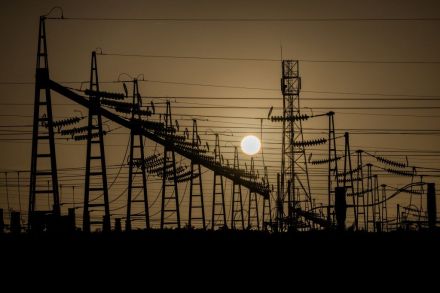
This has, so far, been a year of hard lessons. Spiraling inflation has given households an expensive economic refresher course. A land war in Europe has offered an unwelcome reminder of old geopolitical and military truths. But arguably the most important lesson of 2022 concerns the point at which these economic, military and geopolitical considerations converge: energy. On this vital issue, the West has suffered from an epidemic of amnesia in recent years. Too often energy security has either been taken for granted by policymakers and voters, for whom the last energy crisis had become a distant memory, or actively disparaged by an environmental movement whose hardline hostility to fossil fuels has become received wisdom in polite circles.

thunberg

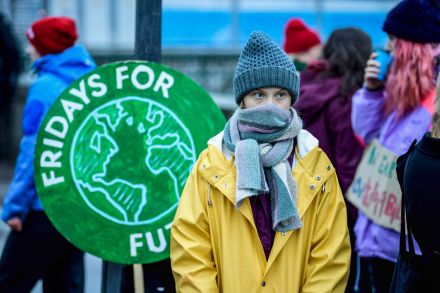
Where in the world is Greta Thunberg?

When the United Nations General Assembly convened in New York in September, climate-watchers may have noticed a pesky, pigtailed vacuum. Greta Thunberg, who spent the summer of 2019 stalking the East Coast after taking a prince of Monaco’s yacht across the Atlantic, reached her zenith that September — the last time this body met in person — at the Climate Action Summit where she delivered her creepy, memed-into-oblivion “how dare you” speech. But the chilling little entity straight out of Kubrick was notably absent at this year’s assembly, at a time when the Biden administration is pushing climate hysteria more fervently than ever.

The tricky debate over fossil fuels on Native American land

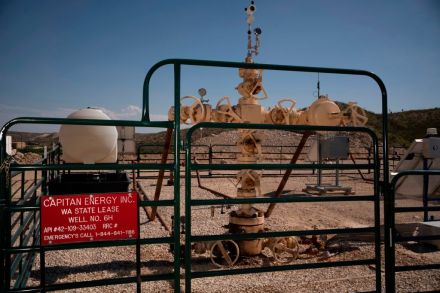
The Biden administration has found itself between a rock and a hard seam of coal. A cohort of Native American tribes have realized just how sacred — and lucrative — their lands really are, and they’re not trusting the promises of an old white man this time. “When the administration says, ‘We're going to create all these millions of jobs if we just switched over [to renewable energy] today,’ they haven't shown us the fine print that says where those jobs are coming, which region, doing what,” Daniel Cardenas, chairman of the National Tribal Energy Association and member of the Pit River Tribe, told Fox News Digital in an interview. "When you start questioning them there, then they start getting defensive.

Meet the Bristol Tyre Extinguishers

From our UK edition

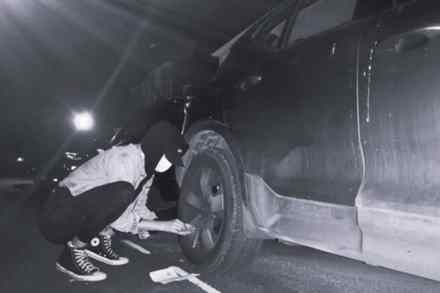
If the world really does face a climate emergency, what ought you, personally, be doing about it? Should you, as increasing numbers of young people are doing, roam the streets at night letting down the tyres of SUVs? The fast-growing movement that calls itself the ‘Tyre Extinguishers’ thinks this is an effective approach, and has targeted thousands of SUVs in cities around the world. My home town of Bristol – always quick to espouse a green cause – has seen at least 200 SUVs ‘extinguished’ in recent weeks. Though they claim to be leaderless, the Extinguishers have a Twitter account where you can keep up-to-date with their latest ‘hits’, and a website that generously invites everyone to get involved.

Feeling grateful for coal in West Virginia

Never did I think the day would come when I would be writing about West Virginia coal miners and Lululemon’s “Hotty Hot pants” in the same article. What truly strange times we live in. Last week, I traveled down to wild and wonderful West Virginia for the Bluefield Coal & Mining Show, “A Show for Mining: Past, Present, and Future.” It was a cloudless day in early fall, with crisp air, manly Southern gentlemen with the most charming drawls, huge, impressive, American-made machinery, and free beer everywhere. “Almost heaven” indeed!

The inconvenient truth about France’s forest fires

From our UK edition

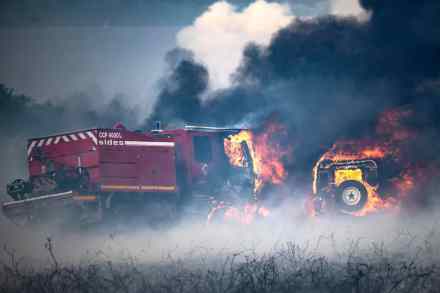
Montpellier Last month the Prime Minister of France, Elisabeth Borne, visited the south-west of the country to offer her support to firefighters tackling a series of large forest fires. It was also a good opportunity to broach a subject close to her heart. ‘More than ever,’ she warned, ‘we must continue to fight against climate change and to adapt. A new plan for adapting to climate change will be put out for consultation at the beginning of the autumn’. Borne isn’t alone in connecting the forest fires that have ravaged much of France this summer to climate change. Newspapers such as Liberation have also linked the two. Last week the paper published an article in which it referenced the United Nation’s World Meteorological Organization.

China, not America, has the real emissions problem

Hailed as America’s first comprehensive climate law, the Inflation Reduction Act was signed by President Biden earlier this summer. It had been thirty years and sixty-five days since President George H.W. Bush signed the United Nations Framework Convention on Climate Change in Rio de Janeiro. The UNFCCC’s objective was to stabilize concentrations of greenhouse gases in the atmosphere “at a level that would prevent dangerous anthropogenic interference with the climate system,” a threshold that the convention left undefined. In 1992, the average concentration of carbon dioxide in the atmosphere was 356.54 parts per million by volume (ppmv).

science

The tyranny of the specialists

We're all in major trouble anyway, so may as well throw another culture war onto the bonfire. How about this: specialists versus generalists. You can picture it now: the specialists refuse to fight except through a very esoteric discipline that only they understand and won't shut up about. While the generalists fight any way they can, on the beaches, on the landing grounds — and badly all around. The debate between specialists and generalists is an old one, and these days it isn't much of a debate at all. The specialists have all but routed their generalist foes, and are busy dictating terms (in extremely technical language with plenty of appendices).

Leonardo DiCaprio only dates women under twenty-five BECAUSE he’s an eco-warrior

There are three certainties in life: death, taxes and Leonardo DiCaprio’s girlfriend being shoved overboard as soon as she reaches the ripe age of twenty-five. But while killjoys are moaning online about the actor’s disposition, Cockburn believes that DiCaprio is actually carrying out God’s work. Climate change, pollution, the energy crisis — the reason for these disasters is simple: there are just too many people on earth. How does this relate to a middle-aged actor dating young supermodels, you ask? Simple: Leo is stealing their best child-bearing years one at a time without impregnating them. Now, Cockburn is no scientist — but he bets that if Leo keeps this up for a few more decades, you will literally see the oceans get clearer. He’s done the math.

leonardo dicaprio

Young people should see climate change as a challenge

I’ve been fed two competing storylines for as long as I can remember. On one side, the world I’ve inherited is a tinderbox just waiting to erupt in flames. If I’m not the one engulfed, then surely my children or my grandchildren will be. And on the other side... crickets. The conversation around climate change has no spectrum. It’s just a bimodal screaming match luring young people into either skipping along into the sunset in blissful ignorance or slowly sliding into the fiery pits of hell in nihilistic resignation. Through young eyes, the dominant message from the right amounts to: your ecological inheritance is diddly-squat to us.

climate change
fracking

The revenge of the analog economy

The last few decades have seen the emergence of two rival economies: an older analog one built on the actual production of goods, and another that profits from financial transactions, images and customer surveillance. The contest between the two has been rather one-sided, with the “laptop economy” the big winner, particularly during the pandemic. But while lockdowns made this one-sidedness clear, recent developments have been an unwelcome reminder that the pain suffered in the analog economy still matters. Whether through inflation, energy shortages or supply chain issues, we are getting an uncomfortable lesson in the enduring relevance of the material world. Sadly, the needs of the analog economy aren’t taken seriously enough in Washington.

How did climate doomsters get the Great Barrier Reef so wrong?

From our UK edition

We are, of course, in the midst of a ‘climate emergency’ and the ‘sixth mass extinction’ of life on Earth. It is just that one of the iconic victims doesn’t seem to be playing ball just at the moment. As recently as May, environmentalists were warning that the Great Barrier Reef, the 1,500-mile coral structure off the coast of Queensland, was being doomed by warming seas. It was reported to be suffering a ‘mass bleaching’ – where the plants which live on the reef and provide food for it die off. The blame was put on warmer seas. Worse, this was the first mass bleaching event to occur in a ‘La Niña’ year, when the seas off Australia are supposed to be going through a cyclical cooling phase.

Everything’s burned to a crisp – and the horses are suffering

From our UK edition

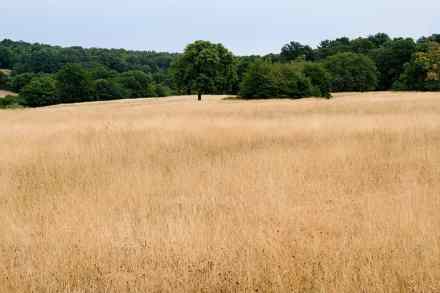
Everything is well and truly burned to a crisp, and we are piling through hundreds of pounds of hay a week. When the sun shines relentlessly and it never rains, keeping horses gets awfully expensive. The poor gee-gees themselves are bored stiff. We heave mountains of hay into the fields but they miss the ability to mooch about foraging and munching the greenery. There is no greenery. Everything is brown and white. I don’t think I can recall ever seeing the fields white before. When the grass first burned off, the paddocks went a taupe colour. But after weeks and weeks of relentless sun and no more than the odd spot of rain, the ground became quite bleached. The builder boyfriend’s cobs loaf about or snooze under trees. They like being lazy.

Why ESG is sinister

In contemporary finance, a bank’s “head of responsible investing” is meant to be an apostle of woke capitalism: a very modern kind of money man who tours the world touting all the good their employer is doing. So you might have expected a speech on climate change and finance by Stuart Kirk, the man with that job title at HSBC Asset Management, to be a bromide-filled snoozefest about the win-win nature of the transition to the green economy. But Mr. Kirk’s address at a recent conference on “Moral Money” was nothing of the sort. Instead, he delivered a broadside against the fashionable idea that climate change is a risk that no financial institution can afford to ignore.

esg

There are almost no animals left – but we’ve been here before

From our UK edition

Laikipia You know things are bad when the zebras are thin. Even during most droughts, zebras are like matrons at the gym in stripey spandex stretched around plump buttocks. Pastures vanished long ago and our plains resemble Sudan’s Batn-el-Hajar – the Belly of Stones desert – so that I cannot even recall what they were like when they were last thick with green grass. The zebra foals are dying, the elephants are thin, while the buffalo disappeared a while back. The dry has killed quite mature trees which now shudder with the sound of termites and crash to the ground. To the north of us, horned skulls and dried carcasses litter the trail where the cattle-keepers trekked their animals vast distances in search of rain. Up there the countryside is silent.

Fact check: Is Sadiq Khan right about fires?

From our UK edition

Will global warming condemn Britain to more fires? Sadiq Khan, Mayor of London, has been widely quoted this morning comparing recent fires around the capital to the Blitz. ‘Yesterday was the busiest day for the fire service in London since the second world war,’ he said – climate change caused the heatwave which ‘led to the fires’. He added that he was dismayed that the Tory leadership contenders were not discussing this ‘elephant in the room.’ So is this right – or misleading? As so often, it’s a mixture. Khan is correct to say that the number of calls to London fire brigade was a record high: it received more than 2,600 calls. But 999 call handlers can receive hundreds of calls about the same incident.

Dutch farmers are fighting for freedom

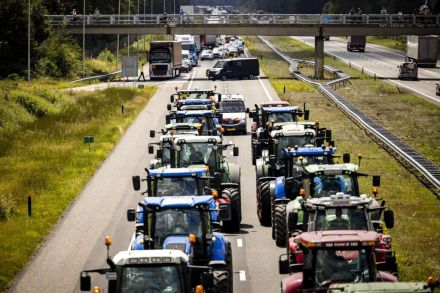
Dutch farmers have had enough of government overreach. And they’re taking to the streets as only farmers can. The government of the Netherlands, in order to fight climate change, recently proposed a 50 percent cut in ammonia and nitrous oxide emissions by 2030 — which will disproportionately impact the agricultural industry. Small farms are thus faced with two choices: shutter entirely or face poverty after culling their livestock. The Dutch government is not sympathetic to these concerns. In their words, “The honest message...is that not all farmers can continue their business.

Among the green conservatives

The American Conservation Coalition last week held its first official summit, hosting a vibrant crowd of over 250 people. The organization boasted speakers such as Michigan congressman Peter Meijer, New Hampshire governor Chris Sununu and conservative radio host Jason Rantz. Cockburn was lucky to attend — and even luckier to partake in the open bar. The many speakers held talks and panels on topics such as China as a player in the clean energy arms race, nuclear power as an alternative to fossil fuels, and the deregulation of free market economies. While it is still far from the mainstream attitude in conservative thought, the ACC represents a growing minority of people who recognize climate change as a threat, only without the left's “doom and gloom.

What the new GCSE in global warming should teach

From our UK edition

For years, environmentalists have campaigned for children to study global warming as a subject rather than simply as a part of geography. Their wish has now been granted in England with a new GCSE in natural history, starting from 2025. We know nothing yet about the syllabus but it’s quite the opportunity to ask what our planet’s problems really are, and how effective the net-zero agenda is as a solution. Rather than be scared to death about the future of the planet, pupils should instead be encouraged to take a rationalist approach. They might ask whether the obsession with climate change in recent decades has taken attention away from the many other major problems facing the planet.