Climate change

The Doomsday Clock has been corrupted by ideology

Ever since I can remember, I have always been aware of something called the “Doomsday Clock,” a symbolized calculation produced by a panel of prominent scientists of just how close humanity is to destroying itself. Published on the cover of every issue of the Bulletin of the Atomic Scientists, a journal founded in 1945 by Manhattan Project physicists, the clock’s hands would move toward or away from the dreaded midnight hour depending on how near Armageddon was believed to be. As a kid, the Doomsday Clock seemed an appropriate warning of how the conflict between the US and the Soviet Union might accidentally spin out of control.

Why California’s rainstorm ‘disaster’ is a blessing

No doubt California’s extreme weather makes for dramatic television, and for climate eschatologists it stirs up another round of end-times unease. California cliffs tumbling onto highways and sinkholes appearing out of nowhere have been all over the news. Lowland and flood plains are underwater up and down the state. Dry creeks have been raging torrents. One Guardian headline goes, “California’s rainstorm hell ‘among the most deadly disasters in our history.’” California governor Gavin Newsom tweets, “California is proof that the climate crisis is real and we have to take it seriously.” Both the media and Governor Newsom should get a grip. There is no evidence that climate change is to blame for these heavy rains. California has long suffered from extreme weather.

How the population scare predicted today’s climate hysteria

Stanford professor Paul Ehrlich's recent appearance on CBS’s 60 Minutes reminds us what can happen when those with impressive academic credentials begin making end-of-the-world predictions. It was 1968 when Ehrlich published The Population Bomb, a book that declared with absolute certainty that “the battle to feed all of humanity is over.” Because so many people were living so close together and consuming so much of the world’s limited resources, the inevitable future was one of “mass starvation” on “a dying planet.” A year after the book’s publication, Ehrlich went on to say that this “utter breakdown” in Earth’s capacity to support its bulging population was just fifteen years away.

Climate change’s biggest casualty is my winter wardrobe

For Christmas this year, Santa Claus brought me the most splendid Maine Mountain Parka from L.L. Bean, rife with thoughtful details and flawless construction from hood to hem. Standing in the living room, I admired the weather-proof cuffs and pulled the oversized zipper with rubber grip pull cord (a must when wearing gloves). I fastened the button-front storm placket — such a satisfyingly haughty act, akin, I’d imagine, to how one of Napoleon’s cavalrymen might have felt strapping on his saber. I flipped the adjustable snorkel hood with its removable faux-fur ruff onto my head and burrowed my hands into the deep snap pockets. I then plopped down on the couch and gazed smugly out the window at the bomb cyclone raging outside.

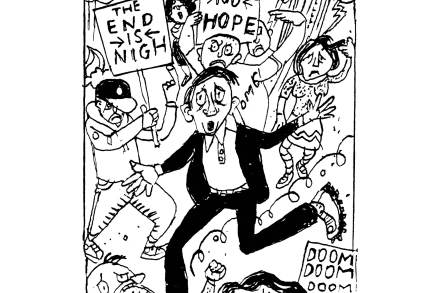
The left’s politics of catastrophe

Having a close, lifelong acquaintance with the animal kingdom, from small reptiles and farm animals to dogs and cats of the large and domestic varieties, I disagree with G.K. Chesterton’s casual statement that the more one gets to know animals, the greater the distance between them and human beings appears. My own experience suggests the opposite. Chesterton had obviously not considered herd animals such as cattle, with their keen instinct for panic that Homo sapiens, taken as a species, so often exhibits. Humanity’s current panic — of global extent, though demonstrated in exaggerated form in the West — touched off by the phenomenon of “climate change” is only the latest historical manifestation of an endemic human trait.

iowa

Stop ignoring the real environmentalists

What does throwing soup on a piece of art have to do with the environment? When we hear the word environmentalist, what comes to mind is something like an Extinction Rebellion or JustStopOil activist: young, urban, progressive, with an expressly political agenda. But what if there are other categories of environmentalists that are expressly ignored, that may have the insights we need to solve the very real environmental problems we face? In my PhD research, I spoke with people who produced a significant amount of food for their own consumption in and around Chicago. Many of them were were disaffected by the focus on climate change and the obsession with consumption as activism.

environmentalists

Kitchen tables versus kitchen tablets: the real election divide

It’s useful to think of this election as a contrast between how, in the simplest understanding, people see the world from two very different perspectives. It’s simple, but it’s important. There was a line on the edge of my memory the other day from a certain victorious congressional candidate: Carry the word throughout this district, the word we said was true: that we do stand for the people who push a grocery cart and worry about the grocery prices, that we do stand for the people who care about this country and their children's future.

gadgets

The lesson of 2022: energy is our lifeblood

This has, so far, been a year of hard lessons. Spiraling inflation has given households an expensive economic refresher course. A land war in Europe has offered an unwelcome reminder of old geopolitical and military truths. But arguably the most important lesson of 2022 concerns the point at which these economic, military and geopolitical considerations converge: energy. On this vital issue, the West has suffered from an epidemic of amnesia in recent years. Too often energy security has either been taken for granted by policymakers and voters, for whom the last energy crisis had become a distant memory, or actively disparaged by an environmental movement whose hardline hostility to fossil fuels has become received wisdom in polite circles.

thunberg

Where in the world is Greta Thunberg?

When the United Nations General Assembly convened in New York in September, climate-watchers may have noticed a pesky, pigtailed vacuum. Greta Thunberg, who spent the summer of 2019 stalking the East Coast after taking a prince of Monaco’s yacht across the Atlantic, reached her zenith that September — the last time this body met in person — at the Climate Action Summit where she delivered her creepy, memed-into-oblivion “how dare you” speech. But the chilling little entity straight out of Kubrick was notably absent at this year’s assembly, at a time when the Biden administration is pushing climate hysteria more fervently than ever.

The tricky debate over fossil fuels on Native American land

The Biden administration has found itself between a rock and a hard seam of coal. A cohort of Native American tribes have realized just how sacred — and lucrative — their lands really are, and they’re not trusting the promises of an old white man this time. “When the administration says, ‘We're going to create all these millions of jobs if we just switched over [to renewable energy] today,’ they haven't shown us the fine print that says where those jobs are coming, which region, doing what,” Daniel Cardenas, chairman of the National Tribal Energy Association and member of the Pit River Tribe, told Fox News Digital in an interview. "When you start questioning them there, then they start getting defensive.

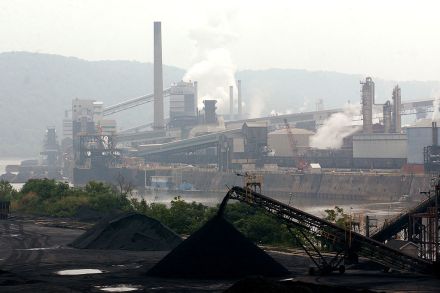
Feeling grateful for coal in West Virginia

Never did I think the day would come when I would be writing about West Virginia coal miners and Lululemon’s “Hotty Hot pants” in the same article. What truly strange times we live in. Last week, I traveled down to wild and wonderful West Virginia for the Bluefield Coal & Mining Show, “A Show for Mining: Past, Present, and Future.” It was a cloudless day in early fall, with crisp air, manly Southern gentlemen with the most charming drawls, huge, impressive, American-made machinery, and free beer everywhere. “Almost heaven” indeed!

China, not America, has the real emissions problem

Hailed as America’s first comprehensive climate law, the Inflation Reduction Act was signed by President Biden earlier this summer. It had been thirty years and sixty-five days since President George H.W. Bush signed the United Nations Framework Convention on Climate Change in Rio de Janeiro. The UNFCCC’s objective was to stabilize concentrations of greenhouse gases in the atmosphere “at a level that would prevent dangerous anthropogenic interference with the climate system,” a threshold that the convention left undefined. In 1992, the average concentration of carbon dioxide in the atmosphere was 356.54 parts per million by volume (ppmv).

science

The tyranny of the specialists

We're all in major trouble anyway, so may as well throw another culture war onto the bonfire. How about this: specialists versus generalists. You can picture it now: the specialists refuse to fight except through a very esoteric discipline that only they understand and won't shut up about. While the generalists fight any way they can, on the beaches, on the landing grounds — and badly all around. The debate between specialists and generalists is an old one, and these days it isn't much of a debate at all. The specialists have all but routed their generalist foes, and are busy dictating terms (in extremely technical language with plenty of appendices).

Leonardo DiCaprio only dates women under twenty-five BECAUSE he’s an eco-warrior

There are three certainties in life: death, taxes and Leonardo DiCaprio’s girlfriend being shoved overboard as soon as she reaches the ripe age of twenty-five. But while killjoys are moaning online about the actor’s disposition, Cockburn believes that DiCaprio is actually carrying out God’s work. Climate change, pollution, the energy crisis — the reason for these disasters is simple: there are just too many people on earth. How does this relate to a middle-aged actor dating young supermodels, you ask? Simple: Leo is stealing their best child-bearing years one at a time without impregnating them. Now, Cockburn is no scientist — but he bets that if Leo keeps this up for a few more decades, you will literally see the oceans get clearer. He’s done the math.

leonardo dicaprio

Young people should see climate change as a challenge

I’ve been fed two competing storylines for as long as I can remember. On one side, the world I’ve inherited is a tinderbox just waiting to erupt in flames. If I’m not the one engulfed, then surely my children or my grandchildren will be. And on the other side... crickets. The conversation around climate change has no spectrum. It’s just a bimodal screaming match luring young people into either skipping along into the sunset in blissful ignorance or slowly sliding into the fiery pits of hell in nihilistic resignation. Through young eyes, the dominant message from the right amounts to: your ecological inheritance is diddly-squat to us.

climate change
fracking

The revenge of the analog economy

The last few decades have seen the emergence of two rival economies: an older analog one built on the actual production of goods, and another that profits from financial transactions, images and customer surveillance. The contest between the two has been rather one-sided, with the “laptop economy” the big winner, particularly during the pandemic. But while lockdowns made this one-sidedness clear, recent developments have been an unwelcome reminder that the pain suffered in the analog economy still matters. Whether through inflation, energy shortages or supply chain issues, we are getting an uncomfortable lesson in the enduring relevance of the material world. Sadly, the needs of the analog economy aren’t taken seriously enough in Washington.

Why ESG is sinister

In contemporary finance, a bank’s “head of responsible investing” is meant to be an apostle of woke capitalism: a very modern kind of money man who tours the world touting all the good their employer is doing. So you might have expected a speech on climate change and finance by Stuart Kirk, the man with that job title at HSBC Asset Management, to be a bromide-filled snoozefest about the win-win nature of the transition to the green economy. But Mr. Kirk’s address at a recent conference on “Moral Money” was nothing of the sort. Instead, he delivered a broadside against the fashionable idea that climate change is a risk that no financial institution can afford to ignore.

esg

Dutch farmers are fighting for freedom

Dutch farmers have had enough of government overreach. And they’re taking to the streets as only farmers can. The government of the Netherlands, in order to fight climate change, recently proposed a 50 percent cut in ammonia and nitrous oxide emissions by 2030 — which will disproportionately impact the agricultural industry. Small farms are thus faced with two choices: shutter entirely or face poverty after culling their livestock. The Dutch government is not sympathetic to these concerns. In their words, “The honest message...is that not all farmers can continue their business.

Among the green conservatives

The American Conservation Coalition last week held its first official summit, hosting a vibrant crowd of over 250 people. The organization boasted speakers such as Michigan congressman Peter Meijer, New Hampshire governor Chris Sununu and conservative radio host Jason Rantz. Cockburn was lucky to attend — and even luckier to partake in the open bar. The many speakers held talks and panels on topics such as China as a player in the clean energy arms race, nuclear power as an alternative to fossil fuels, and the deregulation of free market economies. While it is still far from the mainstream attitude in conservative thought, the ACC represents a growing minority of people who recognize climate change as a threat, only without the left's “doom and gloom.

My raging case of ‘climate anxiety’

Recently, I came down with a severe case of climate anxiety. Not because I was worried about global warming but because the globe wasn't getting warm enough. It has been an unseasonably cold spring here on the East Coast. As recently as two weeks ago, a winter storm thrashed the Northeast, while last week the temperature here in Virginia kept getting stuck the 50s. Of course, our science-positive betters insist that a single spell of cold weather can't be used to challenge the climate change "consensus." But then they also seize upon every drought, heat wave, wildfire, hurricane, tornado, flood, derecho, hailstorm, rainstorm, power outage, riot, and coup in Myanmar to argue in favor of climate change. So no wonder some are feeling a little on edge.