Brexit

Letters of no confidence in Theresa May: live updates

UPDATE: 48 letters of no confidence have now been reached. It’s been four long weeks since the last rebellion against Theresa May, when the ERG and Brexiteers fell short of the numbers they needed to trigger a leadership election. Now, it’s being reported that Tory MPs have had enough, and are once again submitting letters of no confidence to the chairman of the 1922 committee, Graham Brady. Speculation is rife that the total number of letters has already been reached this evening. Once 48 letters have been submitted, a confidence vote will be triggered. But before them, Brady is likely to let the PM know in private first, to give her

Now Theresa May has postponed the vote, how will the EU react?

Even before today’s announcement that the Brexit vote would be pulled, a number of media leaks indicated the EU’s plan in case of a parliamentary defeat. According to Reuters, the EU had been planning to concede a number of cosmetic changes. However, those changes would not be made to the withdrawal agreement, but only to the non-binding political declaration. As one EU diplomat said: ‘we could look at doing something cosmetic, relatively quickly. First, we would have to hear from May, see what they want’. Another EU diplomat, however, warned that ‘if she falls short of a hundred votes, it’s probably not doable.’ It now makes sense for the EU

The ECJ wants to take back control of Brexit

Given that the ECJ often takes years to give an opinion, the speed of its Brexit judgement is unprecedented. Now and again, the mask slips: in theory the ECJ’s court judicial, cares only about good law. In practise this is nakedly political – explicitly so this time, given the vote tomorrow. It’s being breathlessly reported that ECJ has said Britain can now abandon Brexit unilaterally, without permission. This is just wrong. Unilateral means on our own. We can’t do that under this judgement. Instead, see paras 73 to 75, the ECJ gets to sign off on whether or not we can revoke. The test is not abuse, as proposed by

Six denials in six days about Theresa May’s Brexit vote

Faced with the prospect of overwhelming defeat, Theresa May has once again decided to kick the Brexit can down the road and delay the meaningful vote on her Brexit deal. Standing before the House of Commons, the Prime Minister told MPs that ‘it is clear that while there is broad support for many of the key aspects of the deal, on one issue – the Northern Ireland backstop – there remains widespread and deep concern.’ which is why she is shelving the vote. All of which rather confused Mr Steerpike. After all, nothing had really changed in the past week, and Mr S was sure he had heard multiple times

Watch: MP tells May: No PM is better than a bad PM

Not for the first time, Theresa May’s words on Brexit are coming back to haunt her. The PM once famously said that no deal is better than a bad deal. But in the Commons just now, Labour MP Peter Kyle had this to say to the PM: ‘Isn’t it true that no Prime Minister is better than a bad Prime Minister?’ Mr S thinks that Kyle has a point. But given that the Labour MP is no fan of the party’s leader, does his logic also apply to the prospect of a Labour government under Jeremy Corbyn?

Speaker Bercow says MPs should get a say in delaying Brexit vote

Speaker Bercow has told MPs that they do deserve a vote on the government’s plan to delay its Brexit deal vote. He told the Commons this afternoon that ‘any courteous, respectful and mature environment, allowing the House to have its say on the matter would be the right and obvious course to take’. We will find out more details on the procedural aspects of the government’s plan later when Andrea Leadsom gives a statement. Bercow’s statement shows why Labour were so keen to protect him as Speaker when his job was in peril over the bullying and harassment scandal. He was always likely to be an interventionist speaker over Brexit,

Watch: Beast of Bolsover takes Theresa May to task

Theresa May is having a hard time in the Commons on all sides but the most outspoken attack has come from a typical suspect. Step forward, Dennis Skinner. The Beast of Bolsover took the PM to task for delaying the Brexit vote, saying that by doing so she had handed over power to Brussels: ‘Mrs Thatcher had a word for it. What she has done today: F – R – I – T. She’s frit.’ Mr S is pleased to see that Skinner appears to have found some common ground with the Iron Lady…

Theresa May must now admit she has failed. What happens next?

The Prime Minister had one job, after she took the greatest office in the land in July 2016 – which was to negotiate an orderly sensible Brexit. Today she will admit she has failed. Because rather than risk seeing an overwhelming majority of MPs vote down the Brexit plan she has meticulously and painstakingly agreed with the EU, she will today tell MPs she is pulling the vote. Two questions follow. What on earth can she say at 3.30pm today to persuade MPs and the nation that she has a strategy for a better Brexit outcome? And will MPs actually let her pull that vote? MPs of ALL parties –

Eurosceptics threaten to block Government delay to Brexit vote 

Could we end up with Parliament voting on the Brexit deal tomorrow anyway? Eurosceptic Tory MPs have reacted with fury to the announcement that the government will delay the vote, with a number threatening to vote against the delay.  I understand that the European Research Group is currently discussing whether this is actually possible as an official position, but in the meantime MPs such as James Duddridge and Andrea Jenkyns have already made their threats public.  However, sources tell me that the advice given to the ERG has been that the Government might not even have to call a vote on delaying the vote, as it can merely avoid moving

Why Theresa May has decided to postpone the Brexit vote

Faced with a choice between a humiliating defeat or moving a vote in order to delay a humiliating defeat, Theresa May has plumped for the latter. This morning, cabinet sources say the Prime Minister made the decision to delay the vote on her Brexit deal. Despite No.10 insisting repeatedly this morning that the vote would go ahead on Tuesday, the scale of defeat appears to have become too much and there are now plans to try and shelve it. Cabinet sources suggest that the vote will be moved to January. The vote could still go ahead if May’s opponents find a procedural ruse by which to thwart the government. This

The ECJ Brexit ruling hands power back to Britain

The “People’s Vote” is celebrating the judgement by the European Court of Justice that Britain could unilaterally revoke Article 50 at any point up until 29 March next year and remain in the EU under existing terms. It destroys the argument that Michael Gove made last weekend: that reversing our decision to stay in the EU would lead to vastly inferior terms, the loss of Britain’s rebate and so on. And while the government still describes the judgement as hypothetical, it will also heap huge pressure on Theresa May if she loses tomorrow’s seemingly doomed vote on her withdrawal bill. Like it or not, she will have to fend off

The Mail may suffer yet for its Brexit volte-face

I may have spoken too soon when I predicted that the Daily Mail might not suffer from its Brexit volte-face. At the Daily Telegraph’s Christmas charity phone-in last Sunday, I was struck by how many donating readers mentioned the Mail’s desertion, and by reports of recruitment by the Telegraph of disconsolate Mail readers. There are rumours that the Mail’s new editor, Geordie Greig, has personally rung to plead with readers who are cancelling their subscriptions. Geordie is a charming man, but obviously he cannot speak to all the disgruntled tens of thousands. The Mail has chosen to switch from an insurgent to an establishment position just when that establishment is

Will the government find a way to avoid Tuesday’s vote?

Key Cabinet Ministers are urging Theresa May to avoid a vote on her Brexit deal on Tuesday night. I report in The Sun this morning that they fear that if it goes ahead, the government will lose by a margin so large that it could bring the whole thing crashing down. One Secretary of State tells me that it would be ‘group suicide’ to press ahead with the vote. Number 10 say that no decision on whether to find a way to avoid the vote has been taken yet; senior figures there say that decision will not be taken until Monday. But they do admit that they are making little

Could Dominic Grieve’s Brexit amendment launch a new party?

Inside the Dominic Grieve amendment carried on Tuesday is the embryo of a new political party. Any parliamentary majority for what Sir Oliver Letwin, who voted for the amendment, calls ‘something real’ (‘Norway plus’) if Mrs May’s deal falls would depend on the support of a good many Labour MPs. After three months’ work, the organisers believe they have got 75 such on board, led by Chuka Umunna. These are anti-Brexit, chiefly Blairite Labour MPs who cannot bear Jeremy Corbyn. If their number held up (a big ‘if’), the organisers calculate, the House could carry ‘Norway plus’, with the government and most Conservative backbenchers supporting, even if the ‘hard’ Brexiteers

The full list: MPs voting for and against May’s Brexit deal

It’s the question that’s on everyone’s lips this week in Westminster: now that the Brexit negotiations have been finalised by the EU, will Theresa May be able to get her withdrawal agreement through the House of Commons? So far, the numbers are not in her favour. Labour have confirmed they will whip against her deal, as have the SNP and other opposition parties. Meanwhile the DUP have said they will vote against the proposal – rather than just abstain. That means even if Theresa May could count on complete party loyalty in the upcoming meaningful vote, she would still be four votes short of the 320 needed for a majority.

Did Vote Leave’s overspending win the referendum for Brexit?

An Oxford professor’s claim that it was “very likely” that  overspending by Vote Leave swung the referendum for Brexit has taken off like wildfire. Professor Philip Howard’s analysis made the front page of yesterday’s Independent under the headline: ‘Illegal Facebook spending ‘won 2016 vote for Leave”. So do the numbers behind the headline add up? Prof Howard, director of the Oxford Internet Institute, calculated that: Around 80 million Facebook users saw the Vote Leave campaign ads on social media during the period of excess spending; 10 per cent of users clicked through; 10 per cent of those users switched their vote as a result, giving over 800,000 switched voters. This argument

Could Labour drop its plan for a no confidence vote?

The working assumption in Westminster at the moment is that Theresa May will lose Tuesday’s meaningful vote on her Brexit deal, and then the Labour Party will table a motion of no confidence in the government. The Tory whips certainly seem as concerned about that no confidence vote as they are about the Brexit vote, given they are resigned to losing one but have a good chance of winning the other. But I’m not sure that this is the case any more. The public language from the Opposition has changed in recent days to suggest that there will not be a separate vote after all – or at least not

The problem with a ‘People’s Vote’

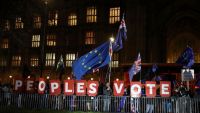
Surprise! The Economist has come out in favour of a new referendum on Brexit, joining Sadiq Khan, Tony Blair and possibly the entire cast of Strictly in calling for a People’s Vote. It observes sagely: “no one can claim to intuit what the people want. The only way to know is to ask them”. And of the PM’s peculiar tour of the nation to flog her plan (why?), it declares that it is an exercise in “pantomime” democracy:“May is right that MPs should take into account what the public think. So should she: not by guessing, but by calling on them to vote”. But on what? What all the demands for

Why politicians should fear Project Fear

‘Project Fear’ didn’t work out in the 2016 Brexit referendum, with voters turning against the ‘experts’ maligned by Michael Gove and other Leave campaigners. So it’s strange to see the Conservatives reigniting it again in the run-up to Tuesday’s vote on Theresa May’s Brexit deal, warning of six months of disruption at Dover and other ports in the event of no deal. There’s no evidence that this squeeze message is really going to work on Tory MPs and whittle down the scale of the expected defeat next week. The return of Project Fear is also a reminder of the danger of a second referendum for those who hope that it