Brexit

Forget the ‘nasty party’, Theresa May has turned the Tories into the zombie party

Watching Education Secretary Justine Greening discuss grammar schools this week, I felt exasperated and in desperate need of a cognac. And it wasn’t because I’m opposed to grammar schools. No, there was something else bothering me: the cold air as Greening stared into the camera. It was the sort of look that could kill you slowly over time, especially when paired with such mechanical, uninspiring words. It left me as cold as Paul Nuttall’s head. And it was then I realised something: this is all Theresa May’s fault. She might have worried about the Tories being seen as the ‘nasty party’. She need not have done. Instead, she’s in danger of turning them

What the papers say: It’s time to stop blaming Brexit

What does a spike in hate crime, a slump in sterling, supermarket price hikes, rising inflation and a squeeze on living standards have in common? The answer is simple, according to some: Brexit is to blame. But it’s time to stop pointing the finger at Brexit, says the Sun, which argues in its editorial that the vote to leave in last year’s referendum has ‘wrongly copped the blame for every negative development since’. Now that it has emerged that inflation has ‘outstripped’ pay for the first time since 2014, the same thing is happening. It’s true, the Sun admits, that the slump in Sterling is pushing up prices. But there’s

Parting on good terms

Many EU officials would like to present the Brexit negotiations as a case of one nervous member, weak at the knees, appearing before a menacing and united panel of 27. But that ignores the political and ideological rifts which are already apparent in the EU. Britain’s departure not only necessitates the creation of a new relationship between us and them; it fundamentally shifts the balance in EU politics. As Angela Merkel has been worrying aloud in recent weeks, the northern European countries which have always tended to take a liberal position on economics and trade are going to have a harder job fighting off the protectionist instincts of the south.

Bias and the BBC

Last week, Nick Robinson wrote an article in the Radio Times saying Radio 4’s Today programme no longer has an obligation to balance its coverage of Brexit. This led to criticism from Charles Moore that he was, in effect, admitting to BBC bias. The two met for a discussion in The Spectator offices. Nick Robinson: As you’re so fond of pointing out, Charles, most economists, business organisations, trade unions and FTSE 100 chief executives were Remainers. The BBC’s difficulty is that news tends to be about interviewing people in power: scrutinising them, asking tough questions. It’s right that we should go and look for other voices, look for critics. But

The Brexit battle is only just beginning

Nick Robinson, of the BBC, compares the Brexiteers and Remainers to ‘fighters who emerge after months of hiding in the bush, [and] seem not to accept that the war is over’. It is a false analogy because, unfortunately, the war is not over. Its most arduous phase has only just begun. This is an extract from Charles Moore’s Notes, which appears in this week’s magazine

Watch: Diane Abbott taken to task by furious Brexit voter

Diane Abbott suggested last year that some voters backed Brexit because they wanted to see ‘less foreign-looking people on their streets’. On Question Time yesterday, she finally got her comeuppance. A furious Leave supporter took her to task on the show by asking her whether she had any remorse for her remarks. The audience member told her: ‘You say you respect the will of the people, but do you have any remorse or any apologies to make for the disgusting lie you made against me and millions of innocent people that voted Leave – that because they voted Leave, they don’t like the look of foreign people and must be racist

Letters | 6 April 2017

All-round education Sir: While much of Ross Clark’s analysis of the direction that independent education has taken is spot on (‘A hard lesson is coming’, 1 April), he could not be more wrong on one issue. Many (or even most) parents who choose a private education for their children do not do so simply to achieve top academic outcomes: one look at the results league tables would disabuse him of this notion. What the average independent school does deliver is a rounded education (drama, sport, singing, D of E, CCF, debating and so on) with an emphasis on self-reliance, character and values, and competitive reward systems which acknowledge success rather

Britain’s comics can’t stand Brexit – but the joke is on them

One of the best things about Brexit has been its shattering of anti-establishment pretensions. All the people who for yonks had been getting away with posing as rebels and disruptors and irritants to the status quo have been exposed as utterly allergic to radical political change; as small-c conservatives freaked out by revolt; as the nervous, nodding footsoldiers of political power. From the trustafarians of Momentum, those laptop Leninists who fantasised that they were revolutionaries, to columnists like Caitlin Moran, the Times’ token rebel who once said she lives ‘like it’s 1969 all over again and my entire life is made of cheesecloth, sitars and hash’ (cringe much?), virtually every

The real significance of Theresa May’s meeting with Donald Tusk

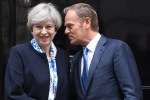
Donald Tusk, the President of the European Council, has been in Downing Street this afternoon meeting with Theresa May. The official readout of their talk is much as you would expect. Warm words about the hopes for a ‘deep and special partnership’, an attempt to calm things down over Gibraltar but nothing major as the EU 27 have yet to agree their negotiating position. But the real significance of this meeting is that it is meant to be one of a series between May and Tusk as the negotiations continue. This shows that the European Council—which represents the member states—wants to keep the Commission on a close rein during these

What the papers say: Why Labour must give Ken the boot

Ken Livingstone’s Labour membership card remains valid – but for how long? The former Mayor of London avoided being booted out of the party following his comments about Hitler. But he was told by Jeremy Corbyn yesterday that he faces another investigation into remarks he has made since the party’s decision to suspend him. The newspapers are unanimous: this sorry mess is doing the Labour party no favours at all. We should be grateful, suggests the Daily Telegraph that Ken Livingstone reached for another dictatorial analogy yesterday rather than his usual choice. But his suggestion that being in the disciplinary hearing deciding his future place in the Labour party was

On balance, I’d vote for a rate rise and a stronger pound

Since Article 50 was triggered last week, City traders have been avidly watching the fluctuations of the pound. Analysts at Barclays, Nomura and Citigroup think sterling is undervalued against the euro and the dollar, and due for a rebound, having dived in the market tizzy that followed last June’s referendum and kept its head down through the phoney war of the past nine months. As ambiguity over Brexit terms begins to recede, says the City, it’s time for the pound to perk up. Well, maybe — as I’m often moved to observe in relation to bald economic statements. Let’s take a closer look. The sudden fall last summer boosted UK

Let’s rein in Brexiteer triumphalism before we all go mad

According to archaeologists and all the papers last week, the 11th-century villagers of Wharram Percy, North Yorkshire, used to mutilate their dead, chopping off their heads and breaking their legs to minimise the danger of zombie resurrection. ‘Imagine being afraid,’ I chortled while reading this, ‘that the undead might put you in mortal danger!’ Whereupon I flicked forward a couple of pages and came across Michael Howard’s plan to defend Gibraltar by sending a gunboat. Personally, I’m against the idea of war with Spain. Although I say that cautiously, because we Remoaners must not hold back the will of the people. Indeed, such is the way of things these days,

EU leaders like Guy Verhofstadt are proving Brexit was the right choice

Only the EU, an organisation with four presidents, could have two ‘chief negotiators’ charged with agreeing the terms of Britain’s departure from the EU. I am not sure, then, how seriously to take the figure of Guy Verhofstadt, a Belgian MEP who has been appointed the European Parliament’s chief negotiator. If we agree something with him, do we then have to agree it with Michel Barnier, the EU’s other ‘chief negotiator’, and if they can’t agree, which ‘chief’ is really in charge? All I know is that what we have seen from the EU’s leaders in months since Britain voted to leave the EU is a good reminder of why

Let’s rein in Brexiteer triumphalism before we all go mad

According to archaeologists and all the papers last week, the 11th-century villagers of Wharram Percy, North Yorkshire, used to mutilate their dead, chopping off their heads and breaking their legs to minimise the danger of zombie resurrection. ‘Imagine being afraid,’ I chortled while reading this, ‘that the undead might put you in mortal danger!’ Whereupon I flicked forward a couple of pages and came across Michael Howard’s plan to defend Gibraltar by sending a gunboat. Personally, I’m against the idea of war with Spain. Although I say that cautiously, because we Remoaners must not hold back the will of the people. Indeed, such is the way of things these days,

How to solve the Gibraltar problem – in the style of Donald Trump

Two of the top tips in Donald Trump’s The Art of the Deal, of which I wrote last week even though he allegedly didn’t write it himself, are ‘Think Big’ and ‘Maximise the Options’, also expressed as ‘I keep a lot of balls in the air’. How should Theresa May apply that advice in response to Spain’s opportunistic bid to raise the issue of sovereignty over Gibraltar as a potential Brexit hurdle? She could, of course, offer a repeat of the 2002 referendum in which Gibraltarians voted 99 per cent ‘No’ when asked whether Britain and Spain should share the Rock’s sovereignty. But the ‘balls in the air’ gambit I

Is Theresa May’s media honeymoon over?

Is Theresa May’s media honeymoon over? The bungled Budget might have led to a raft of bad headlines for the Government, but these were mostly aimed in Philip Hammond’s direction. Today, the Sun turns its fire on the Prime Minister. The paper says May has ‘shown she understands what most Brits want’ from Brexit. But it adds a crucial caveat: ‘until now’. The Sun says that while it agrees with her plan to leave the single market behind, it is ‘deeply concerned by suggestions that free movement may apply for a further three years’ after Brexit. Most Brits who wanted out of the EU did so to tighten up Britain’s

Brexit is exposing the cowardice of conservatism

The decision by Conservative MPs to walk away from the Commons Committee on Exiting the EU is one of the most unintentionally revealing abdications of duty I have seen. The report they refused to endorse was polite to the point of blandness. The necessity of securing cross-party approval meant that its restrained language bore little relation to the chaos in Whitehall the committee’s hearings had uncovered. In March, the committee’s chair, Hilary Benn, showed its extent when he submitted David Davis to a tough cross-examination which the Brexit Secretary was lamentably unable to withstand. Although ministers were parroting the line that ‘no deal was better than a bad deal’, Benn

The hypocrisy of the Brexit blame game

One looked in vain for the words ‘Islamic extremist’ in the Guardian’s reporting of the Westminster attack a fortnight ago. Even after Isis claimed the attacker, Khalid Masood, as one of its own, the paper declined to accept him as a terrorist motivated by religious extremism. And who knows, maybe it was right. Masood had had a violent past, even before he had converted to Islam. It is still far from clear whether he had been influenced or was controlled by an Islamist group, or whether he was a freelance operative motivated entirely by his own internal anger and frustrations. But if you are going to take that line and

Can Anglo-Spanish relations survive Brexit?

As the events of the last few days show, the increasingly toxic issue of Gibraltar means the UK’s Article 50 talks with Spain might become more fraught than either party would like. It’s not just that Spain wants to share sovereignty of the Rock with Britain; more dangerous is the fact that Brussels can exploit this dispute to punish the UK for Brexit. In fact, this weekend’s fracas over Gibraltar’s post-Brexit status shouldn’t have caused the uproar it did. True, the document distributed to EU member governments on Friday by Donald Tusk highlighted Spain’s ability to veto Gibraltar’s inclusion in any EU-UK deal; but as part of the soon-to-be 27 member bloc, Spain already possessed that ability. After all, every other member state would have a veto too.