Brexit

Investing in zero-carbon shipping will only benefit the UK economy

The shipping industry contributes around 2% of all global carbon emissions – a figure comparable to the entire CO2 emissions of a country the size of Germany.  In many ways that isn’t surprising: shipping powers the world economy, and carries 90% of all international trade. But although people understand the link between trade and prosperity, they quite rightly demand it is done in a responsible and environmentally friendly way. Globalised trade has brought rapid growth and helped see a remarkable fall in extreme poverty around the world, but it is not without negative consequences. Scientists say that to stave off potentially dangerous levels of warming later in the century, global

Brexit blunders

A few months ago, Britain’s most senior ambassadors gathered in the Foreign Office to compare notes on Brexit. There was one problem in particular that they did not know how to confront. As one ambassador put it, the English–language publications in their cities (it would be rude to name them) had become rabidly anti-Brexit: keen to portray a country having a nervous and economic breakdown. Their boss, the Foreign Secretary, later summed it up: many believe that Brexit was the whole country flicking a V-sign from the white cliffs of Dover. The job of his ambassadors is to correct this awful image. But how? Their plight has not been made

I’m an optimist for trade despite the idiocies of politicians

I’m proud to be a member of the 661-year-old Company of Merchant Adventurers of the City of York, having qualified on the strength of a first career spent trying to sell British financial services around the globe from Hokkaido to Gdansk. Before our annual feast last week we prayed optimistically for the discovery of ‘a better world’ from which we might bring back treasure, spiritual and material — and I couldn’t help thinking that UK trade prospects are a lot less straightforward today than they were in 1357, when the known world was eager to buy woollen cloth from English mercers as often as their little ships could cross the

Boston Notebook

My wife laughs that my love of gadgets is a remnant of my Communist upbringing, when western toys were objects of veneration. A couple of days ago, I found myself on a Lufthansa flight over the Atlantic indulging precisely that love: using an app, I could see live pictures of our house in rural Poland via the security cameras. I could also check that the alarm is on, heating system off and the new photovoltaic farm is producing more energy than the house is consuming. I suppose that’s the consumerist heaven we fought for in those days, just as much as for freedom and democracy. Back in Boston, I am

The Brexit bounce making a mockery of George Osborne’s Project Fear

We are now just two months away from the second anniversary of the Brexit vote and therefore in a position to judge the apocalyptic forecast made by the Treasury in May 2016 in the run-up to the vote. In a paper signed off by George Osborne, which neither the former chancellor nor anyone else who has made a grim prognosis for Britain’s departure from the EU should be allowed to forget, the finest minds in the Treasury came up with two scenarios for the aftermath of a vote to leave the EU. In the ‘shock’ scenario, GDP would be 3.6 per cent lower after two years (compared with if the country

Why Theresa May is to blame for the Windrush scandal

To see the cruelty of bureaucracy, the injustice that can spring from reducing public life to mere process and human beings to paperwork, look no further than the Windrush scandal. Scandal is an overused word these days. Everything from a politician’s ill-advised tweet to a celeb’s extramarital affair gets chalked up as scandal. But if we abide by the true definition of the word — to mean something that is morally wrong and which stirs outrage among the public — then the British state’s sudden, hostile turning against the Caribbean people and others who have made their home in Britain over the past 70 years genuinely fits the bill. This

The Spectator’s Notes | 12 April 2018

The Good Friday Agreement (GFA), which celebrates its 20th anniversary this week, is not a peace, but a truce. This does not mean that it has no value. Most people in Northern Ireland wish to abide by its terms; it has helped them get on with normal life. But it does mean that difference, rather than being gradually dissolved, is institutionalised. You almost have to sign up to one side or the other. A friend sends me the diversity form of the Northern Ireland civil service which, as a candidate for the service, you must fill in. Unlike some such forms, it offers no ‘prefer not to say’ option. Each candidate must declare whether

A new world role for Britain

Britain’s imperial past distorts the debate about our place in the world, but not in the way that is commonly assumed. It is often asserted that claims about this country’s international importance are a form of nostalgia. It would be more accurate to say that Britain tends to underestimate its power because it is no longer the global hegemon. Britain might not be, in 1066 and All That terms, ‘top nation’ any more. On any objective reading, however, the United Kingdom is still an influential global player. It is a permanent member of the UN Security Council, the sixth largest economy in the world, a nuclear weapons state, a member

Where is Artificial Intelligence taking us?

Recently, The Spectator, in association with NatWest, brought together leading entrepreneurs, MPs and technology writers to discuss where Artificial Intelligence (AI) – or the fourth industrial revolution as it is often termed – is taking us. Guests included: Simon McNamara , group CAO of NatWest, Damian Collins MP, Tugce Bulut, CEO of Streetbees, Nathan Gralton, MD of Scopesuite, Rob O’Donovan, CEO of Charlie HR, Jesse Lozano, CEO of Pi-Top, Charles Arthur, former tech editor for The Guardian and Independent, Alan Mak MP, Sarah Drinkwater, head of Campus London for Google, Rory Cellen-Jones, BBC technology correspondent, Kevin Hanley, director of innovation for NatWest, Leigh Renders, Senior Public Affairs Manager for NatWest

Labour frontbencher: Labour’s Brexit test is ‘bollocks’

Oh dear. Barry Gardiner’s bad day has gone from bad to worse. After a recording emerged of the shadow international trade secretary describing the Good Friday Agreement as ‘a shibboleth’ in the Brexit negotiations, Gardiner issued an apology. Now it seems as though he may be required to apologise for the second time in the space of two hours. The BBC have obtained a recording of Gardiner – speaking at the same event to Labour MEPs – as describing his party’s Brexit tests as ‘bollocks’. ‘Well let’s just take one test – the exact same benefits. Bollocks. Always has been bollocks and it remains it. We know very well that we

How dare David Davis blame Sinn Fein for the Irish border mess

Sweet baby Jesus, is there nobody in the Department for Exiting the European Union who can give David Davis a briefing on Irish politics? Not a full, in-depth, Donegal-to-Kerry briefing; just the basics will do. And if there isn’t anyone at DEXEU who could do this, perhaps some kind soul at the Northern Ireland office could pop over to give Davis a quick tutorial? The Times reports this morning that this kind of briefing is urgently needed. Of course the paper doesn’t quite put it like that but this is the inescapable conclusion to be drawn from Davis’s own remarks at a conference in London yesterday. According to our gallant bulldog, the question of Brexit and

Morrissey’s reading list

Morrissey caused a stir last month when he used a blog post to lambast the Indy for an article – aka ‘an extreme Hate Piece so loaded with vile bile that it almost choked on its own endless capacity to be appalled’ – daring to criticise him. Happily, the former Smiths frontman’s latest entry is more jolly – with Morrissey discovering a tome he actually wants to read: ‘We plan a release for our Back on the chain gang single for August – if the wind remains at our backs and in our sails. If you find yourself at a loose end until then, please read Douglas Murray’s The strange death

The next big Brexit battle: protectionists vs free marketeers

Although politicians and pundits have learnt the hard way not to take polls as gospel, the latest Opinium/Independent poll on free trade ought to give the government some cause for alarm. New polling has found that when asked whether ditching current food standards would be a price worth paying for a deal, 82 per cent of those surveyed said keeping current regulations in place should take priority – even if that meant no deal. Meanwhile, just 8 per cent said a free trade agreement with the US should take priority. Of course this is just one poll and the stark findings could in part be down to the phrasing of

Sunday shows round-up: Christopher Wylie – ‘I want a democratic mandate for Brexit’

The former director of research at Cambridge Analytica, the data-mining firm notoriously suspended by Facebook for harvesting details of up to 87 million Facebook accounts without their consent, has told Andrew Marr that the 2016 referendum on the UK’s membership of the EU should be re-contested. Wylie’s suggestion comes after it was highlighted that Vote Leave – the official Leave campaign – had employed the services of AggregateIQ (AIQ), a company which Wylie claims to have founded in order to support Cambridge Analytica. AIQ was also suspended from Facebook on Saturday for improperly receiving users’ data, charges which AIQ denies. Wylie argued that Vote Leave’s connections to alleged misconduct by

What Brexit Britain can learn from German Reunification

Obscured by the hubbub of rolling news and the cacophony of Twitter, an important anniversary has passed by virtually unnoticed. The Berlin Wall has now been down for longer than it was up. Berlin’s ‘Anti-Fascist Protection Barrier’ (as the Communists used to call it) stood for 28 years and three months, from August 1961 to November 1989. It’s now been down for 28 years and four months. Its fall reunited the two Germanies, and changed the course of history. So, 28 years on, what can Brits learn from German Reunification? What lessons does the Wiedervereinigung hold for us today? I filed my first report from Berlin in the first year

UK investment is at a record high. So why has almost no one reported it?

Why is it that whenever some organisation comes up with some half-baked prediction of doom for the UK economy post-Brexit it is splashed all over the news, yet real data on the economy gets ignored? Yesterday, the ONS quietly released the latest figures for Gross Fixed Capital Formation (GFCF) which covers investment across the whole economy, public and private sectors, manufacturing, construction, services and extractive industries. They showed that contrary to the received wisdom that investors have fled the UK following the Brexit vote, investment grew by 1.1 per cent in the fourth quarter of 2017, to a total of £84.1 billion. Over the course of 2017 it grew by

Michel Barnier makes easy work of David Davis

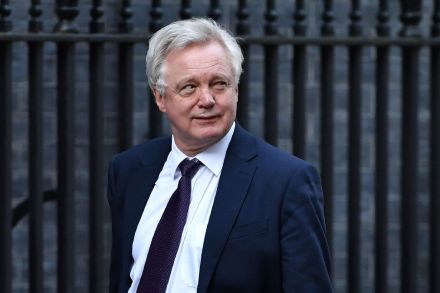
On Wednesday evening, David Davis left his sick bucket at home and made his way to the Emmanuel Centre in Westminster for an hour long grilling courtesy of Andrew Neil. At the Spectator event, the Brexit Secretary spoke of his supreme confidence that the final deal would be voted through – and that the makings of a trade deal would be know by this time next year. However, it was Davis’s comment about Michel Barnier – the Chief EU negotiator that caught Steerpike’s attention. The Cabinet minister joked that Barnier had said it was not ‘too hard’ to get Davis to give in: AN: The £37bn divorce bill agreed last

David Davis: There’s no deal without a trade deal

With a year and a day to go to Brexit, David Davis sat down for an interview with Andrew Neil this evening. Davis was clear that there wouldn’t be a deal, and thus a £37bn payment to the EU, unless there was an agreement on the future relationship too. Contrary to the received wisdom, David Davis told this special Spectator event that the UK and the EU will ‘get pretty substantively close’ to a free trade agreement by October. He argued that this meant that the withdrawal agreement would have a lot of detail on what the future trading relationship would be. He said that he thought that this would

Toys ‘R’ Us: the predator that became the prey

I remember the arrival of Toys ‘R’ Us in Britain, because as a young banker in 1984 I was tasked with devising a menu of exciting financial products to offer a brash American retailer that was clearly going to take a bite out of our sleepy — and in those days still Christmas-seasonal — domestic toy market. How we sneered at that childlike reversed R in the logotype; likewise the Guardian, commenting on insatiable demand for Cabbage Patch dolls, derided the chain’s huge stores as ‘-cathedrals to kiddie gratification’. But however tacky its image, this was the ultimate ‘economic disruptor’, to use The Spectator’s current favourite phrase: a business that