Brexit

Portrait of the week | 8 March 2018

Home Sergei Skripal, aged 66, and his daughter Yulia were found in a state of collapse on a bench outside a shopping centre in Salisbury. Mr Skripal, a retired Russian military intelligence officer, was jailed by Russia in 2006 on charges of giving secrets to MI6; he was deported in a swap of spies in 2010. Boris Johnson, the Foreign Secretary, said that the incident had ‘echoes of the death of Alexander Litvinenko’. Public Health England threatened food manufacturers and supermarkets with new laws unless they reduced the calories in portions of crisps, pizzas and pies. In a speech on Brexit at Mansion House (intended, before the snow came, to

How will May respond to the EU’s Brexit approach?

‘Evolve’ is the new word of the Brexit negotiations. The draft Council negotiating guidelines presented by Donald Tusk yesterday, stressed that the EU’s offer would change if the UK’s position evolved. Meeting Tusk today, the Irish Taoiseach Leo Varadkar has made exactly the same point. The negotiating strategy is clear: keep telling the British that if they are prepared to change their position, then the EU will come back with a far more wide-ranging deal. As I say in my column in this week’s magazine, the EU will continue to offer Theresa May a choice between—basically—Canada or Norway. They hope that if they can keep this up, the UK will

The Spectator Podcast: Prince Charming

On this week’s episode of The Spectator Podcast, we look at the new Saudi Crown Prince as he visits the UK. Is he the great moderniser that some imagine, or are we sweeping the more unpleasant elements of his regime under the carpet? We also consider the many strands of Labour’s Brexit position, and look at a rocky week for British sport. First, Mohammed bin Salman, known to some as MBS, is making his first trip to the UK this week since assuming the role of Saudi Arabia’s Crown Prince last year. He has been heralded by some as the radical modernising force that the country has been calling for,

Why won’t Remainers get behind Corbyn’s Brexit plan?

At the BBC early doors for the Today programme, to preview Corbyn’s speech advocating membership of a customs union. I suggest that ‘this is something Remainers can get behind’, but come off air to a torrent of denialism and abuse on Twitter. In a parallel universe, the people who feel existentially destroyed by being halfway out of the EU would have made this case passionately before the vote, instead of trying to rely on fear and platitudes now. In quick succession, the European Commission drops its bombshell, obliging Britain to impose customs controls across the Irish sea; then Theresa May delivers her speech applying for a kind of off-peak gym membership of

European Commission rain on Theresa May’s parade

Here we go. The European Commission draft guidelines for the Brexit trade negotiations have leaked – and, as expected, it doesn’t make all that pretty reading for the British government. Although Theresa May’s Brexit speech was well-received in the UK, in Brussels many of May’s arguments and proposals appear to have fallen on deaf ears. Speaking today, Donald Tusk has warned that it is not his priority to make Brexit a success: ‘I fully understand and respect Theresa May’s political objective to demonstrate at any price that Brexit could be a success and was the right choice. But sorry, it is not our objective.’ The main takeaways from the text,

Britain should rise above Trump’s trade war

The stock market is reeling. The White House has already witnessed the resignation of the President’s most senior economic adviser. The EU is preparing retaliation, and other countries are checking the rule books to see what sort of tariffs and quotas they might be allowed to impose. In the wake of Donald Trump’s decision to whack hefty tariffs on steel imports into the United States a full-blown transatlantic trade war is brewing – and if China and Japan wade in, that may quickly turn global. That will, of course, be terrible for the global economy. But it might also be the perfect moment for a soon-to-be-out-of-the-EU Britain to reassert its

How Theresa May’s reforming ministers are constrained

When Theresa May gave her big housing speech today, in front of a rather strange fake brick backdrop that made the Prime Minister appear to be emerging from a chimney, she was trying to speak to two audiences. The first was those who believe, as she says she does, that the housing crisis is one of the biggest barriers to social justice in this country. The second was those who may agree with the first sentiment in abstract, but who are very worried about inappropriate development and destruction of our green and pleasant land. It’s a tricky game, playing good-cop, bad-cop all by yourself, but that’s what the Prime Minister

I doubt the EU will budge – so Britain faces a tough choice

It can be impossibly hard to concentrate on the intricacies of the Brexit negotiations. But over the past week, we have got a certain bracing clarity. There are two logical British positions. We mostly turn our backs on the EU way of doing things, and become a noticeably different country — less European, less regulated. That is where most Conservatives seem to be heading. Or we conclude that the economic risk is too big and stick close to the EU, ceding freedom to strike new trade deals in order to keep those nearer markets fully open. After his speech, that’s where Jeremy Corbyn’s Labour is going. What is being squeezed

Theresa May’s masterclass in mutual dissatisfaction

Theresa May’s speech today won’t have left any portion of her party ecstatic. As the Prime Minister promised ‘ups and downs in the months ahead’, she warned that ‘no-one will get everything they want’. With compromises coming down the track, May made sure to dish today’s disappointment out in an even-handed manner. For the Remain side of her party that meant their hopes for a customs union compromise – as Isabel reported earlier in the week – were dashed. She not only re-iterated her stated position that the UK would leave the customs union but said that the UK should be able to set its own tariffs. That suggests not even a partial

May tries to strike an optimistic tone on what Brexit can do for Britain

Despite the rather muted colours for the staging of her Road to Brexit speech, Theresa May tried to make her address as upbeat and cheerful as it was possible to be. She started by talking not about Brexit but about her agenda, restating a great deal of what she said on the steps of Downing Street when she became Prime Minister. Perhaps this was because May is worried that people have forgotten what her domestic mission is, or perhaps it was because she felt it would be best to suggest that Brexit could play a large part in making Britain a better, happier and less divided country. She said that

Theresa May’s Brexit speech: full text

I am grateful to the Lord Mayor and all his team at the Mansion House for hosting us this afternoon. And in the midst of the bad weather, I would just like to take a moment before I begin my speech today to thank everyone in our country who is going the extra mile to help people at this time. I think of our emergency services and armed forces working to keep people safe; our NHS staff, care workers, and all those keeping our public services going; and the many volunteers who are giving their time to help those in need. Your contribution is a special part of who we

Low life | 1 March 2018

Poperinghe, Bailleul, Wytschaete, Gheluvelt, Ploegsteert, Messines, Zonnebeke, Passchendaele. The other week I grandiosely claimed that I have been reading about the first world war, on and off, all my life. What I ought to have added was ‘with little or no understanding’. Because it wasn’t until a fortnight ago, when I bought a 1916 Ordnance Survey map of Belgium (Hazebrouck 5A), and consulted it while reading Anthony Farrar-Hockley’s account of the First Battle of Ypres, that I began to fix these blood-soaked villages in my mind. The Second and Third Battles of Ypres were disputed over a few square miles. Stated objectives might be a slight promontory or a smashed

Portrait of the week | 1 March 2018

Home Crisis loomed over Brexit negotiations as Theresa May, the Prime Minister, travelled to the north-east to explain ‘this Government’s vision of what our future economic partnership with the European Union should look like’. Jeremy Corbyn, the leader of the Labour Party, had announced that its Brexit policy was now ‘to negotiate a new comprehensive UK-EU customs union’ that would still (somehow) ‘ensure the UK has a say in future trade deals’. Sir Keir Starmer, Labour’s Brexit spokesman, had said earlier that the party would back an amendment to the Government’s delayed Trade Bill hatched by the Conservative Remainer Anna Soubry, to keep Britain in a customs union. The European

Back off, Barnier

There’s an unwritten law governing Boris Johnson in Westminster: every-thing he says or does is a gaffe, or can be portrayed as one. Yet actually Johnson has an uncanny knack for conjuring similes which sum up the political situation precisely. So it was for his much-ridiculed remark, in response to a question about the Irish border, that there are no border posts between London boroughs even though they have different business rates and policies on various other things. His phrasing was careless but the point stands: it is nonsense to claim that different regimes must mean border patrols. There are significant tax and excise differences on either side of the

May’s Brexit Speech: David Davis pushes back against a ‘binding commitment’ to align with EU rules

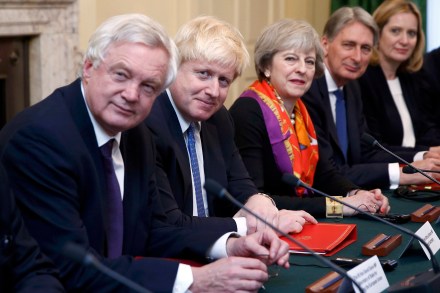
The Cabinet met earlier today to discuss Theresa May’s big speech on Brexit tomorrow. I understand that in a lengthy meeting most ministers applauded the speech. But there is one particular area of controversy, I hear. Both David Davis and Boris Johnson pushed back against the idea that the UK should make a ‘binding commitment’ to align with EU rules and regulations in certain sectors. The Brexit Secretary, I am informed, led the charge against this idea which the Brexiteers feels go further than what was agreed at the Chequers meeting of the Brexit inner Cabinet. My information is that Greg Clark, the Business Secretary, passionately defended the speech’s language,

Tony Blair continues the campaign against Brexit

The campaign against Brexit continues today with Tony Blair’s speech in Brussels. I personally think that this campaign is unlikely to succeed, it is simply too much of a replay of the In campaign’s arguments from the 2016 referendum. But if this attempt to reverse the referendum result is to have any hope of succeeding, Blair’s leg is the most important. For he is asking the EU to make the UK an improved offer, to show that it is trying to address the concerns that led to so many people voting to Leave. Every time the European Union has asked a country to vote again on a treaty it has

Jeremy Corbyn’s custom union fantasy

Jeremy Corbyn wants Britain to ‘stay in a customs union’, according to the BBC. The phrase does not make sense. We could possibly stay in the customs union, if the EU decided to let us, but that is not the policy of his party or of the government. We cannot ‘stay’ in ‘a’ customs union, because that would require us to join something which does not at present exist. But the use of the reassuring word ‘stay’, in reference to an as yet unformed, unnegotiated customs union, is exactly the rhetorical sleight of hand which Mr Corbyn seeks. It is designed to persuade Remainer Conservative rebels that they must side

Major hypocrisy

With the Irish border problem rearing its head once again this week, Sir John Major has popped up with an intervention Theresa May could probably have done without. In a speech today, the former prime minister urged May to keep Britain in ‘a’ customs union for the sake of the peace process. He went on to say MPs should be given a free vote on whether to accept or reject the final Brexit deal and that this should include the option to decide on a second referendum. However, Mr S can’t help but sense a whiff of major hypocrisy in the air. Firstly, Major did not practise what he is

PMQs sketch: MPs take the Barnier Plan seriously

The thoughts of M Barnier get barnier and barnier. Today’s crazy idea from the EU’s chief negotiator was a ‘common regulatory area’ on the island of Ireland. Perhaps he didn’t understand what he was proposing: the break-up of the UK, with Ulster remaining within the EU. This would turn the Six Counties into Brussels’s first colony. As it happens, Britain began its colonial adventures in Ireland so our politicians know a thing or two about annexing hostile territory over there. At PMQs they took M Barnier’s plan for direct rule from Brussels very seriously. Four questioners sought reassurance from the Prime Minister. Answering David Simpson, Mrs May pointed to the