Books

The dauntless spirit of Richard Halliburton

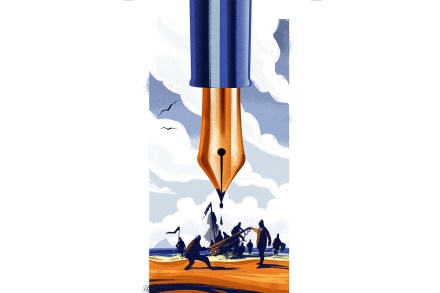
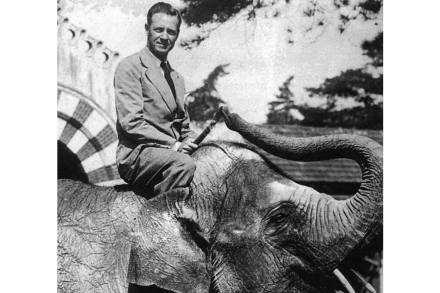
A sailor; a conqueror of the most treacherous mountain peaks; a man who wades defiantly under the stars of the Far East sky; a dashing writer who pursues his mark as a hunter on safari; an explorer who rides elephants through the Alps. This is not a collection of young men, newly emancipated by the end of the Great War and a new era of global empires. It is the nearly improbable life of one man, Richard Halliburton, whose swashbuckling existence was inspired by everyone from Daniel Defoe and Rupert Brooke to Odysseus. Halliburton was the self-proclaimed protagonist of his own heroic epic. He decided in the days before his graduation from Princeton in spring 1921 that he would forgo a life of tedious expectations and “let those who wish have their respectability.
Halliburton
authors

Where will the vogue for censoring our best-loved authors lead?

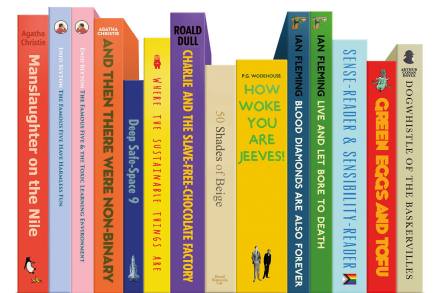
It was recently announced in the Daily Telegraph that the novels of P.G. Wodehouse — much beloved by millions, including me, for their combination of wit and soufflé-light evocation of an England that never really existed but which almost might have done — are the latest to fall foul of that new scourge of writers the world over, the “sensitivity reader.” New editions of Wodehouse’s masterly works Right Ho, Jeeves and Thank You, Jeeves have been reissued with the craven disclaimer “Please be aware that this book was published in the 1930s, and contains language, themes and characterizations which you may find outdated. In the present edition, we have sought to edit, minimally, words that we regard as unacceptable to present-day readers.

Alison Roman: ‘My desserts are consistently imperfect’

From our UK edition

Alison Roman’s cooking is a counsel of imperfection. She serves dinner late (fine, as long as you have snacks), gets her guests to pitch in on the washing up and won’t make her own ice cream – ‘it simply will never be better than what you can buy, sorry’. ’Her ‘pies leak, cheesecakes crack and pound cakes are pulled from the oven before they’re fully baked. Lopsided and wonky, occasionally almost burned, unevenly frosted, my desserts are consistently imperfect’. In her new book, Sweet Enough, Roman wants to free the home cook from the dessert ties that bind them. ‘My hope for you,’ she tells her reader, ‘is that you strive for the animalistically irresistible, not aesthetically pristine’. The two, she finds, are ‘rarely the same’. ‘Baking is annoying.

London hotels with a literary twist

From our UK edition

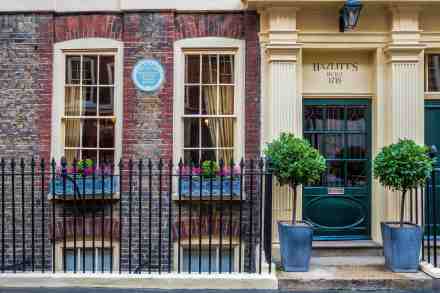
There’s something rather wonderful about the idea of settling down for the night in the spot where one of your favourite writers once slept, played or dreamed up a plot. There are a range of hotels across London with a vast array of bookish associations: some have played host to writers both famous and infamous, while others have been commemorated in novels, poems and short stories. Their present-day owners are all too happy to show off their literary heritage, should you ask nicely. Here are six with the most interesting tales to tell. Hazlitt’s [Alamy] There are few London hotels with so existential a literary connection as Hazlitt’s on Frith Street in Soho.

The best coronations in literature

From our UK edition

‘In her big, white dress the Queen looks like a balloon that’s about to float up to the roof of Westminster Abbey and bob about up there amongst the gilded arches and roof bosses. To prevent this happening people keep weighing her down with cloaks and robes, orbs and spectres, until she’s so heavy that bishops and archbishops have to help propel her around.’ This is the coronation of Elizabeth II in 1953 as described by one-year-old Ruby Lennox in Kate Atkinson’s Behind the Scenes at the Museum. These observations might seem preternaturally advanced from a narrator not yet old enough to walk and talk, but that is consistent for this witty novel. It opens with Ruby being fully aware of her own conception: ‘I exist!

What makes a novel funny?

What makes a novel funny? As well as being too enormous a question to tackle properly here, such an enterprise would, I suspect, require so clinical an approach to reading comic fiction as to remove entirely any possible joy or amusement. As the old saying goes, deconstructing a joke is like dissecting a frog: nobody laughs, and the frog dies. However, the question came to me again recently, as I reread John Kennedy Toole’s A Confederacy of Dunces. I howled with laughter from the initial farcical scene outside a department store, through Ignatius J.

funny novel
grann

Madness and cannibalism with David Grann

David Grann is one of a very select club of writers: those whose books of history are so diverting that they almost seem implausible. Their narrative constructions are so effective, the dialogue so apposite, that jaded readers might think everything has been made up or twisted to give the books life, in novelistic fashion. And yet — as with the books of Erik Larson — that’s not true at all. It’s all there in the notes: everything between quotation marks was actually said or written. It’s a remarkable skill. This is a hell of a story, and I use that word appropriately. Those who shipped out from Portsmouth on HMS Wager in 1740 — part of George Anson’s circumnavigation of the globe — struggled through hell.

Read all about it: 12 of the best novels about journalism

From our UK edition

A recently published novel, Becky by Sarah May, is the latest in a long tradition of fiction based on journalism – and a good excuse to think again about the great books from that sub-genre. May’s is a curious hybrid of the life story of News UK CEO Rebekah Brooks and a repurposing of Vanity Fair. George Cochrane, reviewing it for The Spectator, called Becky ‘a good novel dwarfed by a great one’.  He was referring to the Thackeray, but he might just as easily have been talking about another classic English novel: Evelyn Waugh’s Scoop. That comic masterpiece from 1938 is the book against which all other fictional evocations of journalists and journalism are judged – and is almost invariably the first on any list of the best of such books.

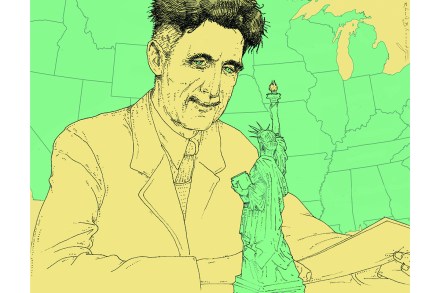
How America influenced George Orwell

Some of the most tantalizing pieces of George Orwell’s journalism are the reviews written on the hoof, filed against deadlines, sent straight to the typewriter while World War Two raged above his head. One of them is a round-up of four reprinted dystopian novels supplied to the weekly magazine Time and Tide in July 1940, shortly after the fall of France. (Today, it’s rarely reissued and barely available outside the stout bindings of volume XII of Orwell: The Complete Works.) The four books are Jack London’s The Iron Heel (1908), H.G. Wells’s When the Sleeper Wakes (1910), Aldous Huxley’s Brave New World (1932) and Ernest Bramah’s The Secret of the League (1907).

orwell

Why adults should read children’s books

From our UK edition

During a recent family trip to South Africa, there was one book from my holiday reading pile that I simply couldn’t put down. It had everything: suspense, mystery, humour, fantasy, plot twists, heroes, villains and, ultimately, a happy ending. It also contained talking animals, unicorns and fauns. Because this wasn’t the latest bestselling crime or psychological thriller – my usual genres of choice. It was The Lion, The Witch and The Wardrobe, the children’s story by C.S. Lewis that I’d first read almost 40 years earlier. Given that I have a nine-year-old son who adores books, you might imagine that my motivation for re-reading it was to do so aloud to him. Not so.

A new book and a newborn

One of the most famous lines from the classic 2002 romcom Sweet Home Alabama has leading lady Reese Witherspoon incredulously asking a redneck hometown friend, “You brought a baby... to a bar?” I encounter that incredulity frequently, every time I cart my kids to work events, including those at bars. But a book tour? This was a new one. A book tour with a baby is hard, but babies (and kids) are worth all the hardships. As Scrubs’s wise Dr. Kelso once explained, “Nothing that’s worth having in life comes easy.” That’s a mantra in our home as we wade through the hard times, and it’s a lesson we impart to our kids as we endeavor to raise them into happy warriors and resilient and caring adults.

book

How the Kindle lost its spark

From our UK edition

With the recent news that Kindle and other e-readers are automatically updating Roald Dahl’s books to sanitised versions, an entire era has come to an end for readers like me. Who in future will feel safe buying an electronic copy of anything? Publishers’ plans here may be modest, but the point about the puritan is that their work is never done. Martin Amis, Evelyn Waugh, Nancy Mitford, George Orwell, Charles Dickens – any one of them feels vulnerable now. If in copyright, the author and their estate can be strong-armed by the publishers; if out of copyright, laying your hands on the right edition will be a minefield. Nor does it seem clear that publishers’ revisions are being done by skilled writers.

After Dahl: what the sensitivity readers did next

From our UK edition

Sensitivity readers have been busy lately, first rewriting the works of Roald Dahl, and then trimming Ian Fleming’s James Bond novels, ostensibly making them less offensive to modern readers. So what will they edit next – and how might they bring it into line with modern mores? Winnie-the-Pooh by A.A. MilneA honey-loving bear goes on a macrobiotic diet, and his best friend Eeyore is prescribed anti-depressants. Christopher Robin receives anti-psychotic medication to alleviate the delusion that animals are talking to him.Othello by William ShakespeareA black military commander is tricked into believing that his wife Desdemona has been unfaithful, so they both enter couples' counselling, and he undergoes anger management training.

The difficulties of writing historical fiction

I was dozing, a little hungover, on the morning flight from Prague to London, when I saw them for the first time. Ten men on a beach, dragging a landing craft up the sands. Where? Can’t tell yet. When? The fourteenth century. Who? Don’t know, but they look like trouble. I woke up. Through my AirPods I heard the Blur singer Damon Albarn growling the final song from their 1997 album Blur. “In these towns, the English army grinds their teeth into glass / You know you’ll get a kicking tonight...” I opened my laptop and started making notes. The men came surprisingly well-formed. They were soldiers of fortune in the Hundred Years’ War. They already had names. Faces. Talents. Foibles. Yearnings. Secrets. I wrote down as much as they could tell me before the plane landed.

historical fiction
colleen hoover

The enigmatic rise of Colleen Hoover

The world’s bestselling author is a forty-three-year-old mom you probably haven’t heard of. In fact, unless you’re an extremely online fiction reader between the ages of sixteen and twenty-four, Hoover is likely to be a bit of an unknown quantity. It’s hard to see how she can stay that way: with 1.1 million followers on TikTok — her fans call themselves her CoHort — Hoover is the platform’s most popular author. As a result of her #BookTok fame, “CoHo” is now the second most followed author on Goodreads; while most authors have a single book on the bestseller list, Hoover dominates with multiple books at a time. In late January this year, her books held three of the top five spots on the New York Times bestseller list.

his dark materials

The magnetism of His Dark Materials

When I was in middle school back in the 1990s, there were two sets of books every boy seemed to have in his backpack. One was the Redwall series, Brian Jacques’s swashbuckling tales of heroic mice and tyrannical wildcats. The other was the His Dark Materials trilogy by Philip Pullman. It’s no coincidence, I think, that both Jacques and Pullman are British. What made these books intriguing, beyond their carefully wound plots, was that they were marketed to children yet addressed subject matter that was very much adult. In Redwall, it was the brutal violence. His Dark Materials had some of that too (in the first chapter of the first book, we witness an attempted killing; in the first chapter of the second book, we witness an accidental fatality).

The rewriting of Roald Dahl is an act of cultural vandalism

From our UK edition

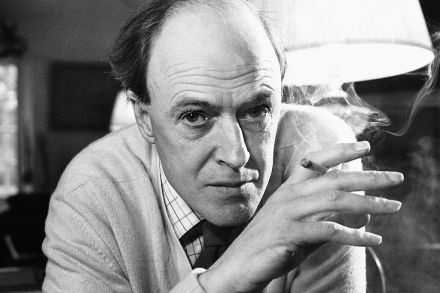
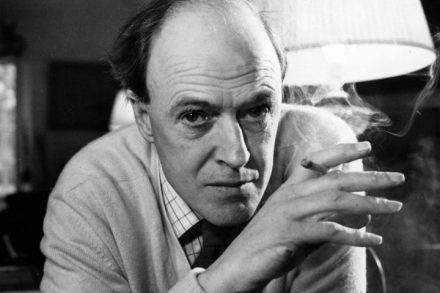
The vandals have come for Roald Dahl. His books for children are to be cleansed of their ‘offensive’ content. Sensitivity readers – what we used to call censors – have been employed to pore over his works and expurgate any word or passage that might hurt a kid’s feelings. If you weren’t worried about cancel culture before, surely this egregious assault on some of the best-known children’s books of the modern era, this posthumous purging of an author’s output, will change your mind. Dahl is being well and truly Ministry of Truthed. Puffin essentially tasked the sensitivity readers with morally improving his stories so that no child will ever feel affronted by their fruity, judgemental language. Some of the changes are crazy.

Stephen Rubin, the publisher who speaks truth to power

Stephen Rubin may not be a household name, but one gets the impression that doesn’t bother him much. Since he began his career in the '80s, he has built his reputation on publishing zeitgeist-baiting fiction and non-fiction alike, ranging from the undeniably good (John Grisham’s The Firm) to the undeniably bad but hugely lucrative (The Da Vinci Code), along with George W. Bush’s memoir Decision Points. You may not like all, or even most, of the thousands of books that Rubin has been involved with, but you cannot deny his commercial acumen. He knows what people want to buy, and has been as responsible as anyone in the United States for bringing it to them.

Why we need a biography of philosopher Bryan Magee

From our UK edition

When I was a philosophy student at King’s College London in my early twenties, I came across a book called Confessions of a Philosopher by Bryan Magee. A history of western philosophy told through the story of the author’s relationship with it, it opens with a three- or four-year old Magee trying to catch himself falling asleep every night. Try as he might, he can never experience himself crossing the threshold from wakefulness into unconsciousness, a conundrum that keeps him in a state of ‘active mystification’. Magee spent the rest of his life like this, wrestling with the mysteries inherent in everyday experience. Far from being a fusty academic discipline with no relevance to the ‘real’ world, philosophy was, for him, an existential matter of immediate importance.

Trainspotting at thirty: an interview with Irvine Welsh

A lot of new books grow old fast. It isn’t even the fault of their material, necessarily, but their milieu. Hour by hour, the means of cultural production are accelerating at an evaporative rate. Today more than ever before, irrelevancy looms large over the shoulder of the novelist. It’s an environment within which thirty days of relevance is a feat, but thirty years? A fiction in and of itself. Yet, throughout three decades of cultural churn, the words of Irvine Welsh have remained steadfast; as culturally relevant and artistically avant-garde as the day they first hit the shelves.

Irvine Welsh