Book review

Help over the hump

From our UK edition

Losing our way in life’s trackless forest, whither should we turn for solace and advice? Wisdom used to be the special province of our elders, though for no better reason than that old people were less common than they are now. Aristotle had their measure: ‘As they have a lot of experience,’ he wrote, ‘they are sure about nothing, and under-do everything.’ Now the old are as common as grass, and we draw the truth about life experience as much as possible from the source. If you want to know how a child feels, ask a child. If you want a considered opinion about Muslim dress codes, stop opining into a bucket, drunk on your own echo, and ask a Muslim. There’s much virtue in this attitude, but some obvious drawbacks.

Animals make us human

From our UK edition

There was a time when biologists so scorned the attribution of human qualities to other animals that anthropomorphism was seen as the ultimate scientific sin and suitable only for children’s stories. Not anymore. Today the inner lives of other creatures are widely accepted as a major research frontier, and here are three books that reflect these preoccupations. One of them even defines it as an entirely new discipline: anthrozoology. Peter Wohlleben may be no scientist, but he is a professional German forester and the author of the enormously successful The Hidden Life of Trees. In this new book he sets out to overturn the stock assumption that other creatures are mere automata driven by instinct, drawing particularly on studies that use MRI digital imaging of the human brain.

The spirits of the age

From our UK edition

Children started knocking on my door last month wearing Donald Trump face masks and asking for money. Indeed, one enterprising group turned up as Trump, Kim Jong-un, a Disney Princess, and — I’ll admit that this had to be explained to me — a zombie Taylor Swift. Truly a quartet of contemporary horrors. Halloween, it is safe to say, is not what it once was: in my day, a gentle bit of apple bobbing, turnip carving and maybe a white sheet with holes for eyes at a fancy-dress disco was about the full extent of it. Ghosts and ghouls, it seems, change their appearance depending on time and place.

Racism is a grey area

From our UK edition

This book is an exercise in crying wolf that utterly fails to prove its main thesis: that Europe is abandoning its core liberal values under threat from a resurgent populist right. It is a largely fact-free polemic that passes itself off as an open-minded work of interview reportage. Yet if you can ignore the author’s sly interventions on behalf of his left-liberal premises, he does introduce the reader to a fascinating cast of characters, mainly from the European populist right.

How to be good

From our UK edition

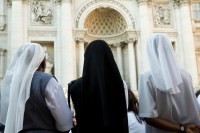
Suffering, wrote Auden, takes place ‘while someone else is eating or opening a window or just walking dully along’. His poem ‘Musée des Beaux Arts’ emphasises the mundanity of pain (‘even the dreadful martyrdom must run its course/ Anyhow in a corner, some untidy spot’) and how irrelevant it is to all but the sufferer: ‘Everything turns away quite leisurely from the disaster.’ Alice McDermott’s eighth novel, The Ninth Hour, is peopled by women who refuse to turn away from the disasters of others. The ‘untidy spot’ is Brooklyn, sometime in the first half of the 20th century, and the unsung heroines with no time for leisure are the Little Nursing Sisters of the Sick Poor.

A Muslim’s insights into Christianity

From our UK edition

I’m not a critic, I’m an enthusiast. And when you are an enthusiast you need to try your best to keep it in check when writing reviews, just in case your prodigious levels of excitement and, well, enthusiasm, threaten to overwhelm readers and only succeed in putting them off. Because people generally need a bit of room — to create some distance, establish a tiny bit of breathing space — in order to make their own considered decisions about the liable goodness or badness of a thing. But shucks to all of that.

Romance and rejection

From our UK edition

‘Outsider’ ought to be an important word. To attach it to someone, particularly a writer, is to suggest that their helpless circumstances have condemned them to struggle and neglect. It is up to us — posterity — to look beyond the writers who had social advantages in the year 1880, say, and find those who wrote best. One group that has been rewardingly elevated in recent years has been women. Although Lyndall Gordon has not tried to unearth anyone very out of the way, she has written about five writers who showed unusual courage and boldness, often behaving unconventionally.

Snatching victory from the jaws of defeat

From our UK edition

Lord Woolton put it best: ‘Few people have succeeded in obtaining such a public demand for their promotion as the result of the failure of an enterprise.’ By that, the Tory grandee meant that in the spring of 1940 Winston Churchill managed to use Britain’s grotesque military cock-up in Norway, for which he was responsible, to supplant Neville Chamberlain. Churchill sidelined Chamberlain’s most likely successor, the foreign secretary Lord Halifax. He overcame Tory backbench distrust. He even got Labour on side, though its leaders had long considered him the class enemy incarnate.

Three daemons in a boat

From our UK edition

Philip Pullman’s new k, the prequel to his Northern Lights series — the one north Oxford academics very much prefer to Harry Potter — is an intriguing work. It’s notionally set some time near our own, but the world it evokes is the 1950s and 1960s England of the author’s youth. The hero, Malcolm Polstead, is the only child of an innkeeper — that timeless calling — and the inn was an old stone-built rambling comfortable sort of place. There was a terrace above the river, where peacocks (one called Norman and the other Barry) stalked among the drinkers...

A choice of first novels | 19 October 2017

From our UK edition

Black Rock White City (Melville House, £16.99) is ostensibly about a spate of sinister graffiti in a Melbourne hospital. ‘The Trojan Flea’ is scrawled across X-ray screens; ‘I am so full of your death I can now only breathe your rot’ on a stairwell; and, on a dead body, ‘cut into the flesh with a scalpel, from throat to navel, is the word INSPIRATION’. A.S. Patric grabs his reader’s attention with the riddle of ‘Dr Graffito’s’ identity, while a more subtle mystery unfurls alongside. Jovan, the hospital cleaner — whose job it is to remove the offensive graffiti — has come to Melbourne from Sarajevo, where he was a teacher and ‘used to wake in the mornings with poetry emerging in rhapsodies’.

Hunt the lady’s slipper

From our UK edition

Who would want to read a whole book about a teenage boy’s gap year? When most 18-year-olds take time off before university, they either head for Thailand to experience middle-class Western culture in warmer climes with more drugs, or spend six months shelf-stacking and six months ‘finding themselves’ at a Ugandan orphanage. A tedious evening in the pub during freshers’ week when all the gap year students bore one another into submission about how much better Mexico made them is normally enough. Leif Bersweden thought so much of his year off, though, that he wrote 360 pages about it.

Something scary in the attic

From our UK edition

How do you like your ghosts? Supernatural fiction is arguably the hardest to get right. Ideally it should terrify, but what appals A might bore B and merely confuse C. The mechanics of apparition, however fanciful, must be internally consistent, and explanations kept simple. M.R. James excelled at giving his spectres agency and focus, but in some hands ambiguity is more effective. Read a Robert Aickman and half the time you have no idea what happened, if indeed anything did. I was once put off by a description in a novel of a ghost drifting round a house at night and contemplating its sleeping inhabitants. While that might give you the willies, for me that violates an essential requirement for manifestation: that it involve interplay between deceased and living consciousness.

A poet in prose

From our UK edition

Literary reputation can be a fickle old business. Those garlanded during their lifetimes are often quickly forgotten once dead. Yet there is a daily procession of visitors to Keats’s grave in the English cemetery in Rome, where the headstone reads, ‘Here Lies One Whose Name Was Writ in Water’, so sure was the poet that the neglect he had suffered up to his death would continue ever after. By any standards, C. Day-Lewis — he disliked Cecil, the name given to him by his Church of Ireland vicar father — was among the most glittering figures on the 20th-century British literary scene, celebrated, well-connected, a bestseller and Poet Laureate for the four years up to his death in 1972.

Wandering Jews

From our UK edition

Simon Schama is an international treasure. Whether on screen or in print, he is all energy, enthusiasm, dramatic gestures, emotional intensity. He clutches his readers in a tiger-like grip, then chews them up with relish until they are almost helpless with mirth or emotional exhaustion. If the first volume of his trilogy on the history of the Jews had something of the quality of Cecil B. DeMille’s The Ten Commandments, this second, carrying the saga forward from 1492 to 1900, is no less of a Technicolor blockbuster. Here too we have a cast of zillions with all kinds of special effects. Composed of a dazzling succession of tableaux with linking intermezzi, this book resembles a medieval pageant.

Our islands’ story

From our UK edition

Britain has 6,000 islands. Not as many as Sweden’s 30,000 but quite enough to be going on with. Only 132 of ours are populated, on a scale that slides from the 85,000 people on the Isle of Man to tiny St Kilda, with its summertime population of just 15. Patrick Barkham is a skilled compiler of lists. His charming and successful first book, The Butterfly Isles, chronicled the sighting of every one of Britain’s 59 butterflies within a single summer. It is high up on my own list of ‘I wish I’d thought of that’ ideas.

Tales out of school | 5 October 2017

From our UK edition

In 1952, the five-year-old Michael Rosen and his brother were taken on holiday along the Thames by their communist parents. The coronation was approaching, and the trip was an effort to ‘ignore it away’. All went well until they reached Wallingford, where Rosen’s father and a friend visited a pub, not knowing it had a TV set. They entered ‘at the very moment the Archbishop was putting the crown on the Queen’s head. The whole purpose of the punting holiday was ruined.’ His family’s political convictions are a recurring theme in Rosen’s account of his childhood and university years.

Who is Sylvia – what is she?

From our UK edition

In May 1956, three months after meeting Ted Hughes, one before they will marry, Sylvia Plath writes to her mother Aurelia about the talented man she has fallen in love with: ‘He will start some portraits of me! A combination of both witch and ghost, perhaps.’ Because of Hughes’s editing and writing of her work, a combination of witch and ghost is precisely how we know her, and he strongly encouraged the idea that the version of Plath he offered was the ‘real one’, a core of personality born in an inevitably fatal struggle narrated through the Ariel poems. Ariel, in his view, was her only true work.