Book review

American Smoke, by Iain Sinclair – review

From our UK edition

If you have read Iain Sinclair’s books you will know that he is a stylist with a love of language. You will also know that he has opinions to express and projects to promote or destroy: London’s Olympic park was one of his targets. He has lived in Hackney for much of the past 40 years and his previous book of that name was so provocative that Hackney council tried to ban him from giving a reading at a local library. He can be digressive to an extent that becomes challenging, as you would expect from a writer who long ago rejected the need for anything as banal as a narrative. And of the 41 earlier works of ‘documentary’, fiction and poetry listed on the flyleaf of this volume, many have been set in the UK, specifically London.

Charles Saatchi’s photo play

From our UK edition

The game that Charles Saatchi plays in The Naked Eye is to find photographs of subjects that look surprisingly like something else. A stork in mid-flight seems to have a jet-trail streaming from it; an ant silhouetted on the rim of a cup seems to be the same size as a helicopter hovering in the sky next to it. An elephant, if you really suspend disbelief, looks as though it is balancing on outstretched trunk (but it was done, with the help of a taxidermist, by Daniel Firman, who wanted, for some reason, to show what an elephant might do in low enough gravity).

Did Hollywood moguls really make a pact with Hitler?

From our UK edition

At the recent Austin Film Festival, at every ruminative panel or round-table discussion I attended, I slapped my copy of this book down in front of me. The cover, I felt, was bound to catch the eye of the screen legends and louche suits from the big production companies. Above the uncompromising title, it shows a photograph of Adolf Hitler watching a movie with his entourage, his stern, blunt features palely lit by the glowing screen, his mouth small, his nostrils flared in concentration. What, one wonders, was he watching? Laurel and Hardy? Mickey Mouse? It’s not impossible, actually. We know for a fact that the psychotic cinephile adored cartoons and slapstick of this kind.

Why worship Prince Philip?

From our UK edition

In this travelogue, Matthew Baylis, the novelist and TV critic and former Eastenders screenwriter, goes to Tanna, a Melanesian island, where, he believes, the locals worship Prince Philip. This sounds weird — to worship a man from far away, who knows little about them, about whose life they weave complex myths. But then again, some Melanesian people worship Christ, and yet others follow an American who might or might not have existed and who might or might not have been called John Frum. Baylis sets out to investigate. Prince Philip, he says, has interested him since he was a boy. Growing up in Southport, near Liverpool, the 11-year-old Baylis was aware of Philip’s visit to Salford university in 1982 and one of his reviled gaffes.

In the heart of darkness, the atom bomb

From our UK edition

At the dark heart of this dark book is a startling fact: Joseph Conrad was employed to steam up the Congo river by the same company, Union Minière du Haut Katanga, that later shipped uranium from the Congo to the US, where it was used to make the bombs that devastated Hiroshima and Nagasaki. Patrick Marnham develops that historical oddity into a brilliant travelogue, blended with an angry history of America’s atomic bomb and a meditation on what the creation of nuclear weapons means for the human psyche. It is his own journey into a Heart of Darkness. He follows not a river, however, but the flow of uranium.

The men who demolished Victorian Britain

From our UK edition

Anyone with a passing interest in old British buildings must get angry at the horrors inflicted on our town centres over the last half-century or so. Gavin Stamp is wonderfully, amusingly, movingly angry. And he has been ever since the early 1960s when, as a boy at Dulwich College, he saw workmen hack off the stiff-leaf column capitals in the school cloisters. He reserves particular rage for that ‘cynical, philistine Whig’ Harold Macmillan for murdering the Euston Arch. Not that Stamp’s a ranting fogey, reserving his anger only for the demolition of Victorian buildings.

The wounded Kennedy – and the people who gave him strength

From our UK edition

Ten years ago, a determined historian transformed our picture of John F. Kennedy. Robert Dallek had finally got his hands on the president’s medical records and discovered just how big a part JFK’s constant health problems played in his life. Instead of a young, fit, athletic leader, Dallek revealed a man racked with pain, suffering from Addison’s disease and excruciating spinal damage and swallowing a daily pharmacy of drugs and potions. During the Cuban Missile Crisis, for example, when his finger hovered over the nuclear button, he was pumped full of steroids and antibiotics, amphetamines and testosterone, ritalin and sleeping pills. He had been given the last rites on three occasions before he was 35.

A place of paranoia, secrecy, corruption, hypocrisy and guilt

From our UK edition

‘Is he a good writer? Is he pro-regime?’ an Iranian journalist in London once asked me of Hooman Majd. Majd is an Iranian-American journalist who was born in Tehran in 1957, but is better known in America. His father was a well-travelled Pahlavi-era diplomat, and his grandfather was an ayatollah. His cousin is married to the brother of Iran’s former president Mohammed Khatami. Majd is not religious, but his criticisms of the Islamic Republic have tended toward the procedural rather than the substantive. He is married to an American, Karri, with whom he has a young son. Family is the great theme of his books. His writings give the impression that Iranians are a big family in need of reconciliation, not another traumatic reckoning on the model of 1979.

Through It All I’ve Always Laughed, by Count Arthur Strong – review

From our UK edition

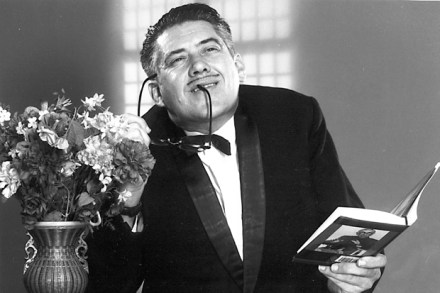
Fans of Count Arthur Strong (and yes I know he’s so Marmite you could spread him on a cheese sandwich) love the failed performer because he does what we all dream of: ranting at others to cover our own mistakes. At the same time he reminds us what a fool this makes one look, so as well as being an entertainer he’s a cautionary tale. The warning is now available in book form, Through It All I’ve Always Laughed. If you’re unfamiliar with the Count’s work you should probably sample him on radio or television first. Converts, however, will relish the revelations about what made Strong the man, the legend, the sole proprietor of the Doncaster Academy of Performance he is.

How many positions are there in the Kamasutra?

From our UK edition

Numbers, as every mathematician knows, do odd things. But they’re never odder than in the human context. Ever since we crept out of the swamps, we’ve been making numbers lucky, fearsome, ominous and even sacred. Across the cultures, we’re nuts about numbers, with little thought for logic. Take 23, for example. In 1960, William Burroughs met a sea captain who, after exactly 23 years at sea, was lost with all hands. The same day, Flight 23 was reported lost in Florida. After that, Burroughs became obsessed by the portentousness of 23, and others followed. At last, 23 was exposed; it’s the psalm of choice at funerals; in ancient Chinese tradition, it meant ‘breaking apart’. There were plenty of other ominous 23s.

The most important gardening book of the year

From our UK edition

I’ll own up at once. Tim Richardson and Andrew Lawson, the author and photographer of The New English Garden (Frances Lincoln, £40, Spectator Bookshop, £30), are friends of mine — no very unusual circumstance in the small world of garden writing. Moreover, I wrote this book’s forerunner, The English Garden, also in collaboration with Andrew Lawson. However, my reputation would falter if I sold you an expensive pup so, if I tell you that The New English Garden is one of the more important and interesting gardening books published this year, you may believe me. The book looks at 25 innovative gardens or public spaces that have either been made, or re-made, since 2000.

Blonde, beautiful — and desperate to survive in Nazi France

From our UK edition

Around 200 Englishwomen lived through the German Occupation of Paris. Nicholas Shakespeare’s aunt Priscilla was one. Men in the street stopped to gaze at this blonde with the careless allure and raw beauty of Grace Kelly. Some fell instantly in love. Her second mother-in-law thought her face showed truth and sincerity, and the reader shares this impression of integrity under duress. She was a reckless driver, yet was also shy, gentle and biddable. She had a beguiling habit of stroking your arm to show affection. She was not vain. Born in 1916, hers was a rackety childhood. Her self-engrossed parents, imprisoned within a failed marriage, then in new partnerships, rejected her.

Rebus is good, but not as sharp as he once was

From our UK edition

Cig 1 Auld Reekie . . . Edinburgh . . . brewers’ town, stinking of beer, whisky, tweeness, gentility, hypocrisy, corruption . . . DS Rebus awoke with a start, his hand still clutching a can of lager. He’d been asleep in his chair, as usual. He rarely went to bed. Bed was for sober people. The phone was still ringing, so stumbling over LP sleeves, full ashtrays and empty bottles, he picked up the receiver, greasy from last night’s fry-up. ‘It’s Siobhan,’ his colleague DI Clarke announced herself. ‘A new case has popped up.’ Rebus massaged his brow with an Irn-Bru can and grunted. ‘An old case, I mean,’ Siobhan corrected herself. ‘Thirty years old.

One Leg Too Few may be one biography too many

From our UK edition

It’s no joke, writing about comedians. Their work is funny, their lives are not. Rightly honouring the former while accurately relaying the disasters of the latter is a challenge few writers can well meet. Peter Cook and Dudley Moore have been extensively studied before. Harry Thompson published his excellent biography of Cook in 1997, Barbara Paskin her authorised biography of Moore the same year; Alexander Games’s joint biography Pete & Dud followed in 1999. There have been memoirs of Peter Cook by his first and second wives, Wendy and Judy, and his third wife, Lin, has edited Something Like Fire: Peter Cook Remembered. What’s to add?

Did Leonard Bernstein do too much to be a great artist?

From our UK edition

Nigel Simeone’s title for his edition of Leonard Bernstein’s correspondence rings compellingly, novellistically, through the force of the definite article, as in The Aspern Papers, or The Scarlet Letter. The reality, though, is more diffuse. Bernstein was a man of enormous endowments. One correspondent, after listing his talents as a composer, orchestrator, pianist, conductor, lecturer and general all-round musical functionary, ends by enquiring ironically, ‘Can you cook?’ The list might have been extended. It could have included a wild diversity of sexual activity, a seemingly limitless gift for affection and friendship, an inexhaustible capacity for work, and a genius for self-promotion. What it could hardly have included was focus.

Why do the British love cryptic crosswords?

From our UK edition

Everyone loves an anniversary and the crossword world — if there is such a thing — has been waiting a long time for this one. December is the 100th anniversary of the publication of what is generally recognised as the first crossword — although back then it was called a ‘word cross’. It was set by Arthur Wynne and appeared in the New York World. The first solution to the first clue was ‘fun’ and it is perhaps no coincidence that Alan Connor begins his journey through the rich history of crosswords thus: ‘This is a book about having fun with words.’ It would take a stony-hearted reader to ignore such a siren’s call. But beware the rocky shores of crosswordland. All sorts of dangers await.

Look! Shakespeare! Wow! George Eliot! Criminy! Jane Austen!

From our UK edition

Among the precursors to this breezy little book are, in form, the likes of The Story of Art, Our Island Story and A Brief History of Time and, in content, Drabble’s Oxford Companion to English Literature and Johnson’s Lives of the Poets. Other notable precursors are How to Read a Novel by John Sutherland, How to be Well Read by John Sutherland, 50 Literature Ideas You Need To Know by John Sutherland, Lives of the Novelists by John Sutherland and more in that vein. The tireless and compendious Dr Johnson — ‘the first great critic of English literature’ — deserves and receives a chapter to himself here, and it’s no great surprise that the tireless and compendious Professor Sutherland entirely sees the point of him.

How the Romantics ruined lives

From our UK edition

It is perhaps the most celebrated house-party in the history of literary tittle-tattle: a two-house-party to be precise. Byron and his doctor/companion/whipping-boy John Polidori in the grand Villa Diodati overlooking Lake Geneva. The Shelleys (Percy and Mary) and Mary’s stepsister Claire Clairmont a short walk away in the modest Maison Chapuis. The cat’s cradle of sexual crossed lines. The dark and stormy nights. Byron’s proposal that they should each write a ghost story. The creation, by Mary Shelley, of Frankenstein. The conception of poor, short-lived Allegra, child of nonchalant Byron (‘When a girl comes prancing to you at all hours there is only one way’) and bold, silly, self-deluding Claire.