Book review

The best children’s books for Christmas

From our UK edition

Animal stories for children are always tricky; as J.R.R. Tolkien observed in his essay on fairy stories, you can end up, as in The Wind in the Willows, with an animal mask on human form. Watership Down has been described as a nice story about a group of English public schoolboys with occasional rabbit features. But if you get too true to nature, the animals don’t have much to say to us, and no reason why they should. Admittedly, The Wind in the Willows does try to capture some of the mole-ness of Moley (he perks up underground) and the water-rattiness of Ratty (restive away from the River). And, as we all now know, Ratty is no water rat but a water vole. Which makes all the braver a new story about these very creatures.


You’ll probably find this book about the ruthlessness of Amazon at a sharp discount on Amazon

From our UK edition

Do you love Amazon? I have to admit that I do, and that I buy books from it far more often than I buy them anywhere else — or bought them in the pre-internet era — and sometimes music, and occasionally kitchen items, and even bedding. I particularly like the ‘1-Click’ payment system, and the choice of price offers down to as little as a penny plus the postage. I’m not offended by emails telling me what else I might like to buy, and the software’s so smart that they’re quite often right. And yet as an author, and a shareholder in a publishing venture, I can see what a monster Amazon has become since it fulfilled its first order (for a copy of Fluid Concepts and Creative Analogies by Douglas Hofstadter) in Seattle on 3 April 1995.

Margaret Drabble tries to lose the plot

From our UK edition

Halfway through her new novel, Margaret Drabble tells us of Anna, the pure gold baby of the title, ‘There was no story to her life, no plot.’ That statement is partly true. It is also a challenge, a gauntlet cast by this very knowing writer at the reader’s feet; in terms of Drabble’s narrative, it is something of a mission statement. Seven years after her last novel, and despite suggestions (by herself) that her fiction-writing days were over, Drabble has written a novel that consistently resists readers’ simplest assumptions. The Pure Gold Baby is a fiction apparently based on fact, which works hard to suggest that it has no pattern, no plot and will reach no neat ending.

In the steppes of a warlord

From our UK edition

I suspect travel writing was once a fairly simple business: the author travelled somewhere, the reader did not; the author explained what the place was like and the reader was duly informed and even entertained. Dr Uno von Troil, for example, went to Iceland in 1772 and served up lurid descriptions of the devil holes and lairs of Beelzebub (geysers). None of his readers had been to Iceland; no one was inclined to argue with Uno von Troil. Later, with the advent of mass travel in the 19th century, Uno von Troil’s former audience could go by steamer to Iceland (or ‘Hell’) and witness the infernal pools themselves.

Should Elizabeth Jane Howard have brought back the Cazalets?

From our UK edition

Some years ago, a woman wrote to Dear Mary, at the back of this periodical, with an unusual problem: she was a keen follower of new fiction but felt guilty to be seen lying around on sofas reading novels in the presence of her domestic staff. Mary advised that she should let it be known she had taken up fiction reviewing. If there is anything in publishing to melt the realities of book reviewing into this delicious scene it’s the prospect of a new Cazalet novel. Not only do I get to read it in plain sight, but the 19-year break since the last one necessitates a re-read of the whole lot. Days and days, that means, immersed in the lives of that many-petalled flower of the home counties, the Cazalet family.

‘A little bit of rape is good for a man’s soul’: the outrageous life of Norman Mailer

From our UK edition

Heroically brave and mad, prodigious in his industry and appetites, Norman Mailer was an altogether excessive figure. Since his death in 2007 there have been several biographies, but this is the big one — big enough to accommodate a triple or quadruple life, let alone a double. It is also the official one, written at Mailer’s request by J. Michael Lennon, his friend, collaborator and literary executor, who is respectful and affectionate but not hagiographic. He calls Mailer a ‘genius’, which in some ways he was, but does not claim that any of his novels were ‘great’, which is just as well. He never glosses over Mailer’s habitually appalling behaviour, and though he has the right he never calls him ‘Norman’.

The pirate myth

From our UK edition

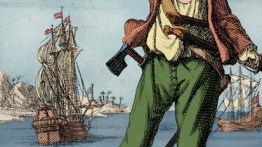
Hear the word ‘pirate’ and what picture springs to your mind? I see a richly-bearded geezer in a tricorne hat and a frock coat, with a notched cutlass and bandolier stuffed with pistols. Never mind the real-life pirates of our present day, the maritime robbery-and-kidnap specialists of Somalia and West Africa — they are all too recent to have generated sufficient fiction for us to draw on. Our common pirate is like the zombie, the vampire, the robot — a creature of the imagination, coming to us via Robert Louis Stevenson, J.M. Barrie and Johnny Depp. But where did he come from, really? He or she, that is.

The best cookery books of 2013

From our UK edition

Nigel Slater’s books lead the field in cookery book design, but his latest, Eat: The Little Book of Fast Food (Fourth Estate, £26, Spectator Bookshop, £20), is the most beautiful yet. The size of a large paperback and twice as thick, the single word Eat is embossed in black on a mustard-yellow cloth cover. The book is very easy to use. In the front is a list of recipes, organised by main ingredient; in the back a good index. The chapters are grouped by cooking method, and the recipes written in shortened form, with ingredients in bold type in the body of the text.

American Smoke, by Iain Sinclair – review

From our UK edition

If you have read Iain Sinclair’s books you will know that he is a stylist with a love of language. You will also know that he has opinions to express and projects to promote or destroy: London’s Olympic park was one of his targets. He has lived in Hackney for much of the past 40 years and his previous book of that name was so provocative that Hackney council tried to ban him from giving a reading at a local library. He can be digressive to an extent that becomes challenging, as you would expect from a writer who long ago rejected the need for anything as banal as a narrative. And of the 41 earlier works of ‘documentary’, fiction and poetry listed on the flyleaf of this volume, many have been set in the UK, specifically London.

Charles Saatchi’s photo play

From our UK edition

The game that Charles Saatchi plays in The Naked Eye is to find photographs of subjects that look surprisingly like something else. A stork in mid-flight seems to have a jet-trail streaming from it; an ant silhouetted on the rim of a cup seems to be the same size as a helicopter hovering in the sky next to it. An elephant, if you really suspend disbelief, looks as though it is balancing on outstretched trunk (but it was done, with the help of a taxidermist, by Daniel Firman, who wanted, for some reason, to show what an elephant might do in low enough gravity).

Did Hollywood moguls really make a pact with Hitler?

From our UK edition

At the recent Austin Film Festival, at every ruminative panel or round-table discussion I attended, I slapped my copy of this book down in front of me. The cover, I felt, was bound to catch the eye of the screen legends and louche suits from the big production companies. Above the uncompromising title, it shows a photograph of Adolf Hitler watching a movie with his entourage, his stern, blunt features palely lit by the glowing screen, his mouth small, his nostrils flared in concentration. What, one wonders, was he watching? Laurel and Hardy? Mickey Mouse? It’s not impossible, actually. We know for a fact that the psychotic cinephile adored cartoons and slapstick of this kind.

Why worship Prince Philip?

From our UK edition

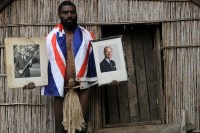
In this travelogue, Matthew Baylis, the novelist and TV critic and former Eastenders screenwriter, goes to Tanna, a Melanesian island, where, he believes, the locals worship Prince Philip. This sounds weird — to worship a man from far away, who knows little about them, about whose life they weave complex myths. But then again, some Melanesian people worship Christ, and yet others follow an American who might or might not have existed and who might or might not have been called John Frum. Baylis sets out to investigate. Prince Philip, he says, has interested him since he was a boy. Growing up in Southport, near Liverpool, the 11-year-old Baylis was aware of Philip’s visit to Salford university in 1982 and one of his reviled gaffes.

Hurrah for Andrew Strauss

From our UK edition

Andrew Strauss is a serious man and Driving Ambition (Hodder, £20, Spectator Bookshop, £18) is a serious book. It looks like most other sporting autobiographies: there are heroes, jokes and solecisms aplenty. Yet it is also the Bildungsroman of a determined bloke making the most of his talents. Strauss rejects the truism ‘You make your own luck’; but in his case, I’m not convinced. He matured as an adolescent when his contract with Middlesex County Cricket Club was threatened. Then he conquered mental frailty to make a career-saving century for England against New Zealand in 2008. There was lots of graft in between. It was his personality principally that turned the England team from a demoralised rabble in 2009 into an irresistible host by 2010.

In the heart of darkness, the atom bomb

From our UK edition

At the dark heart of this dark book is a startling fact: Joseph Conrad was employed to steam up the Congo river by the same company, Union Minière du Haut Katanga, that later shipped uranium from the Congo to the US, where it was used to make the bombs that devastated Hiroshima and Nagasaki. Patrick Marnham develops that historical oddity into a brilliant travelogue, blended with an angry history of America’s atomic bomb and a meditation on what the creation of nuclear weapons means for the human psyche. It is his own journey into a Heart of Darkness. He follows not a river, however, but the flow of uranium.

The men who demolished Victorian Britain

From our UK edition

Anyone with a passing interest in old British buildings must get angry at the horrors inflicted on our town centres over the last half-century or so. Gavin Stamp is wonderfully, amusingly, movingly angry. And he has been ever since the early 1960s when, as a boy at Dulwich College, he saw workmen hack off the stiff-leaf column capitals in the school cloisters. He reserves particular rage for that ‘cynical, philistine Whig’ Harold Macmillan for murdering the Euston Arch. Not that Stamp’s a ranting fogey, reserving his anger only for the demolition of Victorian buildings.

The wounded Kennedy – and the people who gave him strength

From our UK edition

Ten years ago, a determined historian transformed our picture of John F. Kennedy. Robert Dallek had finally got his hands on the president’s medical records and discovered just how big a part JFK’s constant health problems played in his life. Instead of a young, fit, athletic leader, Dallek revealed a man racked with pain, suffering from Addison’s disease and excruciating spinal damage and swallowing a daily pharmacy of drugs and potions. During the Cuban Missile Crisis, for example, when his finger hovered over the nuclear button, he was pumped full of steroids and antibiotics, amphetamines and testosterone, ritalin and sleeping pills. He had been given the last rites on three occasions before he was 35.

A place of paranoia, secrecy, corruption, hypocrisy and guilt

From our UK edition

‘Is he a good writer? Is he pro-regime?’ an Iranian journalist in London once asked me of Hooman Majd. Majd is an Iranian-American journalist who was born in Tehran in 1957, but is better known in America. His father was a well-travelled Pahlavi-era diplomat, and his grandfather was an ayatollah. His cousin is married to the brother of Iran’s former president Mohammed Khatami. Majd is not religious, but his criticisms of the Islamic Republic have tended toward the procedural rather than the substantive. He is married to an American, Karri, with whom he has a young son. Family is the great theme of his books. His writings give the impression that Iranians are a big family in need of reconciliation, not another traumatic reckoning on the model of 1979.

Through It All I’ve Always Laughed, by Count Arthur Strong – review

From our UK edition

Fans of Count Arthur Strong (and yes I know he’s so Marmite you could spread him on a cheese sandwich) love the failed performer because he does what we all dream of: ranting at others to cover our own mistakes. At the same time he reminds us what a fool this makes one look, so as well as being an entertainer he’s a cautionary tale. The warning is now available in book form, Through It All I’ve Always Laughed. If you’re unfamiliar with the Count’s work you should probably sample him on radio or television first. Converts, however, will relish the revelations about what made Strong the man, the legend, the sole proprietor of the Doncaster Academy of Performance he is.