Benefits

Cameron’s government has been brave so far; it must not flinch at the finish

The spending review’s actors are jostling for position at the final curtain call. Bit-part players are stealing for the prominence of the centre, Whitehall’s bigger beasts fight to preserve their dwindling limelight and the leadership try to direct and subjugate the warring egos. Defence seems more or less settled, with the navy’s grandiose element apparently securing its two super-carriers. Doubts remain over the education budget’s final reckoning and welfare is unsettled as yet. Après child benefit, le deluge – so to speak. An attack on the principle of universal benefit would have predictable consequences. Questions have arisen about the government’s commitment to the winter fuel allowance and the cold weather

The scale of IDS’ and Gove’s challenge

Yesterday was a day of weighty reports. At 700 pages, the Equality and Human Rights Commission’s ‘How Fair is Britain?’ won the thoroughness stakes. Aside from the usual findings that a disproportionate number of young black men are imprisoned and that the white working class is outperformed at school by Indian and Chinese migrants, it made some telling discoveries. The report found that a staggering 50 percent of Muslim men and nearly 75 percent of Muslim women are unemployed in certain regions. No clues as to where, though the reasons as to why should now be familiar: the figures correspond with the Centre for Policy Studies’ view that Britain has

What a coincidence…

Ed Howker’s weekend post about life in Rochdale – and The Spectator’s study of welfare ghettos – has made the news today. There’s a powerful spread in The Sun, with full and due attribution to the source. But the Daily Mail also ran the figures, incorrectly attributing them to the DWP. (We expressed DWP dole figures as a share of ONS population estimates. The resulting ratio only we produced.) We at The Spectator have no doubt that the Daily Mail reporter did actually visit Rochdale. It’s just that her material looks as if it could have been copied from Ed’s Coffee House post. Here are some coincidental overlaps: Coffee House

Reforming incapacity benefit will not be easy – but it is crucial

‘500,000 to lose sick pay as welfare reforms bite’. Those words boom from the front-page of the Times this morning – and they’re based on an article by Iain Duncan Smith (£) in which he admits that some 23 percent of the country’s 2.1 million Incapacity Benefit claimants could be found fit for work. This, it is said, should save the Exchequer some £4 billion. The numbers are striking enough, but the policy behind them shouldn’t be surprising at all. Even the last Labour government intended to reverse a political deceit that they had nurtured, but which was birthed during the Thatcher years: the artificial swelling of the sickness rolls.

Rochdale, revisited

Putting Ed Balls into Home Affairs is like trapping a bee in a jar: he’ll come out furious, and anxious to sting. In his new brief, he has immigration. And he’ll know Cameron’s vulnerabilities. The greatest threat facing the coalition doesn’t come from Ed Miliband. It comes from a deep dysfunction in Britain’s economy: that when it grows, we just suck in more workers from overseas. Balls knows this, and the resentment it causes in affected communities – which is why he was talking tough on immigration during the leadership contest. He knows where the economic bodies are buried: he dug the graves. He also knows that unless Cameron manages

The consequences of the child benefit row

“You only get cut through when there’s a row,” one Tory observed to me on Friday as we discussed the anger that had followed George Osborne’s announcement on child benefit. So in one way, the Tories are not unhappy with the fact that this story is still rumbling on. It is imprinting on the public mind that the Tories have hit the well-off. This is in advance of a spending review that is bound to hit hardest those people and regions that are most dependent on the state. Following the media coverage of the child benefit row, it will be much harder for Labour to make the charge that the

Spectator Exclusive: Britain’s welfare ghettos

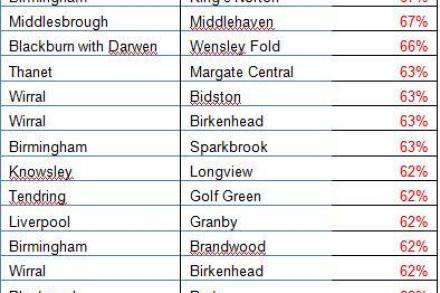
Today we are releasing a brand new picture of the nation’s welfare ghettos. Our research gives a disheartening insight into the extent of dependency in England and Wales. The top line: things are getting worse. This is much more detailed and useful information that the statistics often bandied about by politicians. It is well known, for example, that nearly 2 million people have been claiming out-of-work benefits for more than five years. But what does that look like? We’ve examined the smallest measurable units recorded by the Department for Work and Pensions (the technical term is ‘Lower Super Output Areas’) which are smaller even than council wards – they contain

Huhne and the universal benefit conundrum

Chris Huhne has given an interview to the Telegraph. According to the front page report, the Energy Secretary has nothing to say about nuclear power, new wind farms or energy security; but rather a lot to say about economic and social policies that are strictly beyond his purview. Jeremy Hunt’s belief that child benefit should be limited across the board is dismissed because there are ‘limits to how much we can achieve through changes in the tax and benefits system’ – this week’s Spectator argues otherwise. Huhne also registers his profound cynicism for the marriage tax break – no surprises there and he has a point that austerity should not

How should Miliband respond to the child benefit reform?

Daniel Finkelstein and Philip Collins’ email exchanges are always enlightening. This week, they discussed child benefit. Both think it has altered the markings on the playing field of politics. Ed Miliband is yet to respond: how should he? ‘From: Daniel Finkelstein To: Philip Collins If you were Ed Miliband, where would you go now on child benefit? First option: total opposition to the Government’s plan. You get to hoover up discontent but you don’t look much like a governing force, do you? And it seems hypocritical. Plus, you said you were going to support the Government on many cuts. If not this, then what? Second: you go with it. You

Osborne has a laid a trap

One of the most intriguing questions about the decision to take child benefit away from households with a higher rate taxpayer in them is whether it marks the beginning of the end for universal benefits. The quotes today from Michael Fallon, the Tory vice-chairman, certainly suggest that it does. Fallon ridicules Ed Miliband with the line: “He wants to tax the poor to give benefits to the better off.” Now, if you accept that the poor are currently being taxed to provide child benefits for the rich (a slight exaggeration given that higher rate taxpayers contribute far more than they take out in services) then this argument applies with equal

The battle for the low-paid working class

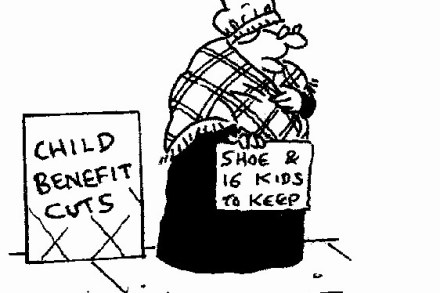
  Should families on welfare limit the number of babies they have? Jeremy Hunt suggested so last night – kicking off a debate fuelled by our disclosure in today’s Spectator about just how many out-of-work claimants have 6, 7 and 8+ children. The moral argument is pretty clear. Before a worker wants to expand his family, he usually thinks about whether he can afford it. It’s far from uncommon to hear people say that they’d like, for example, three kids – but this brings with it a certain financial requirement (size of house, car, etc) which is prohibitive (and far bigger than can be offset by child benefit). Yet the

Britain’s welfare families

We have a new facts and figures column in the magazine, Barometer, and I thought CoffeeHousers might like a preview of one of the data series we have dug up for tomorrow’s edition. George Osborne has this week pledged that, from 2013, no family on benefits should receive more than the average family does through work. But how many will it affect? Those living in expensive areas, for example, but also those with large families. CoffeeHousers may remember Karen Matthews, who lived on benefits with seven children. She was demonised, understandably, but I was left thinking: we paid her to do that. The more kids she has, the more money

Cameron stumbles onto the stage

Who’d have guessed that David Cameron would go into his conference speech on the backfoot? This was supposed to be a moment tinged, if anything, with jubilation: the first Tory PM for thirteen years addressing a party that seems to have fallen in love with him. But instead we’ve got the child benefit row, and with it apologies, rebuttals and hasty repositioning. It is to Cameron’s credit that he can breath the two words that evade other, more culpable politicians: “I’m sorry”. But on the eve of his big speech? Far from ideal. This exercise in damage limitation may have slightly eased Cameron’s situation today – but it has put

IDS sets out his vision for combating poverty

There was a quiet momentousness about Iain Duncan Smith’s speech in Birmingham today – even before he started speaking. When IDS resigned the Tory leadership in 2003, he could barely have imagined that he would one day address his party as a leading member of the government. Even a few weeks ago, he couldn’t have been sure that the coalition would implement the policy agenda that he developed during his time at the Centre for Social Justice. Yet here IDS was, receiving a standing ovation for his efforts. What a difference seven years make. And then to the speech itself. Much of it reverberated to the same reforming drumbeat that

This is not a 10p tax moment

Last night, one minister came up to me nervously and asked, ‘is this our 10p tax moment?’ He was talking, obviously, about the decision to take child benefit away from households with a higher rate taxpayer in them.   My answer was no. The comparisons with Brown’s removal of the 10p tax rate miss a crucial point: Brown tried to hide what he was doing. In his final Budget statement to the Commons, the abolition of the 10p rate wasn’t even mentioned. Instead Brown boasted about a 2p reduction in the basic rate, to huge cheers from the Labour benches.   By contrast, the Tories have been upfront about the

Cameron tries to defuse the child benefit row

Whether you agree with the plan to restrict child benefit or not – and, broadly speaking, I do – there’s little doubting that it has met with some fiery resistance in the papers today. The Telegraph leads the attack, calling it “a hastily conceived about-turn bundled out on breakfast TV”. The Daily Mail highlights the “blatant anomaly,” currently riling up the Mumsnet crowd, that a single earner family on £44,100 a year might lose the benefit, while a dual earning family on £87,000 can keep it. And the Independent does likewise. It should be said, though, that the Sun, the Times and the Financial Times are considerably more generous about

Withdrawing child benefit at 16 would be the wrong call

In the last few weeks, there has been much speculation that child benefit would be stopped when a child reaches 16. Today’s announcement suggests that this is not going to happen, although the Tories are refusing to rule it out. If there are to be changes to child benefit — and given the financial situation there need to be — then removing it from households with a higher rate taxpayer is a better move than stopping it at 16. Child benefit ending at 16 would send out a message that at 16 a child should start earning its way in the world. This would, for obvious reasons, have a negative

The beginning of the end of universal benefits

The most important line in George Osborne’s speech was this one: “It’s very difficult to justify taxing people on low income to pay for the child benefit of those earning so much more than them.” Logically, this argument applies equally to all other universal benefits. Why should someone on £12,000 a year be paying tax to help cover the cost of Ken Clarke’s pension? Personally, I’m quite happy to see universal benefits go. The end of universal benefits would, though, change the nature of the welfare state. Quite rapidly, it would become a safety net not a contributory system. This is why Labour will oppose so vigorously taking child benefit

Is there an alternative to cutting child benefit?

Beware a mother scorned. George Osborne’s copping some stick on Mumsnet, social forum for the Latte-drinking classes, and with good reason. ‘Hard-working families’, many of them far from rich, will feel abandoned by the party that ought to be theirs. IDS, Cameron and Osborne have taken a huge a political gamble, as James noted earlier, and they have also taken an enormous social risk. It is telling that the Centre for Social Justice, IDS’ think tank, are lukewarm about the proposal, describing it as ‘probably appropriate’ but calling for an alternative.  Skipping through the comments on Mumsnet and you can see why. Many of those whose combined income is roughly

Welfare dominates Osborne’s speech

George Osborne delivered everything we expected, and then some. This was a confident and wide-ranging speech from a Chancellor who has suddenly discovered a central message: what’s right about burning £120 million of taxpayers’ cash in debt interest payments every day? Wouldn’t it be better to get to grips with that waste as soon as possible? And that message percolated down through everything from his attack on Ed Miliband to his case for reforming our public services. “It’s like a credit card,” Osborne growled, “the longer you leave it, the worse it gets.” But if that was the theme of Osborne’s symphony, then the motif was certainly welfare. Huge chunks