Auschwitz

Némirovsky’s love letter to the France that spurned her and killed her

By 1940 Irène Némirovsky, who had arrived in France at the age of 16 as a refugee from Kiev, had become a prominent and successful novelist. In March of that year she celebrated what was to be her final publication day. She was Jewish, and for French publishers under Nazi occupation she had ceased to exist as an author when the German army entered Paris. But she continued to write. She moved with her children to a village in Burgundy, hoping to protect her family from the Vichy government’s manhunt, and she started work on her masterpiece, Suite Française, which would lie undiscovered until 2004. She also started three other novels, two of which she finished. Both were published in France after the war. By then their author was dead.

The Zone of Interest is grubby, creepy – and Martin Amis’s best for 25 years

‘Everybody could see that this man was not a “monster”, but it was difficult indeed not to suspect that he was a clown,’ wrote Hannah Arendt of Adolf Eichmann, in Eichmann in Jerusalem. Indeed, Eichmann was certified as ‘normal’ by half a dozen psychiatrists. On more than one occasion in Martin Amis’s troubling new novel one of its main characters, the fictionalised commandant of a thinly disguised Auschwitz, declares himself ‘completely normal’. He also happens to be an oaf, a clown. We are dealing, then, with the banality of evil. Set in the months from August 1942 to April 1943, when it became clear that the Germans were going to lose the war and that the Final Solution had better be hurried up, the story is told in three voices.

When a survivor of Auschwitz asks for your story, what do you say?

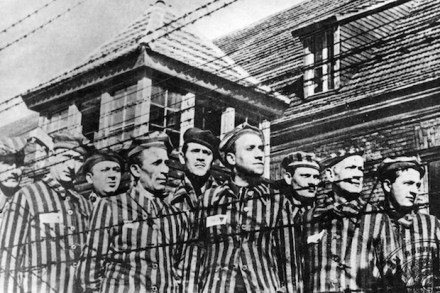
My aim as a hospital visitor is to cheer, befriend, have a chat, do something to disrupt the bleak monotony of the modern hospital day. Some patients talk amiably while others are grumpy, demented patients kept on wards for months and who won’t shut up. Many conversations lead nowhere. Some days the pillow talk is dull, so I paid attention when someone in the chaplaincy mentioned a lady who’d been in Auschwitz and still had the camp tattoo. I’d heard of Polish girls working in London cafés after the war showing numbers etched on their arms, but I’d never met anyone who had one. I taught English in Poland for a year and made friends with a student who came from the village of Oswiecim, which the Germans renamed Auschwitz.

Hanns and Rudolf, by Thomas Harding – review

Confronted by this lavishly endorsed book — ‘compelling’ (David Lodge), ‘gripping’(John le Carré),‘thrilling’ (Jonathan Freedland) — I felt depressed. Two weeks ago, the New York Times’s savvy London correspondent accused the British of being obsessed with the Nazis. This might appear a case of pots and kettles: not for nothing did America’s widely watched History Channel become known as the Hitler Channel. Nevertheless, Sarah Lyall had made a valid point. A stupefying 830 books on the Third Reich were published in the UK in 2010 and — although no figures are yet available for 2013 — a reduction any time soon seems unlikely. Germany’s history of genocide is unforgivable.