Academia

How useful is AI for research?

Late last year, I published the first theoretical physics paper in which the main idea originated from artificial intelligence – from an AI. And my experience working with the most powerful AI models left me both impressed and wary. The most accurate analogy I can offer is that it’s like something familiar to anyone who has done research: a brilliant colleague who is also unreliable. This colleague can produce deep insights at surprising speed – and then, the next second, make an error that ranges from the trivial to the profound. That tension – capability versus reliability – has shaped how I now use these systems in mathematics and theoretical physics. It is also what will shape how they affect scientific research over the next few years.

Slipshod: a short story by Sarah Perry

It was months before the difficulty with Marnie and Addison was talked about, or even alluded to. The sight of their names in emails circulated around the department was enough to cause a pall to settle on everything, like ash from fires only just put out. Besides, the nature of the difficulty (that was the word we all used) was both so opaque and so distressing we’d have had trouble talking about it, even if we’d wanted to. It fell to me to piece things together. My brief from Helen was simply to satisfy the university that nobody in the department was to blame. It fell to me because I am, she tells me, part of the furniture: unremarkable, functional, predictable.

slipshod

The battle to stop US universities aiding Chinese repression

It goes by an innocuous name – “Integrated Joint Operations Platform” (IJOP) – but it’s one of the most sinister components of China’s surveillance state, managing what has been described as a genocide against the Uighurs. The IJOP combines multiple systems of repression – location, messages, contacts, social media and other data from phones, together with information from checkpoints, cameras and biometric records. It then flags “suspicious” individuals for detention and forced labor. Now leading US universities have been accused of extensive collaboration with Chinese laboratories which develop technology that may be deployed or adapted for use in this system.

The steady erosion of academic rigor in German schools

German teachers are a privileged species. Most of us enjoy the status of a Beamter, a tenured civil servant. We can be dismissed only after a serious criminal conviction, we are exempt from social-insurance contributions and even our mortgage rates are lower. Such comfort discourages dissent. Yet, after more than 25 years as a pampered Beamter, I find myself overwhelmed, not by the teaching load or the students, but by the accelerating erosion of academic standards. Having taught English, history and Latin at four different Gymnasien, I have learned that challenging students is now frowned upon by both bureaucrats and politicians. Nearly all my colleagues agree that standards have plummeted.

The students bullied into being woke

If, as Shakespeare observed, “all the world is a stage, and all its men and women merely players,” no place is that truer than the modern American university. In the first study of its kind, 88 percent of Northwestern and University of Michigan students admitted they “have pretended to hold more progressive views than [they] truly endorse to succeed socially or academically.” While the phenomenon of college students pretending to be more liberal than they actually are to make life easier for them as they attend these hotbeds of radicalism is not surprising, the true scale of it is. But how have we got here? If you’re looking for a single explanation, I’m sorry to disappoint you. The modern college environment is a perfect storm of several factors working together.

College

The reviving of the American mind

In his 1987 book, The Closing of the American Mind, Allan Bloom argued that higher education no longer taught US citizens how to think. “We are like ignorant shepherds living on a site where great civilizations once flourished,” he wrote. “The shepherds play with the fragments that pop up to the surface, having no notion of the beautiful structures of which they were once a part.” Now, almost 40 years later, we’re even more clueless. The rot in academia has spread throughout the education system and can be found all over American life. Rational thinking has now been almost entirely usurped by the baser passions of anger and grievance, as we saw all too clearly in the collective insanity of the Black Lives Matter riots of 2020.

Trump

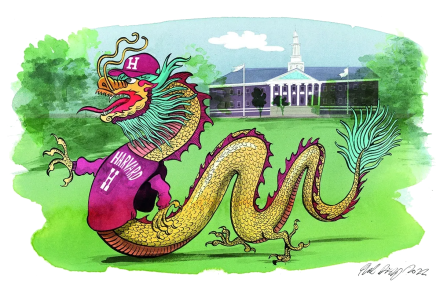
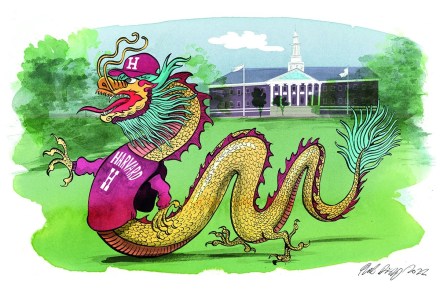
Harvard’s intricate China ties

Scratch almost any major US political story and sooner or later you’ll hit a big red nerve that belongs to the Chinese Communist party (CCP). Tariffs, energy, TikTok, the border, Fentanyl, Greenland, Panama, the Gulf of America – on all these subjects the Trump administration is, one way or another, trying to limit Beijing’s power in the West. And Donald Trump’s "war on Harvard," it turns out, is no exception. It’s clear that the President is pushing against anti-Semitism and the Diversity, Equity and Inclusion madness on America’s most famous campus, as well as in countless other colleges and universities.

Harvard

Harvard against America

This is drumming season.  That’s the time of year when the woodpeckers stake out their territories by tapping out tattoos on hollow trees.  Road signs or “no trespassing” edicts make an even more impressive racket.  I come to Vermont to get away from Midtown Manhattan’s horns and sirens – but this time of year, it’s just a visit to the percussion section.  But the real racket isn’t from the birds declaring their sovereignty over the woods.  It is from Harvard declaring its sovereignty over American higher education. In a letter dated April 14, the principals of two Washington law firms wrote a brief letter to three officials in the Trump administration telling them they need not worry about antisemitism at Harvard.

harvard

David Lodge, the master of Anglo-American campus humor

"Literature is mostly about having sex and not about having children.” So said the British novelist, occasional screenwriter and literary critic David Lodge, who died at the beginning of 2025 at the age of eighty-nine. Lodge, who had suffered from encroaching deafness for several decades, had not, in truth, been a major literary figure for a considerable period before his death. This retreat into obscurity had not been helped by a trio of memoirs, beginning with 2015’s Quite a Good Time To Be Born, which perplexed critics — including this one — with their dour, downbeat and decidedly un-humorous tone. Few would have known, from reading them, that their author had once been regarded as one of the late twentieth century’s most accomplished comic novelists.

Lodge

An explanation of the campus protests

A friend wrote me to ask, “Why is this mess happening on campus?" Here is my response.  Let me offer some thoughts, as a long-time professor, in hopes they spur your own.  Let's begin with something apolitical: young people love expressions of group solidarity. Some protests are like football games, held conveniently in the spring when spirits soar. Let's all join in, especially if it is costless virtue-signaling. And in the absence of any serious punishment, that's what it is.  These demonstrations happen a lot more often when the weather is nice. It's a lot easier to pitch tents on the quadrangle in April or October than in January and February. It’s a lot easier to sit on the Golden Gate Bridge, too.  But why the hatred of Israel and so often of Jews?

campus protest

Want student loan forgiveness? Make universities pay

At the turn of the twentieth century, Saturday Evening Post editor and Yale dropout George Lorimer bitingly summed up academia when he said “colleges don’t make fools, they only develop them.” On the heels of yet another multibillion-dollar Biden administration college bailout, it seems we haven’t learned the lesson: colleges might not make fools, but they’re certainly trying to make fools of us. The bailout projects come from a Biden campaign promise: “I will eliminate your student debt.” Half-slogan, half-bribe, this resonated with millions burdened by the unpayable debt brought on by liberal arts degrees that may barely be worth the paper they’re printed on.

debt

The fight for civilization in higher education

The idea that Western civilization ushered in an age of oppression, cultural destruction, environmental degradation and all manner of human exploitation, is bittersweet. I don’t mean that it tastes like coffee or dark chocolate. I mean bittersweet the vine, Celastrus orbiculatus, with the colorful orange-red berries. This kind of bittersweet grows at a phenomenal rate, ascending into the canopy and strangling trees. If you drive north out of New York City, you will pass endless miles of arboreal carnage. Tens of thousands of roadside trees are draped in the deadly vine. It is an invasive Asian species that, once established, is impossible to eradicate. And while its fall berries are attractive and make for good floral arrays, they are inedible.

civilization higher education

What lies behind the obsession with race transforming universities?

The first problem about decolonization is the word itself. Colonization is the process of establishing control over a foreign territory and its indigenous inhabitants, by settlement, conquest or political manipulation. But decolonization? It has come to mean much more than the reversal of that process. Today, it refers to an altogether wider agenda, whose central objective is to discredit or downgrade the cultural achievements of the West. Objective truth and empirical investigation are mere western constructs. They are optional ideas which need have no weight beyond the western societies which invented them. But the West has imposed them on the rest of the world by a process akin to the colonial conquests of the past four centuries.

decolonization

The shrinking lifespan of the college president

Twenty-five years ago I published an essay titled “Dogfish.” It was not about the little sharks that skim along the bottom of the Atlantic and Pacific coasts and only rarely end up on the American dinner table. It was rather a fanciful way to draw attention to the brevity of the average tenure of the college president. Back then the average president served 6.7 years. The spotted dogfish, by contrast, was believed to live almost three times as long. A lot has changed in the intervening quarter century. For one thing, it is now believed that the natural lifespan of the dogfish is thirty-five to forty years, though some say eighty.  Meanwhile the average term of a college president has shrunk to 5.9 years.

college president

Christopher Rufo’s new book is impressively erudite

When a new book by an author often characterized as a conservative polemicist earns a rave review in the staid Economist, independent thinkers take notice. Christopher Rufo’s articles on recent US radicalism for the Manhattan Institute’s City Journal have long attracted wide attention, and now America’s Cultural Revolution has been praised as “meticulous” and “cerebral” as well as “persuasive and well-written.” All true, for Rufo’s book is impressively erudite, reflecting a breadth and depth of familiarity with influential leftist writings that will shame any number of “woke” academics.

rufo

The virtue-signaling behind the renaming of the Middlebury College chapel

Early on the morning of September 27, 2021, Middlebury College president Laurie Patton had a stone bearing the name of the campus chapel removed from the building. It was done deftly. I don’t imagine she showed up with her own hammer and chisel, but the campus groundsmen executed her orders. Later that day, Patton and the chairman of the board of trustees sent out a message to the community announcing that they had de-named Mead Memorial Chapel, which henceforth would be known simply as Middlebury Chapel. The de-naming was a stealth operation. Outside of a small circle, no one knew it was coming.  Picture a small liberal arts college tucked away in the American hinterland. Picture on the crest of a hill a white marble church with an impressive spire flanked by academic halls.

middlebury college chapel

Disinfo-nation: the new censorship is here to stay

Lying is the great American pastime. We’ve been at it ever since some of the Pilgrim fathers shined on some of the folks back home with tales of the Eden they had found on the barren coast of Massachusetts: For fish and fowl, we have great abundance; fresh cod in the summer is but coarse meat with us; our bay is full of lobsters all the summer and affordeth variety of other fish; in September we can take a hogshead of eels in a night, with small labor, and can dig them out of their beds all the winter; we have mussels; and ... As the American Socrates, P.T. Barnum, may once have said, “There’s a sucker born every minute.” Or he may have not said. The Fort Wayne Weekly Sentinel in 1894 said he said it, but P.T. denied it.

disinformation

The dangers of faux-education

François-Marie d’Arouet (1694-1778), commonly known as Voltaire, devoted his life to waging intellectual warfare against Christianity — the Catholic Church and Catholic culture in particular — along with its historic political and social allies, royalty and monarchy, which he condemned as a monstrous entity in his famous battle cry“Écrasez l’Infȃme!” Given his aims as a polemicist, a deist and a republican, Voltaire did not misconstrue the enemy whose destruction he called for.

education

The university fighting back against the diversocrats

The latest news in the Hamline University saga is that a large majority of the faculty — seventy-one of ninety-two members — have called on university president Fayneese Miller to resign. Miller had played the principal part in the dismissal of art history instructor Erika López Prater, after Prater had shown two images of the Prophet Mohammed in her online art history class. One image was a slide of a fourteenth-century painting by a Muslim artist; the other was Muslim painting from the sixteenth century in which the Prophet is veiled. Condemnation of the Hamline administration for dismissing Prater has been nearly universal in American higher education.

Art history is now ‘Islamophobic’

At a private liberal arts college in Minnesota, art history is now Islamophobic. In October, an art history professor at Hamline University was teaching Islamic art, a segment that included two depictions of the Prophet Mohammed in fourteenth- and sixteenth-century paintings with significant historical value. The professor alerted her students beforehand, careful to ensure that observant Muslims who object to the depiction of their prophet would not have to see him on screen. It seems that the professor had done everything right: providing images of famous paintings for her students’ edification but allowing students to opt out of viewing them if doing so ran contrary to their religious beliefs. But who are we kidding? This is a liberal arts college in the twenty-first century.

Quaran