Features

Are we on the brink of World War Three?

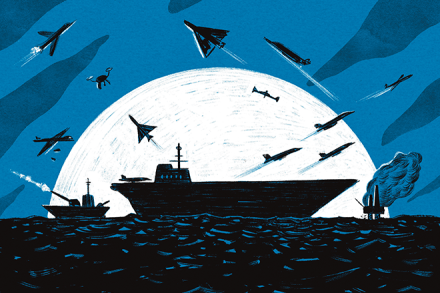
Last month, an Iranian cargo ship in the Caspian Sea was struck by a Ukrainian drone. Kyiv claimed the vessel was carrying military equipment heading toward Russia. “The regime in Tehran is a direct accomplice to Russian aggression against Ukraine, fueling Moscow’s criminal war with weapons,” Kyiv’s foreign minister said. Tehran reportedly contemplated a counterstrike on one of Ukraine’s Black Sea ports, then thought better of it. But the threat of a conflagration is higher now than at any point since the end of the Cold War. Conflicts that are currently contained risk spilling out and engulfing whole regions, perhaps the world. If the Iran and Ukraine conflicts were to merge, we’d see a war that runs from Poland to the edges of India.
world war three
pardon

How to get a Trump pardon

“I was just talking to the President,” Tiger Woods told officers after clipping another vehicle in April. Woods was booked for driving under the influence regardless, even though he’s dating Vanessa, the ex-wife of Donald Trump’s eldest son, and has been coaching the President’s granddaughter Kai at golf. He isn’t the only person attempting to use Trump as protection from law enforcement. Most, however, don’t have his phone number. Instead they are at the mercy of the presidential pardon process. On Trump’s first day back in office, he pardoned around 1,500 people who took an unguided tour through the US Capitol on January 6, 2021.

missiles

There’s no good outcome for this groundhog-day war

Since the end of the Cold War, America has been the world’s supreme power. The idea that the United States could be taken down militarily by any other country is simply implausible. US invincibility, indeed, has spawned the concept of asymmetric warfare: instead of trying to overwhelm an enemy, you prod relentlessly at its weak points. This has changed the world from one in which organized warfare would break out between the major powers from time to time to one where peace has to be maintained against the constant hum of terrorism and guerrilla action. It comes as a shock, then, to learn that the US has apparently all but run out of long-range precision missiles.

rod liddle

Rod’s bravery made others brave too

How do you produce the type of person who cares deeply while seemingly not giving a damn? With great difficulty, it turns out. Plenty of people imagine that they can say what they think, but very few do. For most people, some real or imaginary social punishment lies on the horizon: a dinner they won’t be invited to; a club of which they fear they will never become a member. Rod Liddle was one of the happy few who was free. He was free to say what he thought. He was free to voice unpopular opinions and – often harder – he was free to voice popular opinions. When the whole world seemed to be falling on his head he had a perfectly contented attitude toward it.

The curious history of sporting superstitions

My father had been waiting his entire life for that whistle. After 75 years, the curse was over. Mayo were Gaelic football champions, having overturned the second-biggest deficit in the history of All-Ireland finals. The county hadn’t seen such a miracle since Father Horan got the taoiseach to fund an international airport near the shrine of Our Lady of Knock. Three months before Dad was born in Castlebar, Mayo won the 1951 title. Their celebrations on the way home were exuberant and, so the legend goes, disrupted a funeral in Foxford. The furious priest (some versions blame the widow) cast a curse on them, saying Mayo would never again lift the Sam Maguire Cup while any of those players lived. Nonsense, right? Except that Mayo then lost 11 finals, four by one point.

sporting

What Istanbul gave me

Why do novelists set their stories in cities or landscapes which seem to haunt them? Not the places of their childhood – an obvious choice – or places they’ve researched because those places are intellectually attractive. The places they can’t avoid in their own subconscious. I’m often asked this question because the places I write about are considered exotic. But to me, it’s the reverse. I write about a city long after I’ve lived there and left it, having never had any intention to write about it at all. Such was the case, for me, with Istanbul. I moved there in 2011 after 20 years in New York. It came about by chance. My mother died that year and I came back to Brighton to attend the service.

istanbul

‘He’s either the Messiah – or the Antichrist’: on the campaign trail with Nigel Farage

“We love you, Nigel!” In Clacton-on-Sea, there is little sign that the Reform leader’s star has waned. Campaigning with Nigel Farage here is a burst of cackles, quips, nicotine and selfies: a march through sun-kissed streets with a cast of canvassers, aides and minders. A child clasping a teddy bear dances around, a Reform rosette pinned to her top; a groaning assistant clutches two dozen poster boards. On the doors in Seawick there is near-universal support, with variations on the theme which Farage has made his campaign slogan: “I’m with Nigel.” In the middle of silly season, Clacton is hosting one of Britain’s most bizarre by-elections.

nigel farage

Tax the poor

A sanctimonious liberal like any other respectable 16-year-old, I made a seminal lurch to the right the first time I opened a pay slip. I was manning the register weekends for the Ice Capades Chalet in Atlanta and made about $40 a week. Or so I imagined. Then where the hell was it? The significantly lighter payment was my rude introduction to taxation at source. Indignation at being fleeced at a minimal income persisted into my adulthood. I lived on a wing and a prayer for decades, and having to pitch anything whatsoever into the communal pot was consternating. I fancied that I asked for nothing from government; in trade, they should ask for nothing from me. I wasn’t yet a grown-up.

tax
rod

Rod had one great regret

In 2019, I had to explain to Iain Dale – live on LBC – that Rod Liddle’s suggestion in his Spectator column that elections should be held on Islamic holy days to deter Muslims from voting was not a serious proposal. Neither was his idea that students be drugged by their parents to the same end. It was humor, and they were jokes. When he was in hospital a few weeks ago, I visited Rod with some cake. While he munched away, he expressed a sense of regret that he could have been a great writer. Rod always thought his true calling was writing fiction, rather than journalism, and always wondered if he’d sold his soul by following the money. He was right – he did have the makings of a British Houellebecq.

rod

‘The Middlesbrough Shakespeare’: Why I loved Rod

I met Rod 22 years ago this month. We had been selected as teammates on a gameshow pilot, and, halfway through the morning’s filming, we went for a fag break. He said to me: “This is crap, shall we go to the pub?” We scarpered and spent the rest of the day in a Covent Garden pub, working our way through the drinks list and chatting away like chipmunks. I’d never been starstruck by anyone before I met Rod. However famous or talented actors are, their job is to say stuff written by other people. Rod, however, was a legend to me. I began reading his Guardian columns at university. Though I was studying all the greats of English literature, it was Rod’s writing which felt like a ribbon-wrapped gift, a treat, a joy.

rod

Can I fucking swear yet?: Rod Liddle’s last column

The following column was written in 2024 for former Spectator editor Fraser Nelson when he left the magazine. This is the first time it has been published. My favorite ever email came from a friend and fellow hack, Roland White. It said: “You bastard. I had a 50 quid bet that Charles Moore would be the first Spectator writer to use the word ‘clunge’ in an article.” Ha. I admit I had been surprised to see the word there, in hard copy, when the mag was published. I had expected the usual haggling. “Can’t you say vagina, Rod? Or just leave it out altogether? Or how about Lady Garden?

rod liddle

Rod’s genius? Driving his enemies nuts

There is a reason the death of Rod Liddle has provoked such a swirling tide of grief among his millions of followers, including readers of this magazine, and that is that in the last 25 years Rod came to occupy a crucial position in journalism, and indeed in our country as a whole. His columns became a haven, a refuge, in which he gave us permission to think things that are in fact common sense, but which have for some reason become taboo. He gave us a renewed permission to laugh – at him, at ourselves, at our collective absurdities – at a time when laughter is increasingly controlled and often suppressed.

The Republican party’s secret weapons

Do the Republicans have a secret weapon they can deploy in the midterms? In fact, I think they have two weapons, one sort-of-secret, the other out in the open but somehow not quite recognized.  “That’s good,” you say, if (faute de mieux) you want the Republicans to win. Midterms, we’ve been told ad nauseam, almost always favor the party out of power. I believe that the last time the incumbent party won in the midterms was in 2002 when George W. Bush, riding the tailwind of public sentiment following the September 11 attacks by our Muslim friends, picked up eight House seats. Many of the most noteworthy Democrat candidates hail from la-la land At the moment, all the polls have the Dems leading by a comfortable margin.

The problem with the Ann Widdecombe suspect’s ‘fair trial’

It’s hard to hold anyone responsible for anything today in British politics. That’s because no sooner have the facts emerged than everybody in Westminster has played another game of musical chairs. If the word “amusing” can be used in the same paragraph as “attempted beheading” allow me one amusing example. In June, a 30-year-old asylum seeker from Sudan allegedly attempted to behead a local man on the streets of Belfast. It was apparently caught on video. Everyone was geared up to make their points. The left was preparing to argue “So you’re saying all asylum seekers are beheaders, are you?” while the right was gearing up to say: “We must hold people accountable.

ann widdecombe

I invented Nixonmaxxing

The kids call it “Nixonmaxxing,” and I invented it 30 years ago. “I think that his historical record is enjoying a bit of a renaissance, but I think deservedly so,” Vice President J.D. Vance says about Richard Nixon, who has become, as a recent Wall Street Journal headline put it, “an unlikely new icon” for young conservatives. Maybe I can’t claim to have been the first teenage Republican to have embraced Nixon chic, but all the way back in 1996 a young Danny, irked by the banality of college application essay questions, decided to make his pitch to higher education by writing about the merits of the president who’d been taken down by Watergate. It was a way of daring colleges and universities to reject me.

nixonmaxxing nixon

Andy Burnham’s centrist act isn’t fooling anyone

When Ed Miliband and Shabana Mahmood arrived in Downing Street on July 20, the image of political rivals arm in arm symbolized a new government of differing views taking shape. It might have been more awkward. As they neared the door of No. 10 and the waiting television cameras, Miliband turned to Mahmood and asked: “Should we turn around for a photo together?” Mahmood gave the idea short shrift: “We’re not getting married, Ed!” But in a sense, Labour is seeking a new relationship with the British public – and everyone around Andy Burnham is alive to the importance of images, symbols and vibes. As Wes Streeting, the new Defense Secretary, put it in cabinet the next day: “We have a second chance to make a first impression with the voters.

burnham
suit andy burnham

Mr. Burnham, put on a suit and tie

A brass fanfare; a wide establishing shot of five men in three-piece suits, seated in a library of leather-bound tomes – this is Harold Macmillan doing informal. The scene is from a 1959 party political broadcast, which purports to show a “relaxed chat” between Macmillan and four of his ministers, all of whom he refers to by their cabinet titles. Almost everything about it is artificial (including quite possibly the claim that it took place the day after the parliamentary recess). Watching it now is a reminder of two things, perhaps contradictory. First, that prime ministers have always played a clever and not entirely authentic game when it comes to informality; second, how far we’ve fallen. Can you imagine the equivalent today?

arwap

The Welsh government’s mad decolonization plans

A teenager in Wales might want to play video games, hang out with friends or even, dare I suggest it, read a book. The Welsh government, however, would prefer they put on a headset and confront their “unconscious bias.” It has created a £1.2 million metaverse, the “world’s first anti-racist virtual world,” to teach Welsh teens about their “white privilege.” But this is only one element of an official commitment to end racism by 2030. Not today, not yesterday, but a specific year in the future. The idea for an Anti-racist Wales Action Plan – ArWAP – was born following fervor around the Black Lives Matter movement, and an official plan followed in 2022.